|
|
 I’ve decided to quit NaNoWriMo this year. I could probably persevere and hit the required word count; I got up to the halfway mark earlier this week. But I’ll be perfectly honest; I’m not enjoying it. I went out on a limb and started writing a fantasy without planning too much, because I’ve always been a seat-of-the-pants writer. As it turns out, not so much these days. I’m not having fun, and I could probably use my time more wisely than sitting here writing a story I’m no longer invested in. I’m finding it more stressful than anything else, and I don’t need voluntary stress. I’ve decided to quit NaNoWriMo this year. I could probably persevere and hit the required word count; I got up to the halfway mark earlier this week. But I’ll be perfectly honest; I’m not enjoying it. I went out on a limb and started writing a fantasy without planning too much, because I’ve always been a seat-of-the-pants writer. As it turns out, not so much these days. I’m not having fun, and I could probably use my time more wisely than sitting here writing a story I’m no longer invested in. I’m finding it more stressful than anything else, and I don’t need voluntary stress.
So, I’ve changed my plans, and I’m going to try using the rest of the time I would have spent writing this month on planning a new novel. I need to figure out what’s going to happen to these people, or at least a little bit more about who they are, and mostly how they’re going to end up. And I just can’t write that many words a day. I give A LOT of credit to those who can – but it’s just not in me this time. So, here’s hoping for next year, and for a new project.
In reading news, as you can imagine, there hasn’t been very much going on. This week I managed to finish Praetorian by Simon Scarrow, and I’ll be posting a review for that tomorrow. I also just read A Moveable Feast this weekend; I’ve been meaning to read Hemingway’s own account of his early life in Paris ever since I finished The Paris Wife, and it promised to be as rewarding as I thought it might. I’ll be trying to review that one, too. And in future news, I squeezed in Trouble at the Wedding by Laura Lee Guhrke for some relaxation – it was just the thing I needed this week, so if you’ve been thinking about pre-ordering, I suggest you do so.
And that’s all the news from me this Sunday evening. This week, I’ll be heading to London for work, and I’m hoping to get some more reading done on the train there and back. This also means I won’t be celebrating American Thanksgiving on Thursday, but I wish a wonderful holiday with family and friends to all who are.
How are you all doing this second to last week in November?
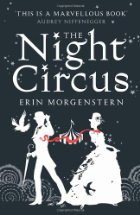 The circus appears overnight without any warning; the next morning, a field that was empty is strewn with magical black-and-white tents that hold wonders of which thousands have only ever dreamed. But at the center of this magical paradise are two magicians, Celia and Marco, whose competition gives life to the circus and keeps it growing and moving across the world. At the center of their rivalry, though, is a love that won’t let them carry out their competition to the bitter end. Who will take their place at the core of the circus as it slowly rots from the inside out? The circus appears overnight without any warning; the next morning, a field that was empty is strewn with magical black-and-white tents that hold wonders of which thousands have only ever dreamed. But at the center of this magical paradise are two magicians, Celia and Marco, whose competition gives life to the circus and keeps it growing and moving across the world. At the center of their rivalry, though, is a love that won’t let them carry out their competition to the bitter end. Who will take their place at the core of the circus as it slowly rots from the inside out?
I can almost guarantee you’ve heard about this book before. I have seen it on many, many different blogs in my feed reader and in fact that buzz is one of the reasons I went ahead and purchased it. Whenever there is a fantasy title that has people talking, I usually try and read it, simply because I love fantasy and I want to keep current and in touch with the conversation. This has gone well and not-so-well previously. Luckily, it went well with this one, which nicely justified my purchase and added up to a very pleasant week of reading.
One of my favorite aspects of The Night Circus straight off was the atmosphere. The way the circus is set up is so mysterious, the characters so quirky, that I was instantly intrigued by the entire situation. We start off with both magicians very young. Celia’s father didn’t even realize he had a daughter, and it is only her emergence as a player that leads Marco to be chosen as her counterpart. The circus comes about slightly differently, through a variety of players, all of whom are quite shadowy characters; merely sketches, not fully fleshed out.
But despite the oft-bemoaned lack of character and plot development, I really enjoyed this book. Maybe I wasn’t convinced by Celia and Marco’s love story, but I could taste the caramel apples and experience the magic of the tents for myself. As Jenny says, this is an atmosphere book. If you can approach it with that in mind and take it for what it is, rather than what it isn’t, I think you’ll enjoy it a lot more. It’s an excellent read for curling up with some tea by your side and taking it slowly – this isn’t a book you want to rush, it’s instead to be savored.
I’m very glad that I picked up The Night Circus, as it suited me perfectly when I am in the depths of my own writing efforts and allowed me to simply relax and sink in. Recommended.
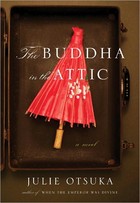 The Buddha in the Attic is the collective story of Japanese “mail-order” brides who came to the United States before World War II. They arrived to husbands they didn’t know, lives they didn’t expect, and a country that refused to accept them. And just when the Japanese finally began to grow a toehold in the community, the accusation and racism that defined World War II took effect and eradicated them from a visible role in the country for years. The Buddha in the Attic is the collective story of Japanese “mail-order” brides who came to the United States before World War II. They arrived to husbands they didn’t know, lives they didn’t expect, and a country that refused to accept them. And just when the Japanese finally began to grow a toehold in the community, the accusation and racism that defined World War II took effect and eradicated them from a visible role in the country for years.
When I saw that this was a finalist for the 2011 National Book Award, I immediately knew I had to read it. I’ve been longing to read Otsuka’s first book, When the Emperor was Divine, for a long time now, but since this was short and available on Netgalley, I seized the opportunity to finally experience this wonderful author for myself. I’m very pleased with the choice I made because this was an excellent book and I enjoyed each and every heartbreaking moment.
Because this is a collective story, it isn’t presented the way you would expect. There are no individual characters. There are Japanese brides, seasick on a boat, leaving behind a multitude of struggles, hardships, and even a scandal or two. There are men awaiting those brides, who may or may not live up to the photos and descriptions they sent across, who may exceed their wives’ expectations or who may disappoint them immeasurably. In less than 200 pages, we’re treated to an extensive range of what may have happened to these Japanese women; even though their experiences can be very different, they start out at the same point and unfortunately all of their stories in this volume end at the same point, with sorrow, heartbreak, and detention camps.
I loved this approach because even though it clearly depicts the difference between individuals, it also highlights the absolute universality of their experiences. It didn’t matter if the women were married to farmers or businessmen or shop owners. The end point for all of them was the same, a camp. And while many women got out of the camps eventually, the experience and suffering was universal. And because they are marked out as individuals in the middle – not by name, but by experience – it’s easy to sympathize with the women and feel that they are human beings, not the “Other” that allowed their fellow human beings to sweep them from their lives and shove them all in one place as “dangers.”
In short, The Buddha in the Attic is an incredibly powerful book, and one that in my opinion is certainly award-worthy. The description on the publishers’ website states that it is a book about the American Dream, and I think that is a particularly apt description – but it’s more about the elusiveness of that dream, and how easily it can be taken away, than anything else. Highly, highly recommended.
 Lady Vivienne Bancroft and her husband Miles have been estranged ever since he embarrassed her and left her alone while he went off with a prostitute after a party. She fled to New York to be with her adopted family, while he continued to languish in London. The series is set around Vivienne and her three siblings, each of whom is sent to a different part of the world to take over one aspect of their father’s business after his death. Vivienne is left with part of his business to develop in South Africa – not exactly the safest place for a woman alone at this point in history. Miles meanwhile has been in despair without his wife, and vows to go to South Africa to prepare the way for her and persuade her to give him half of the million dollars her father has promised her. Once together, though, they both realize that perhaps they should be working together as a team instead of standing at cross ends. Lady Vivienne Bancroft and her husband Miles have been estranged ever since he embarrassed her and left her alone while he went off with a prostitute after a party. She fled to New York to be with her adopted family, while he continued to languish in London. The series is set around Vivienne and her three siblings, each of whom is sent to a different part of the world to take over one aspect of their father’s business after his death. Vivienne is left with part of his business to develop in South Africa – not exactly the safest place for a woman alone at this point in history. Miles meanwhile has been in despair without his wife, and vows to go to South Africa to prepare the way for her and persuade her to give him half of the million dollars her father has promised her. Once together, though, they both realize that perhaps they should be working together as a team instead of standing at cross ends.
This was a book that I had trouble buying into at the start, but wound up feeling won over by the end. Primarily, I had a lot of trouble liking Miles, or believing that Vivienne would ever really fall for him again. Vivienne very obviously thinks of him as a frustrating wastrel, and the fact that he at first attempts to win her over because he wants the payout from her success at her father’s business meant I didn’t like him on my own, either.
But what I discovered as I went along is that while Miles tried to appear like he didn’t care and only wanted the money, he actually did care for Vivienne. He’d missed her. And he hid it from her, and to some extent from himself, mainly because he felt guilty. He’s a classic example of a person who needs genuine work to keep him out of trouble; once he’s given an actual purpose, he transforms. It’s not Vivienne who does it; she already tried. It’s simply the concept of a life outside the ordinary interactions of Victorian London.
I also liked the fact that, as the book developed, Vivienne and Miles became a team. It wasn’t that one of them could rescue the other. They both had their strengths and they learned to use them together rather than against one another as they had previously. Working towards a common goal instead of cross-purposes draws them together and helps them see how their relationship could be different. This focus was an excellent choice for me; instead of an indolent life with a multitude of servants and a lack of real effort, the characters realize that they can do and be more in the world. It was an inspiring turn and added something more to the book beyond the romance.
Not that there was anything at all wrong with the romance, which I enjoyed. But it was nice to have two powerful facets to the book, and Flawless is certainly one I would recommend to others who appreciate a good historical romance set outside the tired world of the ton.
All external links are affiliate links and I received this book for free for review from the author.
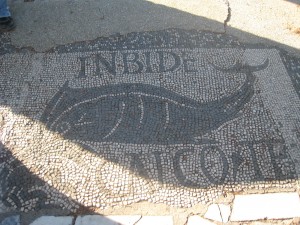
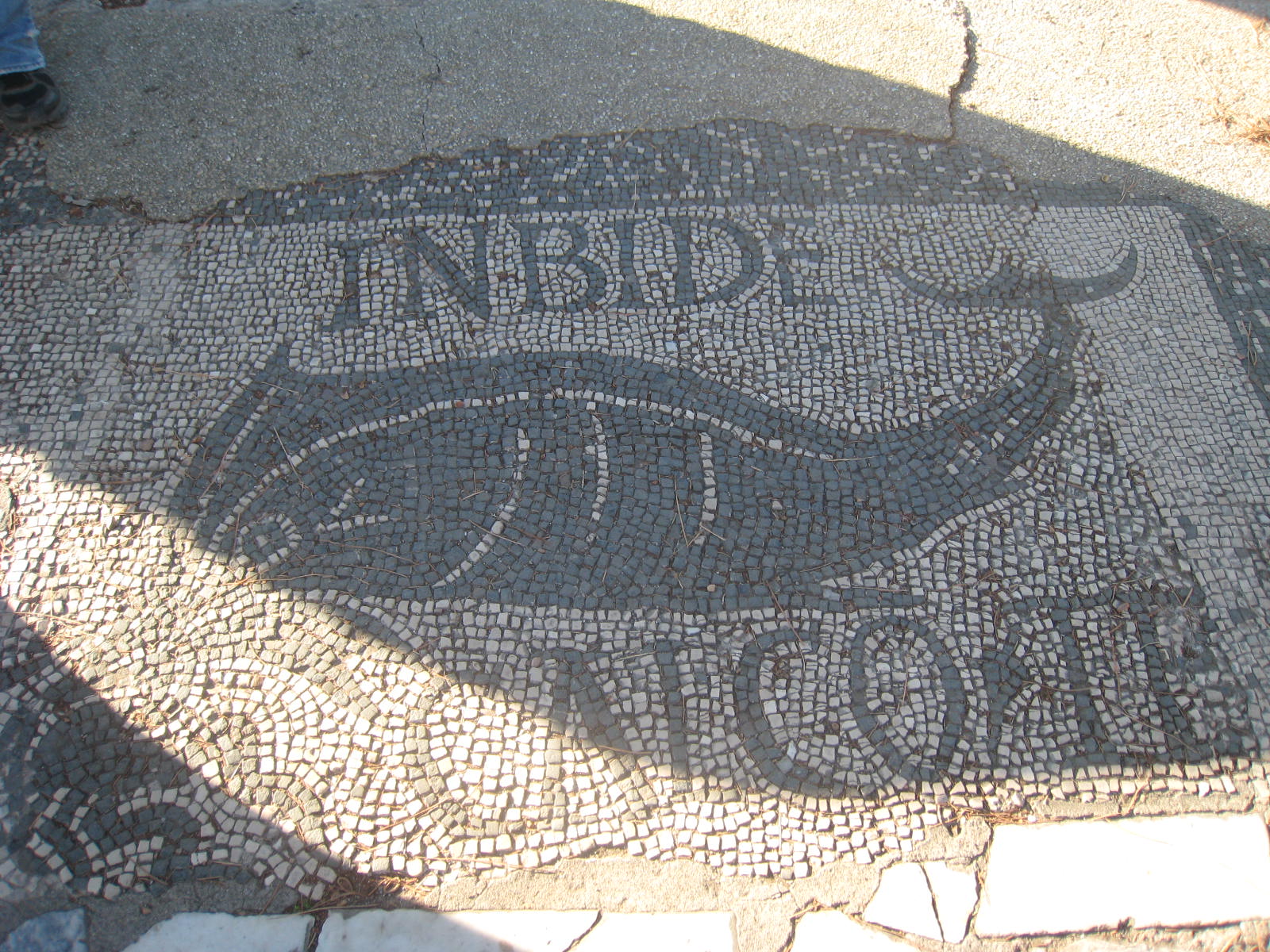
A fish shop mosaic from Ancient Rome, in Ostia Antica.
More Wordless Wednesdays
 Rome, the Eternal City; a place where Roman emperors have paraded, painters have worshipped God with their art, and ordinary people have lived. Robert Hughes touches on all of these aspects with his massive book on Rome, which is a mish-mash of history, art, and politics that spans the thousands of years that the city has stood upon its seven hills. Rome, the Eternal City; a place where Roman emperors have paraded, painters have worshipped God with their art, and ordinary people have lived. Robert Hughes touches on all of these aspects with his massive book on Rome, which is a mish-mash of history, art, and politics that spans the thousands of years that the city has stood upon its seven hills.
It’s non-fiction heavily filtered through Hughes’s own lens; he doesn’t provide any footnotes or endnotes, so I decided not to take anything he said for absolute truth and just enjoy the ride – although there is a lengthy bibliography for those who would like to learn more (as I would).
The book follows the history of Rome in chronological order, but it switches around between different areas of focus. It shifts around mostly with what was happening in the city at the time. So, while it takes place during the Roman empire, the focus is mostly on the history and the emperors, because for the most part we know a good amount about that. There’s less about individual artists, simply because there is less about them. The book moves on to the Middle Ages and devotes a lot of time, naturally, to Renaissance artists, and then straight up to the present day. In the 20th century, though, we move away from art and back into history and politics with Mussolini.
It also seems as though Hughes focuses less on art when he’s less interested in the art – he is an art historian after all – so when Rome is mostly influenced by Greece, and when Rome is in the modern period, there is far less art history and more just ordinary history.
Unsurprisingly, the narrative is actually most interesting when Hughes is talking about art. He’s clearly an expert and reading his opinions and views on the many different works of art that I actually saw was enlightening. It also made me really want to go back, but in the meantime my hardcover edition had a lot of photos inside so I could get an idea of what he was talking about in the parts of Rome I didn’t see. Reading more about Michelangelo, Raphael, Caraveggio, and Bernini, just to name four, was fascinating for me. If nothing else, this book will make you crave a really good art museum like little I’ve ever read before.
Unfortunately, I do think the book fell down somewhat in areas that aren’t Hughes’s expertise. He also gets very pessimistic about modern Rome and mass tourism – and given that I just engaged in mass tourism, I know that it is ridiculously overcrowded, but still felt a bit insulted that he could wish to deprive everyone of the sights he so gloriously describes – which was off-putting, and right at the end of the book as well. But Rome is the Eternal City, and even if we can’t see where it’s going, it’s hard to criticise modern Romans. After all, their ancestors took pleasure in watching lions tear humans apart; you can’t really get much worse than that, in my view. People throughout history have decided that their era is the worst of all of them; this sort of tired attitude was quite frustrating, in the end.
Still, Rome was a fascinating if uneven work – it really shines when Hughes is talking about his clear expertise. I’d recommend it for anyone who is particularly interested in the art of the city, but be aware that it isn’t a perfect book, and certainly can’t fit the whole of Rome’s history, art and political, in the space of a 500-page hardcover. You’ll find it hard to resist a trip after this read.
All external links to book sites are affiliate links. I bought this book.
Good morning Saloners! As I expected, my week hasn’t actually involved as much reading as normal, because I’ve been busy writing. As of yesterday, I had 8,606 words, which is just slightly above where Nano writers should be right now. I’m hoping to get a little further ahead today; that’s because it’s much, much harder to devote time to writing during the week than it is on the weekend. In fact, I didn’t write anything on Friday, so I need to prepare a bit better for that going forward. I have no idea where the story is going, so I’m really glad this is my practice!
I did spend some time reading, though, I finished Rome by Robert Hughes and managed to read the very short but excellent The Buddha in the Attic by Julie Otsuka. I’m hoping to also actually write some posts today so the blog doesn’t remain silent for an entire week, but it depends on how all of my writing progresses really.
It’s probably good right now that I have an outlet anyway as real life is a tad stressful at the moment. I’m applying for my next UK visa next weekend, but by post this time, so there will be several anxious weeks during which I cannot leave the country, and of course I’m worried about the outcome despite the fact that I really shouldn’t be as hubby and I satisfy every requirement.
I’m also presenting at my company’s International Search Summit in London in less than three weeks’ time, which will be the biggest audience I’ve ever presented to. That carries its own small anxieties, though they’re nowhere near as large as the visa application.
I’ve also been investing a little bit more time into cooking; we signed up for an organic vegetable box scheme a couple of weeks ago and learning how to cook various different vegetables has been a surprisingly educational and tasty experience. Among things I didn’t realize I liked are zucchini (courgettes) and beets. Overall, the outcome has been so far exactly what I’d hoped for; we’re eating way more vegetables and experimenting with cooking. I’m hoping to eventually get organized enough to post some recipes to Weekend Cooking, maybe starting next Saturday.
Have a fantastic Sunday!
As usual, it’s hard to believe we’ve already hit November! I’m on my third day of #nanowrimo and so far the first couple have gone pretty well, even though it is really hard to try and fit that writing in after work. Unfortunately, you’ll definitely be seeing less of me this month, but we’ll see how it goes.
October, though, was a decent month for reading. Even though I spent a week in glorious Rome, I still read quite a few really amazing books. The Read-a-thon helped too! 17 books in total, not bad.
Fiction
- Unclaimed, Courtney Milan
- The Dragon and the Pearl, Jeannie Lin
- The Lady of the Rivers, Philippa Gregory
- The Duke is Mine, Eloisa James
- The Autobiography of Mrs. Tom Thumb, Melanie Benjamin
- Miles Errant, Lois McMaster Bujold
- Miles in Love, Lois McMaster Bujold
- For the King, Catherine Delors
- Just Like Heaven, Julia Quinn
- A Touch of Dead, Charlaine Harris
- After the Golden Age, Carrie Vaughn
- The Perks of Being a Wallflower, Stephen Chbosky
- Far to Go, Alison Pick
- Storm Front, Jim Butcher
Non-fiction
Pick of the Month
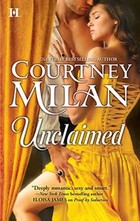 
I couldn’t really choose between these two, and I think they have very different audiences, so I chose them both. I loved them and would wholeheartedly recommend them, so there you go.
In November, I expect I’ll be reading a lot less as I try to shift my focus to writing this month. I’ll try to keep up with reviews, which should actually be a lot easier if I read as little as I’m expecting to, and I will be posting about my trip to Rome this weekend and probably a few times over the next few weeks – it was quite a busy vacation!
I’d still like to squeeze in the following books:
- Rome by Robert Hughes (already reading!)
- Flawless by Carrie Lofty
- The Courtesan’s Lover by Gabrielle Kim
- Praetorian by Simon Scarrow
- The Peach Keeper by Sarah Addison Allen
What’s on your list for November? Wishing you all fantastic months!
 This book is very well-known, so I won’t get into a summary too much. Suffice it to say that Levitt and Dubner use economic theories to tease out the truths behind commonly held misconceptions. For instance, what was the cause of the drop in crime across the United States in the 90’s? Do sumo wrestlers cheat? The authors look at things in a slightly different way to others to try and make sense of the world as they know it. This book is very well-known, so I won’t get into a summary too much. Suffice it to say that Levitt and Dubner use economic theories to tease out the truths behind commonly held misconceptions. For instance, what was the cause of the drop in crime across the United States in the 90’s? Do sumo wrestlers cheat? The authors look at things in a slightly different way to others to try and make sense of the world as they know it.
There doesn’t really seem to be any cohesion behind the book, and there isn’t actually supposed to be. Rather, it’s a portrait of causes that Levitt, the economist, found interesting and worth researching. I did find them to be very revealing and interesting at the same time. He finds out, for example, that names given to children don’t really have an effect on their destiny – it’s instead the economic situation of their parents that is the true predictor. It just so happens that a child raised in a poor family is not as likely to succeed as a child born in a rich one who is more likely to give that child a trendy and stylish white name.
The most interesting of the studies, naturally, is the one referenced in the first paragraph; namely that Roe v. Wade eventually caused crime to be lowered because many babies that are aborted would have been born into situations that would have predisposed them to crime. The authors do argue, actually, that the laws didn’t lower the birth rate. What usually happened was that the potential mother put off having a child until she was better able to support it, so we got more well-off, wanted babies than desperately poor, unwanted ones, and the former are far less likely than the latter to go off murdering people. I didn’t actually find this controversial at all, but maybe because I’m young, liberal, and have had similar stories before.
Freakonomics is worth the read if you have the opportunity, as it does alter slightly the way we embrace problems, but given how much of it has seeped into public awareness, it’s perhaps not as important to read now as it was six years ago. Regardless, I would recommend it, if only for the trivia you’ll spout after reading it (did you know swimming pools are more dangerous to children than guns? I didn’t either).
All external books links are affiliate links. I borrowed this book.
 Celia’s parents are superheroes, but she has never been anything more than normal. Eking out a standard existence on a single salary, renting her own apartment, taking the bus to work; this is Celia West’s life. Her parents Captain Olympus and Spark keep the city safe, while operating a huge and successful business, but never seemed to have enough time for their daughter. When it was discovered who they were, Celia’s life was guaranteed to be abnormal, but she does her best. Unfortunately, when danger erupts in the city, it’s Celia who has the power to understand what’s going on and, ultimately, prove that regular humans can accomplish just as much as those granted special powers. Celia’s parents are superheroes, but she has never been anything more than normal. Eking out a standard existence on a single salary, renting her own apartment, taking the bus to work; this is Celia West’s life. Her parents Captain Olympus and Spark keep the city safe, while operating a huge and successful business, but never seemed to have enough time for their daughter. When it was discovered who they were, Celia’s life was guaranteed to be abnormal, but she does her best. Unfortunately, when danger erupts in the city, it’s Celia who has the power to understand what’s going on and, ultimately, prove that regular humans can accomplish just as much as those granted special powers.
This is another Read-a-thon choice and in that context it was a fun, easy choice of read. Superheroes are everywhere these days, and the concept of a normal person getting mixed up in the fray isn’t really strange either, so it’s pretty easy to determine whether or not this book is a choice that will appeal to you. It tries at times to deal with more complex issues, but given that Celia is behind her teenage-rebel days, I think it actually mostly fails at this – she comes off as whiny rather than strong, even when she’s actually the one going behind the scenes to make things happen. I didn’t actually dislike her in the present day, but I definitely would have if this were a YA novel and she was carrying out some of the behavior she did in her younger years.
The other bizarre part of the book for me was the romance, which I felt came out of left field. I had a certain character pegged as an older mentor, only to find out he’s actually a romantic interest, which just didn’t work. I can see how it would work sometimes, but here I just wasn’t feel any sort of spark between them. Overall, disappointing for someone who actually likes romance on the side.
Still, the superhero world was interesting, and I certainly found After the Golden Age captivating enough to read it over a couple of hours straight during the Read-a-thon. I’d recommend it for a bit of fun and for a fast read, but not for a memorable one.
All book links to external sites are affiliate links. I received this book for free for review from Amazon Vine.
|
|




Recent Comments