|
|
 Today I’d like to welcome one of my friends, Josh, who blogs at Fortress of Solitude, with a review of The Trinity Six by Charles Cumming. Today I’d like to welcome one of my friends, Josh, who blogs at Fortress of Solitude, with a review of The Trinity Six by Charles Cumming.
In The Trinity Six, Charles Cummings picks up on the tradition of authors such as John le Carre in the genre of Cold War British spy novel. The prime innovation is that rather than using a spy as the main character, Cummings uses a professor of Russian history named Sam Gaddis. Gaddis is an academic trope of sorts in that he is an excellent historian, but down on his luck and in his attempt to extricate himself stumbles upon a quarter century old story that could collapse a government.
But I am getting ahead of myself. One of the most famous spy rings in history was the Magnificent Five. Maclean, Burgess, Blunt, Philby and Cairncross were students at Cambridge in the 1930’s when they were recruited by a professor as spies for Russia. At the time of recruitment they were soldiers in the war against fascism in Europe. Each excelled and took posts in the British government, working against fascism, but also passing information to their Russian masters. In the 1950’s when the Americans began to break encryption patterns from World War II, they caught on to Maclean and Burgess and the ring began to collapse. The last of the Magnificent Five, Blunt was not exposed until 1979. But perhaps these five were not alone; perhaps there was a sixth, and that is the discovery from which all of Gaddis’ adventures stem. One revelation leads to another and Gaddis finds himself unravelling one Cold War mystery after another.
Despite the traditional qualifier that all characters are used fictitiously and the story is a product of the author’s imagination, the situation presented of an immensely popular Russian President who was a mid-ranking officer in the last years of the Cold War, but through brutal suppression of opponents of his reign had transformed into a dictator in all but name, smacks of reality. Perhaps incidental, but Cummings reveals a commentary on the Russian state. All the while The Trinity Six is compelling and an easy read. My only critique is that at one or two points the supposedly coincidental events seem to be a stretch. As such they make the story seem somewhat railroaded, rather than a narrative that actually could happen. But it is not the characters or anything that they do, or even the scenario that is unconvincing. Simply put, there was just one too many coincidences.
Anyone who likes thrillers or spy novels ought to give The Trinity Six a read. Cummings is not yet to the level of le Carre, however the best is yet to come and this is a good place to start.
I am an Amazon Associate.
 Trevor Stratton finds a peculiar box in his office one day; naturally, he can hardly resist opening it, though he has no idea where it has come from. Inside he finds the memorabilia of the life of Louise Brunet, a Frenchwoman who lived much of her life stifled by a boring marriage and the staid affairs of a housewife. But Louise is innately passionate, having loved her young cousin, a soldier killed in World War I, and later developing illicit feelings for her neighbor. As Trevor unravels Louise’s story, he finds that one of his own is just beginning. Trevor Stratton finds a peculiar box in his office one day; naturally, he can hardly resist opening it, though he has no idea where it has come from. Inside he finds the memorabilia of the life of Louise Brunet, a Frenchwoman who lived much of her life stifled by a boring marriage and the staid affairs of a housewife. But Louise is innately passionate, having loved her young cousin, a soldier killed in World War I, and later developing illicit feelings for her neighbor. As Trevor unravels Louise’s story, he finds that one of his own is just beginning.
This was quite an odd book to start out with. Much of the beginning is actually written in second person and I can’t recall the last time I read a book that had such a strong component written like that. I must confess it threw me and I wasn’t sure I would like it, simply because it was so confusing. I wanted to have concrete facts, not have this peculiar vagueness. Lucky for me, and for the book, it all settles after the first quarter of the book or so. I figured out who all of the characters were and understood what the book was trying to do. After that, I enjoyed it a lot more. The book is composed of several different types of writing, between normal prose, letters, and the second person explorations of what’s inside the box.
One of my very favourite aspects of this book was the way that Trevor crafts Louise’s story from her memorabilia. I don’t know about you, but I do sometimes think about what I keep and what it says about me; this story is that writ large, an attempt to derive a woman’s life simply from the objects and letters she kept over the course of her life. There are pictures of all of the objects and I had a lot of fun puzzling over the photographs and examining each object in detail. It’s certainly fun for those of us who hoard to think that someday, someone might make something of all of those little treasures.
Another very appealing part of the book is Louise’s story itself. It’s impossible not to feel for her, even in contemplating adultery, because she is a vibrant person. I felt as though she’d been cheated by life, robbed of her love, and then had much of her spirit taken out of her. But she still leaps off the page with her strong character. I had the feeling that if life had treated her a little differently, she could have been a wonderful woman.
13, Rue Therese is an imaginative look back at the life of a Frenchwoman who survived much of nineteenth century history. Though confusing at first, it swiftly resolves and becomes a pleasant story of discovery and passion. Recommended.
I am an Amazon Associate. I received this book for free for review from Amazon Vine.
 Sophie is the eldest of three girls; though her own mother has died and her father has married, she gets on very well with her stepmother and two stepsisters. But when her father dies, things begin to change; Sophie’s sisters are sent to learn different trades and Sophie herself must take over in the hat shop. Unhappy with her lot, Sophie longs for change, and runs afoul of the witch of the wasteland, who turns her into an old woman. To get her life back, Sophie heads to Howl’s Moving Castle, where she hopes the enigmatic wizard Howl can help her. Sophie is the eldest of three girls; though her own mother has died and her father has married, she gets on very well with her stepmother and two stepsisters. But when her father dies, things begin to change; Sophie’s sisters are sent to learn different trades and Sophie herself must take over in the hat shop. Unhappy with her lot, Sophie longs for change, and runs afoul of the witch of the wasteland, who turns her into an old woman. To get her life back, Sophie heads to Howl’s Moving Castle, where she hopes the enigmatic wizard Howl can help her.
I bought this book before Diana Wynne Jones’s recent passing; I felt the best way to react to that news was to start reading her work ASAP, as I should have done when she was alive. And I really should have because, as everyone told me I would, I loved this book and I was completely captivated by the story here. I read it during the Read-a-thon all in one go and that was truly perfect for it, because I could simply lose myself in this lovely book.
For me this book felt like a fairy tale I might have read when I was much younger, though it is obviously also very appealing for adults. It certainly seems a book to suit all ages, personally. I was entranced by the idea of the moving castle and Howl himself – I could see the end coming from a while previously, but that didn’t make it any less sweet.
My favorite part really is Sophie’s entire switch of thought process. As a young woman, she’s trapped in the hat shop. She becomes very timid and set in her ways. By turning her into the old lady she’s become, the witch actually does her a favor, because she realizes what she is missing. She also brings her into contact with Howl, and unquestionably the best scenes in the book occur when Sophie has actually gotten to Howl’s castle.
The fantasy characters themselves can be a riot with each of their very distinct personalities. In particular, I thought Calcifer in the fire was a fun character, and I was intrigued by the relationships Howl had with people outside the castle – I wondered how much the rest of the series picked up on what was established here, and trust me, I intend to find out.
Howl’s Moving Castle is exactly as wonderful as you suspect it is. Read it! You won’t be sorry.
I am an Amazon Associate. I purchased this book.
 Billed as Jane Austen with magic, Shades of Milk and Honey starts out with our protagonist, Jane Ellsworth, anguishing over the fact that she and her sister have feelings for the same man. Jane’s sister Melody is beautiful and socially accomplished, turning the head of every man she sees, while Jane is plain but has a much greater skill in the art of glamour. Jane is 28, though, and thus firmly on the shelf. She’s resigned herself to spinsterhood and determines to allow her sister the greater happiness, even as her heart cries otherwise and she longs for not only skill in glamour but a little love of her own. Billed as Jane Austen with magic, Shades of Milk and Honey starts out with our protagonist, Jane Ellsworth, anguishing over the fact that she and her sister have feelings for the same man. Jane’s sister Melody is beautiful and socially accomplished, turning the head of every man she sees, while Jane is plain but has a much greater skill in the art of glamour. Jane is 28, though, and thus firmly on the shelf. She’s resigned herself to spinsterhood and determines to allow her sister the greater happiness, even as her heart cries otherwise and she longs for not only skill in glamour but a little love of her own.
This was an absolutely perfect book for the Read-a-thon and many thanks to Memory for telling me so! It is beautifully written and evokes Jane Austen’s world incredibly well. Kowal’s prose is neat and refined, giving a real sense of Jane’s emotions while never straying into pity-me sessions. It’s the type of writing I adore – restrained but with true passion lying underneath. I have only read this book and already I can tell you I would happily read anything else Kowal writes.
The world itself too is wonderfully done. Of course, Regency England is an appealing time period in its own right, but the addition of magic to the world just rounds it all off beautifully. It reminded me of The Magicians and Mrs Quent in that it’s an homage to Jane Austen but has its own twists too. Glamour fits right into the Regency world; it’s a feminine accomplishment, like drawing or singing, but as usual men are the instructors and generally the exhibitors as well.
As for the story, not much of it comes as a surprise; I’ve read all of Austen’s novels and I think most of us know how they’re meant to end. Some of it, particularly toward the end, was a bit melodramatic, but nothing really exceptional in a world that gave birth to the fretting Mrs Bennet or Mr Woodhouse. It was sweet and romantic and I felt the book was perfect for how I read it – straight through, no breaks, simply caught up in the beauty of the writing and the pace of the story.
Shades of Milk and Honey is a lovely read, an excellent choice for someone who enjoys light fantasy or has read all of Austen’s work and is looking for more. Recommended.
I am an Amazon Associate. I _ this book.
 This collection of stories is the first set in Charles de Lint’s mythical city of Newford, where everyone from all segments of society can get in touch with magic if only they believe. This collection of stories is the first set in Charles de Lint’s mythical city of Newford, where everyone from all segments of society can get in touch with magic if only they believe.
Kelly at The Written World and I both chose Dreams Underfoot for the Once Upon a Time V challenge – once we saw that we both intended to read it, we decided to read it together! We each asked the other three questions. Here are the three she’s asked me, and my answers:
1. What is it, in your opinion, that makes de Lint’s stories so readable for the people that pick up one of his collections?
De Lint’s stories are so immediately captivating for me because they take place in a world we could all easily imagine ourselves living in. His fantasy is the stuff of myth and feels organic, so it could well have come from our world – it fits right in with Native American creation myths, for example, and is never out of place. Because Newford is fictional, it could be right in our backyard. For me at least, I think this is a low barrier to entry; you don’t need to be acquainted with the world to hop right in, like you would with most fantasy.
2. Last year when I read The Ivory and the Horn with Carl, I said that I thought de Lint could write very believable female and male characters. Would you agree?
I would definitely agree. I find all of the characters to be very realistic and they usually manage to have character arcs no matter how little they stick around. I can’t recall any time where I felt he’d stuck one of his characters into a pigeonhole, which can be so easy to do in a short story. They’re all living, breathing people, which I think goes along with the first question because it’s another thing that makes his work very appealing.
3. At the same time that I was reading this book, I was also reading The Very Best of Charles de Lint. One of the things that both collections had me thinking about were de Lint’s ability to capture very serious issues in very readable ways. Would you agree with this based on what you have read by him so far?
Absolutely – a lot of the characters here go through really tough situations. It can be hard to read about the abuse they’re put through, but I am always reminded that this happens to real people. People die here, they beat each other up, and they even abuse themselves. In some ways I think de Lint softens the edges – the fantasy aspects can be terrifying or they can be an escape, and the supportive Newford community is certainly something that doesn’t always exist when real people need it. But overall the stories feel incredibly real.
You can read Kelly’s answers to the questions I asked over on her blog! I am an Amazon Associate. I purchased this book.
 Look around you and attempt to count how many objects of plastic are nearby. If you’re on the computer, you’re probably touching some right now. Besides my laptop, I can see my cell phone, which is plastic, the plastic on the cushion I’m sitting on, the plastic on my pen, and there are even some synthetic fibers in the clothes I am wearing. And I’ve gone no further than an inch. When Susan Frienkel attempted to categorize the plastic in her life, she became overwhelmed, and set about writing a book on plastic. Focusing on eight key items that have shaped plastic’s history and our own, she examines the effect the plastic industry is having on our bodies, on the environment, and on the economy, going down to what we can do about it and even whether or not we should. Look around you and attempt to count how many objects of plastic are nearby. If you’re on the computer, you’re probably touching some right now. Besides my laptop, I can see my cell phone, which is plastic, the plastic on the cushion I’m sitting on, the plastic on my pen, and there are even some synthetic fibers in the clothes I am wearing. And I’ve gone no further than an inch. When Susan Frienkel attempted to categorize the plastic in her life, she became overwhelmed, and set about writing a book on plastic. Focusing on eight key items that have shaped plastic’s history and our own, she examines the effect the plastic industry is having on our bodies, on the environment, and on the economy, going down to what we can do about it and even whether or not we should.
I’ll confess right here and say that I’m not a huge anti-plastic person. I do bring reusable bags to the grocery store and I recycle the plastic that’s accepted at my local dump, but I don’t really think about it much more than that. Reading this book suddenly made me realize how much of our lives seriously are based on plastic and how little of it is reused. People are far more likely to recycle glass or cardboard or paper, even though plastic is what’s cluttering up the earth, and every attempt at minimising waste or implementing “better” plastic is generally stymied because it costs money. This, while animals are dying and the sea is covered in little tiny bits of plastic, while some plastics are having unknown effects on our bodies, and while we continue to accept the dominance of it in our lives.
Frienkel doesn’t say plastic is all bad, far from that. She even talks to experts, and most of them say that they don’t put plastic in the microwave (whoops, I do this) and do recycle, but they’re not really worried about it in any other sense. Some are damaging, but more research will enable us to sort out the dangerous plastics from the safe ones. Some have already been banned and it’s a matter of paying greater attention as opposed to outright expulsion of plastics. She accepts that we have a reliance on plastic, so in addition to the historical parts on each plastic product, she is more pragmatic about going forward while continuing to keep plastic in our lives. It’s fairly obvious that she leans more towards the side of less plastic is more, but then ideally so do I, and she does treat both sides equally.
Naturally for me, the historical parts were the most interesting. Susan delves into eight items, among them the comb, the lighter, the plastic bag, the plastic chair (who hasn’t spent their childhood sat on a tiny plastic chair?), and IV tubing. With the comb, for example, she looks at how the comb was made before plastic, and how sustainable that practice was. Combs were expensive, generally made from tortoiseshell, ivory, or even wood – they’re something that’s found in virtually all layers of human history, and used to be a high status value item. Those of us who read historical novels probably know that already. Now, obviously, using a tortoiseshell or ivory to make a comb is considered atrocious, and wasn’t exactly sustainable then, so in this respect plastic, if treated properly, has actually improved things. Plastic combs are cheap, easy to use, and hardly ever get damaged, unlike the other types. It’s very, very interesting reading, and gave me a lot to think about that I’d never actually considered before.
Of course, Frienkel also stresses the need for more research, more recycling and investment, and more consideration of our choices. Implementing things like bottle charges are proven to work, yet have been shot down since 1986 because people don’t want to pay and don’t want to be obliged to return to the store to get their five cents per bottle. Thinking about the wider impact, though, makes it obvious that we should go that extra step. It’s not hard to round up all your bottles and cans and take them with you when you next grocery shop, and it’s those little steps, combined with larger measures of research and safety standards across plastic manufacturers, that will make the world a safer place for our children.
Plastic is a flat out fantastic book, well worth reading for everyone, because let’s face it: plastic is a huge part of our lives and it’s a part that’s going to stay. Isn’t it worth educating ourselves? This book is a great first step in that direction.
I am an Amazon Associate. I received this book for free for review from netgalley.com.
 I’ve never been one to take notes in books. I have cracked spines and dog-eared pages, but putting a mark in a book? Nope. I find notes in books distracting and am actively irritated when I’ve taken one out from the library and discover that someone else has written in it. Buying used textbooks in college was a necessity but I disliked having someone else’s notes in the margins of my book. I just find it distracting – I can sort of see the appeal in seeing someone else’s thought process at work, and the obvious historical potential for marginalia, but I find that they get in the way of my own thoughts. I’ve never been one to take notes in books. I have cracked spines and dog-eared pages, but putting a mark in a book? Nope. I find notes in books distracting and am actively irritated when I’ve taken one out from the library and discover that someone else has written in it. Buying used textbooks in college was a necessity but I disliked having someone else’s notes in the margins of my book. I just find it distracting – I can sort of see the appeal in seeing someone else’s thought process at work, and the obvious historical potential for marginalia, but I find that they get in the way of my own thoughts.
Since I don’t write in books themselves, I’ve seldom actually taken notes. Strangely, though, this weekend I had an urge to actually write some things down. I often start composing reviews in my head as I read, but if it takes me too long to actually sit down and write the review, I forget what I meant to say. As I get further behind on reviews, this gets more and more irritating, and I find myself putting off reviews because I don’t remember what I wanted to talk about in a particular book. So, in lieu of writing in my actual books, I have purchased a nice little notebook and for the first time have my very own reading journal. I am planning on noting down whatever comes to mind as I go along and, hopefully, using the results to make my reviews easier to write and more interesting to read.
Do you take notes while reading, whether in your books or in a notebook? Does it make it easier to write reviews?
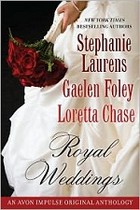 In celebration of the Royal Wedding coming up later this month, Avon commissioned this romance anthology from three of the genre’s best authors. Stephanie Laurens, Gaelen Foley, and Loretta Chase are all household names in the romance world. Each of these stories revolves around a royal wedding but has the characters finding a bit of love themselves along the way (naturally!). In celebration of the Royal Wedding coming up later this month, Avon commissioned this romance anthology from three of the genre’s best authors. Stephanie Laurens, Gaelen Foley, and Loretta Chase are all household names in the romance world. Each of these stories revolves around a royal wedding but has the characters finding a bit of love themselves along the way (naturally!).
The first one is “The Wedding Planner” by Stephanie Laurens. In it, Lady Margaret Dawlish is called upon to plan a royal wedding; with her exceptional planning skills, surely such a big event is well within her grasp. Throwing a wrench in her neat plans is the new Duc de Perigord, a man she’d met years ago while still engaged. Now, Meg’s fiance has been killed in the line of duty and Gaston has come to seize her heart for himself.
I quite liked this story; it’s the longest in the book but still very short. Gaston has a few obstacles in his way to winning Meg over finally which make for an engaging read, plus I liked that Meg had a sort of career of her own. It’s a bit rarer in historical novels to find a woman who is actually busy doing something other than waiting for a husband – and she’s good at her job, too. It’s probably not the most memorable story I’ve ever read but was lovely nonetheless.
The second story is “Ever After” by Gaelen Foley. Surprisingly, given my recent history with Gaelen Foley’s novels, I loved this one. It’s about a husband and wife who have grown apart over the years. Eleanor feels that her husband always puts his work first and has recently become convinced that he’s acquired a mistress, while he struggles with post-traumatic stress disorder and is perplexed at his wife’s coldness. It was so sweet to watch these two come back to loving one another after an obviously painful separation for both of them and it did a stand-out job of portraying the way misunderstandings can mushroom in a marriage. I really felt like Foley got some of her passionate storytelling back with this novella and I can only hope it comes back to her novels soon, too.
The final story, and my favorite, is “The Jilting of Lord Rothwick” by Loretta Chase. In this very short tale, heiress Barbara has decided that she and her fiance, Lord Rothwick, simply won’t suit, and writes him a letter to that effect. Inspired by the imminent loving nuptials between Queen Victoria and Prince Albert, Barbara craves a loving relationship and is convinced that Rothwick is only marrying her for her money. But Rothwick has simply been behaving as society expects him to; in reality, he’s head over heels in love.
Much like the last story, this is about a misunderstanding that has completely magnified; it’s obviously an overused trick but here it is also done very well. I have to admit that this story captured me with the sheer romantic appeal of it; the characters’ personalities and emotions just leapt off the page and into my head. Chase has the perfect opportunity to really work this situation and she does a fantastic job – further proof that I should be reading more of her novels. Luckily, I have three in my possession and I suspect it will not be long before I read them now!
This is a lovely anthology celebrating the upcoming royal wedding. If you’re craving a bit of romance, it’s ideal, and at the bargain basement prices of $1.99 and £0.49, there is no reason to resist!
I am an Amazon Associate. I received this book for free for review from Netgalley.
 Mount has declared that Latin is fun and is using this book to show the rest of us the way. It’s a quick Latin primer, designed to take the casual reader or lapsed Latin learner through the paces of the language, up to the point of translating a small passage at the end. Interspersed with the tables are a lot of amusing stories about Latin and the appropriate hints of what you’ll begin to understand once you actually can read Latin. Mount decries the falling trends in Latin learning and explains, convincingly, why Latin is indeed a worthy language to learn. Mount has declared that Latin is fun and is using this book to show the rest of us the way. It’s a quick Latin primer, designed to take the casual reader or lapsed Latin learner through the paces of the language, up to the point of translating a small passage at the end. Interspersed with the tables are a lot of amusing stories about Latin and the appropriate hints of what you’ll begin to understand once you actually can read Latin. Mount decries the falling trends in Latin learning and explains, convincingly, why Latin is indeed a worthy language to learn.
In many ways, Mount is preaching to the crowd with this book and me. I have taken Latin, both at undergrad and graduate levels, but it has slipped out of my mind in the past two years. I don’t want to get too rusty, as I do want to do a PhD, so I have been trying to find ways to improve and refresh my Latin without actively sitting down and devoting hours to it. This was a fun way to do so and reminded me of all the Latin I used to know (thanks Professor Johnston!). Plus, I adore languages. I ascribe my general ability to understand grammar and my wide vocabulary (not usually evidenced around here) to the fact that I’ve studied five – even though I speak none but English fluently, they’ve taught me an insane amount about my own language and codified the intuition I’d picked up from reading everything in sight.
Latin in particular is surprisingly fun, and that’s one of the best parts of this book. Translating Latin into English is like doing a puzzle; you first have to find all the pieces and then put them together in a way that makes sense. I’m probably crazy for thinking that’s fun, but it truly is if you’re armed with the knowledge to do so. The not-so-great part of this book is that it’s too speedy. It’s easy to just skip the charts and move on to the next bit of English. It’s a nice refresher, but I couldn’t imagine actually learning any Latin from the book, and I certainly wouldn’t have been able to translate the bit at the end.
Regardless, Mount reminded me of how much I love to study languages, and his goal to encourage others to learn them too is nothing short of inspiring. He laments ‘the good old days’ a bit too much, but his intentions are excellent. I immediately decided to learn French, too, and actually bought myself a beginner’s course. In for a penny, in for a pound, I suppose – why not learn both languages I need to at once?
Anyway, Amo, Amas, Amat, and all that … is a fantastic choice for the lapsed Classicist and an interesting book for the rest of us, too, giving us a peek into the history of a civilisation and a language that has influenced a huge amount of what we do today. Highly recommended.
I am an Amazon Associate. I borrowed this book from my library.
 More and more women over the course of the twentieth century made the choice to be single; still more didn’t choose to be single but ended up in that boat anyway. Marching alongside the female crusade for greater freedoms was often a parade of usually young women determined to enjoy them, creating waves and social trends as they went along. Israel’s book charts their progress, from the Flappers of the ’20s to the working women in World War II to the professional single women of today. She ends by asking whether or not women are still expected to marry and have children – and if so, why? More and more women over the course of the twentieth century made the choice to be single; still more didn’t choose to be single but ended up in that boat anyway. Marching alongside the female crusade for greater freedoms was often a parade of usually young women determined to enjoy them, creating waves and social trends as they went along. Israel’s book charts their progress, from the Flappers of the ’20s to the working women in World War II to the professional single women of today. She ends by asking whether or not women are still expected to marry and have children – and if so, why?
This is a very light, magazine-like read about the history of single women, mainly in New York City to give the book a focal point, though Israel actually starts out with nineteenth century women that chose to be or ended up single like Louisa May Alcott. In many respects the book wavers between these two types of women, the ones who chose not to marry and the ones who were widowed or simply couldn’t find an appropriate husband (the advent of the spinster). She charts the greater freedoms accorded to women and just when it became okay for a girl to go out on dates alone, when they went out dancing with just their girlfriends, and how employment helped the single woman get by and enjoy herself.
The most interesting aspect for me was obviously the historical, rather than the sociological angle. I had fun imagining my grandma out in New York City with her friends as a young girl; I know she got married young and didn’t really work before she married my grandpa, but it was still fun to think about, putting a human face on the stories of the women Israel actually discusses. It’s fascinating to see how the pendulum on treatment of women swings depending on circumstances and even events going on in the wider world – everyone knows that women were freer during the World Wars because the men were off fighting and they had to work, but the book also discusses what happened when the Depression hit and mentions other, later eras as well.
The real downside of the book was the fact that, although it is meant to focus on the single woman, the author really emphasizes the stigma they’ve always faced in opposition to the celebration the book suggests. Yes, there are issues even now; women are still looked down upon for not wanting to have children, for getting on in years without marrying, and so on. Men are still praised for doing things that women are expected to do, like childcare and housework. But I went into the book expecting a celebration of choices, because we really can lead happy and fulfilled lives without getting married (not that I can talk having been married at 23), and didn’t really feel I got that. The author takes things from a feminist point of view, but I felt depressed by the end of the book instead of empowered. If it makes sense, there wasn’t enough, “Look how far we’ve come, we can go even further!”, and too much, “Things are still bad and probably won’t get better.”
Still, Bachelor Girl was an engaging read that delved a bit deeper into the issues single women have faced throughout history right up until the present day. Its approachable, magazine-style prose makes it perfect for even the most casual reader. Recommended.
- No buy links because the book appears to be out of print and I can’t find anywhere that has it!
I am an Amazon Associate. I borrowed this book from my library.
|
|


Recent Comments