|
|
I truly can’t believe that October has ended and we’re almost in the long, cold, dark stretch of winter. About the only thing winter is good for is reading – as well as my birthday, but I’m sure I won’t like that any more either soon! – and I have a lot of that lined up this winter. Unread book numbers have been pretty constant since July, which isn’t terrible but isn’t great either. I doubt I’ll make a dent in them this winter with the holiday season coming around, but I can dream, can’t I?
I read 19 books, which is a bit less than normal, but still an entirely satisfying month. Here’s the breakdown:
Non-fiction
Historical Fiction
Historical Romance
Literary Fiction
- The Passport, Herta Muller
Contemporary Fiction
- A Long Way Down, Nick Hornby
Fantasy
- Of Saints and Shadows, Christopher Golden
- Spirit Bound, Richelle Mead (YA)
- Angel Souls and Devil Hearts, Christopher Golden
- The Demon’s Lexicon, Sarah Rees Brennan (YA)
This may be the first month ever where my largest category of reading was non-fiction. I think I like it! I felt like I was learning a lot this month, and while it may have meant I read less fiction, I really found myself craving facts and history. There are also a few memoirs in there, which I found quite interesting as well.
The clear favorite for fiction for this month is Mistress of the Art of Death by Ariana Franklin – I still haven’t got my hands on the sequel, but it’s sitting in the library reservation basket and I’m just waiting for it to come in so I can get to it right away.
How was your October reading? Are you looking forward to settling in with a book on the ever-colder November nights?
 It seems like that’s all I do these days! Obviously, I didn’t blog while I was in Paris last weekend, and shortly after we returned I (and my husband) promptly got sick with a cold. All I did this week and go to work, get home and try not to fall asleep immediately! I’m just starting to feel better now, though, so I’m hoping to catch up on all the blogging I’ve missed over the last week and a half while I was gone. Halloween isn’t going to be celebrated around here; I know it’s not a very popular attitude but it’s actually my least favorite holiday! My only observation has been the spooky books I read for the RIP challenge, which I still haven’t wrapped up. It seems like that’s all I do these days! Obviously, I didn’t blog while I was in Paris last weekend, and shortly after we returned I (and my husband) promptly got sick with a cold. All I did this week and go to work, get home and try not to fall asleep immediately! I’m just starting to feel better now, though, so I’m hoping to catch up on all the blogging I’ve missed over the last week and a half while I was gone. Halloween isn’t going to be celebrated around here; I know it’s not a very popular attitude but it’s actually my least favorite holiday! My only observation has been the spooky books I read for the RIP challenge, which I still haven’t wrapped up.
I meant to write a quick recap of our Paris trip – at least the literary bits of it – before now, but better late than never, right? I’d read about so much of what we saw, and it added an extra layer onto everything which was fantastic. It was especially awe-inspiring to be in Versailles, having read numerous books, fiction and non, about Marie Antoinette in particular. Here’s the bedroom which was last hers:

Unfortunately I couldn’t get the bottom because there were simply so many people there. At times we felt like cattle being herded through the palace – I can’t imagine how busy it must be in the summer if it was this bad at the end of October! They also had contemporary Japanese art scattered around that, to be honest, I wasn’t sure worked in that context. The whole place really made me interested in reading more about the others who lived there, though. I’ve learned about Louis XIV in school, but was never particularly inspired to read further about him – seeing evidence of his work, and that of his descendents, has definitely brought about a change in attitude.
Seeing history from a French perspective was so fascinating and I’m reminded of how limited I am by the fact that I only speak English fluently enough to read in it. Many times victories for the English, of course, were defeats for the French; almost everything I’ve read has been from an English perspective, or an American writing on an English perspective, and I can’t wait to try and seek out some French authors who’ve managed to get their work translated into English. I want to learn French (I have for a while now) but while I’m learning SEO I don’t think I can handle both. That might be a goal to start in 2011.
The other literary highlight to the trip was seeing one of Michelangelo’s statues in person for the very first time. I’ve really wanted to since I read The Agony and the Ecstasy last year, and at the Louvre I got my chance. Here’s a picture again if you missed Wednesday’s post:
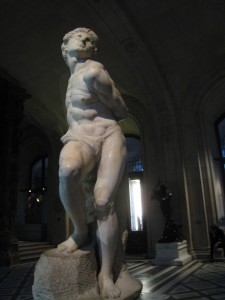 The two Slave statues really did stand out from the others; the muscle definition and level of reality was truly a step above. I wasn’t sure my inexperienced eye would be able to catch that, but even in the dimmed light it was remarkable. The two Slave statues really did stand out from the others; the muscle definition and level of reality was truly a step above. I wasn’t sure my inexperienced eye would be able to catch that, but even in the dimmed light it was remarkable.
This week is going to be all about catching up. I have a few reviews to get done and a lot of blogs to comment on. So I’ll end here, and hope you all have a wonderful Halloween and a great start to November.
I never do this meme, but as I have struggled to compose reviews as yet since I got back – here’s a photo for you.
Not a great picture, but I finally got to see a Michelangelo statue in person!
For the next few days, you might find me here!
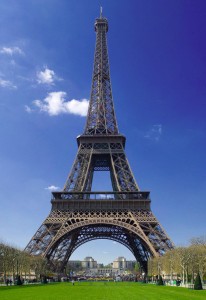 My husband and I are celebrating our first anniversary with a long weekend in Paris. It was actually last weekend, but this one worked better for our trip! I’ll be back on Tuesday, probably with a whole new lot of unread books along too. Have a great weekend! My husband and I are celebrating our first anniversary with a long weekend in Paris. It was actually last weekend, but this one worked better for our trip! I’ll be back on Tuesday, probably with a whole new lot of unread books along too. Have a great weekend!
 Having taken a rather memorable few trips through Europe in his youth and early adulthood, Bill Bryson decides to repeat the experience solo as an adult. After all, at the time of writing he lived in England but had hardly ever traveled across to the continent. In an effort to remedy that, he first sets off for Norway to watch the Northern Lights, then slowly makes his way south to city after city of hotel rooms and amusing cultural insights, ending up in Istanbul. Having taken a rather memorable few trips through Europe in his youth and early adulthood, Bill Bryson decides to repeat the experience solo as an adult. After all, at the time of writing he lived in England but had hardly ever traveled across to the continent. In an effort to remedy that, he first sets off for Norway to watch the Northern Lights, then slowly makes his way south to city after city of hotel rooms and amusing cultural insights, ending up in Istanbul.
It’s no secret that I am a big fan of Bill Bryson, and now that I’m off on my first ever trip to the Continent myself, I thought it was the perfect time to be reading this book. I’m only going to Paris right now, but I have big plans for the future, and I couldn’t wait to read Bryson’s perspective on Europe. (I did plan to read a book more specifically on Paris, but the library lost it before it got to me, so I chose this instead.) Bryson didn’t disappoint me at all, and I found myself laughing along at all of his jokes and thoroughly enjoying this book. I also discovered that it was perfect for late night Read-a-thon as everything he says just becomes hilarious when you’re that tired. I may possibly have preferred more depth – a bit more detail on the history of each place perhaps – but I was still quite pleased with what I got.
What I like most about his books is that while he encounters stereotypes and in many respects has a “typical” experience in certain countries, I never feel like he’s stereotyped the country without a good bit of humor. He pokes fun at them, but he also regularly pokes fun at himself in the world, so it’s impossible to be offended by anything – something which I admired when reading his books about my own country. I like that Bryson’s books feel like a friend has sat chatting with me about his trip; they’re not high literature or particularly sophisticated, they’re just about a really funny writer who has had quite a few memorable trips and life experiences.
Contrasting his trip now with his trip years ago really brought to life how much the world has changed in a short span of time and simultaneously how much remains the same. Our world is indeed evolving, but in ways perhaps different from what we might expect. The most poignant section of the book for me was his trip back to Sofia, Bulgaria, formerly in his mind a wonderful place with a particularly notable huge shopping mall. When he arrived this time, there were queues for bread and the shopping mall was virtually empty. The landmarks were the same, but the entire feel of the city had changed and was set to change again just a short time later.
I’m definitely looking forward to reading more by Bill Bryson – his later writing is definitely better, if The Life and Times of the Thunderbolt Kid is any indication, so I’ll be rounding out my collection of his books sometime in the very near future. In the meantime, Neither Here, Nor There was an amusing, sarcastic little read and I would definitely recommend reading it before or during a trip to Europe.
I am an Amazon Associate. I purchased this book.
Lucien de Malheur has it out for the Rohan family. He’s determined to make their lives miserable, and he decides to enact his revenge through the only girl in the family, Miranda. He arranges for an accomplice of his to seduce Miranda, abduct her, and marry her. In the event, he ends up raping her and ruining her forever, rather than marrying her, which is not good enough for Lucien. Several years later, once Miranda has gained her independence and feels more comfortable as a forever-single woman, Lucien decides the time is right and seeks to seduce her himself.
This is one of those books that, while I rather enjoyed reading it, caused some serious ideological issues for me. I could not fathom why Miranda would ever stay with Lucien, for one thing. Love is NOT unconditional, certainly not to the extent that he challenges her, and I can’t imagine any self-respecting woman clinging to a man who clearly didn’t care very much about her. Simply the fact that he’d arranged for her rape would have been enough to drive me up the wall; it’s stranger because she seems to suffer no ill effects from being raped, I expected at least something when she first slept with Lucien but it’s as if it didn’t happen. This seems so unrealistic to me; I would contrast it with Gaelen Foley’s depiction of Bel’s recovery in The Duke for a novel that felt more in the realm of possibility in this regard. Miranda is even determined not to call it rape, which I suppose could be a coping mechanism, but it was. She did not consent, therefore it is rape, and to imply otherwise is wrong.
I also was quite dissatisfied with the ending, mainly because I couldn’t understand how the problem was going to be resolved. I didn’t get how someone like Miranda, who clearly can think for herself throughout the book and is quite a spirited character, would end up just settling for this horrid man. We can see that he’s not as horrid as he claims, but the things that he does completely bely what we see going on in his head. And sometimes he has even thoughts that make him seem truly evil, such as when he expresses relief that Miranda is not a virgin (due to him) because he doesn’t like virgins. Ugh. It just seemed so insensitive, so much the opposite of a man who is supposed to be falling in love. I would have expected jealousy at that point in the story.
Then there was a secondary romance, which was quite sweet overall except it was a love at first sight type deal. I struggle with those as well; I generally didn’t see enough of the couple to really believe they’d fallen in love. I liked the couple, don’t get me wrong, but it just felt a bit too hasty.
It’s kind of a shame, because I think Breathless could have been a decent romance otherwise. Anne Stuart is a fine writer and has a great ability to carry a narrative along; I kept reading even with all my “WTF” moments and I was convinced she’d find a way to wrap it all up in the end. I usually like the bad boy redeemed stories, but Lucien just never seemed like he was actually redeemed, not until he’d gone too far. Unfortunately, that meant it didn’t wrap up nicely, but I’d still read another book by Stuart. I would just hope that it wasn’t full of so many romance cliches, soulless heroes, and willfully blind heroines.
I am an Amazon associate. I received this book for free through Netgalley for review.
 Explorers throughout the ages have been convinced that a huge city lies within the Amazon rainforest. Descriptions written by the first conquistadors only backed them up, and many men set out to find it only to lose their lives in the process. One such determined explorer was Percy Fawcett, who took his son and his son’s best friend into the jungle. Convinced he knew where the city was, he eagerly set off with the boys and only two guides, only to vanish forever. Mysterious legends sprouted up around his disappearance as well. Dozens of years later, author David Grann decides to head into the forest after them, seeking to find out what really happened to the trio and to uncover some truths about the mystical city itself. Explorers throughout the ages have been convinced that a huge city lies within the Amazon rainforest. Descriptions written by the first conquistadors only backed them up, and many men set out to find it only to lose their lives in the process. One such determined explorer was Percy Fawcett, who took his son and his son’s best friend into the jungle. Convinced he knew where the city was, he eagerly set off with the boys and only two guides, only to vanish forever. Mysterious legends sprouted up around his disappearance as well. Dozens of years later, author David Grann decides to head into the forest after them, seeking to find out what really happened to the trio and to uncover some truths about the mystical city itself.
What a fascinating book. You may notice I’ve been into travelogues lately, and there is nothing I enjoy more than an author combining history with his or her own personal journey. This is precisely what Grann does with his search for a city in the Amazon. I adored the chapters on Fawcett, on the Amazon, and was as wrapped up in the legend as all the explorers were – although not quite enough to set off on foot through the Amazon. I particularly appreciated the fact that Grann travels in a vehicle and notes that such a journey would have taken Fawcett weeks of hacking through undergrowth. When Grann thought his trip was hard, it really brought into focus how incredibly difficult exploration of the rainforest was for men of Fawcett’s time and before.
Grann also notes that explorers of the Amazon are often ignored in favor of those who explored the North Pole. For one thing, those explorers eventually succeeded, whereas no one managed to find the city of Z. The exact same thing was happening while Fawcett was alive. He struggled to get funding whereas northern explorers received both money and glory. He became famous in the end, only to vanish at the apex of his popularity. One particularly notable chapter included a famed northern explorer heading into the Amazon with Fawcett, only to turn back because he couldn’t take it. It seems that either you’re suited to risking your life in intense heat and with many creatures out to kill you, or you’re more suited to dying of the cold – you can’t be awesome at both apparently.
I was probably least interested in Grann’s personal story. It’s fairly obvious that he hasn’t died, which takes away all of the suspense, and he doesn’t really risk his life that much either. I’m not saying that he imposes himself too much on the story; he doesn’t, it’s simply that I find historical details far more exciting. He does make a few interesting discoveries, mainly at the end, and it’s worth it to get an up close and personal look at the natives that are likely very similar to those that Fawcett and various other teams encountered while on their hunt for the city.
The Lost City of Z was a fascinating look into exploring the Amazon rainforest and all of its perils. I would definitely recommend it.
I am an Amazon associate. I borrowed this book from my local library.
 During Chairman Mao’s Cultural Revolution, Jan Wong traveled to China to attend university. As a third generation Canadian Chinese, she was one of the first two non-native Chinese admitted since Mao took power, and much of that was undoubtedly due to her belief in Mao’s principles. In actuality, she believed in the watered-down version she’d been taught, and had no idea of the real depth and consequences for people who disagreed with Mao. As such, when she told a teacher that a girl she’d just met had asked her how to leave China, she had no idea that she was irrevocably changing that girl’s life. As an adult, she deeply regrets her actions, and decides to head to China and find the woman she betrayed to ask forgiveness. In the meantime, she discovers how much Beijing has changed and continues to change to meet the 21st century. During Chairman Mao’s Cultural Revolution, Jan Wong traveled to China to attend university. As a third generation Canadian Chinese, she was one of the first two non-native Chinese admitted since Mao took power, and much of that was undoubtedly due to her belief in Mao’s principles. In actuality, she believed in the watered-down version she’d been taught, and had no idea of the real depth and consequences for people who disagreed with Mao. As such, when she told a teacher that a girl she’d just met had asked her how to leave China, she had no idea that she was irrevocably changing that girl’s life. As an adult, she deeply regrets her actions, and decides to head to China and find the woman she betrayed to ask forgiveness. In the meantime, she discovers how much Beijing has changed and continues to change to meet the 21st century.
I found this book utterly fascinating. I’ve read a few books now on the experiences of Chinese people during the Cultural Revolution, but never one from the perspective of an outsider like this one was. Mainly, I was amazed that despite growing up as a Westerner, Wong became obsessed with China and her Chinese past. I was also quite surprised to discover that much of Mao’s regime had been whitewashed, so even when she was in China she had no idea what was really going on. I think that got across more of the deception than a few of the other books had; growing up in China, you would quickly realize that life was very uncertain and a heartbeat separated you from ruin. Growing up in Canada, Mao’s China simply seemed like a place where everyone worked for the betterment of society.
Standing in vivid contrast to Wong’s memories is the Beijing of 2008 (when she returned) with its glitzy buildings, intense consumerism, and ever-expanding apartments. She’s amazed that apartments formerly admired, reserved for only the highest of professionals, now look worn and tiny in comparison to the immense ones her old contacts have achieved. There are shopping malls everywhere, even if no one shops in them, the smog is so thick you can’t see the sky, and there are so many cars in Beijing that you’re risking your life by stepping onto the road. They’re also steadily pulling down the remnants of China’s past in favor of skyscraper after skyscraper. This is Beijing, which means I hope that the rest of the country still has a few historic palaces, but the rampant destruction of perfectly good historical architecture made me very sad.
It makes Jan Wong quite sad, too; even the China she knew no longer exists, but some of it is still around. China is still a police state, so the government can do mostly whatever it wants. That means large, endless building projects that no democratic country would ever approve. Wong spends time reminding us of those contrasts as well. In terms of her search for the woman she’s betrayed, she finds it extraordinarily difficult to find her because the country has in effect wiped away the Cultural Revolution. Records mysteriously vanish from that period and no one wants to tell her what has happened to Lu Yi.
I really enjoyed Chinese Whispers. I thought it perfectly combined the history of the Cultural Revolution, with which I’ve been so fascinated recently, to modern day Beijing. Since Wong is Canadian, I felt like I received a whole new perspective on the period, and as a result I’m very happy I read this book and would recommend it to anyone else interested in modern China.
I am an Amazon Associate. I borrowed this book from my local library.
 A rare female doctor, trained in Salerno, is recruited to head to England along with two men in order to solve an important crime. Adelia is a mistress of the art of the death; she “reads” bodies in order to find out exactly what happened to them. In short, she does autopsies, and her skills are essential to try and find out who has been taking and killing small children in Cambridge. The Jews have been blamed, of course, despite the fact that they’re obviously innocent, and they have even been killed by townspeople, so they are all holed up in the center of town. Adelia’s job is to find the murderer, without getting murdered herself. A rare female doctor, trained in Salerno, is recruited to head to England along with two men in order to solve an important crime. Adelia is a mistress of the art of the death; she “reads” bodies in order to find out exactly what happened to them. In short, she does autopsies, and her skills are essential to try and find out who has been taking and killing small children in Cambridge. The Jews have been blamed, of course, despite the fact that they’re obviously innocent, and they have even been killed by townspeople, so they are all holed up in the center of town. Adelia’s job is to find the murderer, without getting murdered herself.
Sometimes being unfamiliar with mysteries is useful, because I just loved this book. I mean, I’m probably going to spend this entire review gushing about it mostly because I can’t help myself. I’ve done what I normally don’t do and read reviews prior to composing my own, and have discovered that quite a few people thought the mystery was too predictable for the book to be interesting. I suppose that some aspects were predictable – the character who commits the murders is always a suspicious character though I didn’t guess which one – but I never read mysteries for the whodunnit aspect. I usually don’t even guess. Taking this solely as historical fiction, I just adored it.
I liked it so much that I didn’t even particularly care that Adelia seemed so anachronistic to me. After all, there were female doctors trained at Salerno (which I knew, but the author kindly clarifies as well) and it’s not outside the realm of imagination that one would develop as independent a spirit as Adelia does, even if it was unlikely. As a modern reader, I thought she was fantastic all around, and I loved the romance that developed and her eventual response to it. I loved even more that it was a romance between two imperfect people who never planned on it happening, but were so drawn in by one another that they simply could not resist.
I also enjoyed all the little medieval details that Franklin sprinkles throughout the narrative. I really felt the atmosphere, which doesn’t always happen when reading historical fiction. I was particularly pleased with her depiction of Henry II, who she describes pretty much precisely as I’d imagined him to be, as a clever man with an unfortunate temper that betrays his intellect. He doesn’t show up often, but when he does he quite steals the show, as I think the king would have done in the Middle Ages.
I can easily say that this is the first medieval novel I’ve read in over a year that I wasn’t ready to pick apart with inaccuracies. The simple truth is that I enjoyed it far too much. Since everyone in the novel was fictional, apart from Henry II, I didn’t have to worry that something was wrong and I didn’t know about it. The case itself was fictional. Even the small details that Franklin includes which didn’t happen she explains in her afterword – including the origin of her idea for the book, a case which genuinely did occur.
I absolutely can’t wait to get to the next book in this series – I’ve already requested it from the library. I loved Mistress of the Art of Death and would recommend it to anyone interested in historical fiction or historical mysteries.
I am an Amazon associate. I purchased this book.
 Emmett Conn has lived a long, normal, and moderately happy life. A veteran of the First World War, he’s now 92 years old and regrettably suffering from a brain tumor which has a strong chance of ending his life. An injury in battle erased his memory from before the war, but thanks to a combination of drugs and the tumor, flashbacks emerge, where Emmett (then known as Ahmet Khan) was a gendarme during the Armenian genocide in the Ottoman Empire during the very beginning of World War I. None of this fits with Emmett’s knowledge of his past, but as the scenes continue to play out in his head, he begins to believe that he was that man and question the entire basis of his American life. Emmett Conn has lived a long, normal, and moderately happy life. A veteran of the First World War, he’s now 92 years old and regrettably suffering from a brain tumor which has a strong chance of ending his life. An injury in battle erased his memory from before the war, but thanks to a combination of drugs and the tumor, flashbacks emerge, where Emmett (then known as Ahmet Khan) was a gendarme during the Armenian genocide in the Ottoman Empire during the very beginning of World War I. None of this fits with Emmett’s knowledge of his past, but as the scenes continue to play out in his head, he begins to believe that he was that man and question the entire basis of his American life.
This was such a powerful book. I thought the reflections were the perfect way to tell the story; it’s an amazing contrast between Emmett’s settled US life and his job forcing the Armenians out of the country. It’s impossible to like him at first, and I’d say it remains difficult throughout the book, simply because he is brutal. He, like so many young impulsive people, seems almost addicted to the feeling of power. The Armenians become faceless evil to him, an “other” that has committed crimes against his people; thus he can commit crimes against them without thinking. It’s a tale that you can find throughout history, still going on in the present day; if we can dehumanize our enemies, it appears easier to watch them suffer or even kill them, for most people. I knew (and know) virtually nothing about the Armenian genocide, regrettably, but it is surely this type of thinking which allows such unspeakable crimes to happen. Even now, we can happily stereotype people based on their age, their race, their gender, their religion, but if you know anyone at all you’ll realize that each and every person is different.
So Emmett discovers when he gets to know Araxie. He finds himself drawn to her without realizing why, and then when he comes to know her, he struggles more with the atrocities he’s committed. He knows they’re wrong. He knows he doesn’t want to hurt her, feels guilty for killing people she knows and loves. He learns precisely that lesson; that each person, no matter where they come from or what they look like, is still just a person. That’s why this book, for me, was so powerful and moving. It was not just an incredible story, but it had that anti-prejudice theme running through it so strongly. I can’t stand people who discriminate against others for any reason; so I struggled to like Emmett. Sure, he doesn’t look evil in the present day, but then how many murderers astonish their family and friends with the crimes they’ve committed? But then he started to realize what he’d done, and I appreciated him more along with the book as the story continued.
Make no mistake, at times this is a violent and disturbing book, but these things happened. Turks did rape, assault, and murder Armenians as they deported them. Mustian doesn’t really shield us from the atrocities committed and at times, the parts in the present come as a relief because the parts in the past are hard to take. It wouldn’t be as meaningful without this, though, and in the end I think a more accurate and detailed depiction is necessary.
The Gendarme is a powerful portrait of and a cry against prejudice. It’s also a really good, gripping story, as Emmett’s past is revealed through his memories and has an increasing impact on his future. Highly recommended.
I am an Amazon Associate. Many many thanks to Candace at Beth Fish Reads for sending this to me for our book club!
|
|



Recent Comments