|
|
 Empress Orchid, formerly known as Lady Yehonala, has truly become the ruler of all China. Despite her desire to retire, she’s forced to train more than one young emperor, and regularly finds herself resuming rule. She faces opposition from virtually all sides, not only from within the court and from the public but also from a variety of hostile nations who wish to invade and capture parts of China. Meanwhile, she’s forced to deny herself the love she desperately craves as she watches her empire slowly begin to collapse. Empress Orchid, formerly known as Lady Yehonala, has truly become the ruler of all China. Despite her desire to retire, she’s forced to train more than one young emperor, and regularly finds herself resuming rule. She faces opposition from virtually all sides, not only from within the court and from the public but also from a variety of hostile nations who wish to invade and capture parts of China. Meanwhile, she’s forced to deny herself the love she desperately craves as she watches her empire slowly begin to collapse.
This is the follow-up to Empress Orchid, which if you’ll recall (or click back to my review) I really enjoyed. I loved the Chinese atmosphere, the intricacy and intrigue of the court, and Orchid herself. I liked this book less. Orchid’s position, while not completely firm throughout the book, is now relatively solid and she finds herself instead dealing with an ever changing rotation of men and women who come in and out of her life.
This is an incredibly detailed time in China and I felt that, for my tastes, the book rushed through it in the interest of getting to the end of Orchid’s life. It’s also darker in character, if that’s even possible, simply because history in China in this period is very dark. The empire is clearly collapsing, and it’s obvious even if you aren’t aware of the general history of China. Foreign powers are regularly invading, even to the point of leveling the empress’s home and driving her out to exile. Still, we unfortunately miss a lot of the background history going on in China at this point simply because she isn’t there, which makes it harder to get a complete picture of the era, and means the reader feels a bit detached.
It’s clear that her way of life is unsustainable, which should lend an air of nostalgia to the work, but instead it just feels corrupt. Even though Orchid is suffering, and it’s painful to see China fall, one can’t help but feel that a better government is genuinely necessary, even if not the one that China eventually ended up with. Orchid can’t even speak with the Western leaders and hardly has any idea of her own country – how is she meant to rule, let alone the privileged boys who are called emperor and then completely spoiled with no responsibilities?
Overall, though, I still enjoyed Min’s writing and I enjoyed The Last Empress overall. I didn’t feel it was quite as strong as the first in this duology, but it hasn’t put me off reading the rest of her work at all. I’m at present especially interested in delving more into a wider history of China in this period; I think it’s absolutely fascinating, so don’t expect my China fixation to stop any time soon!
 Katherine Swynford is one of English history’s best known mistresses. Her attractions were clearly so strong to John of Gaunt, Duke of Lancaster, that he eventually broke all tradition and gave up the prospect of marital advance in order to marry her, a knight’s daughter who offered very little at that point in her life. But who was Katherine and what do we know about her? Katherine Swynford is one of English history’s best known mistresses. Her attractions were clearly so strong to John of Gaunt, Duke of Lancaster, that he eventually broke all tradition and gave up the prospect of marital advance in order to marry her, a knight’s daughter who offered very little at that point in her life. But who was Katherine and what do we know about her?
As it turns out, the answer is not much, and this effort by Alison Weir ended up as a disappointment for me. I’ve never really enjoyed the history that is virtually all speculation. I understand some of it is necessary in many pursuits, but I went through this book feeling that Weir didn’t really need to write an entire book on Katherine’s life when she had so little to work with. As always, it ended up being a book about the men in Katherine’s life and bits about her more illustrious relations and children. Large sections are devoted to Chaucer, who had an absolutely tiny role in Katherine’s life, but because he’s a well known figure in history and was married to Katherine’s sister, he gets a role, even after Katherine’s sister dies. I have to say I was disappointed in that; I thought a book based solely on John of Gaunt or Geoffrey Chaucer would have been far more interesting, as Weir could have dug deeper into their lives and drawn a few more relevant conclusions. It’s a sad reality that medieval women’s lives are so little documented, something we all wish we could fix, but that’s not a case to make a book out of something.
I was also disappointed with the level of scholarship I found in the book. Weir’s analysis of her sources seems very uneven. Virtually all first hand medieval sources are unreliable to a degree – you have to take into account bias, propaganda, and so on, just like you would when deciding whether to believe someone today – and she seems to use this when it suits her and ignore it when it doesn’t. This is especially true in the case of Froissart – I thought she should have addressed his unreliability from the start, so readers had a solid background going in. I like that she uses so many primary sources, but I would prefer a bit more depth of analysis, even in popular history like this.
I also really disliked how she drew conclusions from what may have been and then just went with them, without considering other options as the text went on, as it severely limited the depths of her continual analysis throughout the book. It also led to flimsy conclusions built on flimsy assumptions, which all historians should do their best to avoid. There genuinely isn’t enough here for a book, which is what’s caused this problem. Some of the assumptions are necessary to keep the history going as a fairly steady narrative, and possibly helps for people who are unfamiliar with the Middle Ages, but I just wanted more from it. I remember enjoying Weir’s earlier books a great deal more than I liked this one.
That all said, I do think Katherine Swynford is a decent choice for getting a nice, reasonably accurate picture of fourteenth century England. Weir’s work is very readable, although at times devolves into lists and dates. For the most part she paints a nice picture of the time in which Katherine lived and how she might have thought or felt. Sadly, it’s impossible to draw any conclusions about Katherine herself, and despite Weir’s flimsy guesses we end up with little picture about the woman herself. I ended up feeling like the book was lacking, even though I liked it while reading it, and would only really recommend it to someone interested in these few years of English history and not necessarily looking for much detail about Katherine herself.
I am an Amazon Associate. I borrowed this book from my local library.
 Shen Ai Li is the daughter of the Emperor of China, though it’s never a position either she or her father wanted. On her way to her assigned marriage, she discovers that her future husband had a hand in her brother’s death, among other things; she immediately does her best to flee despite knowing she will have brought dishonor to her family. With butterfly swords in hand, she seeks to rescue herself, but she is greatly aided by the help of a strange white man, Ryam. Realizing that this barbarian stranger is probably the only person she can trust right now, she lies to him about her identity in a bid to get him to return her to her family. Amidst the challenges of the road ahead and her betrothed’s constant attempts to get her back, Ai Li and Ryam start to feel more for each other, but such a relationship is well outside society’s expectations of them. Shen Ai Li is the daughter of the Emperor of China, though it’s never a position either she or her father wanted. On her way to her assigned marriage, she discovers that her future husband had a hand in her brother’s death, among other things; she immediately does her best to flee despite knowing she will have brought dishonor to her family. With butterfly swords in hand, she seeks to rescue herself, but she is greatly aided by the help of a strange white man, Ryam. Realizing that this barbarian stranger is probably the only person she can trust right now, she lies to him about her identity in a bid to get him to return her to her family. Amidst the challenges of the road ahead and her betrothed’s constant attempts to get her back, Ai Li and Ryam start to feel more for each other, but such a relationship is well outside society’s expectations of them.
I’m sure I’m not the only one who is thrilled that a romance set outside of England or the US has managed to take hold like this one, which is set in Tang dynasty China, and the hype it’s already received is genuinely well deserved. Plus, check out that lovely Chinese girl on the cover! This is the kind of book that I want to champion, that I want to see more of. It helps that this is a thoroughly enjoyable romance. I loved that the white man was turned around and made the minority, something I think we get too little (if any) of in romance literature these days, so even though Ai Li falls in love with him fairly quickly they still have to deal with not only the stigma of his different race but the issues of honor which bind her so strongly.
Of course, I adored Ai Li, how she was equally capable of being tough and being fragile; she can fight, though she’s never had to use those skills, but she can also be very, very feminine. It’s a nice juxtaposition in a world where I think girls are often judged to be either one or the other. Ai Li is strong and honorable, particularly loyal to her family and her values, but she’s not afraid to acknowledge her love for Ryam and face the consequences of her actions.
If I did ask more of this book, I’d probably wish for it to be a bit richer in its historical detail. The setting is phenomenal and I suppose I’d just like to see more of it and have more detail. In a romance that’s less than 300 pages long, however, I think that’s probably too much to ask, and may have taken away from the main plot for some readers. I also didn’t like that Ai Li was often referred to as Ailey, which was Ryam’s version of her name, even when from her own perspective. Since I don’t know much about the Tang dynasty, I couldn’t judge this book’s historical accuracy for myself, but Jeannie Lin has a section on her website devoted to the historical accuracy in her books – which she calls historical fantasies – for which I am grateful. I rarely expect any real accuracy from historical romance, which has a tendency to plop modern day heroines in Regency settings, but I like when it’s noted!
If you enjoy romance and are looking for a change in your historicals, look no further. Butterfly Swords delivers a compelling story with wonderful characters and a thoroughly exciting setting.
I am an Amazon Associate. I received this book for free for review through Netgalley.
 Hal Montgomery is alive and at war on the Christmas truce during the first World War in 1914. The British and the Germans laid aside their arms for one day and met halfway across No Man’s Land, exchanging gifts and conversation as though they hadn’t just been trying to kill one another and didn’t intend to do so again in a matter of hours. Hal finds himself chatting with a German officer named Wilhelm who is engaged to a British girl. He’d formerly lived in Stratford-upon-Avon and met a schoolteacher, Sam, with whom he fell deeply in love. Wilhelm gives Hal a picture of himself and asks him to let Sam know that he’s alive, still loves her, and still wants to marry her if he ever gets the opportunity. Hal Montgomery is alive and at war on the Christmas truce during the first World War in 1914. The British and the Germans laid aside their arms for one day and met halfway across No Man’s Land, exchanging gifts and conversation as though they hadn’t just been trying to kill one another and didn’t intend to do so again in a matter of hours. Hal finds himself chatting with a German officer named Wilhelm who is engaged to a British girl. He’d formerly lived in Stratford-upon-Avon and met a schoolteacher, Sam, with whom he fell deeply in love. Wilhelm gives Hal a picture of himself and asks him to let Sam know that he’s alive, still loves her, and still wants to marry her if he ever gets the opportunity.
Shortly afterwards, Hal is shot and crippled in a way that he means he’ll probably never return to the front and may always walk with a limp. This actually gives him the perfect opportunity to find Sam, with whom he’s developed an obsession, and deliver Wilhelm’s picture to her. Instead of honorably fulfilling that request, Hal himself falls in love with Sam and determines to spend the rest of his life loving her, regardless of how she feels about him.
Initially, I really enjoyed this book, and it definitely made me reconsider all the other ARCs on my shelf in which I’ve lost interest. I’m trying to get through them now and this one seemed to declare itself a winner right away. It has a fascinating story, starting with that legendary Christmas truce, and ending up dealing with difficult questions for people living in the early twentieth century. Sam has borne a child out of wedlock, for example, and the scrutiny and discrimination towards her is immense, even leading towards her potential expulsion as a schoolteacher. Her relationship with Hal is frowned upon by all of society and they pretend to be married to escape censure. These are all issues that we no longer have to deal with and the book made me deeply consider how profoundly life has changed.
Throughout the novel, the war goes on, and it ends at about the same time as the book ends. As a result, many of the people Hal knows and loves are off at the front even when he can no longer be there himself. His perspective gives us an insight into the daily stress that people were under but also contrasts the scene of the war with the surprisingly ordinary daily life in Britain. It’s too easy for people to forget that war is happening, even when their lives are consumed with spying and reading intelligence daily as Hal’s is. Still, his losses hit hard, and I found myself regretting all of the deaths that happened.
I had a few disappointments with the book, despite the fact that I did enjoy it and thought it was well-written. First of all, Hal is almost unbearably selfish. I could not believe he didn’t give Sam Wilhelm’s picture, lied to her about meeting him, and then did his very best to make her fall in love with him, mainly because he was so attracted to her. I hated him at times for that. Sam herself wasn’t a particularly standout character and I found her to often be cold and to use Hal in her own ways to get what she wanted. In that respect they deserved each other. My favorite character was probably the child Will, who just doesn’t understand what is going on and wants what a child wants, his parents to be together and happy with him. The ending was also completely unsatisfying. I’m not going to lie, it fit in with the characters’ personalities, but it was not what I wanted out of it, and so I was disappointed even if I should have seen it coming.
So, Gifts of War. It was well-written and interesting, but lacked the spark that would have connected me better to the characters and the story, and I ended up unsatisfied with it as a whole. If Mackenzie Ford were to write another book, I would probably read it, but I would lower my expectations accordingly.
I am an Amazon Associate. I received this book for free for review from the publisher a shamefully long time ago.
September was a bit of a crazy month around here. First of all, my Kindle arrived, and I’ve read quite a few books on it. I’m surprised by how much I like reading on it; I don’t want to give up my books but I definitely haven’t wasted my money. Then I won the Best Historical Fiction Blog award for BBAW 2010, which was really exciting, and I’m still really happy about that. Then, through a few interesting events at work, I’ve landed into a new job, which is by all means a good thing but also has meant that I’ve spent quite a bit of the last week learning things, and I’m not going to stop learning for some time yet. The new job is probably all good for my blog though; it should involve far less writing, which means I may actually be able to blog after work and not feel sick of writing all the time. We’ll see how it goes, but I’m cautiously optimistic.
September was a pretty good month in terms of reading too. I somehow read 22 books.
Historical Fiction
- The Baker Street Phantom, Fabrice Bourland (mystery)
- Ellis Island, Kate Kerrigan
- Splendour, Anna Godbersen (YA)
- Prima Donna, Megan Chance
- Shadow of the Swords, Kamran Pasha
- The Last Empress, Anchee Min
- The Last Full Measure, Ann Rinaldi (YA)
- Gifts of War, Mackenzie Ford
- Dark Road to Darjeeling, Deanna Raybourn
- The Transformation of Bartholomew Fortuno, Ellen Bryson
Non-fiction
- Tom Thumb: The Remarkable True Story of a Man in Miniature, George Sullivan
- Katherine Swynford, Alison Weir
- Geisha of Gion, Mineko Iwasaki
Romance
Fantasy/Sci Fi
Children’s
Contemporary Fiction
Obviously, historical fiction has completed its comeback and now makes up the majority of my reading once again. I mainly enjoyed the books I read this month, but I vastly preferred Warm Bodies by Isaac Marion to the rest. It just completely set itself above much of what I’ve read lately – I found myself marking passages and thinking about it almost constantly. I feel like I love very few books these days, and this was one I loved. I can’t wait to tell you about it later this week.
In the meantime, October looks to be another amazing month, or so I’m hoping! The Read-a-thon is next weekend; I haven’t even begun to think about what I plan on reading and I may join in a bit late, but I will be reading and I’m looking forward to it. Then, towards the end of the month, my husband and I are going to Paris for a short holiday, which I absolutely cannot wait for. Otherwise I’m looking forward to reading a lot of good books and enjoying some nice autumn weather if it ever stops raining!
What do you have planned for October? Will you be reading or cheering during the Read-a-thon next weekend?
Trying to catch up again before the start of October!
 Bombay Time, Thrity Umrigar Bombay Time, Thrity Umrigar
In this moving novel, a group of families in Bombay come together for the wedding of one of their children. While there, they are all thrown into reminiscing about their past together and just how they got this far in the future.
I wish I’d reviewed this one earlier so I could look more deeply into it, but unfortunately it got a little lost in the shuffle as I tried to get reviews for actual review books out. I loved it, however, most particularly the depth of the relationships between the people and their all too human foibles. I found it gave me striking insight into some aspects of Indian communities and India itself, how it was growing and changing and the people either grew or didn’t grow with it. The relationships – both romantic and platonic – between all of these people are gorgeously drawn, and what I really appreciated was the fact that they weren’t over. This is a snapshot of lives, not an ending to them. Beautiful book and has me determined to read more by Thrity Umrigar.
 Splendour, Anna Godbersen Splendour, Anna Godbersen
I actually haven’t reviewed any of the last three of this series, so this will stand as my summation of all of them. As a result I won’t bother with a summary here; let’s just say that the ladies of New York City are out and about yet again, as things are shifting and their lives are going slightly crazy as always. I have enjoyed this series; I still stand by my original assessment that it’s a bit of a guilty pleasure read as these girls’ lives are so scandalous and probably not quite accurate to history. Unfortunately I wasn’t quite satisfied by the ending, but I am glad I managed to read to the end, and would recommend the whole series to anyone who is interested in a very romantic YA series based around the lives of a few girls in early twentieth century New York City.
 Winnie-the-Pooh, A. A. Milne Winnie-the-Pooh, A. A. Milne
I’d never read the actual Winnie the Pooh before, so when I found it was free for my Kindle, I decided to give it a read. I was thoroughly charmed, let me tell you; these stories are so enchanting and so quick to read. Even with the black and white screen, the illustrations are just gorgeous and bring the words to life. This is really the perfect book for children and if/when I have some of my own, I fully intend to get them this book for their very own. It was only missing Tigger; when does he show up??
 The School of Essential Ingredients, Erica Bauermeister The School of Essential Ingredients, Erica Bauermeister
As a girl, Lillian uses food to express herself and to bring her mother back to her. As an adult, she runs a restaurant, and on Mondays holds a cooking class to bring other people together with food. The motley mix of students this time each have their own problems and varying degrees of happiness, and Lillian doesn’t offer them a solution. Instead she offers them a peaceful haven to rediscover themselves and to find connections with others that they’d feared lost forever.
This is one of those books I suspect I’d like more if I actually enjoyed fiction about people who have lives just like mine. Unfortunately I didn’t think it dug quite deeply enough; each person got a single chapter, which was just enough to get a taste of their lives and not much else. They were, for obvious reasons, all heavily tied in with food. Eventually they do start to link together, but without the community feel and thoughtfulness of a book like Bombay Time. This one just left me empty, although it did make me hungry as well with its luscious descriptions of food. I’d hesitate to recommend this but I know others have enjoyed it more than me, so it might just be my dislike of women’s fiction popping back up again.
I am an Amazon Associate. None of these books were sent to me for review.
 Sabine’s life hasn’t been easy since she fled from her career as a cushy opera star. She’s gone as far as offering sex for food; she ends up in a saloon sleeping with the proprietor and hiring other prostitutes to dance and sell drinks as well as sell themselves. When she was seventeen, however, her life was full of bright lights, scandal, and music she thought she couldn’t live without. When a little bit of that music comes back into her life, Sabine has to choose between the life she thought she’d left behind, and all its complications, and shutting away that life forever, if she still can. Sabine’s life hasn’t been easy since she fled from her career as a cushy opera star. She’s gone as far as offering sex for food; she ends up in a saloon sleeping with the proprietor and hiring other prostitutes to dance and sell drinks as well as sell themselves. When she was seventeen, however, her life was full of bright lights, scandal, and music she thought she couldn’t live without. When a little bit of that music comes back into her life, Sabine has to choose between the life she thought she’d left behind, and all its complications, and shutting away that life forever, if she still can.
Sabine’s story is told through alternating viewpoints; her adult life serves as the current narrative, while her more youthful diary regularly fills us in on the backstory behind her career and her more youthful life. At first, I had a really difficult time reconciling the two. The older Sabine, known as Marguerite to hide her past, is cynical and has closed off much of her personality. In vivid contrast, youthful Sabine is full of hope at the start, can’t imagine a life without music, and is almost unbearably teenage in her thoughts and emotions. She’s ridiculously self-centred, almost certain that the stage has an empty slot just waiting for her voice to fill it, and is prone to vivid imagination and silly delusions of love. I couldn’t help but like the older, more mature version better, even as I admired Chance’s skill in creating a teenager that recalled a little too clearly what it feels like to have everything be so brightly colored and full of drama.
The atmospheres of each location really drew me in. Seattle feels damp and grim, full of people who are mainly at the end of their ropes. It perfectly matches Sabine’s attitude at the same, where her own life has lot all of its former glitter. As she begins to open up again to music, so does Seattle; the first musical lands in town and Sabine begins to make a friend who tries her best to lighten up her life, when Sabine isn’t busy lying about her past. In vivid contrast is the soap opera-esque world of the stage, where Sabine is universally adored on stage but confused, in love, yet often very alone off stage. Everyone is sleeping with everyone else and the diary entries from this period are as high strung as Sabine herself. While I liked the back stage peek of the historical opera, I didn’t like the vast amounts of scandal that seemingly dripped from these pages; Sabine made choices I couldn’t condone and the entire world there was foreign and not particularly appealing to me. When Sabine herself grew uncomfortable with it, I felt I had judged it all rightly and wasn’t surprised that eventually she was driven to flee as she does in the beginning of the book.
The last thing that I didn’t like about the book – I liked most of it, honest – was the ending. I felt Sabine made the wrong choice. I couldn’t understand the logic behind it and while I liked that she was human and thus fallible, I suppose I hoped she would have learned in the way that I would have. But she didn’t, and so the whole book left me feeling a bit disappointed. The writing was beautiful and the story was well done, but I just couldn’t connect in that essential way with the characters or even truly understand their decisions. It’s wonderful for a backstage peek at opera houses of the period, and an atmospheric glimpse into a very youthful Seattle, but Prima Donna wasn’t the stand out historical fiction novel I hoped it would be.
I am an Amazon Associate. I received this book for free from a publicist for review.
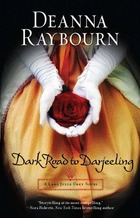 Lady Julia and Brisbane may have tied the knot, but that doesn’t mean intrigue has absented itself from their lives. No, even on their honeymoon, there is a mystery which they are compelled to solve. When Julia’s siblings Portia and Plum turn up, asking Julia and Brisbane to come to see Portia’s former lover, Jane, who is pregnant and suspects her husband has been killed, the new couple simply cannot say no. When Brisbane stays behind and doesn’t immediately go to the estate with Julia, she is distressed but resolves to try and find the murderer out for herself. What she does find is a strange mix of people both old and new and a mystery she cannot begin to guess how to solve, if there even is one at all. Lady Julia and Brisbane may have tied the knot, but that doesn’t mean intrigue has absented itself from their lives. No, even on their honeymoon, there is a mystery which they are compelled to solve. When Julia’s siblings Portia and Plum turn up, asking Julia and Brisbane to come to see Portia’s former lover, Jane, who is pregnant and suspects her husband has been killed, the new couple simply cannot say no. When Brisbane stays behind and doesn’t immediately go to the estate with Julia, she is distressed but resolves to try and find the murderer out for herself. What she does find is a strange mix of people both old and new and a mystery she cannot begin to guess how to solve, if there even is one at all.
It’s not a secret that I’m a big fan of this series, so I was thrilled when I found it on Netgalley, saving me the cost of importing the book just to see what happened (although this is one I do intend to purchase a paper copy of). I was a little worried about how it would go once Julia and Brisbane were actually married. Although none of the books’ plots have revolved around their romance, it has been a big part of the series and the tension between them has been a main linking factor of all the books; no matter what they’re trying to figure out, these two people have been drawn to one another. As it turns out, they still are very attracted to each other, although Raybourn fades to black so we never witness any of their more intimate scenes, for which I was grateful. They have their arguments, but they are still very in love throughout this particular novel, and I didn’t feel the lack of their courtship too keenly.
The mystery itself in the book was an interesting one, with pieces I didn’t put together until the end, but I’m not sure I was meant to. I often could tell that the real culprit wasn’t any of the people Julia actually suspected but I didn’t guess who it was; I did assume there was a murderer or the book would have ended without any sort of climax. As it stood, however, quite a few things did happen at the end of the book, few of which were particularly happy, and Raybourn drops us off with a nice cliffhanger that has me ready for the next in the series immediately.
What I liked the most about this book, as I often do in series that earn themselves a place on my favorites list, was the fact that the relationships within the series continue to grow and change with each installment. I also love that we learn bits about each character as the series progresses. Bits and pieces of the past come back to haunt them and play a role in each new storyline, so we’re always tied neatly in to the past. The books themselves have storylines but the whole series is an arc as we learn more and more about each individual character.
I still love this series and I am already anxious for number five! Dark Road to Darjeeling is a fantastic installment in a series that is just pure pleasure. If you enjoy historical fiction and mysteries, you will enjoy this series.
I am an Amazon Associate. I received this book for review through Netgalley.
 Mineko Iwasaki was the foremost geisha of her time, to the extent where she became a legend and was invited to entertain the highest levels of world society. When Arthur Golden wrote his novel, Memoirs of a Geisha, he consulted with Mineko but was apparently sworn to silence. Unfortunately, he then went on to tell people that it was Mineko who had spoken with him about the life of geisha in Japan; Mineko herself was upset that he had twisted what she said and as a result chose to write this book, her own memoirs, to explain to the world what geisha really are, what they do, and her own life story (much of which Golden borrowed for his own book). Mineko Iwasaki was the foremost geisha of her time, to the extent where she became a legend and was invited to entertain the highest levels of world society. When Arthur Golden wrote his novel, Memoirs of a Geisha, he consulted with Mineko but was apparently sworn to silence. Unfortunately, he then went on to tell people that it was Mineko who had spoken with him about the life of geisha in Japan; Mineko herself was upset that he had twisted what she said and as a result chose to write this book, her own memoirs, to explain to the world what geisha really are, what they do, and her own life story (much of which Golden borrowed for his own book).
I read Memoirs of a Geisha a long time ago, but I remember enjoying it thoroughly when I did. I was later dismayed to learn that Golden’s story wasn’t nearly so close to the truth as I’d imagined and that in fact he got a number of things wrong. (Yes, I have always been picky about historical fiction). I’d heard about Mineko Iwasaki writing her own book, and wanted to read it, but for some reason never actively sought it out. Then I saw it on the shelf in a charity shop and I was reminded that I really did want to read it and learn something a little closer to the truth than was portrayed in Golden’s book.
This isn’t the best written memoir I’ve ever read; Mineko Iwasaki has a ghost writer, Rande Brown, helping and presumably transforming her story into better English, but she definitely maintains a distance throughout and the book is very simple in tone. The story she has to tell, however, is far from simple and is completely engrossing. I did have the sense that Mineko purposely picked and chose which episodes to relate in order to emphasize certain facts about geisha (she splits them into two groups, maiko and geiko) which she knew that Golden got wrong or deliberately changed, but that didn’t lessen my interest in the memoir as a whole.
Sometimes, however, I had trouble believing what she’d said. For example, she first says that men rarely got very far into the okiya, the house in which a family of geisha lived. There were prescribed hours men were allowed in, and she uses this to argue that geisha are most certainly not prostitutes. But shortly afterwards she relates the fact that her older sister did bring men into the house and allowed them to sleep over, that she ran into them in the bathroom, and then was nearly raped by her own nephew in that same house. If men could not enter the house, why were these men permitted in?
She also begins the book when she is three years old and ascribes to herself adult thoughts and sayings. I couldn’t believe that a five year old child made the decision on her own to become a geiko, which led me to believe that in fact her parents were willing to sell her like they’d sold her sisters – all of whom became very bitter. Mineko seems like a much more driven and responsible girl, and since she did end up happy with her life, I wonder if she’s forgiven her parents and thus portrayed them in a much kinder light than she might otherwise have done. It is possible that at five she decided she wanted to be a geisha, but I would think her parents had a greater role in such a choice than either she knew or wanted to disclose.
Saying those things, I did thoroughly enjoy this memoir even if I took a few of her memories with a grain of salt. I knew little about the life of geisha and I was happy to be educated. Mineko is something of a rock star; she was the foremost geisha until she abruptly retired in the middle of her career, sick of the rules and restrictions that she couldn’t manage to change. She was so popular that no less than seventy other geisha retired within a few months of her, to pay her respect; she wanted to make changes, not endanger the profession, which is what may have ended up happening after her retirement.
As always, it was the little details that thoroughly captivated me. The clothes Mineko wore – backed up by the amazing photographs in which she looks astonishingly like a painting – the life she lived, the few skills she had as a normal human being. No one ever taught her any conception of money, for example, until she was in her twenties, so she worked constantly knowing she had to support the okiya but without any real conception of how much she was earning or how much money could buy certain things.
Despite my reservations, this was a truly fascinating book. I wish more geisha would write memoirs so I could compare and get a little closer to the truth, but for now, I would definitely recommend Geisha of Gion.
I am an Amazon Associate. I purchased this book.
 This week, I posted a review of Shadow of the Swords, a book that I enjoyed but found too many historical accuracies in to be entirely comfortable with. I loved the idea of it, but worried that the doubts the changes would leave in readers’ minds would undermine the otherwise important story the author was trying to convey. The author, Kamran Pasha, dropped by, and left his opinion on my review; namely that fiction is an art and is still enjoyable despite changes made to history, that it’s more than a dry retelling of facts. You can read his comment in full here. I’ve really appreciated the fact that he left a comment because it led us to an interesting email discussion, which has given me the idea for this post and the desire to find out whether others agree or disagree. This week, I posted a review of Shadow of the Swords, a book that I enjoyed but found too many historical accuracies in to be entirely comfortable with. I loved the idea of it, but worried that the doubts the changes would leave in readers’ minds would undermine the otherwise important story the author was trying to convey. The author, Kamran Pasha, dropped by, and left his opinion on my review; namely that fiction is an art and is still enjoyable despite changes made to history, that it’s more than a dry retelling of facts. You can read his comment in full here. I’ve really appreciated the fact that he left a comment because it led us to an interesting email discussion, which has given me the idea for this post and the desire to find out whether others agree or disagree.
In essence, my opinion of historical fiction when it involves mainly real characters and events is this; that it should follow historical fact as much as we know and use the author’s imagination to in effect fill in the blanks. I do think that sometimes minor changes are necessary, and fictional characters inserted into said history don’t bother me particularly, but I really dislike the changes of major events, the omission of important historical characters, and in general anything that could give a reader the wrong impression about the period, the event, or the person.
Undoubtedly a book can be a wonderful read even if it gets history wrong, but I know some people do read historical fiction and allow it to influence their beliefs and feelings about the historical period in question. Yes, this includes me, although I do try to read history about any period that I am really enjoying in fiction, to make up my own mind. I love that historical fiction has really taken off in the past few years, but I am often running into people who believe they know something but they’ve been misled by a book or a movie. Historians do get it wrong and historical understanding can change over time, which is why it’s important to read a few different sources in order to escape bias, but so few people do that and I dislike the fact that they could easily pick up and spread a mistaken belief because of a fiction book they read.
Even major politicians get history wrong and many people seem to have lost the ability to think for themselves; that probably doesn’t apply to anyone reading this blog, but I firmly believe we should get it right whenever we possibly can. Think about all the backlash against immigrants; how many Americans are from immigrant stock themselves? All of us who aren’t Native Americans, if you think about it. As an example, how many of us are proud to be Irish now, and how many of those have neatly forgotten the discrimination our grandparents endured and insist on perpetuating it by discriminating against others? This is why history is important, because it does profoundly affect what is happening today and can help us to determine how we react to the calamities of the future.
Finally, I also think a lot of my desire for history to be as accurate as possible in historical fiction is simply because I love history. I think it’s all fascinating on its own. I love historical fiction because it can bring that history to life, and I will admit that I feel misled and cheated if I believed what I read and the author had in fact changed things to suit his or her story without saying a word about it anywhere. In the book I first referenced in this post, Shadow of the Swords, Pasha does freely admit that he changed things in his author’s note, and in general if changes are necessary I like when they’re detailed somewhere. I still probably won’t agree with what was changed, but at least I know what to believe and what not to believe and I can respect the author’s desire to construct his or her own version of the story.
Perhaps I’m thinking too deeply about historical fiction, but I do believe an understanding of history is important in becoming an informed citizen of the world. Many of us do feel we’re learning from historical fiction; it’s not just mindless pleasure that is immediately forgotten. Fiction can be a powerful tool to inspire us to learn more, to understand the world that much better, to become better people. As a result I do feel we should get it as close to the truth as we can; the wonderful stories are there. They just need a clever mind to give them life and make them accessible to those who prefer not to read straight non-fiction. Obviously, much of my own personal preference as represented in this post is due to the fact that I think everyone should have some basic understanding of history. My own studies have massively expanded and drastically changed my own view of the world in ways that I appreciate on a regular basis; I wish that for everyone else, too, and I think historical fiction could be an important first step.
What do you think? Do you agree or disagree? Am I missing the point of fiction? How much history do you like in your historical fiction?
|
|


Recent Comments