|
|
 Vanilla is one of the world’s most delicious flavors. It also happens to be one of the most complex and difficult to harvest. The vanilla orchid not only requires manual fertilization outside of its native swathe of Mexico but also has a long and complex drying process that lasts months. As a result, the vanilla bean is an incredibly expensive and desired substance. Tim Ecott journeys to all the places where vanilla is grown, interviewing farmers, buyers, and connoseuirs alongside his telling of the history of this intriguing flavor that is anything but boring. Vanilla is one of the world’s most delicious flavors. It also happens to be one of the most complex and difficult to harvest. The vanilla orchid not only requires manual fertilization outside of its native swathe of Mexico but also has a long and complex drying process that lasts months. As a result, the vanilla bean is an incredibly expensive and desired substance. Tim Ecott journeys to all the places where vanilla is grown, interviewing farmers, buyers, and connoseuirs alongside his telling of the history of this intriguing flavor that is anything but boring.
Vanilla is actually one of my favorite flavors and I’ve been curious about it for a few months now. Last August I visited the Eden Project in Cornwall where they have a vanilla vine and a short description of the intensive process that is required just to get the flowers to bear fruit, then to cure and dry them for general consumption. This book definitely satisfied my curiosity and provided a totally readable and full account of everything I’d ever wanted to know about vanilla.
Tim Ecott’s background is in journalism; he worked for the BBC and his job took him to many of the places he wrote about in the book. It’s something of a travelogue as many of the world’s vacation hotspots are also great climates for the vanilla plant. He visits Mauritius, Reunion, Madagascar, Tahiti, and Mexico in his search for the background of this plant. I could tell straightaway he was a journalist because his interviews read like exactly that; he doesn’t excel quite so much at the narrative non-fiction. I think I was spoiled by The Immortal Life of Henrietta Lacks. But regardless, the story he has to tell is vastly interesting and I was fascinated by the surprisingly complex politics that happen around vanilla growing, curing, and selling.
He doesn’t spare on the history; we learn all about how the Mexicans first used vanilla, how it made its way to Europe, and finally how Europeans transplanted it to their warmer island possessions. Ecott reveals the story of the first person to learn how to manually fertilize vanilla and the background on all the different varieties, plus the competition between genuine vanilla and artificial vanillin, which isn’t as good but is what you’ll find in cheaper vanilla-flavored products. Also, I never knew that Coca Cola had vanilla in it, but it seems that most cola soft drinks do. Just one interesting fact I’ll be taking away from this book.
One warning though, you’ll be intensely wanting vanilla ice cream throughout the book! Overall, I was thrilled that Tim Ecott made the provenance and current status of my favorite flavor into a great book. He’s proved that vanilla isn’t as boring as people claim, but actually has a rich history and complex chemistry that rivals any artificial taste out there. Vanilla would be a perfect read for anyone interested in food, especially desserts.
 Weekend Cooking is hosted by Beth Fish Reads. From her blog: Weekend Cooking is hosted by Beth Fish Reads. From her blog:
Weekend Cooking is open to anyone who has any kind of food-related post to share: Book (novel, nonfiction) reviews, cookbook reviews, movie reviews, recipes, random thoughts, gadgets, fabulous quotations, photographs. If your post is even vaguely foodie, feel free to grab the button and link up anytime over the weekend. Please link to your specific post, not your blog’s home page. For more information, see the welcome post.
While this book didn’t have any recipes in it, it was about a food!
I am an Amazon Associate. I borrowed this book from my local library.
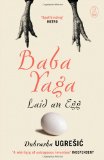 This is a novel in three parts, all about women. The first part is the story of a woman and her elderly mother, whose faculties are starting to flee in the face of age. The second delves into the lives of three older women on a once-in-a-lifetime trip to a spa in a totally different country. The last section embarks on a fictional literary analysis of the first two stories and ties them in with the traditional Baba Yaga myth. This is a novel in three parts, all about women. The first part is the story of a woman and her elderly mother, whose faculties are starting to flee in the face of age. The second delves into the lives of three older women on a once-in-a-lifetime trip to a spa in a totally different country. The last section embarks on a fictional literary analysis of the first two stories and ties them in with the traditional Baba Yaga myth.
This book was really difficult to get into. I have never actually read any of the Canongate Myths series despite intending to for a good long time now. This was to be my introduction, and unfortunately the fact that the first two segments had almost nothing to do with Baba Yaga put me off to a certain extent. They were all about older women and while I could see how they tied into the myth slightly, it was often frustrated to feel like I just didn’t know enough to “get” the book the way I wanted to get it.
I’ve said before that I’m not a short story fan and that hindered my appreciation of the book as well. Just when I got interested in the first story, it switched over, and the second story was a bit peculiar. I actually found the literary analysis section quite interesting because while I knew a little about the myth from learning Russian, I didn’t know anywhere near what the book told me. It was all really fascinating. And then to my surprise, I found the last five pages amazingly powerful. The end is almost brutally about women’s rights – about how wrong it is that women are so often the witches and the subjects while men who wear fancy hats decide our lives for us – and I almost wanted to stand up and cheer for Ugresic.
The last section also cast the book in a whole new light. I’d almost like to read it again just to pick up what I knew I was missing the first time, but the analysis was so good I’m not sure I need to – I was reminded of literature classes, but in a good way. It was a bit slower going but it really made the whole book an intriguing intellectual exercise that I felt was rewarding despite the initial frustration.
In short, if you enjoy the idea of myths and literary analysis, I think Baba Yaga Laid an Egg will work for you. It also would be a fantastic choice for feminists, just for those five pages alone.
Anyone out there have a suggestion for another Canongate Myth for me to try? I have a PDF of The Good Man Jesus and the Scoundrel Christ, I just need to figure out how to get it on my phone for easy reading.
I am an Amazon Associate. I received this book for free from the publisher for review.
 Kevin Khatchadourian, famously known as “KK”, killed nine people in his high school gym, in the process earning a long jail sentence and infamy – for him and his mother Eva. In a series of letters to her husband, Eva lays out the fabric of their lives from the beginning of their love story to Kevin’s fateful day in the gymnasium. Confronting difficult questions, such as who is to blame for a child’s violence, Eva lays her heart out for her husband and the reader. Kevin Khatchadourian, famously known as “KK”, killed nine people in his high school gym, in the process earning a long jail sentence and infamy – for him and his mother Eva. In a series of letters to her husband, Eva lays out the fabric of their lives from the beginning of their love story to Kevin’s fateful day in the gymnasium. Confronting difficult questions, such as who is to blame for a child’s violence, Eva lays her heart out for her husband and the reader.
I have heard so very much about this book since its publication date. It’s easy to know what it’s about; it’s revealed on the first few pages. Even then, though, it’s absolutely devastating as it continues to its inexorable end. It’s only as the book goes on do we realize how much Eva’s life changes because of an act her son committed. He’s gone to jail, but she’s lost her company, her house, her social life. She’s gone from traveling the world to write guidebooks for her highly successful company to staying in mostly to avoid acts of revenge.
The most important question the novel asks is whether or not a child’s crime can be the parents’ fault. Much as she tried, Eva struggled to love Kevin. She felt that he was malevolent when he was a baby and almost everything he did encouraged her suspicions. But Eva is wrong a time or two, which causes us to question just how evil Kevin really was, and what really drove him to kill like that. I think the saddest part is that even early on we realize that Eva does love Kevin even if she resented him from the start. She had him mainly to keep the husband she loved so desperately happy, which is always a mistake, but I thought she recognized more of herself in him than she ever wanted to admit.
As for my own experience, I recognized almost too much of my own self in Eva (how horrible is that?). She often comments on how she’s really too selfish to be a mother, she still wants to have her own life and somewhat resents her children for becoming more important than she is. I think every mother must have selfish moments – otherwise she wouldn’t be human – but I have to say it made me worry. And, of course, the fact that your kid could turn out to be a murderer is scary, but it happens to millions of mothers.
Despite its often difficult subject matter, I had a hard time putting We Need To Talk About Kevin down. I found myself thinking about it when I wasn’t reading and talking about it to everyone who had an ear to listen. It truly was fascinating and I found it completely deserving of its Orange Prize.
I am an Amazon Associate. I received this book for free from the publisher for review, but I already had a copy. Expect a giveaway soon!
 Isabel and her sister Ruth have been slaves their entire lives. On the eve of the American Revolution, their owner dies and sets them free in her will. But because of the turmoil, no one bothers to find the lawyer or read the will, so Isabel and Ruth are inherited and sold to a cruel Tory family who lives in New York. There Isabel tries her hardest to free herself and her sister just as her country tries to free itself from British rule. After all, if a country can be free, why can’t two little girls? Isabel and her sister Ruth have been slaves their entire lives. On the eve of the American Revolution, their owner dies and sets them free in her will. But because of the turmoil, no one bothers to find the lawyer or read the will, so Isabel and Ruth are inherited and sold to a cruel Tory family who lives in New York. There Isabel tries her hardest to free herself and her sister just as her country tries to free itself from British rule. After all, if a country can be free, why can’t two little girls?
Slavery during the American Revolution isn’t something we always think about. There is so much going on in the period that I think we tend to get excited about Americans winning our independence from Britain and completely ignore the fact that we chose to keep thousands of people enslaved at the same time simply because of the color of their skin. Laurie Halse Anderson rightly points out how utterly wrong this was by writing this compelling tale of two sisters who are legally free but trapped because white people simply don’t care and don’t want to bother finding out the truth.
Anderson is a master at creating characters’ voices and I just adored Isabel’s, who is the narrator of this story. I felt for her the whole way through the book and I really, really wanted her to win freedom for herself and her sister. Her every failure broke my heart, especially when it wasn’t her fault. She’s just a child and that really becomes clear – it’s horrible how she’s treated. Somehow, though, this book is more readable than many books about slavery. Even though Isabel suffers, she doesn’t get beaten down. She has a fantastic spirit and I think it enlivens the whole book because hope remains in the darkest times for her.
It also speaks to Anderson’s talent that she took an era in which I have relatively little interest, for whatever reason, and make it the background for an utterly compelling book. I had never known that the British promised freedom to the slaves to get them on their side, for example. I’ve only ever read one book set in New York City at this time, The Tory Widow by Christine Blevins, and I was intrigued by the parallels and differences told by each author.
I thought Chains was a fantastic work of YA historical fiction. It’s compelling, readable, and haunting. I can’t wait for the sequel, Forge, and just wish it was out now!
I am an Amazon Associate. I borrowed this book from my local library.
 Isabella d’Este, daughter of the Duke of Ferrara, is thrilled with her father’s choice of husband for her. Francesco Gonzaga, the future Marquis of Mantua, is not a wildly handsome man but their betrothal looks to lead to a love match. Just one month later and she’d have been marrying her younger sister’s Beatrice’s betrothed – the much older Ludovico Sforza, regent of Milan. Ludovico has more power, but he’s put off Beatrice’s wedding for so long that it looks like it might never happen. When it does, however, Isabella meets Ludovico and for the first time is jealous of her younger, less attractive sister, because she and Ludovico are clearly of the same mind about many things. Moreover, Ludovico’s Milan is home to Leonardo da Vinci and Isabella wants nothing more than to be made immortal by the genius artist. But all is not well in Italy as the political machinations of her leaders come back to haunt them. Isabella d’Este, daughter of the Duke of Ferrara, is thrilled with her father’s choice of husband for her. Francesco Gonzaga, the future Marquis of Mantua, is not a wildly handsome man but their betrothal looks to lead to a love match. Just one month later and she’d have been marrying her younger sister’s Beatrice’s betrothed – the much older Ludovico Sforza, regent of Milan. Ludovico has more power, but he’s put off Beatrice’s wedding for so long that it looks like it might never happen. When it does, however, Isabella meets Ludovico and for the first time is jealous of her younger, less attractive sister, because she and Ludovico are clearly of the same mind about many things. Moreover, Ludovico’s Milan is home to Leonardo da Vinci and Isabella wants nothing more than to be made immortal by the genius artist. But all is not well in Italy as the political machinations of her leaders come back to haunt them.
I have wanted to read this book ever since I read Stealing Athena by the same author two years ago. When I started to get bored with most historical fiction, I thought I would give Karen Essex a chance to bring back my fascination with it. At first, it wasn’t looking good. The book started off slowly and I set it aside for a full week in favor of other, more immediately compelling books. When I sat down to finally force myself to read it, though, it picked up and I enjoyed it by the end.
There’s no denying that Essex’s writing is lovely. She paints a gorgeous picture of a variety of places in Italy. I loved how the book was set right during the Renaissance, but there are still plenty of reminders of the Middle Ages, like jousts, hanging around to remind me that this was a period of transition. I could definitely imagine myself feasting and dancing in the courts along with the main characters, which I did appreciate.
The focus on art was fascinating as well. Isabella’s desire to immortalize herself takes up quite a bit of the story and art remains a central focus throughout. The characters are either painted or commissioning paintings or both – while Leonardo da Vinci slowly gets on with a variety of different kinds of art. Essex also reminds us how transient art is; some of the paintings she mentions are lost or have been destroyed in the meantime. It doesn’t all lead to immortality as Isabella would like.
The story is compelling in the end; it’s far more than a simple battle between two sisters for one man, as the cover would have you believe. It’s really about all of the women who are painted, or long to be painted, by Leonardo da Vinci, and the way that politics can destroy the overambitious. I would definitely recommend Leonardo’s Swans to anyone who enjoys historical fiction.
I am an Amazon Associate. I purchased this book.
Another round of library loot this week! I don’t have too much to share, just three books. I’ve been requesting a lot of books, so I’ve been reading my acquisitions surprisingly quickly. I hope to get through the two YA books this weekend.
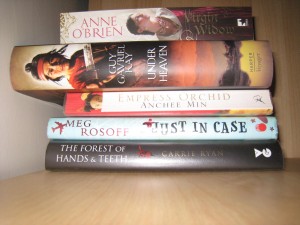 The library books are the three at the bottom: The library books are the three at the bottom:
- Empress Orchid, Anchee Min – I have really been eager to read more by Anchee Min ever since I finished Pearl of China. I have her novel Katherine on my TBR pile but this one has always appealed to me, too.
- Just In Case, Meg Rosoff – Continuing my small obsession, I appear to be determined to read all four of Meg Rosoff’s books in a couple of months. Actually, the release date of The Bride’s Farewell may prevent that, but I will definitely be reading it.
- The Forest of Hands and Teeth, Carrie Ryan – I’ve been wanting to read this since release and now I finally have my hands on it.
The top two are books that came to me in the mail. I thought it would be fun to add them in for once, too, so I’m hijacking my own post.
- Under Heaven, Guy Gavriel Kay – I have Nymeth to thank for this. I don’t recall if I ever mentioned that I didn’t get a gift from the Book Bloggers Holiday Swap. My Santa never responded to emails, and when I chose one of the donations to make up for it, that person didn’t respond either. So Ana generously offered to buy me a book herself, and I’m so grateful that as a result I have the newest release of one of my absolute favorite authors. Thank you, Ana!
- Virgin Widow, Anne O’Brien – Got this one for review. It’s about Anne Neville, and I will admit that I hesitated to accept it. But it’s my thing, it’s been too long since I reviewed a medieval historical fiction novel, and it’s had good reviews. It comes out in the UK later this month and will be published in the US later this year – I imagine I’ll be seeing a good number of reviews for it around then!
Thanks as always to Eva and Marg for hosting Library Loot!
 Adeline’s mother died when she was a baby. As the fifth child, with three brothers and a sister, she was always going to be teased, but when she was a year old her father remarried a woman who had it out for her predecessor’s children. Adeline’s stepmother was half French, automatically placing her above the rest of her Chinese family. While Adeline and her four older siblings wore old clothes, ate cheap food, and weren’t allowed to see any of their friends outside of school, her stepmother’s children were pampered and treated with endless luxuries. They walked to school while their younger siblings were given money for the tram or driven to the most exclusive schools available. Adeline yearned to escape and distinguished herself at school, but her life often seemed like the worst misery possible. Adeline’s mother died when she was a baby. As the fifth child, with three brothers and a sister, she was always going to be teased, but when she was a year old her father remarried a woman who had it out for her predecessor’s children. Adeline’s stepmother was half French, automatically placing her above the rest of her Chinese family. While Adeline and her four older siblings wore old clothes, ate cheap food, and weren’t allowed to see any of their friends outside of school, her stepmother’s children were pampered and treated with endless luxuries. They walked to school while their younger siblings were given money for the tram or driven to the most exclusive schools available. Adeline yearned to escape and distinguished herself at school, but her life often seemed like the worst misery possible.
This memoir was absolutely heartbreaking. I just could not believe anyone could treat a little girl so badly. It’s obvious that Adeline (her Chinese name is Jun-ling) is a clever child with a huge heart. She loves her grandparents and her aunt, the only people who treat her well, with an earnest devotion that I wished she could have applied to her parents. Instead, her stepmother convinces her father that his older children deserve nothing but the worst – subsistence food, hideous clothes, unflattering but cheap haircuts. They are mocked in school and at home alike.
I was amazed that Adeline could retain her sense of self despite all of the abuse. She has no self-esteem, but she is a good person and as such she makes friends. Eventually, people flock to her, leading to one of the saddest scenes in the book. It wouldn’t have been so bad even if the siblings that shared a mother with her had compassion, but they are either innately cruel, venting their unhappiness on their little sister, or seek her stepmother’s approval and then continue to mock her.
Adeline’s story is intertwined with the history and culture of China. It’s often obvious that this is a middle grade book and that the history is slightly simplified for the child’s mind, but it lends flavor to the story and Adeline’s surroundings. The book would really be perfect for a middle grade reader eager to learn more about the wider world – I know I learned virtually nothing of twentieth century China in school. There is a follow-up for young adult readers which I have already requested from the library and am very eager to read.
Chinese Cinderella was a fast, simple but absolutely heartbreaking read. It’s a memoir that will have you cheering for Adeline and hoping that she finally earns happiness in the end.
I am an Amazon Associate. I borrowed this book from my local library.
 Henrietta Lacks, a poor black woman, died of cervical cancer in the 1950’s. Her doctor had never seen a tumor like hers and scraped some cells off for research purposes. To everyone’s surprise, those cancer cells were the first to keep on living and separating outside the human body and spawned an entire research industry. Nicknamed HeLa after the first two letters of Henrietta’s first and last names, these cells caused a virtual revolution in research and led to cures and treatments for a variety of illnesses as well as a way to test the effects of various calamities on human tissue. But Henrietta’s family received no money and Henrietta received no recognition for her contribution. Rebecca Skloot puts together the facts and gets the family’s side of the story in an effort to earn Henrietta the recognition she deserves. Henrietta Lacks, a poor black woman, died of cervical cancer in the 1950’s. Her doctor had never seen a tumor like hers and scraped some cells off for research purposes. To everyone’s surprise, those cancer cells were the first to keep on living and separating outside the human body and spawned an entire research industry. Nicknamed HeLa after the first two letters of Henrietta’s first and last names, these cells caused a virtual revolution in research and led to cures and treatments for a variety of illnesses as well as a way to test the effects of various calamities on human tissue. But Henrietta’s family received no money and Henrietta received no recognition for her contribution. Rebecca Skloot puts together the facts and gets the family’s side of the story in an effort to earn Henrietta the recognition she deserves.
I have one word for this book and it is wow. I was incredibly fascinated – and at times saddened – by this entire book. I am not anything even close to a scientist and had never heard of Henrietta or the HeLa cells, but now I think that’s a shame. I’m glad Skloot finally got a book published and is setting up a scholarship fund so Henrietta can get the recognition she deserved, even if she’ll never know it.
The book flips between the past and the present, explaining Henrietta’s story and later that of her cells alongside Skloot’s quest to get in contact with the family and then her relationship with each of the individual family members. I read this for a book club and one of the members suggested that Skloot was essentially harassing the family with constant phone calls and visits. While I do think she was especially persistent at the beginning and that wasn’t right, the fact that the family wanted Henrietta’s story told and appreciated the recognition she received for me outweighed the fact that Skloot was pushy in the beginning. I wished that the family could have told Henrietta’s story instead, but the poor state of their education has prevented it all this time. I was pleased to hear, though, that the latest generation is going to college and grad school, so they’ll be moving up in the world.
Skloot really excels at explaining the scientific parts that are scattered throughout this book. I’m not a scientist and I have never really been interested in science, but I was surprised by how fascinating I found the various processes related in here. I was also totally astonished at how unethical the current system is. I had absolutely no idea that doctors are pretty much free to do as they like with discarded human tissue. Some do offer a consent form, but they’re not legally required to do so and it’s perfectly okay for someone else to make money off of my cells without giving a cent to me. I don’t want to hinder medical research but something about that seems very wrong. Henrietta’s family didn’t even have health insurance so they had no access to any of the treatments that their mother’s cells made possible!
This whole book is genuinely fascinating. It’s a completely readable work of narrative non-fiction that brings up a ton of issues about medical science and ethics while telling the story of a woman who should definitely be remembered and commemorated. I very highly recommend The Immortal Life of Henrietta Lacks.
I am an Amazon Associate. I purchased this book.
 Hilary, now an old man, takes the time to reflect on one year of his life in a boarding school – the year he found love. He was a troubled child who often resisted authority, longing to be something he was not, and as a result had ended up unpopular and unsuccessful in different schools already. On a run with his entire school, he discovered a boy who lived by himself on the coast of East Anglia, where the water is slowly creeping up on the land. Hilary immediately did his best to cultivate a friendship with the boy, Finn, finding himself compelled to spend more and more time in Finn’s tiny cottage, totally unaware of the effects his friendship would have. Hilary, now an old man, takes the time to reflect on one year of his life in a boarding school – the year he found love. He was a troubled child who often resisted authority, longing to be something he was not, and as a result had ended up unpopular and unsuccessful in different schools already. On a run with his entire school, he discovered a boy who lived by himself on the coast of East Anglia, where the water is slowly creeping up on the land. Hilary immediately did his best to cultivate a friendship with the boy, Finn, finding himself compelled to spend more and more time in Finn’s tiny cottage, totally unaware of the effects his friendship would have.
I am not honestly sure where to begin this review. I’ve let this book percolate in my head slightly too long, I think, for my thoughts to be coherent to anyone but me. I can say what I loved most about this book was the perfect way it captured teenage awkwardness. Meg Rosoff’s writing perfectly encapsulated everything Hilary was feeling – I could almost have been him. The fact that the book was narrated by Hilary’s older self remembering makes it all too poignant. I’m far from old, but my teenage years have already begun to take on a similar gloss, a comparison between what I thought I knew was true then and what I know to be true now. I’m sure it will only become stronger as the years march on.
There is an air of mystery surrounding the entire book. The narrator’s name is scarcely mentioned – it took a lot of searching before I found out what it actually was in order to write this review. And Finn, too, is a mystery – a character who barely speaks yet embodies virtually everything to Hilary. Hilary’s unsure whether he’s in love with Finn – and resisting his newfound homosexuality – or simply wants to be Finn, which he’s clearly more comfortable with and makes efforts to actually do. Rosoff never explicity spells this out, though, but merely gets it across with Hilary’s actions and thoughts.
I loved the book’s focus on history, too, Hilary’s awareness of the continuity of life. Things change constantly and his ruminations on history only remind us that what he’s going through will be over, too. The coast will continue to vanish and the remains of Roman forts will soon be taken away by the ocean.
There’s a twist at the end of the book which turned it all upside down, but I thought it just fit. I knew something was going to happen and I’d considered the idea at the start, but when it happened I was still surprised. I don’t want to give it away because the book’s pull won’t be nearly as powerful if you know the ending – there’s a constant, looming sense of almost dread throughout most of the book, a focus on the frailty of our lives. Ties in well with the history, doesn’t it?
Anyway, I’m not actually sure I preferred What I Was to How I Live Now, but it was certainly thoughtful and addictive. Rosoff’s writing is beautiful and perfectly emulates the teenage mind – I can’t wait to read more of her work.
I am an Amazon Associate. I borrowed this book from my local library.
 This is book five in the Mercy Thompson series by Patricia Briggs and as such there may be spoilers for the first four books. Check out my review of Moon Called, the first book in the series. This is book five in the Mercy Thompson series by Patricia Briggs and as such there may be spoilers for the first four books. Check out my review of Moon Called, the first book in the series.
The fae are possessive and secretive. So when Mercy Thompson’s friend, who is slightly fae but mostly human, loaned her a book, she probably shouldn’t have accepted it. But she did, and now he’s disappeared and a faery queen wants that book from her. Meanwhile, her dear friend and former love Samuel is losing his will to live, letting his wolf take over (a dangerous situation for any werewolf) and she’s still trying to navigate the murky waters of her new and uncertain mate bond with Adam, the alpha of her new werewolf pack.
I’ve said it on every single review of these books but I love them! I think they’re fantastic and Patricia Briggs has a great story in every book. She never goes too far, it’s always just the right mixture of plot and character development. In each book, the main plot wraps up but the overarching plot keeps developing – the characters grow and change over the whole series. This book isn’t an exception. I loved returning to her world and picking up the same characters’ stories.
In this particular volume of the installment, I really appreciated where the characters’ relationships went. I have always totally loved Adam and I’m so encouraged by his relationship with Mercy. It was fantastic that there was more of him in this book. And Samuel – I may not like him as much as Adam, but I was still very captivated by what was going on with him in this book. I liked how she wove in aspects from her other Alpha and Omega series, too, because I also like Charles and Anna.
I liked the plot, too. I didn’t remember the person who lent Mercy the book, but I thought enough was explained that it didn’t matter. It wasn’t entirely suspenseful because I didn’t think anything particularly bad was going to happen to the characters (although I have been shocked by that in other series) but I was definitely intrigued by what happened. In fact, the book captivated me enough that I could read it in the space of three hours while sitting in a noisy van moving furniture. Yes, it’s that absorbing.
In short, I still love this series! And now I have a really, really long time to wait for the next installment. But when it comes out, I’ll be reading. I highly recommend Silver Borne and the rest of the Mercedes Thompson series to anyone who likes urban fantasy.
I am an Amazon Associate. I purchased this book.
|
|


Recent Comments