|
|
 As a child, Alexandra Solarin’s father is shot in front of her eyes at a chess tournament in Russia. The mysteries surrounding his death don’t begin to explain themselves until Alexandra is much older. As an apprentice chef, she has now given up on chess, but the game hasn’t abandoned her. Her mother, Cat Velis, throws a birthday party and invites not only Alexandra but several of her irritating neighbors, Alexandra’s aunt Lily Rad, her best friend Nokomis Key, and her last chess opponent, Vartan Azov. The truth behind her parents’ past is revealed to Alexandra bit by bit as the next stage in the game plays itself out against elaborate backdrops with hugely prominent characters holding pivotal roles in the search for the purpose of the Montglane Service. As a child, Alexandra Solarin’s father is shot in front of her eyes at a chess tournament in Russia. The mysteries surrounding his death don’t begin to explain themselves until Alexandra is much older. As an apprentice chef, she has now given up on chess, but the game hasn’t abandoned her. Her mother, Cat Velis, throws a birthday party and invites not only Alexandra but several of her irritating neighbors, Alexandra’s aunt Lily Rad, her best friend Nokomis Key, and her last chess opponent, Vartan Azov. The truth behind her parents’ past is revealed to Alexandra bit by bit as the next stage in the game plays itself out against elaborate backdrops with hugely prominent characters holding pivotal roles in the search for the purpose of the Montglane Service.
Unfortunately, I was not a fan of The Eight, the first book in this duology. I knew I wasn’t going to like The Fire and I continued to put it off, but I did agree to review it, so I had to read it eventually. Waiting did not help me to like it any better. My biggest problem with it was that the book was very difficult to follow, particularly for me, since I don’t really like puzzles. The story alternates between two time periods and I had some difficulty figuring out just why. It’s hard to maintain the threads of the story across time and there seems to be little to no purpose for all the famous name dropping. It does give background as to why the chess pieces are where they are, but I’m not sure that was entirely necessary for the story.
I already mentioned it, but I don’t like books that involve puzzles or riddles. It’s always irritating when the characters solve a riddle and say, “Of course!” and proceed to explain the meaning behind it; I’d have never had a clue, so I was happy that they were explaining, but the entire book seemed like a huge complicated mess to me. I dislike puzzles that are impossible for me to solve. (This isn’t confined to books; I also dislike video games with excessive use of puzzles, although somehow straight puzzle games are fine). I think it would have been even worse if I hadn’t read The Eight. I would not recommend starting with this book, it would be too confusing. It’s hard to care about the characters; even Alexandra wasn’t particularly appealing and fell totally flat, which is never good with a main character.
In short, I felt like this book was a disaster for me. I don’t like this type of book and even the historical sections didn’t appeal. They just felt tacked on, especially with the historical characters that are included purely for name dropping, and took away from the more suspenseful plot with Alexandra and her many friends. I have no interest in reading books of this kind. Overall I would say that if you enjoyed The Eight or The Da Vinci Code, give this a shot. If you didn’t, don’t.
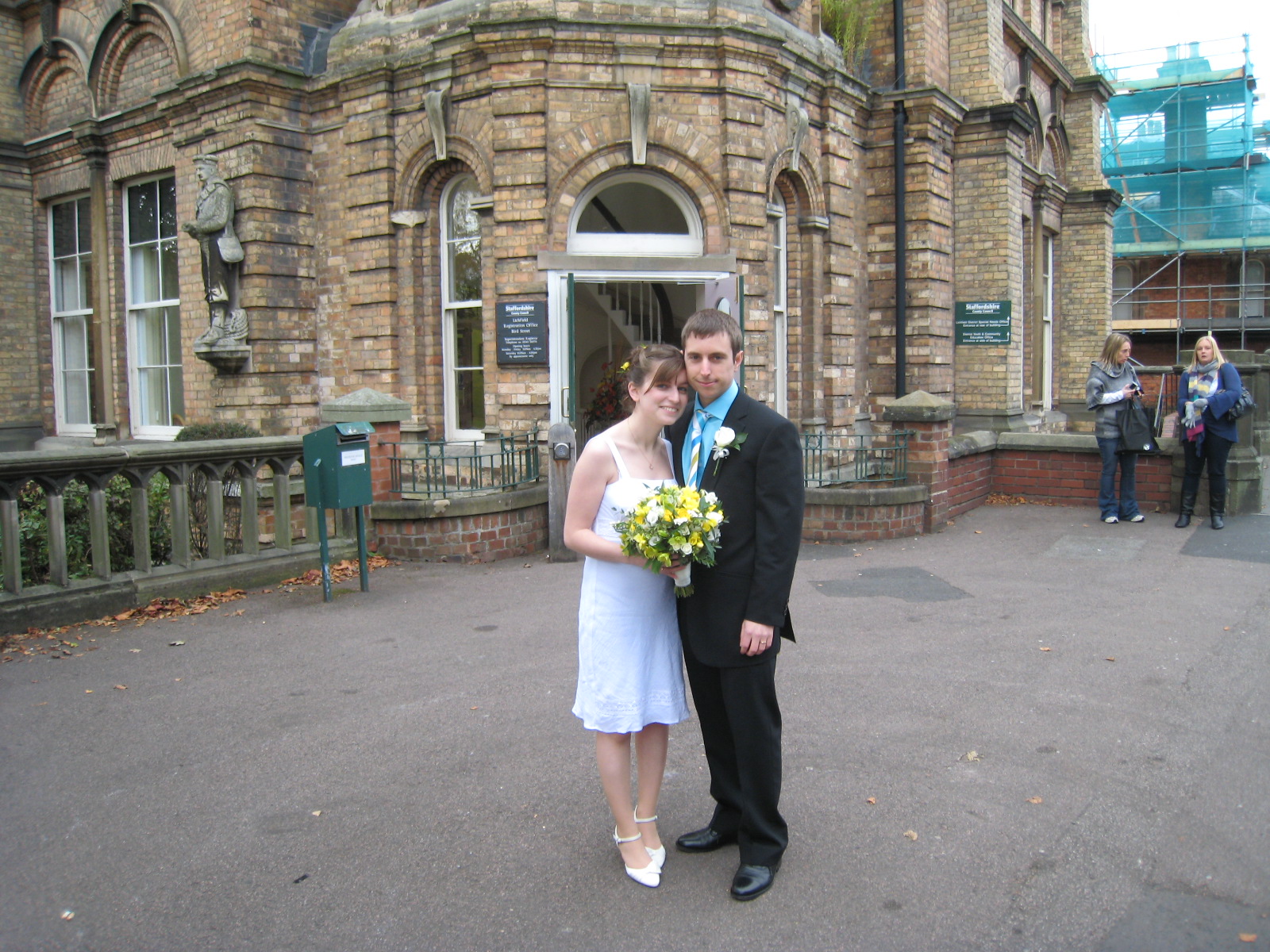
Well, I haven’t been reading at all, but thought I would thank everyone for their congratulations and show just one of the pictures; we mostly left the pictures to the photographer, but we don’t get those for a while, so here’s one of our own, even if my bangs are in my face:
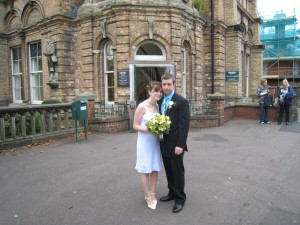
The day was just perfect. Everything was on time and exactly how I wanted; we are still astonished! We’ve been extremely busy since my parents arrived on Thursday and expect to be until Tuesday when they go home; I have a few reviews left, but will be working hard to catch up afterwards. I haven’t read a word in a few days, but I’m sure I’ll be back to it soon and then my blog will resume its bookish nature. I hope everyone has a great week!
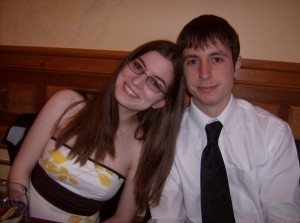 Years of distance, all worth it in the end. We knew it from the beginning! Years of distance, all worth it in the end. We knew it from the beginning!
 This is book four in the Sookie Stackhouse series and this review may contain spoilers for the first three books. For the first book in the series, see my review of Dead Until Dark. I’m reading this as part of the Sookie Stackhouse challenge hosted by Beth Fish Reads. This is book four in the Sookie Stackhouse series and this review may contain spoilers for the first three books. For the first book in the series, see my review of Dead Until Dark. I’m reading this as part of the Sookie Stackhouse challenge hosted by Beth Fish Reads.
After the disastrous events in Club Dead, it looks like Bill and Sookie’s relationship is officially over. Bill heads on a trip to Peru while Sookie remains in Bon Temps, making a New Year’s resolution not to get beat up again. Life doesn’t return to normal, however, because on the way home from work Sookie spots Eric running around naked. When she gets him in her car, she realizes that he has amnesia and has no idea who he is. Not only does this new, sweeter Eric fluster Sookie, but she learns that there is a were-witch coven at work who cast this spell on him. Worse, the coven is extremely dangerous. It looks like Sookie may not keep her New Year’s resolution after all.
Like nearly everyone else who has been reading these books, I have been crossing my fingers for Eric and Sookie to get together. His sex appeal just oozes off the page, and here he’s sweet, old-fashioned, and totally perplexed in addition to ridiculously sexy. How can this go wrong?
Well, after reading this book, I’m glad that the reviews for the next one promise no romance. Poor Sookie’s heart has been totally put through a wringer. Between Bill and Eric, I feel sorry for her! There is also Alcide, who I wouldn’t mind having a little more screen time. It doesn’t help that her brother goes missing and she is once again stuck helping to save everyone, even though she’s not actually anything paranormal herself. It just never ends. Although if it did end, there wouldn’t be much of a series! I also was very intrigued by the nearby town that Sookie discovers and its residents. I didn’t see that coming at all, but it’s an interesting twist and I hope they stick around to wreak a little bit more havoc.
Anyway, this isn’t much a review, it’s more a random collection of various thoughts which have popped into my head. Regardless, I am really enjoying this series! My new library has all the rest of the series and I couldn’t be happier. Expect more reviews soon! In the meantime, Dead to the World is another great addition to this series, which I am definitely thrilled I started.
 When’s the last time you weeded out your library? Do you regularly keep it pared down to your reading essentials? Or does it blossom into something out of control the minute you turn your back, like a garden after a Spring rain? When’s the last time you weeded out your library? Do you regularly keep it pared down to your reading essentials? Or does it blossom into something out of control the minute you turn your back, like a garden after a Spring rain?
Or do you simply not get rid of books? At all? (This would have described me for most of my life, by the way.)
And–when you DO weed out books from your collection (assuming that you do) …what do you do with them? Throw them away (gasp)? Donate them to a charity or used bookstore? SELL them to a used bookstore? Trade them on Paperback Book Swap or some other exchange program?
I have only just started with attempts to weed out my library. On reflection, if I don’t think I’m going to reread it, I am not sure I want it any more. I have so many books I want to read and so many that I want to read again. Why keep the ones that aren’t calling to me? I do have trouble giving up books that I paid for, though, especially full price. If I got it from a used bookstore or charity shop and it was very cheap, I generally don’t mind turning around and giving it back if I didn’t like it. I plan on doing more giveaways for this once I’m employed, especially with ARCs and review copies. There is also the ever-important issue of space and the fact that I don’t have all my books with me ever. They’re spread in two locations for now. While I’d like to bring all my books together, it’s not going to happen for a good few years. I’m sure that when it does I will have a lot to reconsider.
 When her grandfather dies and Lily Balfour hears gossip at how far her family has fallen, she begins to despair. She, her mother, her aunt, and her slightly strange cousin Pamela live in a dilapidated Tudor mansion, poor as dirt since her father died in India when she was a little girl. Some say the Balfour clan is cursed. Lily throws off that idea and decides to head to London to find a rich husband before it’s too late. In London she comes across Major Derek Knight, a war veteran from India waiting for money from his men and taking the opportunity to seduce as many women as possible while he’s there. Lily has already found a willing mate, a rich but slightly stupid man willing to infuse his low class status with Lily’s blue blood. She is irresistably attracted to Derek but must put him out of her mind for the sake of her family, at least until Derek suspects her husband-to-be of corruption. Exposing that plot will put both of them in danger of losing their lives and perhaps their hearts as well. When her grandfather dies and Lily Balfour hears gossip at how far her family has fallen, she begins to despair. She, her mother, her aunt, and her slightly strange cousin Pamela live in a dilapidated Tudor mansion, poor as dirt since her father died in India when she was a little girl. Some say the Balfour clan is cursed. Lily throws off that idea and decides to head to London to find a rich husband before it’s too late. In London she comes across Major Derek Knight, a war veteran from India waiting for money from his men and taking the opportunity to seduce as many women as possible while he’s there. Lily has already found a willing mate, a rich but slightly stupid man willing to infuse his low class status with Lily’s blue blood. She is irresistably attracted to Derek but must put him out of her mind for the sake of her family, at least until Derek suspects her husband-to-be of corruption. Exposing that plot will put both of them in danger of losing their lives and perhaps their hearts as well.
Oh, Gaelen Foley. I loved your books so much when I was young. Where has the spark gone, I ask? It must be true that The Spice Trilogy, of which this is the second book, is not up to your usual standards, because while I enjoyed this book, it was lacking the magic. The magic that makes me fall in love with your characters and want to read your books again and again.
I’m not sure where this went wrong. I certainly felt the sparks between the main characters and I did think they comported themselves well in their budding relationship. I loved that Lily’s cousin Pamela wrote novels and that her mother disapproved; I loved the idea of the collapsing Tudor mansion. I think my problem with this novel was the two main characters. Even though Lily is poor, she is still a fairly typical romance novel heroine. Gorgeous, submissive, the usual. She has a secret, but it’s not original or interesting, and doesn’t matter at all when she confesses it to the hero. Derek is big, manly, obsessed with war, the usual. He’s the reformed rake and while I love reformed rake stories, this one wasn’t working for me, possibly because despite the gorgeous women on his arm and in his bed, he never changes much. Their love story didn’t sweep me away.
As I said, this one’s lacking the magic. I loved Gaelen Foley because her romances always seemed a little darker than normal. One of the earlier ones had a rape scene, one featured a female bandit, and so on. This one is just a little ordinary. I think its only redeeming feature is the fact that Lily’s betrothed isn’t actually a bad man, just a desperate one. He was fairly interesting, but not enough to save this one from the “average” shelf. I enjoyed it, but it’s not converting anyone to the genre.
For a truly charming story of poor girl needs to marry rich man, go with How to Marry a Marquis by Julia Quinn.
Available via IndieBound, Powell’s, Amazon, and Amazon UK.
 In Katsa’s world, people with Graces, or extraordinary skills, are feared and sometimes exploited. They are distinguished by their dual colored eyes. Unfortunately for Katsa, she has a killing Grace, and has been used by her uncle to do his bidding since she was eight years old and accidentally murdered a man with her bare hands. When Katsa seeks to rescue the father of the King of Liend, she stumbles upon a mystery and on Po, a man who can fight almost as well as she. Katsa decides to defy her uncle the king and set off to solve the mystery, the curious Po at her side. In Katsa’s world, people with Graces, or extraordinary skills, are feared and sometimes exploited. They are distinguished by their dual colored eyes. Unfortunately for Katsa, she has a killing Grace, and has been used by her uncle to do his bidding since she was eight years old and accidentally murdered a man with her bare hands. When Katsa seeks to rescue the father of the King of Liend, she stumbles upon a mystery and on Po, a man who can fight almost as well as she. Katsa decides to defy her uncle the king and set off to solve the mystery, the curious Po at her side.
I love fairy tales, especially fairy tales expanded into novels. While this is a completely new story, it feels very much like a fairy tale. It is a once upon a time fantasy with a darker edge in that Katsa’s Grace is so violent. The closest I can compare it to in style is Robin McKinley, who I recently discovered and loved. Thus it’s not at all a surprise that I really enjoyed this book too.
For Katsa, this is completely a coming-of-age story. She is disgusted with herself, with her uncle, and with the world. She knows so little about both her Grace and the wider world, though, that even as a teenager she essentially goes on a journey of self-discovery. She realizes how much she herself is a product of the kingdom in which she grew up and takes steps to become a strong, confident woman. Add in a little bit of budding, confusing romance and Cashore has the perfect combination for a teenage girl. Although I enjoyed the adventure that Katsa went on, I appreciated her believable and steady character growth much more.
Cashore’s pseudo-medieval world is also very well considered. The kingdoms that we see are distinct and interesting, especially Po’s, and the idea of Graces is beautifully developed. It’s fascinating that even people with Graces shy away from others who have them, because no one knows what particular skill might be lurking behind blue and brown eyes. Everything feels organic and natural and it’s very easy to lose yourself in this world.
Graceling is a compelling fantasy set in a fairy tale medieval world. Katsa is one of the best female characters I’ve come across in YA, with strengths and vulnerabilities in equal measure, and her adventure had me spellbound. Well worth a read for both young and regular adults.
 On the Prowl is an anthology of novellas by four urban fantasy/paranormal romance writers, so I’m just going to treat each story separately. On the Prowl is an anthology of novellas by four urban fantasy/paranormal romance writers, so I’m just going to treat each story separately.
Alpha and Omega, Patricia Briggs
I adore the Mercy Thompson series, so moving on to the Alpha and Omega series was practically a given for me. This short story was surprisingly more substantial than just a teaser. Anna thinks that she’s the most submissive wolf in her pack; turned without a choice, she is threatened frequently by other pack members and has been subject to gang rapes and other such cruelty. When she sees a man missing on the news and realizes that her pack leader has not only turned but sold him, she finally calls the Marrok, the leader of all the werewolves, and he sends his son Charles to investigate. The connection between Charles and Anna’s wolves is immediate and he helps her to realize she’s not worthless after all. I liked the relationship between them and the fact that they don’t exactly act on their animal impulses. Restraint is something that doesn’t happen very often in this type of novel and I love that Briggs’s characters are always building their actual relationships, not just hopping into bed with one another because they want to. I feel that this is a delicate handling of Anna’s horrible situation and I liked the resolution of this story. I’m looking forward to reading the next two in the series but I do think that I could have stopped here satisfied at how it stands alone.
Inhuman, Eileen Wilks
This story reads much more like a teaser for a series. Kai Michalski is a physical therapist who also believes she’s a telepath. She’s friends with Nathan, a police officer who isn’t exactly human. When suspicious deaths begin to occur, Kai is immediately blamed thanks to prejudice against magical people from politicians and because another creature has taken her form, fooling credulous officials. While all her affairs on earth are cleared up, thanks to a handy deus ex machina that Nathan can summon at will, the story ends in a massive “buy my book if you want to know what happens now”. It’s a shame because I did like this one, although somehow it managed to feel too long, perhaps because it is all background and not really a story on its own. I might be interested in reading the Lupi series, of which this is a part, but I am not in a rush to do so.
Buying Trouble, Karen Chance
This was my second favorite story in the anthology. Claire has the ability to calm magic around her, so she’s been hired at an auction house to prevent the magical devices going wrong until the duped customers can get them home. One night, however, she discovers that she herself is on auction because of her skills; she can be killed and her abilities drained to make a bomb. Lucky for her, she is rescued by a Fey, Heidar, who realizes that there is even more to Claire than she herself suspected, not to mention a reason for her pesky attraction to all Faery men. This story alone was actually very funny at times and I really liked the main characters, Claire and Heidar. It struck a good balance between action, humor, and romance, and it was a great self-contained short story, not an ad for a book like the other three are. After reading this story I put a request in at my library for another of Karen Chance’s books.
Mona Lisa Betwining, Sunny
This was my least favorite story in the anthology. Basically, it felt like an infodump with lots of sex attached. Mona Lisa is a new Monere Queen, but she’s special because she’s half-human. In this story, she’s called to account for the death of another Monere Queen, who was part demon, and she laments the death of one of her lovers. She also makes an unpleasant discovery about herself. A lot of the story consists of recounting what happened before to get to this point. In the meantime, she has sex with two different men and one of the scenes made me very uncomfortable. The story is only 60 pages long, so at least it went by quickly, but I probably would have skipped this one if I’d known. I went on Sunny’s website and it turns out that her books are mainly paranormal erotic romance, which I really don’t like, so that explains my reaction to this. Her novels have won a number of awards so I’m assuming they have more actual plot and less recapping, but I don’t intend to try them.
If you have this hanging around, I’d recommend it for the Read-a-thon, which is coming up soon!
 For today’s guest post, I’ve asked Amelia Grey to share with us how she manages to build the relationship between her hero and heroine. I hope you find her answer as interesting as I do. Stay tuned for giveaway info at the end of the post! For today’s guest post, I’ve asked Amelia Grey to share with us how she manages to build the relationship between her hero and heroine. I hope you find her answer as interesting as I do. Stay tuned for giveaway info at the end of the post!
Every writer has a different way to develop the relationship between the hero and heroine. Some plan out the development from start to finish and they know exactly everything that will happen between them before they write the first word of the book. Others allow the relationship to grow spontaneously from the start and never write a word of synopsis or plan any of the story in advance. When I think about this concerning my books, I realize that most of the time I actually do a little of both.
I always start by writing a master plan, which is actually my synopsis, and the development of the romance is a big part of that. Writing a synopsis allows me the time to think through the major events in the hero and heroine’s relationship. To me those major events are the meeting, the first love scene, the break up, and then the makeup. Everything that comes between the meeting and the makeup is what I like to call the courtship.
To me the courtship of the relationship is the part that is spontaneous as I write. That is what I allow to grow and develop as I write the story, and sometimes, I’m astounded at what comes up during the courtship. Let me give you an example from my current book A Marquis To Marry, which is the second book in The Rogues’ Dynasty Series.
First I’ll give you a short, word-for-word excerpt from the original synopsis that I sent to my editor. This will show you how from the beginning how I set up what I call the major events to love story.
The meeting: But then the duchess shows up at his door. She’s not old and she’s not ugly. Susannah Brookfield is Race’s age. She’s beautiful, enchanting and has the most tempting lips he’s ever seen. With her intelligence and wit she intrigues him as no other woman ever has.
Susannah doesn’t care how fast her heart beats when she encounters the Marquis. She can’t allow him to intimidate her with his commanding words or enthrall her with his chiseled good looks and charming smile.
The love scene: Race and Susannah meet again at a party, and Race asks Susannah to dance. The minute their hands touch he knows he wants her in his bed. And he has no doubts he’ll get her there. He senses she is as drawn to him as he is to her, and being a widow she has the freedom to accept him as a lover.
Even though Susannah believes Race is trying to trick her into giving up her claim on the pearls by charming her into his bed, she finds his kisses too persuasive to resist. She surrenders to his skilled seduction and they become lovers.
The break-up: But later, things take a decided turn for the worse when Race discovers the ropes of pearls have been stolen from his home. He automatically assumes Susannah had someone steal them while he was at her house making love to her. With distrust between them, separately they search for the pearls.
The makeup: Race and Susannah’s attraction to each other is maddening and irresistible. Before too long they end up back in each other’s arms.
All of the above was written before I wrote the first sentence of the book. But that gave me a fairly good outline of where in the book I needed the major scenes of the loves story. I had no idea what would happen during what I call the courtship. That is where I let the characters take over and show me what they want to do and say to build their relationship.
When I started writing A Marquis To Marry, I had no idea that in the beginning Race and Susannah would be competitive with each other, but they are. I had no idea that throughout the book Race was going to write Susannah short, informal notes that makes her heart pound with excitement every time she gets one. I had no idea that Race would have to cut a hole through a seven-foot high and three-foot wide hedge to get to Susannah’s house, or that they would attend a boxing match together. I hadn’t planned out any of the little things that would make their relationship grow and thrive.
So now that I’ve shown you how I develop the relationship between the hero and heroine, why don’t you tell me if, when reading a book you can tell what is planned from the beginning, developed spontaneously, or do you think all authors are like me and do a little of both?
A Marquis to Marry, Book Two in the Rogues’ Dynasty Trilogy, In Stores October 2009
Alexander Mitchell Raceworth, the dashing fourth Marquis of Raceworth, is shocked when the alluring young Duchess of Brookfield accuses him of stealing pricelesspearls belonging to her family. Susannah Brookfield is the most beautiful, enchanting woman he has ever met, but despite his attraction, he’s not about to hand over the pearls.
Though suspicion and mistrust drive them apart when the pearls are stolen, Race suggests they pool their resources to recover them. If they do find them, will they finally be able to give in to love, or will the truth of the elusive necklace tear them apart once and for all?
About the Author
Amelia Grey’s awards include the Booksellers Best and the Aspen Gold, and as Gloria Dale Skinner, the coveted Romantic Times Award for Love and Laughter and the prestigious Maggie Award. Her books have been featured in Doubleday and Rhapsody Book Clubs. Happily married for twenty-five years, she lives in Panama City Beach, Florida.
Giveaway Info
Sourcebooks is sponsoring a giveaway for one reader to win a set of Amelia’s current romances in this trilogy, A Duke to Die For (which I reviewed here) and A Marquis to Marry. To enter, leave a comment on this post with an answer to Amelia’s question above before midnight on Monday October 26th. US and Canada only. Good luck! The winner of this contest according to random.org is commenter number twelve, Anita Yancey.
 At first, Mamah Cheney knew Frank Lloyd Wright as the brilliant architect who was going to design her new house. While he did, they developed a close friendship, but on realizing their bounds, stepped away from each other purposely. It didn’t last long and soon they fell headlong into an affair that shocked both their families and the world. Both Mamah and Frank struggle to find their identities in the face of a hostile world and their own love. At first, Mamah Cheney knew Frank Lloyd Wright as the brilliant architect who was going to design her new house. While he did, they developed a close friendship, but on realizing their bounds, stepped away from each other purposely. It didn’t last long and soon they fell headlong into an affair that shocked both their families and the world. Both Mamah and Frank struggle to find their identities in the face of a hostile world and their own love.
I thought I was going to enjoy this far more than I did and to be honest it was a disappointing work that didn’t meet its full potential. The idea of humanizing and developing the love story between one of America’s greatest architects and his mistress, who appears to have been more or less reviled at the time, is at first a great one, and the book starts out promisingly. The characters struggle with the damage they’ve done to their families and themselves in the name of a “free love” which no one can understand but them.
By the time Frank and Mamah start to explore Europe, though, they had lost me. For one thing, Mamah is not a very sympathetic character. She places the discovery of the meaning of her life before her children and before Frank and it’s difficult to agree with her choice when it involves merely translating another woman’s works. Did she really have to seek out solitude and hurt everyone she loved for something that she could have done in their presence? Moreover, I didn’t like the philosophies that Ellen Key espoused and to be honest, didn’t like Ellen herself, and wished Mamah had the fortitude to write herself rather than give a voice to someone else. These are doubts that she herself struggles with, and even that bothered me to an extent. Much of this book is wrapped up in Mamah’s thoughts, regretting what she’d done and who she’d hurt, yet largely failing to right any wrongs she thought she had committed.
Frank isn’t much better, as he is brilliant but something of a wastrel, spending money on extravagances, going to faraway places, and even at times pushing Mamah into his ideal vision. This is a book with characters so flawed that they got on my nerves, and while that may be realistic, it does mean I had trouble going back to the book and concluded my dislike for it. It didn’t help that I hated the ending. Honestly, this is a true story, so I feel like it’s wrong to say that, because it would also have irked me if Nancy Horan had made up something else.
In the end, I didn’t like the characters, didn’t like where the story wound up, and didn’t like the philosophical dilemmas in between. Loving Frank was not a book for me.
|
|





Recent Comments