|
|
 When the Roman empire withdraws its troops from Britain, they leave a land in chaos. Vortigern, a name meaning “proud tyrant”, seizes control of the land from Uthr Pendragon, who is banished to Brittany. When Uthr returns, he is killed in battle, leaving his son Arthur as heir to the throne of Britain. Previously, Arthur had imagined himself as an insignificant bastard, but learning that he is Uthr’s son gives a whole new dimension to his dreams. Newly included in those dreams is Gwenhwyfar, the young daughter of his father’s ally Cunedda. Gwenhyfar pledges herself to him when he accepts the throne as heir. Winning Britain back is destined to be an uphill battle, but Arthur shows strength, tenacity, and smarts in his attempts to educate himself and get his legacy back. When the Roman empire withdraws its troops from Britain, they leave a land in chaos. Vortigern, a name meaning “proud tyrant”, seizes control of the land from Uthr Pendragon, who is banished to Brittany. When Uthr returns, he is killed in battle, leaving his son Arthur as heir to the throne of Britain. Previously, Arthur had imagined himself as an insignificant bastard, but learning that he is Uthr’s son gives a whole new dimension to his dreams. Newly included in those dreams is Gwenhwyfar, the young daughter of his father’s ally Cunedda. Gwenhyfar pledges herself to him when he accepts the throne as heir. Winning Britain back is destined to be an uphill battle, but Arthur shows strength, tenacity, and smarts in his attempts to educate himself and get his legacy back.
Helen Hollick has made it pretty clear that she’s thrown out the Arthurian legends and attempted to re-imagine this as it really would have been, using the original Welsh poems. I think that’s awesome. Don’t get me wrong, I love Arthurian literature, but it’s not actually ever historical fiction, it’s just a literary tradition. I think it’s neat to put Arthur in a rougher context, and since there are so few sources relating to this period, the author has free reign and she really uses it to her advantage.
I liked this story. It feels huge. The book is long and many, many events occur within its pages, but it felt like an epic and I love epics. It’s a great mix between battles and more intimate goals and dealings of the heart. Tons of scheming goes on and I think Hollick gets across the nature of the changeable early middle ages especially well. I loved that some of the Britons thought that the Romans were coming back especially. They must have thought that given that the Romans had been ruling in Britain for hundreds of years. Who was to guess that the abandonment would have been so complete? The mixture between Christianity and paganism was interesting. Christianity didn’t “arrive” in Britain for several hundred years after this, but I’m sure there must have been devotees left from the Roman occupation. Overall, I think the stage is set very well for this sort of story. No one quite knows what to do, but they know they want power, and they’re all fighting for it.
When you throw Arthur and Gwenhwyfar into the mix with real figures from history, however shadowy, it makes for a fantastic story like this one. Both the protagonists go through a lot just to be together and their dominance is hard-won. I love the interpretation of Arthur as a tough guy, not a gentle chivalric knight who turns the other way when his wife starts cuckolding him (there is no Lancelot here, fyi, if you’re looking for him). He fights for what he wants, I’m sure this Arthur would have had Lancelot’s head rotting on a stick. And as for Gwenhwyfar, she is a powerful and inspiring woman in her own right here who grows from a lovely tomboy into a woman who isn’t afraid to defend herself and her family. They both have their moments of weakness, but it makes those moments of strength even stronger.
I do recommend this. It’s a fascinating re-imagining of Early Medieval Britain and gives the Arthurian legend a boost. If you enjoy historical fiction, I think you should read this. I for one am looking forward to the next two installments of the trilogy.
The Kingmaking comes out on March 1st. Preorder it on Amazon. on Amazon.
(As an addendum, I would just like to say that I don’t believe King Arthur actually existed – if he did, he wasn’t a king – and thus historical fiction written about him is free from all accuracy requirements I normally apply to historical figures. I can just enjoy it as a good book like this one!)
If you want to hear more opinions and read more interviews and guest posts from Helen, check out these other blogs throughout this week and next:
Harriet Devine’s Blog
Lazy Habits of Thinking interview 2/27
Carpe Libris Reviews
Historical Novels Book Reviews
Bibliophile Musings
Lilly’s Reading Extravanganza guest blog 2/25
Books Are My Only Friends 2/25
Peeking Between the Pages 2/26 and guest blog 2/27
We Be Reading 2/26
A Hoyden’s Look at Literature 2/26
Books Thoughts by Lisa 3/1
S. Krishna’s Books 3/1
Jennifer’s Random Musings 3/1
RhiReading 3/1
Passages to the Past 3/2
The Tome Traveller 3/2
Medieval History, Historical Fiction, Fantasy, Writing Fiction 3/2
Savvy Verse and Wit 3/2 and interview 3/3
A Striped Armchair 3/3
Carla Nayland’s Blog 3/3
A Reader’s Respite 3/3 and interview on 3/5
Library Queue 3/4
The Bookworm 3/4
My Friend Amy 3/5
Sam’s Book Blog 3/5
Good Books, Bright Side 3/5
So Many Precious Books, So Little Time 3/6
Susan’s Art and Words 3/6
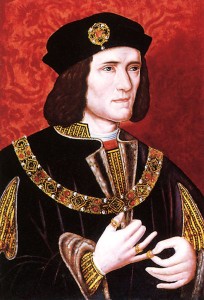 I know I don’t actually talk about medieval history all that much around here, even though I originally wanted to. Instead I’ve settled for attempting to read and review more historical fiction. I have been thinking about one particular question, though, and it’s quite relevant to historical fiction, so I thought I’d give it a whirl and see if anyone was interested. I know I don’t actually talk about medieval history all that much around here, even though I originally wanted to. Instead I’ve settled for attempting to read and review more historical fiction. I have been thinking about one particular question, though, and it’s quite relevant to historical fiction, so I thought I’d give it a whirl and see if anyone was interested.
Why is Richard III so often presented as a chivalric figure in modern historical fiction?
First, what is “chivalric”? Well, success in war (prowess) is easily the most important factor overall. In most historical fiction novels about Richard, he is highly successful in battle except for Bosworth Field. He is regarded as a key figure in his brother Edward’s battle of Barnet and often he’s off fighting the Scots with great success. Fighting the Scots is brilliant for prowess because to Richard, they were foreigners, and killing foreigners was usually second only to killing heathens, especially if they came at you first. I came across the mystifying fact that we’re not even sure how much Richard fought except at Bosworth Field in my research last year. He was there, but we know so little of those battles that he might not have lifted a finger to help his cause. Of course, the fact that he was killed on the battlefield at Bosworth indicates he did think he knew what he was doing, or perhaps it indicates that he had no bloody idea. One never knows.
Secondly, success with ladies is key. This is the fun phenomenon known as courtly love. Lords were expected to flirt with highborn ladies, and usually one lord would pick one lady to carry on about, although it isn’t necessary for him to actually have a proper affair with her and in fact that would be frowned upon. Gazing and loving from afar is the best option unless you are married. Actually, virginity was the best option (like Galahad), but not a very likely one. Loyalty to the one you choose is essential. What do we have in Richard but a man who is always portrayed as deeply in love with one woman? Usually, it’s his wife, Anne Neville, but in A Rose for the Crown he is portrayed as faithful to his one mistress. Again, this is a fun little fact that can’t be verified. He had at least a couple of bastards, so he broke the no sex outside of marriage requirement and there’s no way to verify the identity of their mother or even how many there were. He may well have loved Anne Neville, but history can’t tell us that and instead shows us that she was actually an heiress with rights to half the extensive Neville/Warwick land (and given the part that Richard played in killing her father and uncle and imprisoning her mother, how do we know she would have loved him?). He wasn’t marrying a pauper and Richard was a very, very ambitious man. It’s just oh so convenient that by marrying her he completed his consolidation of the northern Neville hegemony, isn’t it?
Third, piety! Religion is very important. Even though chivalric men were ultimately warriors, they were supposed to view themselves as suffering. Strange as it may sound, they decided that warfare was a kind of martyrdom and thus eases the way into heaven. Don’t ask me, I didn’t come up with it. Richard is often fictionalized as an exceptionally pious man. He probably was to some extent, but all late medieval lords were to some extent. Richard planned for three foundations during his lifetime. I know they didn’t all succeed, but let’s think about this. Richard was a rich man. He had huge swathes of countryside and even if the economy was suffering, he must have had his fair share of disposable income. I must admit that I have not looked into this personally, but it stands to reason that he had plenty to give to his retainers since he was such a successful lord. In addition, he probably had his share of sins to atone for. Think of all the men he ordered killed for the sake of becoming king. He chose his side of the Wars of the Roses, may have (probably) killed a whole bunch of people, and may even have had a say in the death of his brother. In this context, foundations don’t mean he was especially pious. It just meant he had the money and the desire to get himself out of the hole called purgatory with a whole lot of praying.
So those are the three tenants of chivalry, as I have gleaned from numerous sources. Richard didn’t necessarily fill any of them. I just think he’s been targeted by historical novelists as a figure to be redeemed. There is no question that he was villainized by the Tudors and those associated with them, but that doesn’t make him a paragon of nobility. I think it’s fascinating that he’s been interpreted as such and that all of his activities have essentially been removed from their historical context, evaluated, and assigned the purest possible motivations. Of course, it’s entirely possible that he was a heavenly figure who has been getting a bad rap for hundreds of years. I think it’s more likely that he was an extraordinarly powerful, ambitious, clever man – a man who was very, very good at governing, no less – who lived in a difficult time and had to make some very hard choices. I often wish I could write a novel so I could put him in between as a human being, not a villain or a saint.
What do you think? Why do we put Richard on a pedestal? The man might have killed his own nephews, after all, although personally I prefer to believe he didn’t just because I like him. He’s by far the most likely culprit. Any thoughts? Or did you stop reading at paragraph 1? 
 The first child of King Edward IV and Elizabeth Woodville, Elizabeth of York seems destined for greatness. She is the apple of her father’s eye, betrothed to the heir to the French throne, and loved by the people. When her father dies too young and Richard III takes the throne over her brother Edward, Elizabeth’s mother rushes the family into sanctuary. Increasingly, the family hears horrible things about Richard and fears for the worst. One night, however, Richard himself visits the sanctuary and everything changes. As history inexorably moves forward, changing lives all over England, Elizabeth well earns her reputation as selfless, generous, and noble. The first child of King Edward IV and Elizabeth Woodville, Elizabeth of York seems destined for greatness. She is the apple of her father’s eye, betrothed to the heir to the French throne, and loved by the people. When her father dies too young and Richard III takes the throne over her brother Edward, Elizabeth’s mother rushes the family into sanctuary. Increasingly, the family hears horrible things about Richard and fears for the worst. One night, however, Richard himself visits the sanctuary and everything changes. As history inexorably moves forward, changing lives all over England, Elizabeth well earns her reputation as selfless, generous, and noble.
I’m not sure how to review this book. Let me say first that I really enjoyed it and give you my historian’s opinion. Sandra Worth never goes outside of the facts; she fills in between the lines. With Elizabeth of York, there is quite a bit to fill in; she is so little known. In some ways, I’d call this a very romantic interpretation of the history, but I think that’s why many of us read historical fiction. I simply know too much about Richard III. Worth has definitely done her research, and I really appreciated her selected bibliography at the end, but I’m wondering why she didn’t include more of the modern histories on Edward IV and Richard III. Personally, I loved the idea that Perkin Warbeck was actually the younger of the two princes in the tower. So little has been done on that possibility and it’s an exciting question, if one we’ll never know the answer to. I too wonder why the bones found in the Tower haven’t been exhumed and analyzed in recent years. If they are the princes, then these questions would be conclusively answered.
Okay, now, as a book, how did it hold up? Well, I really liked it. I loved Elizabeth. She’s a great, strong, sympathetic character throughout. I knew what was going to happen, so I didn’t get caught up in the plot, but I think if I didn’t know the history I would have been. In any case, the book is well-written and easy to lose yourself in for a while. Something else I really liked was how well the author depicted the changes between the Plantagenet kings and the Tudors and the shift into the early modern period, which for me is marked by the growth in the king’s power and the lessening of the nobles’ power.
Overall, this is solid, entertaining historical fiction and I definitely recommend it.
Buy The King’s Daughter on Amazon. on Amazon.
 I think many of us who read a lot of historical fiction hear about Elizabeth Chadwick. Her books are not available to Americans except through imports, which is a shame, and quite strange considering how popular historical fiction is these days. Anyway, usually the one we hear about most is The Greatest Knight, the fictionalized life story of William the Marshal, one of medieval England’s most fascinating knights. I saw it at the library and just couldn’t resist despite my staggering TBR piles. I think many of us who read a lot of historical fiction hear about Elizabeth Chadwick. Her books are not available to Americans except through imports, which is a shame, and quite strange considering how popular historical fiction is these days. Anyway, usually the one we hear about most is The Greatest Knight, the fictionalized life story of William the Marshal, one of medieval England’s most fascinating knights. I saw it at the library and just couldn’t resist despite my staggering TBR piles.
As a small child held hostage by King Stephen, William nearly loses his life when his father breaks his agreement with the king and switches allegiances. After all, William is only his fourth son. Stephen, not a strong king nor a hard man, chooses not to kill William and lets him go, but impresses on him the importance of loyalty and honor. At first, an adult William struggles to make himself known, but his extraordinary talent and aforementioned loyalty speak for him and he earns a place in the Plantagenet household, eventually training and serving Henry the Young King, eldest surviving son of Henry II and Eleanor of Aquitaine. As his star rises, William’s life and fortunes are shaped by this most powerful family.
William the Marshal is a fascinating historical character and I think Elizabeth Chadwick has done him justice here. He certainly stuck with his loyalties in an age where many men switched allegiance to suit themselves; his father is a very good example, as are the sons of Henry II. As such, William truly stands out from the crowd, and he lived an extraordinary life in the shadow of five kings. As a result, in most places Chadwick doesn’t need to embellish the history, it’s a great tale as the chroniclers tell it. So for the most part, she sticks to it. She adds mainly a mistress, as we can assume that most well off knights had mistresses, and some story continuity, which works fairly well. You can still tell a little bit that she got her start in romance when William develops love interests, but this book is clearly beyond that and stands as a really good work of historical fiction. It isn’t the best I’ve ever read, but it is a worthy read.
I’m definitely looking forward to reading the sequel, The Scarlet Lion, which I conveniently enough have on my bookshelf. I would recommend this to other historical fiction lovers, it is a very solid and compelling work. Buy it on Amazon UK.
 Azincourt is the French spelling of Agincourt, known widely as a shocking loss for the French against the English in the Hundred Years’ War. Bernard Cornwell imagines the lead-up to the battle here focusing again on an archer, Nicholas Hook, who serves as our lens looking in on the wider struggle, ending with the monumental battle itself. We all know the ending, but Cornwell still manages to make it suspenseful as we never know who will live and who will die. Azincourt is the French spelling of Agincourt, known widely as a shocking loss for the French against the English in the Hundred Years’ War. Bernard Cornwell imagines the lead-up to the battle here focusing again on an archer, Nicholas Hook, who serves as our lens looking in on the wider struggle, ending with the monumental battle itself. We all know the ending, but Cornwell still manages to make it suspenseful as we never know who will live and who will die.
As usual, the battles are the best thing about Cornwell’s writing. He makes us feel like we’re there, or at least that we could have been there in a past life. He underscores the extraordinary importance of archers with their longbows, the single greatest advantage that the English had against the French here and during many other battles in this lengthy on-and-off war. I should also mention that the priests are corrupt and the good one is not as religious as you’d expect a priest to be, so another warning for those of us who are devout Christians and prefer not to have their reading slander their religion unfairly.
Cornwell’s third person narration is a bit different from his first person fare, most of what I’ve been reading lately. It feels colder and it’s much harder to get into the characters’ heads. As such, Hook and Melisande remain very distant from the reader throughout the novel. Hook is a bit humbler than Cornwell’s normal male heroes, but of course he is still the best. In all, this feels very much like the Grail Quest trilogy, and as I believe Hook is related to Thomas of Hookton, that’s not entirely a surprise. Still, I think I prefer his first person narrators, arrogant and similar as they all are. The books feel more human with a fully fleshed out narrator.
I enjoyed it, but I’d definitely recommend his Arthurian trilogy or Saxon Chronicles first. I feel this one may only be for fans of Cornwell or those of us who like to read about the more violent side of the Middle Ages. Pre-order this book on Amazon.
 *If you don’t know the history, this review does contain spoilers* *If you don’t know the history, this review does contain spoilers*
Henry II and Eleanor of Aquitaine lead a very hectic life. Between them, they control England and most of France, and in an age of very slow travel, they struggle in many ways, particularly where their children are concerned. Nearly everyone knows of the chaos that these four sons wreaked on the Angevin Empire; they embroiled it in warfare, usually against their father, and wound up losing much of it to the French king, Philip Augustus. In Devil’s Brood, Sharon Kay Penman elucidates the very human struggle of sons against father, husband against wife, and country against country as all control slips out of Henry II’s fingers, bit by bit.
I unequivocally love Sharon Kay Penman. She is the origin of my over-the-top love for everything Richard III and I have eagerly consumed all of her previous historical novels. This book is no exception. Her previous work in this trilogy, Time and Chance, was probably her weakest effort, but I still loved it, and I loved this one more. She allows us to immerse ourselves in a world that is distinctly not our own, but allows us to relate to historical characters that, after all, were just people.
The book does, at times, move slowly. At its length, that is virtually a given. On the other hand, though, this isn’t an action oriented tale. It’s about the people involved as Penman fleshes out historical personas and makes us feel for them as if they’d walked out of the page and into our lives. The struggle between Henry II and his sons could happen to anyone; how many of us know fathers (or mothers) who are hard-headed, children who are determined to rebel and can’t see where they are wrong? What happens when you place that child on the world’s stage with resources at his disposal? English history happens as sons turns against their father.
As always, my favorite character is Eleanor of Aquitaine. She’s fascinating in both history and fiction and Penman certainly gives her what I believe is her due. The other characters are also well developed and fascinating, an exercise in what-might-have-been like all medieval historical fiction, but Eleanor steals the show. Some old friends return, including Penman’s rare fully fictional main characters, Ranulf and his wife Rhiannon. Like I said before, this is definitely a book about characters. Wars and rebellions go on constantly, but it’s all about them and their reactions to those events. There are heart-breaking moments and there are joyful moments for these characters and it’s easy to get sucked in and feel how they feel.
It’s not perfect. It does move slowly and Penman has an odd tendency to toss in “certes” and other medieval-esque words that aren’t entirely necessary. In real life, these people were speaking Norman French usually, so it doesn’t work for me. And she does romanticize history, but she never does it in a way that makes it inaccurate; just makes you feel for people you wouldn’t have otherwise liked.
Would I recommend this? Most definitely. Not if you’re looking for a quick read, but if you want to immerse yourself in a terrific historical novel, live and breathe the Middle Ages as best we’re able, you should be looking for Sharon Kay Penman. Buy this book on Amazon.
 Growing up on the streets of medieval Florence, uncommonly handsome Luca Bastardo knows how to survive. His skills come in handy as he goes on to have a lifespan that is absolutely extraordinary, experiencing the transition from medieval to Renaissance Florence; he endures many trials, some harder than others, in his search for his heart’s greatest desire. Growing up on the streets of medieval Florence, uncommonly handsome Luca Bastardo knows how to survive. His skills come in handy as he goes on to have a lifespan that is absolutely extraordinary, experiencing the transition from medieval to Renaissance Florence; he endures many trials, some harder than others, in his search for his heart’s greatest desire.
This is one chunky historical novel. Not only is it fairly long at over 500 pages, but it also covers a fair span of history. Luca experiences the beginning of the Renaissance and is consistently involved with some of Florence’s most famous faces. I did find it a bit of a stretch that a homeless boy would encounter and befriend so many “famous” people, but I rolled with it and enjoyed guessing who he met before we were told.
The story is very engaging. It moves along, skipping many years when necessary, and with such a long lived character, we lost out on the many boring parts of Luca’s life. In general, I liked him, although he did irritate me at times. There is some magic involved; Luca practices alchemy and obviously his lifespan is not that of any normal human being. So we have to suspend our disbelief to enjoy the book, but as a reader of fantasy, I didn’t mind. I try to take historical fiction with a grain of salt and a bit of fantasy tossed in does help that. To my knowledge, however, the actual history is pretty accurate.
In short, I enjoyed this book and I’d recommend it to other readers of historical fiction. Buy this book on Amazon.
Already read Immortal? Want to discuss it? Join The Literate Housewives, an online book club started by Jennifer at The Literate Housewife!
 Much as Uhtred hates Alfred and wishes to fully identify with the Danes who raised him, he finds himself once again drawn into the conflicts on the Saxon side instead of taking his hereditary castle, Bebbanburg, from his scheming uncle. This time, Uhtred must capture London for his cousin, Aethelred, who is marrying Aethelflaed, Alfred’s daughter and Uhtred’s friend. This book is the fourth in the Saxon Tales series, which is ongoing. Much as Uhtred hates Alfred and wishes to fully identify with the Danes who raised him, he finds himself once again drawn into the conflicts on the Saxon side instead of taking his hereditary castle, Bebbanburg, from his scheming uncle. This time, Uhtred must capture London for his cousin, Aethelred, who is marrying Aethelflaed, Alfred’s daughter and Uhtred’s friend. This book is the fourth in the Saxon Tales series, which is ongoing.
As usual, Cornwell delivers on many fronts. His books always provide exciting battle scenes, arrogant and capable main characters, and satisfying friendships and rivalries. Usually, however, Cornwell doesn’t do so well with women. They tend to be on the edges of the story, flat characters who serve as love interests and nothing else, and I’ve heard that this is the worst in the Sharpe series. I was a little worried about this here. Aethelflaed is one of my absolute favorite historical characters. We know very little about her, but we do know that she led men to battle and that she was known as “Lady of the Mercians”, effectively ruling Mercia when her husband Aethelred died. This, to our knowledge, is extremely rare in Anglo-Saxon England, so I was hoping for Cornwell to more fully portray Aethelflaed, perhaps on par with the men Uhtred fights with. She’s not there yet, but she does have a small, defiant, royal place in this series. She is still young in the series timeline, but I am hoping that Cornwell will continue to flesh her out as he writes more books.
This book also strays a bit more from the historical record, as the author’s note tells us, but Cornwell pulls it off and his fictional events seem plausible next to the real battles. He knows what he’s talking about and it’s obvious. His battle scenes are some of the best I’ve ever come across, and he just seems to be getting better; they’re not glorious heroes of war, they are flesh and blood men trying to kill each other just to stay alive. I like this perspective; I think if we thought about wars that way, we might fight less of them. (Wishful thinking?)
I’ll continue to recommend this series and I’ll look forward to the next, although I’ve no idea when it’s coming out. In the meantime, if you’re new to the series, see the first one on Amazon here , or if you want to look at this one, see here , or if you want to look at this one, see here . .
 This is the tale of a golden brooch and how it wreaks havoc on the lives of fourteenth century English and Irish. The brooch is imbued with the spirit of a malevolent Irish queen, but it is highly desired thanks to a clever lie propagated by its fourteenth century discoverer. He claims the brooch was owned by St. Patrick and will bring luck, and though he dies the day after its discovery, no one ever suspects. We watch as the brooch continues to bring disaster everywhere it goes. In the fourteenth century, our main character is John de Bermingham. We accompany him when he is fostered to an Irish family, when he has his first love affair, and throughout many other ordinary and extraordinary events as he struggles to save Ireland from the conquering English. This is the tale of a golden brooch and how it wreaks havoc on the lives of fourteenth century English and Irish. The brooch is imbued with the spirit of a malevolent Irish queen, but it is highly desired thanks to a clever lie propagated by its fourteenth century discoverer. He claims the brooch was owned by St. Patrick and will bring luck, and though he dies the day after its discovery, no one ever suspects. We watch as the brooch continues to bring disaster everywhere it goes. In the fourteenth century, our main character is John de Bermingham. We accompany him when he is fostered to an Irish family, when he has his first love affair, and throughout many other ordinary and extraordinary events as he struggles to save Ireland from the conquering English.
I like Birmingham’s idea, that this period in English and Irish history is so destructive that it allows him to introduce an external force as a frame for a historical novel. It’s a clever device and this is a great story. Birmingham has no trouble with plotting; his novel is a roller coaster powered by history and takes no time to get going. I knew all the history he was introducing except for a few of the Irish segments, but I still found it to be an exciting and at times unpredictable read. His research on the de Bermingham family and the period is evident, and he uses that knowledge to great effect here.
I did have a few issues, however, namely with some of the dialogue. This is a self-published work and though it has had one professional edit, it could use another to reach its full potential. Some of the dialogue could be more effective and realistic, a few commas are missing, and the Latin doesn’t seem to make sense. I didn’t like John very much (though his arrogance is a part of his journey, so it makes sense, and he does repent by the end), but I loved some of the supporting cast – my favorites were Avalena and Deirdra. Both of them are excellent in their own ways.
This is a novel that needs some work, but has a ton of potential and is certainly entertaining. I’ll happily be reading Mr. Birmingham’s next book. Buy this book on Amazon.
I’ve chosen to review these two books as one because it’s become extremely difficult to separate them in my mind. Actually, even separating them from the first book is hard, but I already reviewed that one.
As the Saxons encroach upon British lands, Derfel and Arthur look to Merlin and the gods for help as they devise battle strategies and struggle with the constant feuding of the British lords. An unexpected betrayal leads to unfortunate consequences in this struggle for survival.
I really enjoyed these books. I liked Cornwell’s different take on the Arthurian legend. He uses many of the typical elements, but in interesting and different ways. For example,
(if you’ve read other Arthurian literature, this is not a spoiler, but if you haven’t, stop reading now! Go read some and then come back!)
the affair between Lancelot and Guinevere is handled in a way that I hadn’t expected, and the woman Guinevere reminds me the most of is actually Eleanor of Aquitaine. That may be partly because I’m reading Devil’s Brood by Sharon Kay Penman and Eleanor is in my head right now, but they’re both defiant women who deserve more authority than they are allowed because of their gender. Guinevere is a great character here. It’s easy to both hate her and love her, as Derfel does. Speaking of our narrator, he’s very endearing and I think I like him the best out of the three Cornwell main characters I’ve read about so far. He’s wonderful and his emotions really come out of the page; he’s fully fleshed out and probably too modern, but I love hearing these events through his voice. Arthur is a superb hero while as always a flawed man. Here, it’s easy to care about him, as it should be.
Again, Cornwell excels at what he does: his battles are exciting and intense and the book is at times full of testorone induced warring. Perhaps I’ve got too much because I love to read about these battles. Cornwell makes no effort to stay in line with history since we know so very little, but I think that actually made these books better because they are so full of imagination. These are all legends anyway and it’s hard to follow history when you’re not even sure Arthur existed or that these battles actually happened. His plots race along and these books never slow down. I love the twists in the traditional characters. It felt like I was reading something new that I could connect with stories more than a thousand years old.
In my opinion, this series is brilliantly done. If you like historical fiction, Arthurian legend, or just a great tale, this trilogy is for you. Give the first book 100 pages and you won’t look back. I never did. Buy The Winter King , Enemy of God , Enemy of God , or Excalibur , or Excalibur on Amazon. on Amazon.
|
|



Recent Comments