|
|
 As a poor urchin, Luciano steals food and crams it down his throat as fast as he possibly can. At least, he does so before he is abruptly adopted off the street by an illustrious chef and hired as an apprentice. There he learns to savor food, to appreciate the process of cooking, and in the process gets an inside view into much of Renaissance Venice’s politics. For the entire city is ablaze with rumors of an ancient book that holds the secrets to immortality, love, and gold. When Luciano witnesses a murder in the doge’s dining room, he begins to reconsider his position in life and whether those around him know the answers to the questions asked by so many of the city’s most important residents. As a poor urchin, Luciano steals food and crams it down his throat as fast as he possibly can. At least, he does so before he is abruptly adopted off the street by an illustrious chef and hired as an apprentice. There he learns to savor food, to appreciate the process of cooking, and in the process gets an inside view into much of Renaissance Venice’s politics. For the entire city is ablaze with rumors of an ancient book that holds the secrets to immortality, love, and gold. When Luciano witnesses a murder in the doge’s dining room, he begins to reconsider his position in life and whether those around him know the answers to the questions asked by so many of the city’s most important residents.
For me, this book is historical fiction, with a little bit of foodie lit and mystery tossed in. I love the setting of Venice. It lives and breathes in this novel, practically becoming its own character as Luciano runs through the streets, whether it’s to escape from authorities or to visit the woman of his dreams, a novice at the convent named Francesca. The food descriptions are similarly to die for; even the act of eating a grape is examined and detailed and made me really wish I had bought some grapes at the grocery store. Since the chef uses ingredients which no one imagines exist, common things about which we know (and I guessed before Luciano figured out what they were), their effect is given in every detail. In other words, yum.
The intrigue had me spellbound, too. I wasn’t sure what Luciano was going to discover, but I enjoyed his journey there. Certain aspects of the plot, particularly Luciano’s infatuation with Francesca, annoyed me, but never too much. Mostly I’m just impatient and I don’t like my characters to be slow on the uptake. I also really dislike it when characters declare their love when they haven’t ever spoken to each other, but I tried to keep in mind the fact that Luciano is a teenager and most teens suffer from this problem. On reflection, I didn’t actually like Luciano very much, but I thought that the plot and the descriptions held the book together enough for me to enjoy the experience overall. I can’t comment much on historical accuracy because I just don’t know much about 16th century Italy, but Elle Newmark does include a nice author’s note explaining what she changed, which is always appreciated.
Overall, this was certainly an enjoyable book. The Book of Unholy Mischief is recommended to historical fiction fans, especially those who appreciate drool-worthy descriptions of food.
 Just after Puttnum is born, his father, Carl, considers breaking his neck to spare him the disappointments of life. At the same time, he wishes for his son to embody certain masculine ideals and make him proud. When Puttnum is seven, he tries to do exactly that by throwing a rock into a boy’s face at a pool party, putting the boy’s eye out. Instead of pleasing his father, he has horrified Carl, and their relationship proceeds in a similar fashion throughout the novel. Puttnum, going from confused adolescent to angry young man to even more confused adult, wars internally with his desire to wear women’s clothing and his need to prove his masculinity to his father and the world. In this book, Jonathan Scott Fuqua takes a close look at the effect both damaging parents and a psyche outside of the norm can have on the life of a well-intentioned and smart man. Just after Puttnum is born, his father, Carl, considers breaking his neck to spare him the disappointments of life. At the same time, he wishes for his son to embody certain masculine ideals and make him proud. When Puttnum is seven, he tries to do exactly that by throwing a rock into a boy’s face at a pool party, putting the boy’s eye out. Instead of pleasing his father, he has horrified Carl, and their relationship proceeds in a similar fashion throughout the novel. Puttnum, going from confused adolescent to angry young man to even more confused adult, wars internally with his desire to wear women’s clothing and his need to prove his masculinity to his father and the world. In this book, Jonathan Scott Fuqua takes a close look at the effect both damaging parents and a psyche outside of the norm can have on the life of a well-intentioned and smart man.
One thing that I appreciate the most in a novel is a great character that grows and develops throughout the whole work. With In the Wake of the Boatman, I got exactly that, as Puttnum was a wonderful character. This book is driven by his life and very little else, but it didn’t matter, because I was rooting for him and I wanted him to get past his problems. Puttnum is confused, but his confusion is understandable and carefully laid out, developing as he grows. It’s fairly easy to see that his identity problems are wrapped up with his idealization of his sister, a beautiful girl who has never had any problems dealing with either of their parents, but that doesn’t lessen his journey there.
Even though I have always been perfectly content with my gender, I found it easy to relate to Puttnum’s confusion and struggle with identity, because almost everyone is uncertain about who they are at some point in their lives. He chooses to enter the army to prove his masculinity, but he knows the army is not the right place for him. He struggles with where to go afterwards. He spends most of his life not fitting in. All of these are problems that so many face, and Fuqua handles his character and issues in such a way that he is a genuine person, multi-faceted and actually interesting.
The other characters are unhappy, too. Despite feeling emotions and having impulses that would ease his family, Carl is never able to express them. Puttnum’s sister Mary marries a man too similar to her father to ever achieve happiness; despite being Puttnum’s ideal, she has many problems of her own. Puttnum’s mother, while perhaps the most content of the lot, grows tired and grey over the course of the novel. Yet the book itself is not sad, but ends on a sweetly hopeful note, without real resolution but with inspiration for the future of these characters we grow to love. If Puttnum can discover who he is and be happy with it, perhaps the rest of us can, too.
In short, I really enjoyed In the Wake of the Boatman. It’s a thoughtful, moving read that had me engaged from start to finish.
 Casey and Joe have been engaged for years. Seven, to be exact, and Casey just wants to get married. So she tricks Joe into joining her on a TV show, where she will appear in a wedding gown and he is meant to marry her on the spot. Unfortunately, Casey is instead humiliated on national television when Joe refuses to marry her and tells her that he no longer loves her. Adam Carmichael, the owner of the business and Memphis’s most eligible bachelor, steps in to marry her, assuming that the marriage is fake. After the televised ceremony is over, Adam and Casey learn that their marriage is actually legal. As they wait for an annulment, both begin to find comfort in their sham marriage and wonder if perhaps they ought to give it a try after all. Casey and Joe have been engaged for years. Seven, to be exact, and Casey just wants to get married. So she tricks Joe into joining her on a TV show, where she will appear in a wedding gown and he is meant to marry her on the spot. Unfortunately, Casey is instead humiliated on national television when Joe refuses to marry her and tells her that he no longer loves her. Adam Carmichael, the owner of the business and Memphis’s most eligible bachelor, steps in to marry her, assuming that the marriage is fake. After the televised ceremony is over, Adam and Casey learn that their marriage is actually legal. As they wait for an annulment, both begin to find comfort in their sham marriage and wonder if perhaps they ought to give it a try after all.
I’m not really a normal Harlequin reader. I find category romances in general to be too short for real character development; they almost inevitably end up as lust = love. This one is different, maybe because it’s a “Super Romance”, but I found the emphasis was in fact totally on the relationship. Amazingly, I could really feel for Casey and Adam and their unique issues and problems. I wasn’t expecting that from a 268 page mass market paperback, but Abby Gaines must know what she’s doing. I loved watching this couple fall in love and was pleasantly surprised at the playful banter that the couple shares and their alternate attempts to woo each other. There is sexual tension, but the scenes themselves are much more restrained and later in the book than I expected.
Somehow, the author even finds time for brief subplots without making the main story feel rushed. Eloise, Adam’s stepmother, still loves her departed husband and struggles to find compassion for a man who has feelings for her. Casey’s family is ridiculously clingy and each member has to learn to stand on his or her own two feet. Adam has a legal battle on with more distant members of his family for ownership of channel 8. And somehow we still manage to get a full picture of Adam and Casey learning to love each other.
Overall, I may have to revise my opinion on at least this category of romances. I still prefer those with more depth, with an actual storyline in addition to the romance, but I was pleasantly surprised by Married by Mistake. If you’re interested in more, Abby Gaines has a website with news, excerpts, and added scenes for this and her other novels.
Amazon | Amazon UK | IndieBound | Powell’s
 Though born as a child of the Maghuin Dhonn, Moirin has always seen two different gods, the bright lady and the man with a seedling in his hand. As she grew up with her mother in a cave, she had no idea that she was also half D’Angeline and destined for greater things than a life in the wilderness. When Moirin gains adulthood and undergoes the rite to discover whether she is truly one of the Maghuin Dhonn, she realizes that she has a mission and that her diadh-anam is leading her to Terre d’Ange and further, into a world she scarcely imagined and a life as far as possible from her cave in the wilderness. Though born as a child of the Maghuin Dhonn, Moirin has always seen two different gods, the bright lady and the man with a seedling in his hand. As she grew up with her mother in a cave, she had no idea that she was also half D’Angeline and destined for greater things than a life in the wilderness. When Moirin gains adulthood and undergoes the rite to discover whether she is truly one of the Maghuin Dhonn, she realizes that she has a mission and that her diadh-anam is leading her to Terre d’Ange and further, into a world she scarcely imagined and a life as far as possible from her cave in the wilderness.
I have loved every book that Jacqueline Carey has written. No exceptions. I even enjoyed The Sundering duology, which most people don’t really like. Naamah’s Kiss is not an exception to this rule because I loved it too. I’m actually left wondering just how this woman writes amazing book after amazing book, but I’m not complaining at all.
As usual, I love Carey’s writing style. Many people have referred to it as purple prose, but I think it suits the book beautifully. It succeeds completely in grounding me in her world and reminds me instantly where I am because it’s certainly distinctive. I do agree that her writing has improved over the course of the past few years and has become even more beautiful. Here’s how this book opens, narrated by Moirin:
I was born to the Maghuin Dhonn.
We are the folk of the Brown Bear and the oldest magic in Alba runs in our veins. Once, there were great magicians among us – men and women capable of seeing all the skeins of the future unwind in the great stone circles, capable of taking on the shape of the Maghuin Dhonn Herself.
No more.
It changed long before I was born, when a prince of Terre d’Ange wed a princess of the Cullach Gorrym, the folk of the Black Boar. The greatest magicians among us saw the seeds of our destruction in that union. They acted to avert it; and in the end, they succeeded.
– p. 1
I also really appreciated that Moirin is not Phedre from the first six books. They have similar characteristics in that they are both to an extent selfless and devoted to loving others, but they feel like very different women. I was a little worried about how well Carey would pull that off, given that many authors settle into one voice and all characters start to feel the same after a while, especially those of the same gender. It’s not so here. The budding love story, while similar in theme given both start off with hatred but protection from the men, also feels different and new, perhaps because this man is no polished warrior like Joscelin. It also doesn’t feel quite as epic, but this is only the first book.
For fans of the series, it’s also interesting to see how the stories in the Kushiel’s Legacy series have trickled down to influence Carey’s world a few generations on. Many of the primary characters here are related in some way to those who populated the first series, excepting the Ch’in, which provides an extra perk to fans of the first series while not leaving behind new readers since all the legends are explained. The book wraps up most of its central storyline, but is completely open for a sequel and I expect there will be one.
I don’t think Naamah’s Kiss is necessarily up to the standards of the Kushiel’s Legacy series yet, but I loved it anyway. Jacqueline Carey is one of my favorite authors and I’ll be recommending all of her work, including this one.
*Worth mentioning, all of these books are quite explicit and include all manner of pairings.
 Isolde, queen of Britain in the 6th century, has just lost her husband King Constantine and finds herself adrift and powerless in a court suddenly full of enemies. A generation has passed since the fall of Arthur and Camelot and infighting is on track to destroy the fragile alliance among the Britons at a moment in which strength is needed to conquer the threatening Saxons. Isolde, daughter of Arthur’s bastard son and murderer Mordred, is accused of witchcraft and sorcery and despite her suspicions, no one trusts her word; this dismays her even more because she has lost both her memories and her Sight. She finds compassion stirred when she visits two Saxon prisoners, aiding them to end their misery by giving them a knife. When she flees, she finds that one of them, Trystan, has escaped and becomes her trusted companion as she fights to save the British kingdom. Isolde, queen of Britain in the 6th century, has just lost her husband King Constantine and finds herself adrift and powerless in a court suddenly full of enemies. A generation has passed since the fall of Arthur and Camelot and infighting is on track to destroy the fragile alliance among the Britons at a moment in which strength is needed to conquer the threatening Saxons. Isolde, daughter of Arthur’s bastard son and murderer Mordred, is accused of witchcraft and sorcery and despite her suspicions, no one trusts her word; this dismays her even more because she has lost both her memories and her Sight. She finds compassion stirred when she visits two Saxon prisoners, aiding them to end their misery by giving them a knife. When she flees, she finds that one of them, Trystan, has escaped and becomes her trusted companion as she fights to save the British kingdom.
I have read many, many versions of Arthurian legends. I took a class in them and I have a personal interest in them, so I’ve read mostly everything from the origins to the present day. At times it feels like it’s impossible for a book to feel fresh and new and exciting when it’s working in this genre. If so, Anna Elliott has definitely achieved the impossible. I could recognize the echoes of the original Welsh legends in this book – the relations between the characters are notable in this instance – but at the same time this is a book (and I suspect will be a trilogy) that stands completely on its two feet.
Twilight of Avalon is grounded in historical fiction with some added magical elements; the author herself plays with the concept that legend is always more far-fetched than truth. For example, when Merlin is sent on a particularly dangerous mission for Isolde, he asks her to say that a beautiful enchantress has stolen him away to the Hollow Hills to explain his disappearance if he dies. Many of us will recognize that as exactly what happens in most versions of the legend.
I really liked one of the narrative strategies that Elliott used. Isolde has lost most of her memory from before a traumatic event in her life. So, she’s lost most of the power she had, and she thinks it’s because she purposely blocked out half her life. In this novel, she slowly regains memories, and by hearing the voices of the deceased come back to her, she learns gradually about her own life. In my opinion, this is a clever strategy to catch the reader up on both the Arthurian legends (in case they have somehow managed to avoid exposure) while building Isolde’s character and history. Elliott’s writing is a pleasure to read and very easily absorbing; I find it harder and harder to really get into books these days and I was thrilled that I could just sink into this one at any time.
Isolde herself is a strong woman, determined to make her world sit properly on its axis to the best of her ability and admirably devoted to Britain. Trystan is a hardened warrior who has seen people at their worst but who is willing to support and save Isolde when necessary. So far, they work well together, and the romance hasn’t even begun yet. I thought the secondary characters were fairly well fleshed out, too, especially Trystan’s little band.
I loved Twilight of Avalon and it definitely receives my enthusiastic recommendation. This is a keeper and I find myself excitedly anticipating the second volume in the trilogy, out next year.
 As a little girl, Cressida is terrified of George Harding, a scarred World War II pilot who insinuates himself into her family’s life. He’s provided for them in a sense since her father was rendered incapable, even moving them into his vacant servants’ house when they can no longer afford their own. For Cressida, he has a special assignment; he wants her to spend time with his nephew Edgar and make the timid boy into a bold spirit like she is. He even pays her to do it. Slowly, however, Cressida realizes that this isn’t about Edgar; it is about George and her relationship with him, and only Cressida can decide where she is going with her life. As a little girl, Cressida is terrified of George Harding, a scarred World War II pilot who insinuates himself into her family’s life. He’s provided for them in a sense since her father was rendered incapable, even moving them into his vacant servants’ house when they can no longer afford their own. For Cressida, he has a special assignment; he wants her to spend time with his nephew Edgar and make the timid boy into a bold spirit like she is. He even pays her to do it. Slowly, however, Cressida realizes that this isn’t about Edgar; it is about George and her relationship with him, and only Cressida can decide where she is going with her life.
I find it hard to clarify how I feel about this book. For one thing, I had a very difficult time identifying with Cressida or her mother. Both of them seem to change their mind on a whim, their opinion of people changing rapidly. Their behavior matches and sometimes I couldn’t understand why they were doing what they were doing. I could easily understand their frustration with each other, though, and recognize their predicament as a case of a mother and daughter being too similar in character to see eye-to-eye.
This book is meant to be a love story, but it’s difficult to see it that way in the beginning, and seems a peculiar one at that. Mr. Harding is a constant feature in Cressida’s life as she goes from despising him to being intrigued by him to loving him desperately. He is a fascinating and surprisingly good man, but is frustratingly determined to stop the relationship and to allow Cressida to use her intellect and succeed in life. Admirable motives, but frustrating to read about Cressida’s longing for him and difficulty with that same intellect.
Despite its very short length, this is by no means a light read. It certainly deals with tortured souls, class struggles, and conflict between all manner of characters, from servants and masters to parents and children. It felt very dark. None of the characters are happy and their lives are constantly changing, an endless seesaw of joy and misery. It is thoughtful and at times feels very deep and brooding.
Perhaps what was most disturbing about this novel is that there is no sense of setting. The period is ambiguous; it’s post-World War II but it’s difficult to tell how much after. The location can only be discerned from reading the book’s summary and even when I knew I found it difficult to believe the book was set in South Africa and not somewhere in Europe. Except for the scarred Mr. Harding, I had no idea what any of the characters were supposed to look like. It’s hard to pin them down. It’s as though I enjoyed reading the book, but felt I was left with phantoms for characters, and perhaps the very end of the book was the only part that pleased me.
I would struggle to recommend The Servants’ Quarters. If you enjoy dark and thoughtful novels about class struggles and strange romances, then by all means read this, but I think it will miss the mark for most people.
 From the back cover: From the back cover:
War is coming to Europe. French and German intelligence operatives are locked in a life-and-death struggle on the espionage battlefield. At the French embassy in Warsaw, the new military attache, Colonel Jean-Francois Mercier, a decorated hero of the 1914 war, is drawn into a world of abduction, betrayal, and intrigue in the diplomatic salons and back alleys of the city. At the same time, the handsome aristocrat finds himself in a passionate love affair with a Parisian woman of Polish heritage, a lawyer for the League of Nations. Risking his life, Colonel Mercier must work in the shadows amid an extraordinary cast of venal characters, some known to Mercier as spies, some never to be revealed.
This may be my very first spy novel, and I liked it! Mercier’s activities are unquestionably risky and exciting, as are those of the people with whom he associates. He operates within a dense network of spies and governmental operatives and the book really feels very pre-World War II. Everyone is on edge, sure that war is coming but not when or where. It’s Mercier’s job to figure these things out by employing both paid spies and by risking his own life investigating in Germany.
The novel opens with a man named Edvard Uhl, who was led into spying through his mistress since he could not bear to give her up. It becomes clear very early on that he’s not the main focus and he’s put to the side eventually through a particularly exciting scene. Mercier takes over and provides the backbone for the rest of the novel. He is torn between a private life and his goal of saving France; as expected, the book has plenty of political discussions and political dinners, but these are neatly counterbalanced by action scenes and the budding romance between Mercier and the Polish lawyer Anna.
Despite its fairly short length, this is not the quickest read. It’s a bit of a dense trawl through the political discussions at times and a healthy knowledge of the events leading up to World War II would be helpful. I don’t have that knowledge and the book didn’t lose me, but I suspect it would have enhanced my appreciation of the author’s work. As it was, I definitely enjoyed the book, but had a marked preference for the scenes where more actually happened rather than the dinners and meetings where the characters sat around and talked.
The Spies of Warsaw is an engaging, interesting book with moments of excitement and passion amidst the tense lead-up to war. I think that this would be an excellent read for anyone who enjoys watching James Bond or has an interest in World War II. If that’s you, you’re in luck, because I have one copy to give away! Just enter by leaving a comment on this review by August 6th. US and Canada only unfortunately, I’m sending this one out myself. The winner of this book is Amanda.
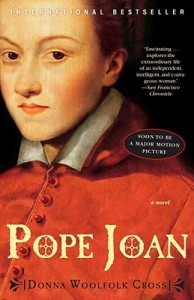 As a child, Joan is beaten for her brilliance and love of books. Her rigid father, a canon of the church, believes that women are inferior to men, incapable of learning, and is certain that his sons are destined for great careers in the church. When Joan’s intelligence gets both her and her brother John into a school, she is mocked by everyone except kindly Gerold, a young count who takes her in since she can’t live in the boys’ dormitory. Joan has an uncertain future until her brother John is killed in a surprise Viking attack along with almost everyone she knows. Assuming John’s identity, Joan enters a monastery and, distinguished by her incredible mind, eventually heads to Rome in a career that will prove as dangerous as it is ambitious. As a child, Joan is beaten for her brilliance and love of books. Her rigid father, a canon of the church, believes that women are inferior to men, incapable of learning, and is certain that his sons are destined for great careers in the church. When Joan’s intelligence gets both her and her brother John into a school, she is mocked by everyone except kindly Gerold, a young count who takes her in since she can’t live in the boys’ dormitory. Joan has an uncertain future until her brother John is killed in a surprise Viking attack along with almost everyone she knows. Assuming John’s identity, Joan enters a monastery and, distinguished by her incredible mind, eventually heads to Rome in a career that will prove as dangerous as it is ambitious.
I don’t know if Pope Joan actually existed, but if she did, her life in this novel certainly makes for an amazing story. It’s incredible how much Joan suffers and achieves in this book, going from beaten, submissive but intelligent little girl to a successful pope, albeit a female one. Joan is someone that can easily be admired as she never lets anyone get her down or force her to do anything that she knows is wrong. Even when the unspeakable happens during the Viking raid, Joan is able to take stock of her situation and figure out what needs to be done in order to both stay alive and get ahead in the world. She is strong enough to deny her own personal needs for the sake of the people and her faith.
The plot of this novel feels like it moves along fairly quickly. For under 500 pages, this book packs in a lot of events, but nothing ever feels rushed, it’s paced perfectly. Obviously, we know Joan is going to become a pope, but how she gets there is a mystery. There are also two other viewpoint characters, Gerold and Anastasius, who provide an alternate perspective on Joan as well as adding subplots and texture to her central story. Of the three, I liked Anastasius the least, but he’s not exactly a true villain because he’s just too ambitious. Most of the church was corrupt and he can’t entirely be faulted for acting as normal; Joan is just different and special enough to point out the flaws in the system.
In the author’s note, Donna Woolfolk Cross includes a fairly compelling argument for the existence of Pope Joan, although of course she was required to add huge amounts of fictional material to fill in the copious gaps which are inevitably left in any ninth-century account. For once I didn’t care all that much if it was true because I could really lose myself in the story. I know that women as strong as Joan must have existed in the Middle Ages, so it wasn’t really all that much of a stretch, whether there really was a Pope Joan or not.
In all, Pope Joan is a fascinating, moving work of historical fiction. It completely captured me and I couldn’t put it down. I highly recommend it.
While you’re here, if you do buy a copy of this book before July 31st, you can enter into the author’s red carpet contest to attend the movie premiere. And don’t forget that if you’ve entered on my giveaway post for a signed copy of this book that a comment here will gain you another entry!
 From the back cover: From the back cover:
It was whispered all through London Society that he was a murderer, that he’d spent his youth in an asylum and was not to be trusted – especially with a lady. Any woman caught in his presence was immediately ruined. Yet Beth found herself inexorably drawn to the Scottish laird whose hint of a brogue wrapped around her like silk and whose touch could draw her into a world of ecstacy. Despite his decadence and intimidating intelligence, she could see he needed help. Her help. Because suddenly the only thing that made sense to her was the madness of Lord Ian Mackenzie.
This is such an interesting premise. That was the first thing I thought when I heard about this book. I’ve never read a romance novel in which one of the main characters had a mental illness of any type. I think Ian is meant to have Asperger’s syndrome, and while I can’t even begin to tell you whether this is a very realistic depiction or not, I think it succeeds extraordinarily well in providing a story that is a little bit different.
Since Ian has this illness, he has certain handicaps on his relationship with Beth, especially at first. He’s convinced he can’t fall in love, for example. He doesn’t feel emotion the same way that other people do, merely mimics their behavior when he realizes he’s missed something. In one of their first scenes together, Beth weeps at an opera while he remains unmoved, completely unable to understand what she’s feeling, although he could easily play back the music and sing the words to her. It takes him a good long time to actually fall in love and understand what it is, although he knows he wants to be with Beth very early on in the novel.
In contrast, Beth appears to be a heroine bent on healing Ian and getting him past some of the scars from his childhood, mainly helping him realize that he is not his father, and falling in love with him despite the fact that he never meets her eyes. This seems an impressive feat to me, but I think the author succeeds in making their love story believable.
There is also a slight mystery plot woven throughout based on Ian’s accusation as a murderer. It’s interesting enough and adds some external tension to the story, but as always, this isn’t what this book is really about. It does, however, set up the Mackenzie family as “villains” of a sort, men incapable of escaping their father’s legacy, as a start to this new series. I’ll continue reading as I quite liked this one. I’d definitely recommend The Madness of Lord Ian Mackenzie to other fans of historical romance.
 From the back cover: From the back cover:
It is the summer of 1950 – and a series of inexplicable events has struck Buckshaw, the decaying English mansion that Flavia’s family calls home. A dead bird is found on the doorstep, a postage stamp bizarrely pinned to its beak. Hours later, Flavia finds a man lying in the cucumber patch and watches him as he takes his dying breath. Then someone steals a slice of Mrs. Mullet’s unspeakable custard pie that had been cooling on the kitchen window … As the noose tightens, Flavia decides it is up to her – and her fully equipped Victorian chemical laboratory – to piece together the clues and solve a murder.
Mysteries are one of the only two or three genres that I really don’t regularly like. I thought this was changing, given that I’ve read several mysteries this year and enjoyed pretty much all of them. That’s why I immediately chose this book from Amazon Vine. I wanted to test my theory and it sounded great. While this book has an interesting plot and should have had an interesting main character, I found that it didn’t work for me.
First, Flavia is not as appealing as she should be given the many blurbs about how awesome she is. In a sense, she is awesome, given her intelligence and ingenuity, but she doesn’t feel like an eleven-year-old girl. There isn’t much that is girlish about her and I feel that she could have been a boy just as easily. Her deep passion for chemistry and certainty about her life’s direction do remind me of that weird stage of youth; it doesn’t really occur to her that others think she is strange, she just goes her own way and pursues her own interests. So as a character, she was a bit hit-and-miss with me.
I read an ARC, and I hope this is corrected in the proper version, but the name of the murdered person changed halfway through the book. Talk about confusing! I also thought that there was too much exposition. Flavia explained how she came to her various conclusions and it all seemed fairly obvious.
I did like the old-fashioned British feel of the book; even if we weren’t told that this takes place in 1950, it would be easy to guess somewhere around the proper time. I liked all the little bits of information about chemistry and postage stamps and boys’ schools. And I was interested in the conclusion to the mystery once I’d figured out who the villain was and who the victim was. The Sweetness at the Bottom of the Pie just wasn’t a major success for me. It succeeded in small ways, but not enough for me to be interested in continuing the series.
|
|



Recent Comments