|
|
 I’ve refrained from being too personal on this blog in a while, but this has not been a particularly easy week for me. We’ve had the first indications that my mom may be getting a diagnosis that I do not want to hear again – my younger brother passed away of cancer five years ago, and I have been petrified since that I will lose someone else to it. I’m doing my best to provide comfort and not let it get to me until the diagnosis is definite, but this has been a hard week. I hope things don’t get worse as the next few weeks continue. I’ve refrained from being too personal on this blog in a while, but this has not been a particularly easy week for me. We’ve had the first indications that my mom may be getting a diagnosis that I do not want to hear again – my younger brother passed away of cancer five years ago, and I have been petrified since that I will lose someone else to it. I’m doing my best to provide comfort and not let it get to me until the diagnosis is definite, but this has been a hard week. I hope things don’t get worse as the next few weeks continue.
Partly because of this I’ve signed up for a “Flying without Fear” course from Virgin Atlantic, scheduled for late April, something I’ve meant to do for a while. I’m terrified of flying and it seems to get worse every time I fly (bad news when your family is all on a different continent), so I’m looking forward to banishing that and feeling comfortable with travel again. Even if my mom comes out perfectly fine and just has an easily-banished infection, I’d like to look forward to visiting my family and going on vacation with my husband.
In other news, the rest of life has continued as normal, which always feels strange when there is so much turmoil in your personal life. This week was my one-year working anniversary, which feels weird; as I said on Twitter, work makes time both drag and fly. I think this is the first year that I’ve managed to stay in one place, doing one thing, since I was in high school. I also passed my Life in the UK test this week, so I am all set for my next visa – indefinite leave to remain – which I will be applying for in November. That visa pretty much means I can live in the UK for however long I want, so we’ll at least never have to worry about immigration to this side of the pond again.
Unsurprisingly, I’ve also been reading a lot. I spent quite a lot of this week wading through the tome that is A World on Fire (Amazon UK) by Amanda Foreman, a truly epic history of relations between the USA and England during the American Civil War. It’s the 150th anniversary of the Civil War and I was prompted to acquire this one thanks to BBC history magazine, which spotlighted both the anniversary and recommended this book, and Amazon.co.uk Vine which featured it at just the right time. It’s totally different from Foreman’s last book about Georgiana, Duchess of Devonshire, but fascinating if slow going. I read a few other short books around it, as I generally do, but it’s been my main read for over a week now, and will probably persist into next week as well.
So that’s my week – how has yours been? Are you reading anything good?
I am an Amazon Associate.
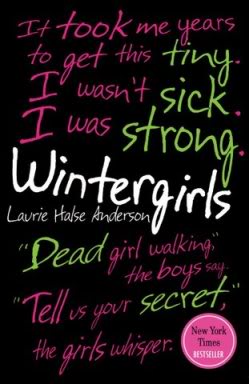 Lia’s long-time best friend, Cassie, has just passed away in a hotel bathroom. Though they haven’t spoken in months, Lia feels Cassie’s loss very strongly, especially because Cassie called her 33 times the night she died. Cassie starts visiting Lia, insisting she’s fat and telling her to eat less. Lia, already anorexic herself and sliding back into it after two hospital stays, has no plans to recover, and does everything in her power to deceive her father, stepmother, and mother that she’s still gaining weight even though she’s starving herself to stay thin. As Lia continues to deprive herself and exercise away the imaginary calories, she finds herself alternating between the world of the living and the world of the dead, a true wintergirl. Lia’s long-time best friend, Cassie, has just passed away in a hotel bathroom. Though they haven’t spoken in months, Lia feels Cassie’s loss very strongly, especially because Cassie called her 33 times the night she died. Cassie starts visiting Lia, insisting she’s fat and telling her to eat less. Lia, already anorexic herself and sliding back into it after two hospital stays, has no plans to recover, and does everything in her power to deceive her father, stepmother, and mother that she’s still gaining weight even though she’s starving herself to stay thin. As Lia continues to deprive herself and exercise away the imaginary calories, she finds herself alternating between the world of the living and the world of the dead, a true wintergirl.
Wintergirls has long been on my wishlist, even though I knew it wasn’t going to be an easy read. I’ll never forget going to a camp for teen Catholics and having every girl in the small group but me – all healthy, beautiful teenagers -confess to either having purged or having starved themselves. It was devastating. Lia’s struggle is an unflinching look at this mindset and what really may be going on in the mind of a girl with anorexia.
As readers, we know Lia is absolutely killing herself. The symptoms are obvious, as she starts to lose touch with reality, her memory slipping, her period ending, her obsession with yellow globules of fat and calorie counting. She tries to eat less than I eat in one meal for the entire day, and if she can manage, stays even below that. It’s also difficult to take because Lia self-harms and it’s absolutely painful to read about someone feeling so bad that she must injure herself to feel better. It’s difficult, but I think it’s so necessary, because an understanding of what goes on in the minds of people feeling like this can help us to get past the society attitudes which push them in that direction.
Lia’s anorexia is not down to one thing, but she’s pushed into it by a variety of factors, such as people insensitive to her growth as a young adolescent, a broken home, and a mother that she feels is never happy with her. Her equally unhappy best friend Cassie helps her down the path. It’s heartbreaking to read Lia’s struggles, how badly she wants to eat but how she won’t let herself, and even the pain she goes through when someone does force her to eat more like a normal human being. I can’t even imagine feeling like that and the book brought me to tears more than once.
The other thing most striking about the book is that Lia is a teenager in a very real sense. She’s needy in some ways, independent in others. Eating is very obviously the one thing in her life she can actually control – she can’t fix her parents’ marriage, she can’t get her mother to accept her, she can’t even get the grades that are expected of her. The only thing she can ensure she wins at is becoming thin, and that’s what she does. How many teenagers fall into this same trap? How many are killed by it? It hurts just to think about.
Wintergirls is a must-read. This is a heartbreaking book about a problem that is very, very real. Anderson outdoes herself once again, something I think I’d better expect next time.
I am an Amazon Associate. I received this book for free for review from Amazon Vine.
 Margaret’s life has been fraught with about as many difficulties as possible. Born of Anglo-Saxon and Hungarian heritage, she is a princess, and her brother Edgar the rightful heir to the English throne. But her father is dead, William the Conqueror has seized the throne, and she and her family find themselves shipwrecked in Scotland. To secure King Malcolm’s support for her brother’s claim, Margaret has to marry him, though all she wants from life is to be a nun. Eva is Scottish royalty of another sort, albeit illegitimate, a bard sent to Malcolm’s court from Moray by his rival Queen Gruadhe, better known as Lady Macbeth. Ostensibly a hostage, Eva is really intended as a spy, but she finds herself torn between two loyalties as she befriends the new queen. Margaret’s life has been fraught with about as many difficulties as possible. Born of Anglo-Saxon and Hungarian heritage, she is a princess, and her brother Edgar the rightful heir to the English throne. But her father is dead, William the Conqueror has seized the throne, and she and her family find themselves shipwrecked in Scotland. To secure King Malcolm’s support for her brother’s claim, Margaret has to marry him, though all she wants from life is to be a nun. Eva is Scottish royalty of another sort, albeit illegitimate, a bard sent to Malcolm’s court from Moray by his rival Queen Gruadhe, better known as Lady Macbeth. Ostensibly a hostage, Eva is really intended as a spy, but she finds herself torn between two loyalties as she befriends the new queen.
I had vaguely heard of Queen Margaret before, but certainly not in as much detail as this book offers. My knowledge of history usually stops at the English border, though not really by choice, and that desire to know a little bit more is what inspired me to pick up this book. After finishing it, I am definitely eager to know more about Margaret and Malcolm and the entire situation in Scotland.
As historical novels go, I liked this one. It was quite an entertaining read; though at the times there was a bit too much info-dumping, overall I felt the story flowed smoothly and was just the right length for the book’s 330 pages. Margaret’s life had many facets between her spirituality, her love for the king and her children, and her desire to do her best for her people. King depicts her as a truly inspiring queen, much as I would imagine she’s been perceived throughout history, who is even willing to disobey her husband for what she believes in.
Eva, the main fictional character of the narrative, actually fits in very well. She’s the perfect lens through which we can see Margaret as she’s perceived, rather than as she perceives herself, especially as her friendship with the queen develops. The novel really starts to come into its own after they’ve met for this reason and depicts a heart-warming relationship between women as well as an interesting story. Eva is really the drive behind the plot, as it is she who is consistently torn between loyalties. She has to decide to what lengths she’ll go to obtain the information Queen Gruadh wants without feeling as though she’s betraying Margaret. Otherwise, not much really happens that’s out of the ordinary; Margaret marries, has children, prays, and gives to the poor. That’s about it.
With a few great characters, relationships, and its fair share of inner turmoil, Queen Hereafter is an excellent choice for historical fiction lovers who are craving a tale set in Scotland.
I am an Amazon Associate. I received this book for free for review.
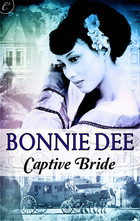 Huiann is far from thrilled about leaving her family and her home in China to marry a wealthy businessman in San Francisco, but she accepts it as her future. In 1870, there is little other choice for her. So on the ship she goes, but when she arrives, she discovers that, far from marrying her, her supposed bridegroom actually wants to sell her off as a high-class prostitute, calling her a princess and letting a huge variety of men bid on her virginity (after they’ve seen what they’re getting). Horrified, Huiann flees, and runs straight into the shop of Alan Sommers, a white man with whom she can’t even speak. She conveys her desperation somehow and he hides her. Through their rudimentary attempts to communicate and Alan’s efforts to keep her safe, the couple begin to form a bond, and wonder what future there is for a Chinese woman and a white man at this period in history. Huiann is far from thrilled about leaving her family and her home in China to marry a wealthy businessman in San Francisco, but she accepts it as her future. In 1870, there is little other choice for her. So on the ship she goes, but when she arrives, she discovers that, far from marrying her, her supposed bridegroom actually wants to sell her off as a high-class prostitute, calling her a princess and letting a huge variety of men bid on her virginity (after they’ve seen what they’re getting). Horrified, Huiann flees, and runs straight into the shop of Alan Sommers, a white man with whom she can’t even speak. She conveys her desperation somehow and he hides her. Through their rudimentary attempts to communicate and Alan’s efforts to keep her safe, the couple begin to form a bond, and wonder what future there is for a Chinese woman and a white man at this period in history.
This is my first Carina Press book and to be honest, I wasn’t too sure what to expect, so I went in with an open mind. Carina Press is the digital branch of Harlequin, and normally I don’t read too many Harlequins – category romances are generally too short for me to believe in them and a bit more stereotypical. Saying that, I really wanted to try Carina Press, which I know is a bit more daring, and this book sounded really appealing, so I requested it.
Rather than being disappointed, I was pleasantly surprised. It’s not a flawless book and does follow the same old conventional formula (with a little too many racy scenes for my liking, which seems to happen very often), but the romance was sweet and believable with efforts on both sides to communicate and understand. Huiann ends up bridging the gap by learning English, but it’s apparent from the start that she’s a bit cleverer than Alan, who comes across as a loyal, hard-working, but not particularly smart man. It’s also true that she wants to strive for independence in her new world and thus needs to learn the language. I loved as well that she doesn’t immediately learn everything – the language barrier remains to some extent throughout the entire narrative, making things a little more realistic as they communicate through gestures, expressions, and pictures as well as words. Alan genuinely tries to understand her culture and give her the tools to make herself a new home, so I couldn’t really fault him for not learning Chinese.
I also found the story followed a nice arc throughout, mainly centering on the historical reality of Chinese prostitution in California. It wasn’t always illegal for Chinese women to simply be brought over as prostitutes. Huiann doesn’t realize that she is, but she does encounter some other women whose fate seems so grim that it isn’t worth living. When she finds herself in the same situation, she takes it upon herself to not only save these women, but to help them thrive. It’s a sweet story in many respects and reminded me a lot of the historical romances I read as a younger girl that tended to range across more time periods and have a little more history in them, as opposed to the completely ton-focused historical romances I find myself reading now.
In short, Captive Bride was a great start for me and Carina Press and I’m very glad I requested it. Recommended for other romance readers who are looking for a nice quick read which may not rock the boat but is satisfying nonetheless.
I am an Amazon Associate. I received this book for free for review from Netgalley.
 Driving along a road near the college where she is a faculty member, Shelly spots an accident happening right before her eyes. She pulls over and races down, calling 911 as she goes along. When she sees that the couple in the car are both alive, and the ambulance driver arrives, she heads to the hospital herself for stitches and assumes everything will be fine. Then she sees in the newspaper that the girl died – was burned beyond recognition and found in a lake of blood – and that both she and the boyfriend fled the scene before the ambulance even arrived. Shelly is upset and angry, but no one will listen to her account of the truth. We then begin to learn bits and pieces about the relationship between the two college students, Craig and Nicole, what happened afterward and what led to the fateful accident. The Raising is a haunting tale of ghosts, university life, and love. Driving along a road near the college where she is a faculty member, Shelly spots an accident happening right before her eyes. She pulls over and races down, calling 911 as she goes along. When she sees that the couple in the car are both alive, and the ambulance driver arrives, she heads to the hospital herself for stitches and assumes everything will be fine. Then she sees in the newspaper that the girl died – was burned beyond recognition and found in a lake of blood – and that both she and the boyfriend fled the scene before the ambulance even arrived. Shelly is upset and angry, but no one will listen to her account of the truth. We then begin to learn bits and pieces about the relationship between the two college students, Craig and Nicole, what happened afterward and what led to the fateful accident. The Raising is a haunting tale of ghosts, university life, and love.
As soon as I started reading this book, I could not put it down. I sat there with my Kindle on a Saturday morning into afternoon, completely putting off everything I had planned for the day, just so I could continue reading this book. Yes, it is that addictive. It’s well-written, so each scene leads into the next, and as the scandals and the lies start to build up, I just had to know what happened. I predicted a few of the twists along the way, but the emotional investment and slow unveiling of the story made it an absolutely fantastic read.
Much of the suspense in the book comes from the fact that we really don’t know what happened that night. Craig has suffered amnesia and Shelly only knows what she saw – she has no idea how the girl’s body got burned beyond recognition, why the couple swerved when nothing was on the road, or why lies pervade stories in the newspapers and on the internet. The mystery is slowly unveiled as we discover what kind of people Craig, Nicole, and their friends are. We go back in their history, from their first year in college to the second, exploring relationships and how they developed. Naturally, everyone assumes rich boyfriend Craig is the killer, but without actual evidence, he’s returned to college and has to deal with the hole in his memories.
Added in to the mix, just to give the story another dimension, is the discussion of death. One of the characters, Perry, insists on taking a freshman seminar explicitly about death. This leads to a lot of fascinating stories about death throughout the ages and the introduction of the professor, Mira, who has her own thoughts on the subject. I almost wished more was done with this.
The only thing that prevents this from being an absolute perfect book for me were the questions I had shortly after finishing. One part of the conclusion doesn’t make sense – and still doesn’t much – and I think it’s this that has held back my enthusiastic, five star reaction. If you’ve read the book, let me know so we can chat about it.
Nevertheless, The Raising is really an amazing book. It’s so compelling you won’t want to put it down, but it’s not without food for thought either. Highly recommended.
I am an Amazon Associate. I received this book for free from Netgalley for review.
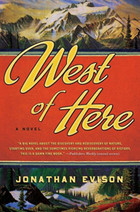 The fictional town of Port Bonita, Washington, has a long history; once a tiny frontier town, full of self-important whites and Native Americans still trying to get by with their native way of life, in the modern day it has become a town trying to move past its history and ready to face the future. Covering a wide span of characters and stories, from explorers doing their very best to conquer the mountains to a new mother striving to make her way under her own steam to a blue collar worker in the clam factory, Evison’s epic attempts to draw a line from the past to the future, to examine what defines our towns and how our history shapes the present. The fictional town of Port Bonita, Washington, has a long history; once a tiny frontier town, full of self-important whites and Native Americans still trying to get by with their native way of life, in the modern day it has become a town trying to move past its history and ready to face the future. Covering a wide span of characters and stories, from explorers doing their very best to conquer the mountains to a new mother striving to make her way under her own steam to a blue collar worker in the clam factory, Evison’s epic attempts to draw a line from the past to the future, to examine what defines our towns and how our history shapes the present.
This is an example of a book that got so much hype it could never live up to it. Don’t get me wrong, I enjoyed it, and I did like reading it, but this review isn’t going to be the love fest that I’ve seen spread around. In some respects, I do wish I’d avoided the praise it’s garnered out there, because then I think I’d have been better able to judge it based on my own experiences. As it stands, though, it was good, but didn’t quite cross the line to great like it has for so many others.
Let’s start with what I did like. I loved what the book tried to do, and in some respects I felt it succeeded. For example, the people in the nineteenth century are in the process of building a dam that, in the twenty-first century, has had a poor effect on nature and has caused the town’s economy to start struggling. This is a perfect illustration of the way that well-meaning people, without armed with the knowledge we have today, started to set things off that have a damaging effect on the present. I love it when books link up the past and the present like this and really show us why where we came from has a huge effect on where we’re going. History is important.
Unfortunately, I simultaneously felt like the book was doing a little too much and that it didn’t all link together like this. There are many storylines, which goes to show just how complex a single town can be, but a lot of them don’t really go anywhere. It’s a series of snapshots of Port Bonita, not precisely an overarching narrative – we have the explorer story, we have the Big Foot story, we have the prisoner attempting to make it on his own, we have a prostitute who is remarkably happy with her employment, and so on. The book is almost too big – and as a lover of epics, that’s a peculiar thing for me to think. As a series of snapshots, I would say it works, but as an entire book, it feels like it’s trying to get somewhere and never quite makes it.
So yes, West of Here is well-written, it is epic, and it has me interested in what Evison is going to write in the future. I liked it and I’m glad I read it. But I really wish I’d fallen head over heels in love with it, and I think it’s that expectation which left me a bit disappointed when I finished.
I am an Amazon Associate. I received an ARC of this book from Candace at Beth Fish Reads (thanks!).
 This week, I finally managed to finish the first in my attempt at a Wheel of Time re-read before the last of the series comes out. The Eye of the World has a lot to live up to, for me; it was my first ever epic fantasy read, after all, and the book that launched my interest in all things fantasy way back in my first year of high school. This week, I finally managed to finish the first in my attempt at a Wheel of Time re-read before the last of the series comes out. The Eye of the World has a lot to live up to, for me; it was my first ever epic fantasy read, after all, and the book that launched my interest in all things fantasy way back in my first year of high school.
A friend recommended it to me and I can still remember that first time I went into the bookstore and held it in my hands. I opened it up and started reading, just to make sure I was interested before I invested my $7, but as soon as I’d read a paragraph I knew I was ready to buy. Fantasy worlds were so new to me, and so appealing, that I inhaled the book when I read it, and then went on to read the rest of the series, up to book 9, in relatively short order. Then, disappointed by book 10 and waiting for what felt like an eternity for book 11, I stopped, and now I’m trying to pick up the pieces.
So, how did my original foray into fantasy hold up, more than ten years later?
Surprisingly, it held up very well. It took me what felt like forever to read (more than a week, which is a long time for me), and I had an unfortunate habit of falling asleep while reading, but it was still a very absorbing and interesting read – I can see exactly what appealed to my fourteen year old self. I was shocked by how little I remembered the story, even though bits and pieces popped up as I read. Mostly I remembered the Trollocs invading Rand’s home, to be honest, and the beginning with Lews Therin Telamon. There were parts of other sections, particularly as I read, but beforehand there was very little in my head from the first time I’d read the book.
What I think struck me the most this time was how very typical a fantasy it is. It so obviously draws from Tolkien and a lot of other fantasy I’ve read draws from it, so it was simultaneously comforting and odd to put together the pieces. I hadn’t read anywhere near enough to pick that up the first time, but here – it’s that farmboy on a journey yet again, that farmboy with a fantastic destiny, who is forced to leave home and who must then go on to save the world. Obviously, it has plenty of its own twists to it, and there is no question in my mind at least that it fills the stereotypes quite well, but it was familiar not only because I’d read it before in this book, but because I’d read it before in others.
Much of the book defies the stereotypes as well, though. Even though it is Rand who is slated to save the world, he is far from the most powerful character at this point, and often reads like a lost puppy who has no idea what to do with himself. There is Lan, who is the most powerful human male we come across, but even he is ruled by the Aes Sedai he serves: Moiraine. Their strengths work together more than they work separately. And that’s what I liked about this book, this time, possibly the most; that the women are the powerful ones. Knowing what comes after does dim that a bit, but I loved that the women are regarded as the ones to keep the party safe, by not only Moiraine but by the people they meet on their journey as well. Yes, the three farmboys are ta’veren, the ones who change fate, not the women, but women hold the men’s destinies in their hands regardless.
You could say as well that the fact that the Aes Sedai are regarded as unnatural, terrifying witches in the country is yet another take on the very real practice of pulling powerful women down – the constant desire to explain away powerful women by turning them into evil is a theme that’s repeated not only here but in the real world as well. For me, this aspect made the book even more interesting, but didn’t really lessen the fact that it genuinely is the women who can protect the men. There are a lot of complex dynamics going on here and I’m looking forward to exploring them as I continue with the series.
The other thing I noticed was that the book is very clearly a first book. There are many little flaws in it that annoyed me; people keep doing the same actions over and over again. Nynaeve chews her braid, for example, while others are always chewing their lips, people blush more often than they ever would in real life, the characters are always throwing their heads back and laughing, and the descriptions of clothes never really flowed properly. It is a great story, and immediately absorbing, but it is not the world’s best written book.
All of that said, of course, I could so easily see what pulled me and so many others into this story. I doubt this is the last time I’ll read this book. My husband decided to read it first and immediately tried to get me to read it because there was so much to discuss, then he immediately moved on to the next book (which he is still reading now). Obviously, The Eye of the World is still very appealing, more than 20 years after its first publication date. I’m looking forward to reading the rest of the series, now.
 Elizabeth I is one of England’s best known reigning queens. Though she was not the first, she set the standard and is widely regarded as a successful ruling monarch. But there were women who ruled, or attempted to rule, England before Elizabeth. There was Matilda, daughter of Henry I, whose cousin got to the throne first; there was Eleanor of Aquitaine, who had plenty of power in her own domains but in many respects is best known for her husbands and sons; there was Isabella, wife of Edward II, who seized a throne for herself in the name of her son; there was Margaret of Anjou, who fought ferociously to maintain her son’s right to the throne; and there were Jane and Mary, Elizabeth’s immediate predecessors. Castor looks at these women and how they ruled and examines the pattern of English thought and how it changed over more than 400 years of history. Elizabeth I is one of England’s best known reigning queens. Though she was not the first, she set the standard and is widely regarded as a successful ruling monarch. But there were women who ruled, or attempted to rule, England before Elizabeth. There was Matilda, daughter of Henry I, whose cousin got to the throne first; there was Eleanor of Aquitaine, who had plenty of power in her own domains but in many respects is best known for her husbands and sons; there was Isabella, wife of Edward II, who seized a throne for herself in the name of her son; there was Margaret of Anjou, who fought ferociously to maintain her son’s right to the throne; and there were Jane and Mary, Elizabeth’s immediate predecessors. Castor looks at these women and how they ruled and examines the pattern of English thought and how it changed over more than 400 years of history.
I loved this book. I didn’t expect anything less; I gushed about Helen Castor’s Blood and Roses a couple of years ago, so it’s no surprise that I couldn’t wait a second to get my hands on this one. None of these women were new to me as a person obsessed with medieval history, but Castor puts their stories together in a way that makes perfect sense. She looks not only at what happened to each woman and how successful she was at ruling, but what people thought about it and how England became a country that could accept a female monarch.
It’s no surprise that they have almost universally been vilified at one point or another. The medieval interpretation of what it meant to be female and the medieval interpretation of what it meant to be king were completely incompatible. As Castor says in the first section, focusing on Matilda, she just could not win. If she exercised the right of a king, the power necessary to be successful, she was an unnatural woman, but if she didn’t, there was simply no way for her to rule. She could not be a success in her contemporaries’ eyes, no matter what she did – at least, not until she started to fight on behalf of her son, Henry.
And the story is the same for many of the women, with incremental changes. Attitudes do take hundreds of years to change, and while the kingdom was changing, the status of women didn’t go very far towards changing with it. All of the royal power women were actually able to hold in England had to be in the name of a man, even if that man was actually a baby. It’s a fascinating exploration of the very different challenges each women faced while at the same time putting together the universality of their condition.
And it’s perfectly appropriate that they lead up to Elizabeth, because she was the game changer, who ruled in her own name, with her own wisdom, and did a fantastic job. There’s no question that women continued to struggle for rights, and they suffered considerably for centuries, in some respects still doing so. But a number of factors contributed towards her doing so, and she must have felt a kinship towards the women who came before and the strides they made to earn power for women in the English kingdom.
Castor treats all of the women with an even hand, taking a steady look at what was expected of them as women rulers, why they got treated the way they did, and even whether or not they deserved it. Isabella, for example, can easily be dismissed as a poor ruler, but we can also understand why she acted the way she did (at least as far as overthrowing her husband) and the results of those actions in a wider context. While there is still a lot about the men in these women’s lives, they were the actual monarchs and thus had a very large role to play in defining the positions of their mothers, daughters, and wives, so it doesn’t feel as though the women have vanished inside the shadows of the better-recorded lives of the men.
In short, She-Wolves is exceptional, inspirational, and endlessly fascinating. If you’re interested in history, especially that of women, this book is unquestionably for you.
I am an Amazon Associate. I received this book for free for review (and then bought a copy so I could have it in hardcover!).
 Sara B. has been the preeminent fashion guru for her entire life. Her column on “Do”s and “Don’t”s is an absolute landmark. She can dictate or destroy a fashion statement more or less at her will. But all of a sudden, everything starts falling apart. She loses her sense of style, slips away from her relationships with friends and coworkers, and wants nothing more than to hide from her life. When she meets Esther and Lila, a pair of elderly ladies, she doesn’t immediately see the connection with her own life until Lila passes away and Sara finds herself remembering a true stylish woman and wondering what’s left of her own life. Sara B. has been the preeminent fashion guru for her entire life. Her column on “Do”s and “Don’t”s is an absolute landmark. She can dictate or destroy a fashion statement more or less at her will. But all of a sudden, everything starts falling apart. She loses her sense of style, slips away from her relationships with friends and coworkers, and wants nothing more than to hide from her life. When she meets Esther and Lila, a pair of elderly ladies, she doesn’t immediately see the connection with her own life until Lila passes away and Sara finds herself remembering a true stylish woman and wondering what’s left of her own life.
I had quite a time with this book – it is definitely a roller coaster ride of emotions and events. I don’t think it’s for everyone, but it’s pretty sensational and at times shocking – the type of book I don’t normally get into, but for once I found that it worked for me. I was in just the right mood for a scandalous, saucy chick lit book – Sara’s whacky narrative combined with her genuine search for meaning worked very well for me.
What I think would probably turn others off is the absolute level of detail she goes into about her life. I had a really hard time believing anyone could live like that. She is constantly drinking, smoking, and even sleeping around – in a variety of graphic ways – and I would never have been comfortable if that was my life. That was the real downside of the book for me, as it’s just very vulgar at times. Sara is lost in many ways and her abuse of her body signals that loud and clear. As a reader, I was cringing for her, and really wanted her to put herself back together. I didn’t like her, but I felt sorry for her.
It’s really the fact that she’s so lost which makes the book so appealing, though. Sara is a woman who was lucky enough to virtually fall into a career related to a silly game she and a friend started out in college. She never had a chance to question whether she wanted that career, and once she starts to lose a piece, she starts to wonder what was holding her together in the first place. Even though her actions wouldn’t mirror my own, and I don’t think I’d be friends with her in real life, I did feel for her, and I found the end to be fantastic. It fit her character just perfectly. Plus, I just adored Esther – what a wonderful woman! She is very much what I’d like to be when I’m her age, except with a husband, because I’ve already got him.
If you’re looking for a contemporary novel focused on the disintegrated life of a fashionista and don’t mind a few graphic scenes, Snapped is a book you should be reading.
I am an Amazon Associate. I received this book for free from a publicist for review.
 The fourth in the Lady Emily Ashton series starts with Colin and Emily married, at long last. They’re off on their honeymoon to Constantinople, intent on spending a lot of time together and only a little bit of time exploring the town. But fate doesn’t leave them alone, as a mystery falls literally into their laps on the train with a man, Sir Richard, falling unconscious at dinner. The plot thickens on arrival in Constantinople as a young English girl, Ceyden, is murdered in the harem, who turns out to be Sir Richard’s daughter. Colin and Emily are immediately off to solve the mystery and figure out who is behind the murder. The fourth in the Lady Emily Ashton series starts with Colin and Emily married, at long last. They’re off on their honeymoon to Constantinople, intent on spending a lot of time together and only a little bit of time exploring the town. But fate doesn’t leave them alone, as a mystery falls literally into their laps on the train with a man, Sir Richard, falling unconscious at dinner. The plot thickens on arrival in Constantinople as a young English girl, Ceyden, is murdered in the harem, who turns out to be Sir Richard’s daughter. Colin and Emily are immediately off to solve the mystery and figure out who is behind the murder.
I knew I couldn’t wait long to read this after finishing A Fatal Waltz and I was glad to immerse myself in Colin and Emily’s world once again. It’s such a thrill to see that they’re finally married; rather than prolonging the suspense, Alexander has just tied the knot and shown that, for once, novels aren’t always dependent on romantic tension. And I was glad the characters could finally release their proper Victorian strongholds – though this novel fades to black, it’s obvious that they enjoy being married a considerable amount!
Other than that, however, I found I wasn’t as interested in this particular mystery as I had been previously. Though the atmosphere is very interesting and well done, the plot itself wasn’t what drew me along. It didn’t help that Colin was actually away for what felt like half the book, leaving Emily to solve things on her own. In some ways, I felt this dragged the story on a bit longer than it would have otherwise. There also isn’t the continuing tension that sprinkled through the last installment, with the bullets left everywhere, which meant that the plot moved a little less quickly. Until the end, that is, when everything gets very exciting.
What did work, however, was the emotional intensity of the novel. As a Victorian lady, Emily is forced to deal with the reality of marriage and its consequences. She hardly knew her first husband and had very little time with him, so the risk of pregnancy was not particularly high. Here, though, it’s obvious that marital relations result in pregnancies and Emily is terrified. Her friend Ivy is pregnant and very delicate back in England, which is a huge weight on her mind, and it doesn’t help that she too could wind up pregnant at almost any time. I felt like this was an incredible insight into the mind of a true Victorian woman; so often books are still written as though babies are always wonderful miracles, particularly in more romantic genres, because that’s the reality of today, when the vast majority of women and babies in western countries survive. What’s so often ignored is that children were far more likely to lead to death a hundred years ago, both for their mothers and themselves. This book presents Emily’s fear in a very realistic way that was easy to relate to.
Tears of Pearl was another excellent addition to the Lady Emily Ashton series. Possibly not enough to persuade those who weren’t enamored with the first or second to continue, but it worked very well for this fan of the series. It won’t be long until I continue with the next!
I am an Amazon Associate. I purchased this book.
|
|



Recent Comments