|
|
 When the economic downturn hit in 2008, Suzan Colon prepared for disaster – and rightly so. Writers are among the least essential employees, and she was shortly laid off from her lucrative job at a popular magazine. While her husband managed to keep his job, Suzan decided to start saving money by cooking more food from scratch. So she got her grandmother Matilda’s recipe book from her mother, and with it started to unearth a store of memories. Among Matilda’s recipes are Suzan’s recollections on her own hard times and many recounted stories from her family’s history from the late nineteenth century to the present. When the economic downturn hit in 2008, Suzan Colon prepared for disaster – and rightly so. Writers are among the least essential employees, and she was shortly laid off from her lucrative job at a popular magazine. While her husband managed to keep his job, Suzan decided to start saving money by cooking more food from scratch. So she got her grandmother Matilda’s recipe book from her mother, and with it started to unearth a store of memories. Among Matilda’s recipes are Suzan’s recollections on her own hard times and many recounted stories from her family’s history from the late nineteenth century to the present.
I had a big problem with about a third of this book. Namely, I couldn’t relate to the author. I might be a bit harsh, but I’m not sure someone who had a six-figure job, continues to do freelance work, and has a year’s worth of savings is really the person to listen to about hard times. Sure, she can no longer justify $40 on having her eyebrows tweezed and can’t shop at the high-end organic grocery store in the center of Manhattan, but then I was thinking, who can justify these things? And could I deal with her unhappiness that she had to switch to a cheaper face moisturiser when I can’t justify buying any? Cut backs are necessary for her, but she’s not missing out on anything essential, and it’s clear her husband thinks her reaction is a little over-the-top. I shared his feelings, especially when he spends $70 on groceries for one home-cooked dinner and she worries when he doesn’t eat half a banana. I know what it’s like to worry about money, but half a banana? Suffice it to say, if you actually are poor, this is probably not a book for you. I was left wondering if she had to fill in the pieces to justify writing a book. After all, she needed the extra income.
It might work better for someone in Suzan’s income bracket. I’m probably being unfair, in that she never really complains. She is a fairly even narrator and she maintains a lot of joy in her life. I just think it all rubbed me the wrong way, because there are plenty of people in the US (and far more over the world) who are actually starving, who have no health insurance, no home, and can’t figure out where the money for the bills is going to come from. At least she donates to charity.
On the other hand, however, I really liked her family’s stories, and I did find them inspirational. For example, her great-grandmother once came home with a collection of vases, a little splurge to make her feel better in a hard time when her family mostly ate applesauce and bread, and those vases are still around. (Seriously, how can you compare the author’s attempts at cooking meaty meals from scratch with applesauce and bread for a week? See my point?) I loved her grandmother’s story, too; she was a typist who rose through the ranks and became a talented writer, if she never published, after nearly starving as a girl when she was forced to work to feed her entire family. And the way her grandparents moved to Florida on $100 and made it work was great. I liked the message, which was to sometimes justify little unnecessary expenses to help get you through the hard times, although again, this is just not possible for some people. This is a book for the upper middle class, no question.
Is it worth reading for that? Probably not. There are plenty of memoirs dealing with hard times and I don’t know that this one really did much for me. The recipes weren’t really anything to write home about, and to be honest, I’m not sure they would save that much money if you’re already cooking from scratch. I mean, one of them is for spaghetti with a jar of pasta sauce. I save money by making my *own* pasta sauce, which is healthier, cheaper, and tastes better than a store-bought jar. I’m sure that one was more for effect, but I just didn’t really need to read about rich people who are less rich now and whose cut back circumstances are more luxurious than my life on a good day.
So, in short, Cherries in Winter was not the book for me. But plenty of people seem to like it, so it might be the book for you.
I am an Amazon Associate. I received this book for free from the publisher for review.
 When Charlotte Wallace lost her parents, she was sent to live with her aunt and uncle, where her only joy in life became riding horses in secret – and being taught by the stable boy, Robert Devington. Now older and completely in love, Robert and Charlotte wish more than anything to marry, but Charlotte’s uncle won’t hear of it, no matter how many ways Robert proves himself. An unexpected betrayal and a lie forces them apart, and only horse racing can bring them back together again. When Charlotte Wallace lost her parents, she was sent to live with her aunt and uncle, where her only joy in life became riding horses in secret – and being taught by the stable boy, Robert Devington. Now older and completely in love, Robert and Charlotte wish more than anything to marry, but Charlotte’s uncle won’t hear of it, no matter how many ways Robert proves himself. An unexpected betrayal and a lie forces them apart, and only horse racing can bring them back together again.
I questioned my judgment a little before I read this book, not sure what I was thinking when I requested it. Horse racing? Really? I loved horse books when I was a kid, but it was something I grew out of. Emery Lee’s book says maybe I “grew out” of it too soon, because I enjoyed this book to a surprising degree.
While Robert and Charlotte are the focus of this book’s plot, this is definitely not a romance. They already fell in love and the book is concerned with getting them married, which is all they both want. They both love horses, though, and the racing is a constant plot point. The horses themselves are almost characters, given little quirks of personality, and it’s clear through their love for animals that Robert, Charlotte, and even Philip Drake are good people thrown in bad circumstances. I really liked many of the characters. A few of them were caricatures, like Charlotte’s uncle, who is the epitome of a fortune seeker and doesn’t care for anyone else as long as he makes money and rises in prestige, but rather than annoying me I thought these people were an interesting backdrop for the characters who are worth reading about.
Plus, the book is exciting. The horse races in particular are surprisingly riveting. I didn’t know who was going to win all the time, and I was genuinely curious. Even though a fair amount of the plot is revealed on the back of the book, I couldn’t really predict where the book was going to go and just how or even if Robert and Charlotte were going to get back together in the end. I also liked that some of the book took place in the Colonies; it gave a different perspective on the new sport and provided another angle. It went very quickly for a 500-page book.
The Highest Stakes is a very enjoyable work of historical fiction, providing a compelling story against the backdrop of thoroughbred horse racing. Definitely recommended. And a totally shallow note, I love the cover of this book. I think it’s gorgeous!
I am an Amazon Associate. I received this book for free from the publisher for review.
 I’m not sure I need to summarize this, but why not? Dorothy lives in the gray land of Kansas with her aunt, uncle, and little dog called Toto. One afternoon a tornado strikes and Dorothy, her house, and her dog are swept away to the magical land of Oz. Accidentally, she kills the Wicked Witch of the East, and attains some measure of fame in Oz, but how will she get home? I’m not sure I need to summarize this, but why not? Dorothy lives in the gray land of Kansas with her aunt, uncle, and little dog called Toto. One afternoon a tornado strikes and Dorothy, her house, and her dog are swept away to the magical land of Oz. Accidentally, she kills the Wicked Witch of the East, and attains some measure of fame in Oz, but how will she get home?
This was a surprisingly delightful read. It’s not too old and reads very smoothly. The movie and the book are very similar in story, and I’ve seen the film about a million times, so there weren’t many surprises for me here. There are a few extra lands, and some of the events are a little different, but the basic story and characters are completely the same. I’ll admit that it dragged towards the end for me when these extra things were introduced, but I think someone less familiar with the film wouldn’t have felt so impatient.
The book is written for children, so some things are rather simplistic; it’s fairly clear that as the characters develop a bit that they don’t really need their gifts from Oz, but it was all very sweet. Dorothy is a bit too sweet, but I love that she actually had some initiative and seemed quite clever for a little girl. The message for children is excellent, IMO, as all the characters work together to vanquish their foes and try their hardest to be smart, good, and courageous.
I actually read this on my phone and was surprised by how well it held my attention, especially given it was the first book I ever read on there. It’s helpful that it’s so short, but I did find the story absorbing and I looked forward to continuing it when I got pulled away. I’m really looking forward to sharing this with my own children someday, although I think I’ll be getting a paper version before that time! The Wonderful Wizard of Oz has held up as a great children’s classic and I can see it continuing on into the future.
I am an Amazon Associate. I downloaded this book to my phone for free through Aldiko.
 Dressed in his best clothes, unemployed Dan Dong heads to an exclusive hotel to apply for a bellman’s job. Instead, he is mistaken for a journalist, and falls into the world of exclusive banquets, where there is a presentation, delicious rare food, and a check for 200 yuan each time. Dan gets business cards made up and decides that banqueting is his new job. He is still a good-hearted man, however, and can’t help being swept up in the stories that desperate people tell him in order to make their lives better. As he uncovers corruption after corruption, Dan’s lies become strangely close to the truth. Dressed in his best clothes, unemployed Dan Dong heads to an exclusive hotel to apply for a bellman’s job. Instead, he is mistaken for a journalist, and falls into the world of exclusive banquets, where there is a presentation, delicious rare food, and a check for 200 yuan each time. Dan gets business cards made up and decides that banqueting is his new job. He is still a good-hearted man, however, and can’t help being swept up in the stories that desperate people tell him in order to make their lives better. As he uncovers corruption after corruption, Dan’s lies become strangely close to the truth.
There are so many facets of this book that it’s going to be hard to include them all in my review! I picked it up on the shelf because of a whim – I’ve been trying to read more multicultural fiction and the Chinese characters on the spine called to me. I was rewarded for my impulse by a really thoughtful book on corruption in modern China and the difference between truth and lies, and how they can mesh. Dan is unusually sensitive to food, so he struggles to quash his natural impulse to go to the banquets, always telling himself that a few more months will buy his wife a condo, a car, and so on, even though neither of them ever get any of these things.
Instead, he gets guilt trips from a variety of people when they find out he’s a journalist, and this is where the corruption comes in. Dan finds out about these things and he wants to do something about them, but he isn’t a good enough writer. He never got past middle school. But, eventually, his honest longing leads to him giving it a try, and that’s when we learn that the papers are corrupt, too. So, is he a freelance journalist, or is he still a banquet bug? Or is he both? It’s intriguing and the book doesn’t give the answers, doesn’t even have a solid conclusion, but instead makes us think about what happened to Dan. The book also demonstrates how the workers – supposedly the lifeblood of communist China – are in the worst possible situation, forced to break the law to get any money because they can’t afford a lawyer or a lawsuit.
Of course, it’s enjoyable, too. The author’s first language is Chinese – she left China for the US in adulthood – but she has a wonderful prose style and I would never have known that this was her first book in English. I was really interested in Dan’s character. He’s so often crippled by guilt because he gets mired in a web of lies, but he’s not as weak as he first appears, and deceit is not actually in his nature. It’s a neat trick to pull off. The secondary characters liven up the story, with various prostitutes, journalists, and rich people making Dan’s life interesting and dangerous. In contrast to Dan’s experience of “modern” life, his wife Little Plum is almost a caricature of the ideal Chinese peasant, as she does little but sit at home, do minor jobs, and cook for Dan, often representing his good side and his wisdom. The nature of Chinese society is depressing here, what with all the censorship and lies, but it seems as though Yan is trying to provide hope through Dan, who sees the injustices and wishes to correct them instead of perpetuating them.
The Uninvited was a fortuitous find for me and I’m very glad I read it. I’m really looking forward to reading more by Geling Yan.
I am an Amazon Associate. This title is known as The Banquet Bug in the US. I borrowed this book from my local library.
 It’s been another busy week over here, with lots of working, packing, and moving stuff around. Internet in the new place got turned on Friday, so I should finally be around the blogosphere more, especially in a couple of weeks when we’ll have moved the majority of our stuff. And now I know I can participate in the upcoming Read-a-thon and my online book club, so I’m very happy about both of those things. My GR has been over 1000 for more than a week, so I think I’ll be marking those as read at some point – I don’t see myself finding time to catch totally up! It’s been another busy week over here, with lots of working, packing, and moving stuff around. Internet in the new place got turned on Friday, so I should finally be around the blogosphere more, especially in a couple of weeks when we’ll have moved the majority of our stuff. And now I know I can participate in the upcoming Read-a-thon and my online book club, so I’m very happy about both of those things. My GR has been over 1000 for more than a week, so I think I’ll be marking those as read at some point – I don’t see myself finding time to catch totally up!
Yesterday I finally finished Lorna Doone, the book that Tasha and I are reading together for our Classics Month. I really need to apologize to Tasha because I haven’t at all been reading the classics I was supposed to read, mostly because I’ve been stuck on this book. And it puts me to sleep almost every time I try to read it! You’ll hear more about it when we review it together after she’s finished. In the next few days, before March is over, I’d like to read both The Wizard of Oz, which is going at a speedy pace even though I’m reading it on my brand new phone, and Villette by Charlotte Bronte. I really wanted to read related books and watched related movies – I have been really slowly working through Hermione Lee’s biography of Virginia Woolf and I recorded East of Eden to watch after I’d read the book – but I see no way I’ll manage to finish those things in the next three days. It’s disappointing, but I do plan to do all these things eventually, so I hope you’ll stick around.
I have still been reading, but I’ve been choosing very light relaxation reads. I’m finishing about three books a week. This week, it was Lorna Doone, Hector and the Search for Happiness by Francois Lelord, and The Bookman by Lavie Tidhar. I haven’t decided if this is my new normal yet but all things considered it still isn’t too bad! Not quite the same as the book a day I was managing before but I really don’t know if that’s possible or desirable at the moment. I do like other things besides working and reading.
Also wanted to ask if any knew about really great ereader apps for an Android phone. I have one on there at the moment but it’s mostly free classics. Of course I love that, but I’d also appreciate the option to buy ebooks should I really love reading on my phone!
I hope everyone has a great week!
 Summary from the back cover: Summary from the back cover:
In a wonderful world shaped by beauty and poetry, ancient traditions and popular intrigue, a young woman at the centre of the eleventh-century Japanese imperial court observes the exotic world around her. Murasaki sees everything, the Emperor and Empress, aristocrats and concubines, warriors and servants, her own family. She records a remarkable place of political and sexual plotting, male power and female manipulation, as she writes the Tale of Genji, the masterpiece of Japanese literature.
For whatever reason, The Tale of Murasaki and I didn’t really get along very well. I had it out from the library for several months and it never really managed to capture my attention in the first few pages, so I always put it aside in favor of something else. When I realized I was going to move and change libraries, I knew it was time to read it or I was probably never going to. Unfortunately it never really improved on the first few pages. I found myself very detached from the narrator, Murasaki, and it irked me that the description (as you see) promised court life when that only comprised the last third of the book. For the most part Murasaki was a passive character, feverishly writing Genji stories but not too in control of her own destiny. I was interested in all the details, but I just felt like I could never really get into the story and appreciate it properly.
I also think it would have been helpful had I read The Tale of Genji beforehand, because apparently the author parallels their stories, and some other contemporary Japanese literature, in interesting ways. Unfortunately, since I am vastly inexperienced with Japanese lit, this didn’t work out so well for me, and I was sorry I tried it without reading Genji first. That still sounds interesting, so I suspect I will give it a shot soon.
Lastly, I can’t really discount the fact that I read this at a somewhat stressful time when most books seemed to be leaving me dissatisfied, so if the premise remains interesting to you, it may still be worth reading. It certainly gets across the feel of medieval Japan, it’s just a shame that I was never really interested in the story or the characters.
I am an Amazon Associate. I borrowed this book from my local library.
 Four women, who have been friends since childhood, together run a wedding company called Vows. Each woman has control over one aspect of the business. Mackenzie Elliott is the photographer and, despite capturing other people’s special moments every day, is determined to resist every special moment of her own due to a selfish, overdramatic mother who has effectively ruined any concept of romance she might have had. Until Carter Maguire enters her life again, at least. Carter had a huge crush on Mac in high school and it hasn’t gone away, but he needs to convince her that love isn’t always a battlefield. Four women, who have been friends since childhood, together run a wedding company called Vows. Each woman has control over one aspect of the business. Mackenzie Elliott is the photographer and, despite capturing other people’s special moments every day, is determined to resist every special moment of her own due to a selfish, overdramatic mother who has effectively ruined any concept of romance she might have had. Until Carter Maguire enters her life again, at least. Carter had a huge crush on Mac in high school and it hasn’t gone away, but he needs to convince her that love isn’t always a battlefield.
I actually enjoyed this first book, Vision in White. I didn’t think any woman but Mac was particularly fleshed out, and if they hadn’t had one defining characteristic each, I’m sure I would have mixed them up easily. That one characteristic makes them incredibly shallow, but their relationships still manage to be sweet and makes me think about how nice friends can be. The romance between Mac and Carter was similarly sweet – actually the whole book is probably best described as that. They get together about halfway through and then the book becomes a struggle between Carter loving Mac and Mac determined not to stay with him, which is a little tiring. Overall, though, it wasn’t too bad, and it was perfect for my stress-fogged brain.
In Bed of Roses, Emmaline Grant is the total opposite. She adores romance and has held her parents’ love story as ideal for her entire life. She wants candles, dancing in the moonlight, expensive dinners, and weekends away in New York City. The girls’ close friend Jack Cooke has almost always been attracted to Emma, as most men seem to be, but only just gets the courage to act on it when she realizes she might be reciprocating his feelings. But Jack hesitates with women, and doesn’t want the permanency that is Emma’s goal. She’ll have to convince him that their love is worth it.
 I’m sure just by reading that summary it’s pretty obvious that this book is almost a carbon copy of the last one. Sure, some of the events are different, but it’s exactly the same pattern of someone wanting a marriage because their family is perfect and someone determined to avoid it because their parents screwed up. Does every child of divorce remain convinced that marriage isn’t for them? Obviously not, given my own marriage (and those of a number of my friends). This sort of stereotype irritates me because it casts all people as the same. The book was way too predictable on the heels of the last one. The characters are still much too shallow, with virtually one facet each. Parker plans, Emma is romantic, Mac is a tomboy. Laurel is the only one I can’t really pin down as anything but a little outrageous. Jack is defined by his desire to avoid marriage and long-lasting relationships. I’m sure just by reading that summary it’s pretty obvious that this book is almost a carbon copy of the last one. Sure, some of the events are different, but it’s exactly the same pattern of someone wanting a marriage because their family is perfect and someone determined to avoid it because their parents screwed up. Does every child of divorce remain convinced that marriage isn’t for them? Obviously not, given my own marriage (and those of a number of my friends). This sort of stereotype irritates me because it casts all people as the same. The book was way too predictable on the heels of the last one. The characters are still much too shallow, with virtually one facet each. Parker plans, Emma is romantic, Mac is a tomboy. Laurel is the only one I can’t really pin down as anything but a little outrageous. Jack is defined by his desire to avoid marriage and long-lasting relationships.
I’m sure at least a little part of my dislike of these books is because I’m not really into the wedding thing. My wedding was tiny and involved a minimum of fuss. For these people the wedding practically is the marriage and that’s an attitude I don’t really understand. Their job is wedding planning, of course, so the books contain plenty of details about the days. I may have to reconsider Nora Roberts as one of the only two contemporary romance authors I read, though. I know all romances are predictable to an extent, because they have happy endings, but if I can predict what goes up to the ending as well, I just get bored. And it doesn’t help that she’s already established exactly who is going to match up in the next two books. I find I’m not really interested after all.
I am an Amazon Associate. I bought these books (at a charity shop, which I am now happy about, and where I suspect they will go back.)
 Emmaline Martin is the only passenger rescued from a boat crash that killed her parents. They were traveling to India so Emma could marry her long-standing fiance, but he isn’t as happy to see her as she’d hoped. In fact, most people think she’s been compromised by the men on the fishing boat that saved her life. Sick of society and hating the way that the British in India simply pretend they’re in England, Emma finds herself meeting and sympathizing with Julian Sinclair, the heir to the Duke of Auburn. When the Indians mutiny, Emma and Julian are thrown together, and he is determined to keep her safe. But it isn’t until years later, marred by the tragedies they’ve endured, that they will meet again. Emmaline Martin is the only passenger rescued from a boat crash that killed her parents. They were traveling to India so Emma could marry her long-standing fiance, but he isn’t as happy to see her as she’d hoped. In fact, most people think she’s been compromised by the men on the fishing boat that saved her life. Sick of society and hating the way that the British in India simply pretend they’re in England, Emma finds herself meeting and sympathizing with Julian Sinclair, the heir to the Duke of Auburn. When the Indians mutiny, Emma and Julian are thrown together, and he is determined to keep her safe. But it isn’t until years later, marred by the tragedies they’ve endured, that they will meet again.
Okay, this is the way to write a romance novel. This book was simply stunning. Everything about it, in fact, was stunning. The book is so dark that it perfectly matches its setting, a rebel India defying the too-confident British occupation. It’s a beginning that neither Julian nor Emma can forget – and honestly, neither will I. The images depicted here are so powerful, Emma’s loss of innocence as she’s forced to keep herself alive is masterfully done. This is not light and fun – this is tragedy depicted as heart-wrenchingly as in any other type of novel. It’s not just romance between two people, it’s a struggle for nationality, for independence, for survival. It’s about figuring out who you are.
The romance is, simply, perfect. The couple are together for such a short time that I think, normally, I would have been perplexed how they managed to fall in love. Somehow Meredith Duran makes it work and work perfectly. The interactions between these two are pitch-perfect, from their frustrated meeting to their exile and fleeing together. And, in London later in the book, I just can’t describe how much I felt for these people. It was like they were real. Julian’s struggle to figure out who he is, rejection from both sides of his heritage, the way he blames himself for everything that’s happened, because he has nothing else to do – for once I understood why a hero was tortured, which believe me, is unusual. Similarly, Emma can’t escape her actions, and though I doubt she’d ever be able to, she can find some sort of peace in knowing why they happened. These characters grow and change throughout the book and it’s all spellbinding.
The writing is probably the most beautiful I’ve ever come across in a romance novel. Duran’s descriptions are gorgeous. I felt like I was in India. I was hanging from that wrecked ship just like Emma was. I could feel her later frenzy to paint. And her use of the title of the book to flesh out Julian’s character with shadows and light and depict the changes in him was really well done. I know there is good, bad, and mediocre in every genre, but this is truly one of the best, and I think it could hold its own against books in a variety of other genres, too.
Meredith Duran has written two more books, I own them, and I can’t quite tell you how glad I am about that. The Duke of Shadows is completely recommended.
I am an Amazon Associate. I purchased this book.
 This is the second of the Lady Emily Ashton books, and may contain spoilers for the first book in the series, And Only to Deceive. This is the second of the Lady Emily Ashton books, and may contain spoilers for the first book in the series, And Only to Deceive.
Lady Emily wants nothing to do with the London Season, but she’s there for it nonetheless, avoiding invitations like mad. She wants to focus on her studies and occasionally on Colin Hargreaves, who is the only man permitted to court her, but a pesky man claiming to be the heir to the French throne is too busy commanding Society’s attention. At the same time, a cat burglar has been stealing anything that belonged to Marie Antoinette from all the best families, and Emily is one of the victims. When another one is murdered, and the burglar begins to show an alarming fascination with Emily, she finds herself in the middle of all this, her reputation and romance at stake if she doesn’t get to the bottom of it all.
I enjoyed the first in this series, but I read it too soon on the heels of the fabulous Lady Julia Gray series by Deanna Raybourn, and the similarities between the first books made them too easy to compare. At a year’s distance, this book stands out and I found I enjoyed it far more. I had a hard time putting it down and I couldn’t guess the twists and turns that make up the plot. There are several threads running through the story, but they all come together very satisfactorily at the end with conclusions to the various mysteries.
I really appreciated Emily’s character in this novel, more so than I did before. She is a budding academic with her opportunities limited due to her station in life. She doesn’t let that stop her, though, and is often found reading and learning Greek. She’s also determined to be independent. She sees her friends shackled down by marriage and realizes that all the things she thought she owned aren’t hers, but are instead owned by her husband’s heir. She doesn’t want that again, and even though Colin wants to marry her, she would prefer to remain an independent woman. This is a huge part of the scandal that surrounds her – without a husband or fiance to protect her reputation, rumors fly freely through London, and Emily realizes how important the reputation of an earl’s daughter actually is when her friends start to snub her. It all feels superficial to a twenty-first century reader and it’s hard to believe that family friends would discard you if a man was seen outside your house at night, but in Victorian society, it’s easy to see how this could happen. It also makes me very glad I live now and not then.
A Poisoned Season is a book that I didn’t want to put down. I am now looking forward to continuing the series, and I think this type of book may cure me of my historical apathy.
I am an Amazon Associate. I purchased this book.
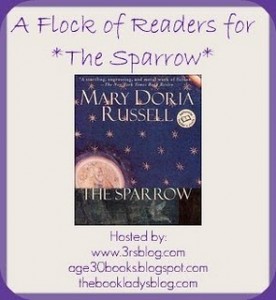
Getting to this book has been a challenge! I meant to go through it slowly but I’ve actually been enjoying it a lot, so even though it took me a few days to read, that has no bearing on my experience. Heather at Age 30+ Books has provided a few questions for us to answer. Unfortunately my answers are not very detailed; my mental energy isn’t doing a fantastic job recovering from working all day.
1. For first time readers, how does your reading so far match up to what you expected from this book?
I think it’s pretty consistent. I expected a science fiction novel with deep characterization, and that’s pretty much what I got. It’s an intriguing combination and I like it a lot.
2. This book is set in a not-so-distant future in which the balance of world power has shifted from the United States to Japan. Poverty, indentured servitude, ghettos, and “future brokers” are common. Based on this projected future, would you classify this novel as dystopian? Do you think this future is a real possibility based on where the world is today?
I’m not sure about the dystopian question. It didn’t feel like one, there wasn’t really a very effective governmental overlord and with the exception of Sofia, how much were the characters repressed? They spoke their minds and went on a secret space mission, after all. Ghettos, poverty, and slavery still exist in our world, too. I do think the future progression is a real possibility, but no one can ever predict the way things will go, as you can tell just from erroneous predictions over the years.
3. From the beginning of the book we know that Something Bad happened during the mission but it takes until almost the end of the book for the reader to get the whole story. Do you think the author built the suspense to the perfect pitch or do you feel that she drew it out too long?
I think it was built to a perfect pitch. I wanted to know what happened but I also wanted to fall in love with these people. I loved spending time with them and knowing about the inevitable bad ending, I wanted it to last as long as it could. The suspense was definitely built up, but it wasn’t a race to the finish this time.
4. If you’ve gotten to the end, was the final truth one you expected or were you taken by surprise?
I was not really surprised by the nature of the final truth, but I hadn’t guessed the details. It was certainly effective and emotional.
I plan to review this book in the near future, so hopefully I’ll be better able to express my full feelings then. I just wanted to answer a few of the questions to show I’m still around for the group read! I hope around the time that it finishes I’ll have the internet at home again and be able to read more responses.
|
|


Recent Comments