|
|
 Welcome to my stop for the Classics Circuit Georgette Heyer tour! As a modern classic, this fit perfectly in with Classics Month, and it was also an absolute delight to read. Welcome to my stop for the Classics Circuit Georgette Heyer tour! As a modern classic, this fit perfectly in with Classics Month, and it was also an absolute delight to read.
 Celebrated dandy Sir Richard Wyndham is desperate to avoid marriage to a famed iceberg of a woman, who refuses to even consider love as a possibility between them. On the eve of presenting his suite to her father, he of course gets ridiculously drunk. On his stumble home, a young woman falls from a window, straight into his arms. She is trying to escape her own arranged marriage and is determined to get to her country house, where she can instead marry a friend. Richard decides to accompany her, and so begins a tale of hilarious adventure and, in the end, love. Celebrated dandy Sir Richard Wyndham is desperate to avoid marriage to a famed iceberg of a woman, who refuses to even consider love as a possibility between them. On the eve of presenting his suite to her father, he of course gets ridiculously drunk. On his stumble home, a young woman falls from a window, straight into his arms. She is trying to escape her own arranged marriage and is determined to get to her country house, where she can instead marry a friend. Richard decides to accompany her, and so begins a tale of hilarious adventure and, in the end, love.
Heyer’s Regency romances are among the most pleasurable books to read. Even when fraught with danger, theft, and compromise, like this one should be, they are still funny and sweet. This couple has a real adventure and it’s obvious that they adore each other as well as the unusual circumstances. As is fairly typical, neither of them realize that they’re in love until the end, but their relationship still manages to grow without them realizing it. And the character interactions really do sparkle. Heyer’s prose is obviously smart and witty and this book will have you smiling as you read it.
I also love that Heyer includes little historical details which more modern romance authors don’t always use to such magnificent effect, like quizzing-glasses and snuffboxes. And I’d never heard of a dandy referred to as a Corinthian before. I’d never heard the terminology anywhere else, but then I don’t generally spend too much time on this particular period in history. Even so, Heyer’s sense of the period is magnificent, and it’s easy to imagine yourself right there with the characters when reading one of her books. I was cheering for this couple from almost the moment they met, and it was utter delight to spend an evening with these people.
As far as Heyer’s Regency romances go, The Corinthian is definitely a good choice. It’s not particularly long, but it’s full of charm and wit, and is well worth a read.
I am an Amazon Associate. I borrowed this book from my local library.
 Tomorrow I want to leave my Georgette Heyer Classics Circuit review up, so I hope no one minds that I’m spending time in the Salon a bit early. Tomorrow I want to leave my Georgette Heyer Classics Circuit review up, so I hope no one minds that I’m spending time in the Salon a bit early.
As you’ll know if you’ve been hanging around my blog or twitter, I started a new job this past week. We successfully rented a flat in a week as well. I advise you not to do this, actually. It was incredibly stressful, and most of the stress landed on hubby who had a hard time getting me on the phone the first day while he was looking at places and then had some bad news. We ended up taking a six hour round trip to get some items the estate agents had neglected to tell us we needed right after my first day of work, which was fun. They told us it would take two weeks to be approved, but after some discussion discovered that it only actually needed to take three days if our employers were quick with our references. They were, and yesterday we got the keys. Now we’re in the process of moving and buying furniture, as this flat is bigger than our last one and we don’t own a lot of newly necessary stuff. We also have to decide whether to sell or rent out that last one.
My first week of work was interesting. I’m an SEO/social media analyst, but the copywriter half, so I mostly write things that search engines like, and then promote them on various social media sites. I am now in charge of maintaining and updating a good number of blogs. I fully intend to continue blogging here, but I was warned that I might get burned out on blogging if I do it at work all day and still have to do it at night. Still, this blog is for fun, not for selling stuff, and I think that different mindset will help encourage me. I’ve been enjoying my job to a degree so far. I like writing and I think I’m pretty good at it when I try, but getting used to doing it constantly is a bit intimidating and leaves my mind totally wiped out by the end of the day. Luckily this last week I’ve been working with the employee leaving this position, and he’s been very helpful. So I know what I’m doing, I just have to get on doing it. Everyone at work is very friendly and has made me feel really welcome, so I think I’ll enjoy working there eventually.
I’m also already reading vastly less. The only book I finished this week was The Sparrow, and seriously, if I hadn’t been so into that book I probably wouldn’t have finished anything at all. Our hotel room for the week was simply terrible – they lost my reservation on the first night, the lightbulb went out one evening and no one could find a replacement so I sat in the bathroom for a while, the bed had a peculiar plastic sheet on it and was uncomfortable anyway, the walls were so thin we could hear all our neighbors talking, and to top it off they began doing construction on the other rooms at 6 every morning. Oh, and they didn’t actually have internet, which made all of our arrangements much harder. I obviously have the internet at work, but I’ve been staying away from my personal sites during work hours.
I hope to do a lot of reading in the next two weeks while waiting for the internet to be connected in my new flat; it just depends how braindead I am! We haven’t had our TV hooked up yet either, so there isn’t much else we can do. I have reviews scheduled for the next couple of weeks, but I really have no time to comment on blogs at work. I tried briefly today but my GR was intimidating and I’m amazingly exhausted. Instead, I read some of Lorna Doone, which I WILL finish this month, and began The Boat to Redemption by Su Tong in my effort to complete all of my library books before maybe next weekend. By my return to steady blogging and commenting, I hope to have a routine in place so you won’t even notice that I’m working!
 Young lute player Blondel recognizes his luck when he is conscripted to play for the princess Berengaria, even when he longs to get away. Soon, however, he falls in love with Berengaria, and his disabled rescuer Anna, duchess of Apieta, falls in love with him. But Berengaria loves Richard of England, and has longed for his hand in marriage ever since she saw him play in a tournament. She’s determined to marry him, and all the players in this novel must bow to her whims, and eventually to the whims of Richard the Lionhearted as he attempts to fulfill his life goal of crusading. Young lute player Blondel recognizes his luck when he is conscripted to play for the princess Berengaria, even when he longs to get away. Soon, however, he falls in love with Berengaria, and his disabled rescuer Anna, duchess of Apieta, falls in love with him. But Berengaria loves Richard of England, and has longed for his hand in marriage ever since she saw him play in a tournament. She’s determined to marry him, and all the players in this novel must bow to her whims, and eventually to the whims of Richard the Lionhearted as he attempts to fulfill his life goal of crusading.
This book definitely fell victim to my recent avoidance of historical fiction. I still love medieval history, but it’s gotten to the point where I’ve read so much that I’ve really heard it all before, particularly with regard to the most popular periods in history. As I was reading this book, for example, I could hear my undergraduate professor telling me all about the crusades, about Saladin and Richard, and about Berengaria and how Eleanor of Aquitaine brought her across various countries just to get Richard to marry her. When I’m seeking something fresh and new, I don’t particularly want to read something where I know what’s going to happen. Of course I didn’t know all the details, but I’m just trying to express my own frustration so it doesn’t put others off reading these books.
And as medieval historical fiction goes, this isn’t a bad choice at all. Told through alternating viewpoints, the reader gets a full picture of a twelfth century crusade, as well as life in Spain and eventually England. The history is a little dated since the book came out in the 50’s, but I don’t think anyone else would really notice since most of the ideas are still the same, and her account of the crusade is surprisingly accurate. I was pretty sure that Richard had an illegitimate son, and Wikipedia agreed with me (with reliable sources), so perhaps no one had investigated that yet. The writing, however, doesn’t feel at all dated, and I could easily imagine this book coming out today as new. As ever, the crusade is the most interesting part of the book for its sheer oddity.
I found some of the characters defied belief somewhat; it’s impossible to imagine Berengaria actually attempting some of the things she does for a man she hadn’t ever spoken to, who was barely aware of her existence, for example. My favorite was Anna Apieta, typically the most fictional of them all, but she was a fascinating character. She is crippled from birth, but she’s been given advantages because she’s the illegitimate daughter of a king, and so she’s much more aware of the plight of the poorest people than any of the others, and she has a great deal of sympathy. I could never blame her for her bitterness and frustration towards Berengaria, because who wouldn’t struggle to be constantly in the presence of a beautiful half-sister? Her ability to stay with that half-sister through many trials is admirable and makes her by far the strongest character in the book.
Overall, if you do enjoy historical fiction set in the medieval period, I think you could hardly go wrong with The Lute Player.
I am an Amazon Associate. I received this book for free from the publisher for review.
 This is book 9 in the Sookie Stackhouse series (and thus completes the challenge for me. Yay!). For the first book in the series, see my review of Dead Until Dark. This is book 9 in the Sookie Stackhouse series (and thus completes the challenge for me. Yay!). For the first book in the series, see my review of Dead Until Dark.
The weres are finally coming out to the world, and Sookie stands by as her friend and boss Sam changes in front of all the bar patrons where Sookie works. Not everything about the reveal goes well; Sam’s stepfather shoots his mother when she tells him that she’s a were, for example. But even worse happens when Crystal, Sookie’s brother’s cheating pregnant wife, turns up crucified in the bar’s parking lot, with parts of her in panther form. Sookie wants to exonerate Jason, but she has other problems, namely that she’s caught in the middle of a fairy war, and half of them want to kill her.
As with all the books in the series, I enjoyed this book. I finally found it in the library (these books are very popular and they only have one copy) and dove right in, finishing it the same day. I do think it was better than book 8, which seemed sort of random. This one is put together more coherently and all the plot elements are, amazingly, related. Things change a lot in Sookie’s world, too. The outing of the weres is not particularly smooth, and the fairy war is difficult for Sookie to deal with given that no one believes in their existence except for supes.
For perhaps the first time the simple writing grated on me; even though I enjoyed the book, I wondered how often I really needed to hear about Sookie slicking up her ponytail or putting on her barmaid outfit or putting her purse in the spare drawer in Sam’s office. I think this is because I’d just finished the fantastic Kate Daniels series, which doesn’t really have any of that going on. And I noticed that even though violence happens, it’s hardly described, and doesn’t necessarily give off the same horrific feel. I think that’s why these are comfortable rather than scary given the subjects dealt with, and even though a lot of bad things happen, I wasn’t really that worried about the characters, though perhaps I should have been. I was also really disappointed that the tantalizing ending in book 8 just wasn’t at all expanded upon, and it’s like the author just dropped that plotline except for a short mention. And I was glad that Eric and Sookie seem to be having a relationship, but then Eric went and shared a whole lot of information about his past in the bar, which struck me as odd, and also that Sookie doesn’t even care that he’s now controlling her life. She’s more obsessed with the blood bond than trying to figure out why she likes him suddenly, and I was a little tired of hearing about that, too. Have to say I may have even liked Vampire Bill better in this book! He was given a lot of great lines and I think he’s gone very far in trying to prove himself.
In short, I can’t say Dead and Gone was the best installment in the series. I have to wonder if it’s ever going to end, because it certainly doesn’t seem to be heading for an ending, and ten books is a lot for a series. I will continue reading it through the library, though, and I look forward to the release of book 10 this year.
I am an Amazon Associate. I borrowed this book from my local library.
These are books 2 and 3 of the Kate Daniels series and these reviews may contain spoilers for the first book. See my Magic Bites review for book 1.
 Magic Burns Magic Burns
Normally, magic and tech waves alternate in Kate Daniels’ Atlanta. This time, however, a magic flare is coming, which means that every magical situation gets even more dangerous. Gods can walk the earth and magic users have more power than they imagined possible. Kate’s mission starts simply, with retrieving some stolen maps for the Pack, the weres. But then she finds a teenage girl whose mother is missing, a man who can disappear at will and regenerate body parts, and a strange hole in the ground. Kate discovers that two gods are struggling to take a place on earth, and she’s caught right in the middle.
As with the first one, I liked this book. The additional character of Julie was a great touch and allowed a softer side of Kate to be exposed. She’s a properly tough girl and it’s hard to get in to her real self, but Julie is clearly paving the way. I also thought the book had an appropriate dangerous feel, and it’s all very dark. Andrews doesn’t spare any details, unlike some other urban fantasy novelists, and the world gives off a feel of neglect and violence. A good addition to the series, I thought, and I wanted to pick up the next one immediately. I also like the sort-of growing relationship between Kate and Curran. It’s strange, but I was definitely curious as to where it was going.
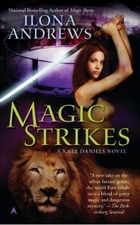 Magic Strikes Magic Strikes
Kate now works for the Order of Knights of Merciful Aid, and she’s been very busy as a consequence, not only working but avoiding werelion Curran. She can’t avoid the weres forever, though, especially when her friend Derek is discovered nearly dead, and no one knows if he’ll recover. Kate has to investigate the Midnight Games, a dangerous illegal operation, in an attempt to figure out what’s wrong with him. The game is much larger than that, and involves someone Kate wishes she’d never have to deal with again.
Whereas I liked the two previous books in this series, I loved this one and it may actually have become my favorite urban fantasy series in the space of one book. About halfway through, I realized I adored these characters. I love Kate’s blend of badass snark and wishing for something else that she’s convinced herself she can’t have. The interactions between all of the major players shine, and I now am a huge fan of the possibility between Kate and Curran. Their relationship has proceeded in such an out-of-the-ordinary way, but it’s exactly that which I like. And the story here was just so enthralling and for a 300 page book, had an amazingly epic feel, which of course is a huge draw for me. It’s desperate and violent but I was glued to the page, heart pounding. Kate’s backstory is revealed and a lot from the previous books starts to make sense, including her attitude. And with all of this is Kate’s trademark humor which had a smile on my face, even when she was hurt so badly she couldn’t move. It’s a perfect blend. I don’t know how I’m going to wait until May for Magic Bleeds but I’m so glad I started reading this series, and I have a feeling I’m going to read everything the husband and wife team of Ilona Andrews writes.
I am an Amazon Associate. I purchased these books.
 After Emily Benedict’s mother dies, she goes to live in Mullaby, North Carolina, the hometown that Dulcie Benedict left behind and never discussed, with the grandfather she never knew she had. Emily wants to learn more about her mother’s past, but in the process she finds a house where the wallpaper changes, where lights dash through the forest behind her house, and where some people have a “sweet sense” and can see cakes being baked. Emily’s neighbor, Julia, a former outcast, does her part to help Emily adjust to the knowledge of her mother’s past, but she has to face some demons of her own. After Emily Benedict’s mother dies, she goes to live in Mullaby, North Carolina, the hometown that Dulcie Benedict left behind and never discussed, with the grandfather she never knew she had. Emily wants to learn more about her mother’s past, but in the process she finds a house where the wallpaper changes, where lights dash through the forest behind her house, and where some people have a “sweet sense” and can see cakes being baked. Emily’s neighbor, Julia, a former outcast, does her part to help Emily adjust to the knowledge of her mother’s past, but she has to face some demons of her own.
While I found Allen’s last offering, The Sugar Queen, to be a little too sweet, I thought this book found the perfect balance. I loved all the characters, even if they’d made mistakes in their past. Julia’s story in particular I found to be heart-wrenching, but she had me cheering for her throughout the entire book. She has a more mature story, knowing all the town’s secrets, while Emily has a lot to learn. There are two separate love stories in the book, but neither is really given much preference and both are wonderful.
I also really enjoyed the doses of magic spread throughout. They never seem out of place, but fit beautifully within the story and add to it, not at all taking away from the feelings or personalities of the characters. The Girl Who Chased the Moon never feels unrealistic or absurd. It is fairly light fiction but I loved it and I’m very much looking forward to further books from Sarah Addison Allen.
I am an Amazon Associate. I received this book for free from the Amazon Vine program.
 In the spirit of Sherlock Holmes, David Grann attempts to solve 12 mysteries that have stymied the public and even the police force. He also looks at the nature of obsession, traveling with a scientist who is determined to catch a giant squid, investigating the strange death of a Sherlock Holmes addict, and talking with a family all employed in building New York City’s newest aqueduct. The stories are wide-ranging but are joined by common themes of death, obsession, and madness. In the spirit of Sherlock Holmes, David Grann attempts to solve 12 mysteries that have stymied the public and even the police force. He also looks at the nature of obsession, traveling with a scientist who is determined to catch a giant squid, investigating the strange death of a Sherlock Holmes addict, and talking with a family all employed in building New York City’s newest aqueduct. The stories are wide-ranging but are joined by common themes of death, obsession, and madness.
This collection really runs the gamut of interest. Some of the mysteries were absolutely fascinating and occasionally heartbreaking. For example, the Sherlock Holmes obsessive is the first case featured in the book, and not only is the guy’s life story interesting, but his death is genuinely a mystery. And I had no idea about any of New York City’s water problems, let alone the men who actually risk their lives down there to build a new gigantic pipeline (with protests from the very people that this pipe is going to help, no less!). But some of the stories aren’t really mysteries. I had no interest in the white supremacy group that killed people in the prisons, and it didn’t seem like all that much of a mystery to me. Nor did Haiti’s “devil” Toto Constant – and that wasn’t a particularly interesting story, either.
Throughout, the writing is smooth and very readable. Some of the mysteries had me turning the pages quite rapidly to find out the truth. It helps that Grann went to talk to many of the people featured, and it’s clear that he’s been working on the stories in this book for a long time. He definitely brought their situations to life.
For some people, these stories might all be interesting, but I think for most this is a book to pick and choose from. If The Devil and Sherlock Holmes sounds interesting to you now, I guarantee you’ll enjoy several of these well-written accounts.
I am an Amazon Associate. I received this book for free from the Amazon Vine program.
I had some big news this week. Namely, I actually got a full-time job! I know, it’s a little crazy to think about, and apologies to those who follow me on twitter because they know all this already. I didn’t mention the interview because I didn’t want to jinx anything this time. I’m starting on Monday, but because we’re relocating, I’ll be in a hotel all week while we attempt to find and rent a place for the foreseeable future. Things will still be a little tight while we are paying for two places (we own the place we live in and we still have to put it up for sale) but not nearly as bad as they’ve been. We might actually be able to save money in a few months. Hard to believe, isn’t it?
What does this mean for you, the person who reads this blog? (Thank you so much for that, by the way!) I hope not too much in the long run. I expect I’ll have far fewer reviews going up, since I can’t imagine I’ll keep up my reading pace in full-time employment. This is my first full-time job so I genuinely have no idea how it’s going to go, how stressed I’ll be, etc. But I’ll certainly be reading. Since we’re moving, we are probably not going to have internet for a few weeks, so I don’t think I’ll be able to comment much after this week until we have it at home. I expect I’ll still be getting blog posts up (especially since I have most of the next two weeks scheduled except for classics reviews), since my job involves the internet and I do have breaks, but I won’t have time to go through GR every day like I try to do now.
This week (and next week) I’ll be attempting to finish all of my current library books and also continue with my last two weeks of classics, so I’ll be reading:
- Virginia Woolf, by Hermione Lee
- Woman, by Natalie Angier
- Germinal, by Emile Zola (for a Classics Circuit tour in April)
- The Boat to Redemption, by Su Tong
- The Uninvited, by Geling Yan
- The Curious Incident of the Dog in the Night-time, by Mark Haddon
- East of Eden, by John Steinbeck
- Villette, by Charlotte Bronte
- Lorna Doone, by R.D. Blackmore
- Barchester Towers, Anthony Trollope
And now I see how overambitious I am – hah! Can I still read five books a week while working full-time? I doubt it. I remember how stressed and tired all of my already-working friends were when they started, and I’ve had months of virtually no responsibility. I know it will be hard to get used to. Luckily three of these books are already in progress and I have a couple of lengthy car rides coming up. So wish me luck!
 On her search for a harpsichord, Madeline Goold comes across a square piano in an antique sale. While not playable, it’s in surprisingly good condition, and after taking note of its serial number, 10651, she sends it off for repair and decides to find out who owned it. Her search leads to a delightful and sometimes sad history of the Langshaw organists, father and son, as well as of Broadwood pianos in general and the effect the square piano had on music for the English public. On her search for a harpsichord, Madeline Goold comes across a square piano in an antique sale. While not playable, it’s in surprisingly good condition, and after taking note of its serial number, 10651, she sends it off for repair and decides to find out who owned it. Her search leads to a delightful and sometimes sad history of the Langshaw organists, father and son, as well as of Broadwood pianos in general and the effect the square piano had on music for the English public.
I didn’t expect much from this book, but it really was fascinating. Goold’s 1807 square piano leads her to a goldmine of information. I know very little about the history of the piano, and she comfortably filled in the blanks and provides a great bibliography for further information. I love it when historians use a small detail to examine the wider history, and that’s precisely what Goold does here. She links successfully the buyer of her square piano, Mr. John Langshaw, with the Broadwood family and their history of harpsichord and then piano making, and further expands to cover the transition from harpsichords to fortepianos and what it did to music. All of it was fascinating.
The most interesting section for me was about the Langshaw family. The elder Mr. Langshaw was disabled and thus forced to choose a different career than his father. He chose music and became a moderately successful organist, at least successful enough to educate his children, particularly his oldest son John. John followed in his father’s footsteps to become an organist, but he also had links with London and may have met the Broadwoods, from whom he commissions pianos for clients in his area. She uses copious quotes from letters to establish his history, and as such it’s almost as though I got a peek into his mind. Their family story is not always cheerful, and the piano was probably not even for them, but Goold speculates to some extent in this direction. She acknowledges that we’ll never know the answer because the relevant records have been destroyed, but her ideas are nonetheless intriguing and plausible.
Goold also links the history with well-known composers and even uses comparisons with Jane Austen to demonstrate the importance of the piano. Cheaper pianos meant newly emerging middle class families could buy the basic models, and piano playing became an important skill for young women, even if they were never permitted to play for public audiences. I loved the way she used the piano to explore the entire culture.
I suppose the only thing that keeps this book from being perfect are the few sections in which Goold attempts to fictionalize various aspects of the Langshaws’ life. She’s not a fiction writer and these few sections, italicized to separate them from the main body of the text, make that very clear. I have to say I skipped over them after the first few, because her regular writing is much smoother and the facts were much more interesting for me than her attempts to picture the scenes.
Mr. Langshaw’s Square Piano is a very interesting little book and I would highly recommend it to anyone interested in the history of music or Jane Austen’s England. I had a great time reading it.
I am an Amazon Associate. I received this book for free from a publicist for review.
 The Ramsay family travels to Skye, a small Scottish island, in the summers, their large house bursting with childish games and guests invited to stay. Towards the end of their stay, unfortunately, six-year-old James has still not been to visit the lighthouse, but the visit is promised for the next day. That promise is not fulfilled until ten years later, in the final stage of the novel, where the nearly-adult James finally gets his chance to see the long awaited lighthouse, when everything in his life is completely different. The Ramsay family travels to Skye, a small Scottish island, in the summers, their large house bursting with childish games and guests invited to stay. Towards the end of their stay, unfortunately, six-year-old James has still not been to visit the lighthouse, but the visit is promised for the next day. That promise is not fulfilled until ten years later, in the final stage of the novel, where the nearly-adult James finally gets his chance to see the long awaited lighthouse, when everything in his life is completely different.
On its own merits, I loved this book. I really like the way Virginia Woolf writes. Maybe because I’d never heard enough about her to be intimidated, I fell in love with her writing style in Mrs. Dalloway and clearly that hasn’t changed with the passing of a few years. It takes a little more effort, but I find her writing to just flow perfectly in line with my own thoughts. I think she captures the vagaries of the human mind better than any other writer I’ve ever read. And the characterization here was so interesting – in so few pages she builds genuine feelings from all these characters towards one another. And the middle section – the way time moves on no matter what happens in people’s lives – is masterful and awe-inspiring.
I found it even more interesting, though, when I started reading Hermione Lee’s biography of Woolf. Much of this novel can be read as autobiographical, and apparently the author and her sister interpreted it precisely that way. I’ll have a lot more to say about that biography when I finish it, but I immediately wanted to start this over and look at it from that way. I can already tell that this is a book which will only improve on re-reading, now that I can pick up nuances and already know what happens. But I suspect all of Woolf’s writing will be like that.
This is only a short review, but it’s impossible to put all I felt about To the Lighthouse into words, honestly. Her work just feels so true to me. I immediately wanted to read it again – and I would definitely recommend it to anyone with a little patience to get used to her style.
|
|



Recent Comments