|
|
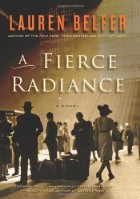 Claire Shipley, a divorced single mother, is a photographer for Life magazine. With the United States on the cusp of, and then deep into, World War II, she has plenty to photograph, but one story captures her devoted attention. It’s the development of penicillin, the miracle antibiotic which has the potential to save lives. After losing her daughter to septicaemia at the age of 3, Claire knows all too well what a difference this drug could make in people’s lives, but it’s incredibly difficult to manufacture and impossible to synthesize – moreover, the government has mandated that penicillin be affordable and patent-free. That means the drug companies are dangerously eager to research more profitable alternatives, and they’re not afraid to hurt the people Claire loves to get their hands on that potential. Can she balance telling the story with keeping her family safe? Claire Shipley, a divorced single mother, is a photographer for Life magazine. With the United States on the cusp of, and then deep into, World War II, she has plenty to photograph, but one story captures her devoted attention. It’s the development of penicillin, the miracle antibiotic which has the potential to save lives. After losing her daughter to septicaemia at the age of 3, Claire knows all too well what a difference this drug could make in people’s lives, but it’s incredibly difficult to manufacture and impossible to synthesize – moreover, the government has mandated that penicillin be affordable and patent-free. That means the drug companies are dangerously eager to research more profitable alternatives, and they’re not afraid to hurt the people Claire loves to get their hands on that potential. Can she balance telling the story with keeping her family safe?
This was a fascinating book. I knew that penicillin, and the other antibiotics we have today, was a game-changer for human life as it stood, but I’d never thought about it from this perspective. The idea that a scratch or a blister could end up killing a person is completely foreign to most of us now. I’ve never had an infection from anything; we even have antibiotic bandages and soaps. Viewing the world from Claire’s perspective, with her full knowledge that this could indeed save lives, was breathtaking and added a layer of intensity to a story that, for me, was already compelling.
That’s because Claire’s emotions don’t remain detached from the story for long. She falls in love with a handsome doctor in charge of the initial tests after photographing him at his work. This makes the hunt for antibiotics personal and close to home; moreover, Claire’s own father, absent from nearly all of her life, begins to make more of an impact on her, leaving her to make tough decisions that affect both her life and that of her son Charlie.
I found all of the characters in the book to be interesting, really; I enjoyed a turn in each of their minds. The book occasionally shifts perspective strangely, because it’s written completely in third person, but it doesn’t happen often enough to be a problem. It’s certainly worth considering everything from each of their perspectives, as in some ways the book is a deeper look at what motivates people to commit certain acts that are either condemned or praised. Life is not black and white, and it certainly isn’t here.
Written thoughtfully, with sympathetic and deep characters, against a truly fascinating backdrop, A Fierce Radiance is one for the historical fiction fans amongst us. And it’s still relevant; after all, with the over-prescription of antibiotics, we may well return to a world where each and every scratch could be a death sentence. Recommended.
All external book links are affiliate links. I received this book as a gift from Kathy. Thanks again, Kathy!
I built up a little review backlog while I was away, even though I didn’t get a vast amount read. To clear up some of this, here are a few completely unrelated brief mini-reviews. Actually, they are related in one aspect; these are the books I read when I’m stressed and solely seeking pleasure.
 Leviathan Wakes, James S.A. Corey Leviathan Wakes, James S.A. Corey
I’m always in the mood for an excellent space opera, and Corey’s debut was lauded by many of my favourite SF bloggers. James S.A. Corey is actually a pen name for Daniel Abraham and Ty Franck, who collaborated on the book, and I’ve actually been meaning to read Abraham for some time now. This seemed like a fantastic chance, and it was indeed a good and gripping book, a surprisingly fast read for its imposing size, and a relatively satisfying story. It felt, in places, a bit detective noir, which was probably my only actual issue with it, as I’m not a huge fan of that particular genre, but there was enough Firefly-esque space opera to keep me very happy indeed. The authors are clearly going for that group crew vibe and, for the most part, succeed nicely, with some interesting characters and relationship dynamics. I’d recommend it to someone looking for more character-driven sci fi with a mystery attached.
 And Then He Kissed Her, Laura Lee Guhrke And Then He Kissed Her, Laura Lee Guhrke
This was a fantastic romance – set between a working girl turning 30 and her oblivious boss in Victorian England, it did an excellent job of showing how people hide parts of themselves from others and how romance can slowly grow. Emma has always wanted to be a writer, and so she works for a publisher, Harry – but he’ll never read her work, a book of advice, because it’s written for women and outside of his interest completely. When she turns 30, she gets fed up and decides to go after her dreams, teaching Harry to look at the world outside of his box in the process. I loved it and I immediately bought the next in the series.
 Spider’s Bite, Jennifer Estep Spider’s Bite, Jennifer Estep
I’m never opposed to more urban fantasy in my life, and this is a series I’ve been eyeing for a while. A lot of people have called Estep’s Elemental Assassin a favourite, so I decided that, as I’m still waiting for new installments in several of my own favourites, that I’d take this one on as well. I immediately liked it; Gin is an assassin who really doesn’t have any problems at all with her job, until someone targets her nearest and dearest for an attack. A quick and enjoyable read which had me ready for the next in the series, and which has satisfactorily filled the gap while waiting for my favourite UF authors to write more books!
All external book links are affiliate links. I purchased all these books.
 How can one write a history of the entire world? It’s not an easy task, and could never be accomplished by a single being. Dr. Neil MacGregor has opted to take the approach of presenting 100 objects from the British Museum, in chronological order, which pick out some of the strands of civilization’s history and which attempt to show us how everything is related and interwoven. How can one write a history of the entire world? It’s not an easy task, and could never be accomplished by a single being. Dr. Neil MacGregor has opted to take the approach of presenting 100 objects from the British Museum, in chronological order, which pick out some of the strands of civilization’s history and which attempt to show us how everything is related and interwoven.
This is a very intriguing book, although as you would expect, it really only scratches the surface and is very, very top-level. The 100 objects are grouped in five for each chapter and tend to come from all over the world. It’s rare for there to be two objects from similar European countries, for example; this does provide a really interesting view of history as we can see what’s happening around the world all at once, even if that is at a surface level.
The objects in the book spread from civilization’s earliest hours to the present day, including a credit card and a solar-powered lamp. Even the author comments on how our choices of what may reflect our society today will not necessarily be the choices made in 100 years, and perhaps the curator in 2112 will be as intrigued by those selections as any others. History, it is fascinating, even more so when you consider the fact that it is happening all around us all the time.
All of the objects included are at the British Museum in London; they’re marked in the museum itself, so you can follow through and try and find all 100. I’m not sure if they were all on display, but I did visit a few on a recent visit to London. For example, here are the Lewis chessmen:
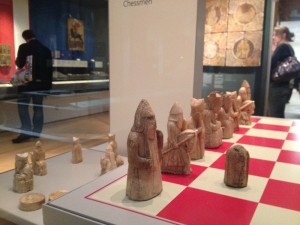
Even though the book has a gorgeous, full colour image of each object, it was still exciting to see a few of them in person, although not exciting enough for me to trek around the entire museum for it.
The British Museum is also a perfect subject because, in many ways, it reflects the overarching theme of a dominant culture taking over smaller ones, something that keeps happening throughout the book with lost civilizations. Sometimes their voices are heard again, as in the case of the Rosetta stone, but sometimes they are truly lost, and we can only speculate. The museum itself is a remnant of Britain’s imperial past, and these treasures may have been contested; the simple fact that they’ve ended up in London from all parts of the globe is a tale worth telling, and which is told for quite a few of them.
I spent a considerable amount of time with A History of the World in 100 Objects and I found it to be a fascinating read, easily digestible in chunks given the nature of the chapters. Not for anyone looking for an indepth history, but for a thoughtful overview, this is perfect.
I purchased this book.
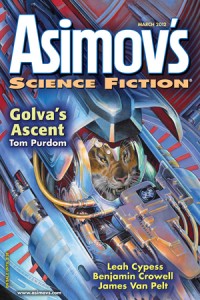 I’ve decided to subscribe to Asimov’s on my Kindle and decided to write very brief thoughts on the stories in this and any other magazines I might choose to read in the future. I think “Short Story Saturday” is probably owned by someone but no one I follow; please let me know if I’m stealing your feature so I can give you credit! I’ve decided to subscribe to Asimov’s on my Kindle and decided to write very brief thoughts on the stories in this and any other magazines I might choose to read in the future. I think “Short Story Saturday” is probably owned by someone but no one I follow; please let me know if I’m stealing your feature so I can give you credit!
My very first short story – or “novelette” as the magazine calls it – in years was The Way of the Needle by Derek Künsken. Both a thriller and a contemplative story about loyalty and friendship, the beings in this novelette have developed under the heat of microwaves. They’re made out of needles and feed one another in a relatively strict hierarchy. Mok, a Follower of the Needle, an order of martial priests, has a reputation to make and an assassination to carry out. On his way, he meets a slave, who he must befriend to make his way to the upper echelons of the palace and his assassination target …
I absolutely surprised myself by how much I delighted in this story. I loved every bit of it, from the weird world to awkward, half-arrogant Mok, to the actual ending of it. It felt quiet, just the way I like, but so powerful – and you’d never really imagine that spiky metal creatures soaking up microwaves could really do that, but these did. Brilliant – this story had me absolutely eager to read the rest of the magazine and reinforced my feelings that science fiction is still my current obsession.
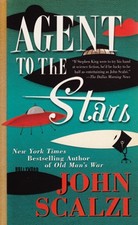 Tom Stein is finally achieving some success for his superstar client, Michelle, in between teasing his stern assistant, Miranda, and bowing down to his boss, Carl. He’s not expecting what Carl lands him with next; no less than the position as agent to the world’s first alien contact. The Yherajk are blobby, morphable aliens with personality, and the one that has come down for exposure to the masses is Joshua. Tom is charged with representing Joshua and somehow earning him a place in pop culture, facing the biggest and most potentially rewarding challenge of his career – and for humanity. Tom Stein is finally achieving some success for his superstar client, Michelle, in between teasing his stern assistant, Miranda, and bowing down to his boss, Carl. He’s not expecting what Carl lands him with next; no less than the position as agent to the world’s first alien contact. The Yherajk are blobby, morphable aliens with personality, and the one that has come down for exposure to the masses is Joshua. Tom is charged with representing Joshua and somehow earning him a place in pop culture, facing the biggest and most potentially rewarding challenge of his career – and for humanity.
I’ve felt very much into science fiction lately, but because this is all fairly new, I don’t actually have very many books in my TBR bookcase that actually fit the bill. Years of historical fiction isn’t cutting it for me right now. So the book sitting by John Scalzi on my shelf – even if humorous rather than the sort of epic I was craving – was the best possible option.
In the introduction, Scalzi writes that this was his first book, his attempt to find out if he could actually write a novel before he tried to get published. Once his books took off, it made sense to dust it off and actually publish it, and that’s roughly how it landed in my hands. The book is full of trademark Scalzi wit, and it’s really obvious as a reader of his blog that it’s his voice coming out through the characters. I find this with almost all of his books these days, and I can’t say I really mind. I’m used to his voice, and I find him very amusing.
That said, this was different regardless as it’s set in the present day, amongst superstars and ordinary working folk alike. I actually liked the setting and the concept, and I found the book to be a fantastic ride. It’s not particularly deep, and it’s relatively predictable, but I think the fun factor is probably precisely what Scalzi was going for here. How much more ridiculous can you make the first alien encounter? I loved the Yherajk, they were truly a great concept for a race of aliens, and I think the book really shows off how Scalzi’s wild mind works.
It’s also a very speedy read – it’s only a short book – and works well as the standalone it is. I often feel there isn’t enough standalone fiction like this – there is the compulsion to turn everything into a series now. While I love series, I also love a book that resolves itself at the end like this one.
I can tell you that I’m now definitely looking forward to reading more of Scalzi’s humorous books as well as his deeper Old Man’s War style reads, but I’d easily recommend both. Agent to the Stars is also not what I’d imagine as a science fiction novel, so it’s a great taster for those who aren’t sure if they’d like the genre or not.
All external book links are affiliate links. I purchased this book.
 By no fault of his own, twelve-year-old Jack is one of the most ostracized boys in town, and all because of his last name. The Witcher family are considered white trash, and even though Jack is smart, fair, and honest, he is tarred by the same brush that affects all his family. It’s harder for sensitive Jack, who has to deal with all of the follies of adolescent life at the same time he’s shunned by the people who he longs to be friends with. The fact that his brother is suspected of murder doesn’t help. How can Jack reconcile his feelings for his family with his longing to be accepted for once in his short life? By no fault of his own, twelve-year-old Jack is one of the most ostracized boys in town, and all because of his last name. The Witcher family are considered white trash, and even though Jack is smart, fair, and honest, he is tarred by the same brush that affects all his family. It’s harder for sensitive Jack, who has to deal with all of the follies of adolescent life at the same time he’s shunned by the people who he longs to be friends with. The fact that his brother is suspected of murder doesn’t help. How can Jack reconcile his feelings for his family with his longing to be accepted for once in his short life?
If Jack’s in Love may be the first Amy Einhorn book that I didn’t outright fall in love with myself. Not that it’s a bad book, really; it was fine, and I enjoyed reading it, but it wasn’t that compelling or earth-shaking for me. I was easily able to put it down and come back to it later, and as I read it a while before I wrote this review, parts of it have faded quickly from my mind, so I’m afraid I didn’t find it all that memorable, either.
But there were certainly parts that I did enjoy – for instance, I liked Jack’s character, although the rest of them I was happy to take or leave, and I found the perspective of his struggle to be really interesting. He’s on the inside of a classic “white trash” family, but he sympathizes with both them, especially his mother, and the family whose son has disappeared. It’s seeing two halves of the coin which draws me in to books like this, and which also makes me a little more disappointed that I didn’t find myself loving it.
The book is set in the American south in the 60’s and 70’s, so there are also hints of the racial divide; for instance, Jack’s father is friends with a black man who lives in a certain district, and Jack’s older Jewish friend Gladstein lives in the same place. But that’s about the extent of these tensions; Jack’s love for Myra, the murdered boy’s younger sister, dominates most of the book. This is the part where the book really fell down for me; I didn’t like their romance much at all, and I didn’t believe in them as a couple no matter how young. There were too many barriers, and while a good book would be all about knocking those down, I wasn’t feeling it here.
Anyway, many others have enjoyed this book considerably more than I have; visit the Book Blogger Search Engine for many more reviews. While If Jack’s in Love had its moments, I ultimately found it to be disappointing; regardless, I’ll be looking out for Wetta’s further work as he has a lot of potential.
I purchased this book.
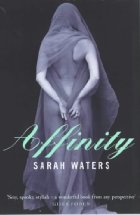 Margaret Prior’s spinsterhood is about to be thrown into glaring relief. Her sister is getting married and her brother has long been wed to Margaret’s friend Helen. As a lady, living in Victorian London, it’s considered an excellent idea for her to devote her time to charitable works. She’d once hoped to spend that time helping her father with his studies, but on his death, her choices have narrowed. She chooses to become a Lady Visitor to Millbank Prison, hoping that her visits will cheer up the inmates. At the prison, she meets Selina Dawes, a spiritualist medium who captivates Margaret almost immediately. As Margaret’s fixation with Selina grows stronger, she begins to fantasize about freeing her, and experiencing a life she’d thought long beyond her reach. Margaret Prior’s spinsterhood is about to be thrown into glaring relief. Her sister is getting married and her brother has long been wed to Margaret’s friend Helen. As a lady, living in Victorian London, it’s considered an excellent idea for her to devote her time to charitable works. She’d once hoped to spend that time helping her father with his studies, but on his death, her choices have narrowed. She chooses to become a Lady Visitor to Millbank Prison, hoping that her visits will cheer up the inmates. At the prison, she meets Selina Dawes, a spiritualist medium who captivates Margaret almost immediately. As Margaret’s fixation with Selina grows stronger, she begins to fantasize about freeing her, and experiencing a life she’d thought long beyond her reach.
I’ve been thinking about this book ever since I read it – it’s wrapped its way into my head and hasn’t left yet. Sarah Waters never fails to disappoint me with thoughtful, intense books that provide excellent stories, well-rounded characters, and real issues that hover about in my head.
Let’s start with the spiritualist nature of the book, and of Selina herself. Victorians were incredibly keen on ghosts and talking with people who had passed on. In the book I just reviewed, Arthur and George, Julian Barnes also sees Sir Arthur Conan Doyle in this light, a little bit, but Affinity naturally goes into much more depth. Like Waters’s later book, The Little Stranger, this novel plays with the extent to which we can believe in characters who experience phenomena that is beyond their understanding. Selina sends Margaret flowers and locks of her hair, and seems to know far more about Margaret than is possible. Nurtured in that atmosphere, it’s easy for Margaret to believe in everything Selina tells her, which I think reflects the relatively common Victorian attitude to acceptance of the supernatural in their everyday lives.
Margaret also has to deal with the difficult reality of being a lesbian in a world that doesn’t really acknowledge their existence. I mean – we have trouble with this today, and over 100 years ago, the situation was much worse. Her first love, Helen, rejected her for the more traditional route of marriage to man – Margaret’s own brother. Now, Margaret is bereft, between the loss of her beloved father and her lover, leaving a massive gap that a girl like Selina could much more easily enter. After all Margaret’s been through, she’s longing for that love, that acceptance.
The story also alternates with Selina’s life before the prison, so we can learn a little bit about how she got there in the first place. Together with Margaret’s story, these two halves combine to make the final twist come to life as we understand it. That twist is something I sort of anticipated, given I’d been warned by Ana that the book was sad, but I didn’t understand what was going to happen until, finally, it did. It is incredibly effective and well done, regardless. I loved the way the book came together with everything making perfect sense – I don’t mind open endings, but there is something satisfying about a book that tells you where you stand.
Well-constructed, with excellent characters and spectacular atmosphere, this is a book that is well worth your time.
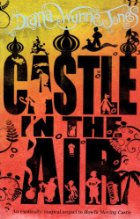 Living in a stall, selling carpets, is not really what one dreams of at night, no matter how successful. In Abdullah’s dreams, he is a prince, destined to marry a beautiful Arabian princess. But they’re just dreams, until one day, a merchant walks by Abdullah’s stall bearing a magic carpet. Abdullah can hardly believe his luck, even as he doubts the merchant, but he buys the carpet regardless and sleeps on it to ensure no one steals it. To his surprise, he wakes up in the garden of a castle, with a beautiful princess, Flower-in-the-Night, by his side. Abdullah quickly falls in love, but his dreams shatter when Flower-in-the-Night is stolen by a djinn. He must travel far and wide, to another castle in a foreign land, to save his princess before she is wed to another. Living in a stall, selling carpets, is not really what one dreams of at night, no matter how successful. In Abdullah’s dreams, he is a prince, destined to marry a beautiful Arabian princess. But they’re just dreams, until one day, a merchant walks by Abdullah’s stall bearing a magic carpet. Abdullah can hardly believe his luck, even as he doubts the merchant, but he buys the carpet regardless and sleeps on it to ensure no one steals it. To his surprise, he wakes up in the garden of a castle, with a beautiful princess, Flower-in-the-Night, by his side. Abdullah quickly falls in love, but his dreams shatter when Flower-in-the-Night is stolen by a djinn. He must travel far and wide, to another castle in a foreign land, to save his princess before she is wed to another.
How I didn’t read Diana Wynne Jones until last year is a complete mystery to me. She writes the type of books that I would have completely fallen in love with as a young adult – not that this means I love them any less now, but my younger self could have spent days wading through her books, off in various dream worlds inspired by these books. I loved Howl’s Moving Castle, which I read last year, and so it’s no surprise that I also enjoyed Castle in the Air – though not quite as much.
This book felt very much like a fairy tale to me, though also distinctly reminiscent of the Arabian Nights series of stories, especially in the beginning. As Abdullah’s quest takes him off north, he meets a number of curious individuals who scramble this somewhat, including a renegade soldier, a cat who seems to turn into a massive feline when she or her kitten is threatened, and a genie in a bottle.
As his journey begins to come to an end, he starts to realize that everyone has put up an illusion of some kind, and nothing is quite what it seems – but none of this is at all bad for him or for those concerned. Diana Wynne Jones seems to take some pleasure in turning stereotypes on their heads while emphasizing core strong ideals with honorable characters, which makes these perfect reads for young adults.
Though the sequel to Howl’s Moving Castle, it takes a good long while for any connections to become obvious. They’re clear by the end, but this is very much its own book, and can be read on its own. (Although why you’d want to, I’m not sure.) It’s still a very good read, and I’m looking forward to continuing with the third of this series.
All external book links are affiliate links. I purchased this book.
 Humans will never stop trying to find a cure for death and disease. In Rhine’s world, scientists thought they’d figured it out – until they realized that the disease simply killed everyone, girls at 20 and boys at 25. Just four years before her inevitable death, orphaned Rhine is kidnapped from her twin brother and married to wealthy Linden with two other stolen sister-brides. Rhine longs for nothing more than to escape – the last thing she wants to do is bear Linden’s baby and spend the rest of her life under the thumb of his scheming, aging father as he attempts to find the cure for the disease that kills all of the perfect generation. Humans will never stop trying to find a cure for death and disease. In Rhine’s world, scientists thought they’d figured it out – until they realized that the disease simply killed everyone, girls at 20 and boys at 25. Just four years before her inevitable death, orphaned Rhine is kidnapped from her twin brother and married to wealthy Linden with two other stolen sister-brides. Rhine longs for nothing more than to escape – the last thing she wants to do is bear Linden’s baby and spend the rest of her life under the thumb of his scheming, aging father as he attempts to find the cure for the disease that kills all of the perfect generation.
I so badly wanted to like this book. It caused a huge splash when it came out, and I’m not capable of resisting dystopias that sound awesome – plus, when it arrived as part of my Secret Santa gift, signed and everything, I started reading almost immediately. Couldn’t resist. So maybe this is a case of expectations getting too high, or me reading too much amazing science fiction and fantasy over the past few months, but this book didn’t live up to my expectations.
First of all, I’m not one to question too much, especially in books like this; I’m really good at suspending disbelief and going where the author takes me. In this book, I had way too much trouble doing that, particularly because the book hammers the discrepancies into your mind. Rhine’s life before the kidnapping is terrible, and she says that she fares better than most in her home city of New York City. She and her brother get by, with both of them working, hiding from the kidnapping gangs that want to take Rhine away. Other orphans get shut out to die in the cold by these two, because they can’t support any more people.
But when Rhine arrives at Linden’s mansion, she is truly in the lap of luxury. She’s a prisoner, in theory, but a very well-treated one. What I don’t understand is why there aren’t poor orphaned girls banging down Linden’s gate trying to get into this life of luxury. Do they simply not know what awaits them? But why shouldn’t rich people tell them, so they have a choice of wives, instead of kidnapping and killing girls? Wouldn’t it be better to have a willing wife than one you had to kill sisters to get? Maybe someone else can explain this to me – not the obvious wealth disparity, but the fact that rich, single men are not in demand. And that they kill the wives that weren’t selected – surely they’d want all the women in the world alive to continue producing children?
The other aspects of the book were enjoyable – it was well-written and well-plotted as it kept me turning the pages – but the world-building simply didn’t make sense. Some of the blurbs compared it to The Handmaid’s Tale and implied that this is a future we could imagine happening, but to be honest, I couldn’t, so it lost the whole creepy point of dystopia where we can see what our world could become. I couldn’t see our world turning into this one, unfortunately, and the best writing in the world wouldn’t be enough to cover that lack.
So, Wither is an enjoyable quick read, but don’t expect to believe in the world.
All book links to external sites are affiliate links.
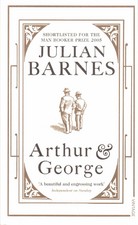 Arthur and George are born in Great Britain in the mid-19th century, but their lives couldn’t be any more different. Arthur grows up in Edinburgh, in a shabby but intellectual and loving family, becoming an eye doctor and then a world-famous author. George grows up in rural Shropshire, tortured by farmboys due to his dark Indian skin, but nevertheless persevering to become a published solicitor in Birmingham. George is one of many; Arthur is one in a million. But when George’s life begins to unravel completely, it is Arthur who must come to his rescue, in this deep exploration of race, prejudice, circumstance, and deeply-held beliefs. Arthur and George are born in Great Britain in the mid-19th century, but their lives couldn’t be any more different. Arthur grows up in Edinburgh, in a shabby but intellectual and loving family, becoming an eye doctor and then a world-famous author. George grows up in rural Shropshire, tortured by farmboys due to his dark Indian skin, but nevertheless persevering to become a published solicitor in Birmingham. George is one of many; Arthur is one in a million. But when George’s life begins to unravel completely, it is Arthur who must come to his rescue, in this deep exploration of race, prejudice, circumstance, and deeply-held beliefs.
Julian Barnes recently won the Booker Prize for The Sense of an Ending, which I immediately wanted to read, but since I had Arthur and George on my shelf, I decided it had to come first. To be honest with you, that was a brilliant decision, because I loved this book. It made me think on so many levels, while at the same time providing a cleverly told story set in a fascinating part of history.
The short description I wrote about probably makes it obvious that the Arthur is question is Sir Arthur Conan Doyle, ridiculously famous for creating Sherlock Holmes, a figure who resonates with us still so strongly that he’s having films and revival novels made about him. He’s less famous for his efforts to reform the law and grant justice to the wrongly accused. One of those cases was that of George Edalji, who is naturally the George in this book. Wrongly convicted of a series of horse murders and threatening letters, even though the letters threatened his own family and the mutilations continued when he couldn’t have committed them, George winds up in prison, and sends a letter to the author of the famous detective stories for help. Luckily for us – and Julian Barnes – Arthur came to help.
Knowing that this was a true story gave it particular resonance for me. The letters quoted within are real letters, including the threatening ones sent to George’s family. What was recorded has been included. Barnes has instead stepped into the minds of the characters and explored what these people might have been thinking and feeling.
In particular, this is a deep exploration of the injustice that was once inherent in the criminal system, but which invites us to work out our own prejudices in the process. We may not condemn George for his half-Indian heritage now, as these Englishmen did, but who do we accuse in his place? I’ll let you read the book to consider this for yourself, as Arthur must when he studies the suspects, but it’s the sort of book to place a reader just slightly on edge, fervently aware of how much and how little has changed.
It’s also an incredibly fascinating case study of two completely different men, who might have grown up in two different worlds, but for the cozy feel of England that seems to steep the book in tradition while carefully probing at these stereotypes that we’re still working to smash. I was kept reading, eager to learn more, and I found both halves of the narrative equally consuming, even before the central characters finally meet. It’s completely engrossing, beautifully written, and convincingly fleshed out. Very highly recommended – thank you, Julian Barnes, for getting my 2012 reading year off to a fantastic start.
All external book links are affiliate links. I purchased this book.
|
|


Recent Comments