

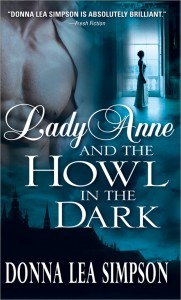
 Please welcome Donna Lea Simpson to Medieval Bookworm! We earlier heard why she writes historical fiction, and now she has agreed to answer a few of my questions!
1. I loved the combination of romance and mystery in Lady Anne and the Howl in the Dark. What inspired you to combine the genres rather than choose one?
I’ve been a mystery reader all my life, so writing it was a natural fit. I came to romance novels later, but fell in love with the way characterization is such a vital part of the story, how the plot emanates from the couple at the heart of the story. So I can’t imagine life without mystery, nor romance, and that is reflected in the stories I write.
I see every facet of human life as a giant mystery; what makes people behave the way they do, what secrets are they hiding… it’s all like a tangled skein of wool that I want to unravel. Even when I’m reading history, I’m trying to figure out what made people tick, why they acted as they did, what made them different from their modern day counterpart, and that is all mystery!
Romance is a vital part of life too, though, and what makes us human, that need to connect, that quest for the happy feeling of being in love. So Lady Anne is an extension of that. She’s a skeptic and an interfering busybody in some ways, but passionately romantic beneath it all.
2. One detail I picked up on and appreciated was Darkefell’s knowledge that Edward the Black Prince was probably never called “the Black Prince” in his life. Do you do a great deal of research for your novels?
Whoa, yes! More research with every book. I get pickier about historical accuracy as I go along, but luckily, research is an absolute joy to me, and I can get lost for hours in internet research or reading old books. I do have to call it quits sometimes—spending three hours researching a tiny detail that no one else is going to notice is counter-productive—but I’m never truly satisfied. I’m terrified that because I don’t really have any scholarly training I’ll have missed something important or misstated something. I’m finding with Lady Anne that it’s all coming much more naturally, though, to work historical information into the books, because both Lady Anne and Lord Darkefell are intelligent, well-read people, so they make casual references to not just English history, but also old folk tales, Greek mythology, military history, world geography.
3. Would you mind telling us a bit about your writing process? Do you plan out a novel from the start or do you let the characters take you where they want you to go?
I’ve always been a planner. I would write the synopsis, then I would take it and expand it into an outline, then I would break the outline up into a chapter by chapter plan. It was a lengthy and involved process, but I wonder now if it helped or hurt my books? It certainly made them long! I ended up writing 120,000 words with one novel, about twenty or thirty thousand more than the contract stated, and not many publishers are happy with that! So I was a detailed planner.
Until lately. A time crunch necessitated that I write swiftly, but what I found out in the process of flying by the seat of my pants is, sometimes the book just takes off. I’m learning (after all these years) that I should trust myself more. I do know what I’m doing. Kind of… LOL. And there is an exhilaration in writing fast and furious, a kind of free-wheeling liberty. Any mistakes I make or things I miss, I can fix in subsequent drafts. I do at least three or four complete drafts, smoothing it out and perfecting it as I go.
4. Can you give us a hint about what’s next for Lady Ann e and the Marquess of Darkefell?
I love these two, Lady Anne and Darkefell! What I know about Lady Anne is, she is truly a woman of her time, educated, intelligent, and beginning to challenge the status quo. Think Lady Mary Wortley Montagu, Mary Astell and Hester Thrale, all women who came slightly before Anne’s time and who informed her world. And think Mary Wollstonecraft, Anne’s contemporary, who wrote A Vindication of the Rights of Woman. It was a time of burgeoning agitation for more rights for women, and though a lady’s rights were circumscribed, it wouldn’t always be like that. Women of Anne’s status and intelligence were getting their first glimmer of a future in which women would have more autonomy.
Anne is a rare bird in some ways, and so she needed a rare man to appreciate her. Darkefell is just that fellow—smart, passionate, active—but he’s got a long way to go before he understands Anne, as you can tell by the ending of Lady Anne and the Howl in the Dark. He is going to have to come to terms with Anne’s independence before he will be a worthy match.
Until then, Lady Anne is going to keep making her own decisions even while the world condemns her for it! She can’t be anything less that she is, not for anyone. And… she’s going to keep sticking her nose in where some would say it doesn’t belong, and, with her skeptical mind, exploring ‘supernatural’ occurrences.
5. Can you tell us a little bit about your writing inspirations? Any favorite authors or books we should check out while waiting for your next one?
Well, luckily, the wait for Lady Anne and the Ghost’s Revenge won’t be long… it’s out in August, then Lady Anne and the Gypsy Curse is out in November!!
But there are a lot of books I’ve read, historical mysteries that have thrilled me, including the fabulous Stephanie Barron, who in addition to her Jane Austen mystery series (wonderful novels!) has written an absolutely perfect book, A Flaw in the Blood. You will be blown away by the dark twists and turns she takes you on through that novel.
I know Elizabeth Peters’ Egyptian mysteries are great. I had only read the Crocodile on the Sandbank before I wrote the Lady Anne books, but I was drawn back to them when a reviewer compared Lady Anne and the Howl in the Dark to her novels. I was enormously flattered, so I read another in the series, and I’m hooked. I’m going to have to go back and begin at the beginning and read them all. What I love is the romantic chemistry between Peabody and Emerson, while the mystery is speeding along… it’s the perfect blend of mystery and romance.
I hope you all enjoy Lady Anne and the Howl in the Dark! Thank you for such fun and fascinating questions. I’ve enjoyed answering them so much!
If today’s discussion of Lady Anne and the Howl in the Dark has piqued your interest, you can check it out on Amazon.



Recent Comments