|
|
 Elizabeth Staveley is a graduate student working on escape narratives when she comes across mention of Celia Lamprey, who may have been the first known English girl to be sold into a Turkish harem. After her discovery, the story intertwines the narrative of Elizabeth, who struggles with modern day love, with Celia’s, who longs to escape the harem and be reunited with her love, Paul Pindar. Elizabeth Staveley is a graduate student working on escape narratives when she comes across mention of Celia Lamprey, who may have been the first known English girl to be sold into a Turkish harem. After her discovery, the story intertwines the narrative of Elizabeth, who struggles with modern day love, with Celia’s, who longs to escape the harem and be reunited with her love, Paul Pindar.
I really enjoyed Celia’s story. I found the environment of the harem fascinating and the political machinations inside of it were intriguing and added to the mystery. I didn’t expect at all what would happen and remained just as clueless as Celia, if not more so, which I always like. It was clear that this was an intricate, self-contained world; I even more enjoyed the backstory of some of the girls, particulary the Valide Sultan’s. I found it to be very good historical fiction.
I did not enjoy Elizabeth’s story as much. I think the author, Katie Hickman, was going for something like The Secret History of the Pink Carnation, but it doesn’t work here. For one thing, Elizabeth’s life is too melodramatic and that takes away from the story. She seems barely interested in Celia and makes discoveries only after the reader has encountered them, so as a result her chapters drag as we wait for her to make some discovery or feel sensual or sleep with someone (although having a romantic interest named Mehmet made the crusades historian inside me very happy for purely silly reasons). I don’t think they added to the book, and in all honesty it would have worked a lot better without them at all. I liked Hickman’s message, that history speaks to us even now, but overall, not worth it.
I’d wait for this one in paperback. I enjoyed it, but there is better out there. Still interested? Check out The Aviary Gate: A Novel on Amazon now. on Amazon now.
 Claire Randall has just ended her tenure as a WWII nurse and is on a second honeymoon of sorts with her husband, Frank, in Scotland, when a stone circle whisks her back in time to the 18th century, a budding war between England and Scotland, and a love that makes her question where exactly she belongs in the world. Claire Randall has just ended her tenure as a WWII nurse and is on a second honeymoon of sorts with her husband, Frank, in Scotland, when a stone circle whisks her back in time to the 18th century, a budding war between England and Scotland, and a love that makes her question where exactly she belongs in the world.
Almost everyone I have spoken to has fallen in love with this book and immediately dashed out to buy the sequels. It’s a bit strange to be the one person not so affected by it. I liked it, don’t get me wrong – I do enjoy romance occasionally and that is what this book is. It just wasn’t unique, except in its unnecessary length. Certainly unnecessary – there are plenty of scenes which are completely superfluous to the novel’s plot and purpose. It just keeps going and going. Moreover, Claire forgives him far too easily for certain transgressions around the middle, and I found the ending scenes extremely disturbing and at times, again, implausible. Their reactions never felt natural, much less how Claire completely forgets her husband of several years after mere weeks in the company of Jamie Fraser.
I did enjoy the book, though. After a while, I started to believe that there was actually something between Jamie and Claire, and for all my resistance to some of their behaviors, sometimes you do just know that a person is right for you. I don’t understand why so many women of the world are in love with Jamie, though, as I certainly wouldn’t leave my fiance for him.
As far as the time travel aspect is concerned, I did my best to ignore the fact that it was simply impossible unless the worlds existed in parallel – a certain person’s death date changes, which makes it completely impossible that they exist in the same world, unless the issue comes up in later books.
Despite my criticism, I did like the book and I actually have Dragonfly in Amber sitting in my Amazon cart, used for $4. What can I say? I did like it, and all the reviews promise that number 2 is heavier on the historical fiction. I tend to prefer that, so I think I will give it a try. I don’t know if I want to embroil myself in the series, so I haven’t ordered it yet, but it’s certainly a temptation.
 Edith Pargeter takes us back to the very early 15th century, to a conflict between Sir Henry Percy, “Hotspur”, and Henry IV, the king of England, who has only recently usurped the throne from Richard II with the support of the Percy family. The story follows each man and his relationship with various people as well as their deteriorating relationship with each other as it continually worsens with time. Edith Pargeter takes us back to the very early 15th century, to a conflict between Sir Henry Percy, “Hotspur”, and Henry IV, the king of England, who has only recently usurped the throne from Richard II with the support of the Percy family. The story follows each man and his relationship with various people as well as their deteriorating relationship with each other as it continually worsens with time.
This book was, honestly, a bit challenging to read. Its prose was, in fact, dated, and although I think that added to the overall feel of the book in a positive way, it made it go very slowly. As a result, a book less than 400 pages took me 4 days to read, which is unusual. In addition, the story doesn’t really sweep the reader away. It is interesting and feels medieval, but it’s not fascinating and is pretty easy to put down. The characters remain detached from the reader as well as detached from each other. I felt the most sympathy for Prince Henry, the future Henry V, as we see the formation of his identity since he is fairly young as well as his conflict between his father and close friend. Otherwise, the two main characters somehow remain distant even though we are given the opportunity to get into their heads. This is somewhat rare for me with a work of medieval historical fiction since I’m getting fairly practiced as placing myself into the medieval mindset (or as close as a modern person can get).
I did enjoy it while I was reading it and I found her perspective interesting, but it certainly isn’t one of my favorites, and I’ll probably wait a while before picking up another of her works.
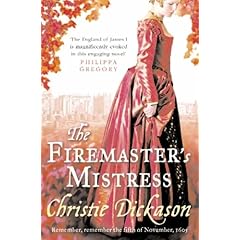 This book was an unexpected pleasure. I purchased it in the UK over a year ago at this amazing bargain bookshop that I found, and which has now closed. I’ve been putting off reading some of them because one of the first books I read from there was terrible and is one of the few books I’ve given away. With this book, on the other hand, I got a great deal! This book was an unexpected pleasure. I purchased it in the UK over a year ago at this amazing bargain bookshop that I found, and which has now closed. I’ve been putting off reading some of them because one of the first books I read from there was terrible and is one of the few books I’ve given away. With this book, on the other hand, I got a great deal!
The book follows the tale of two people, mainly, Francis Quoynt and Kate Peach. They were lovers before Francis left Kate a ruined woman two years before the novel’s beginning. Kate has had to do all that she can to survive, while Francis has been at war for England as a firemaster – someone who makes gunpowder and sets off “controlled” explosions. Not surprisingly, as the country’s premier firemaster, Francis is sent to London and ordered to ingratiate himself among a group of men who plan to kill the king. This is the famous Gunpowder Plot of 1605, and all the plotters aside from Quoynt are real historical figures. Francis finds himself involved with Kate, who is a secret Catholic like the plotters, and confusion ensues as he isn’t sure where his loyalties lie while she attempts to adjust to having the Quoynt family back in her life.
I particularly enjoyed this book. It was well-plotted, though a bit slow in the beginning, and I was hooked only a little way in. I could really empathize with Francis and Kate because the author gave me a great perspective right into their heads. Even Francis’s father, Boomer, was done well. The subject matter is as ever interesting and I felt was handled pretty well. The only thing that dissatisfied me was part of the ending, which constitutes a spoiler.
*spoiler warning*
I did not like that Kate ended up with Boomer. After all of Francis’s effort, I felt that he really deserved the girl, especially when he loved her so. I couldn’t see their relationship at all, and this change marred what was a really good book.
*end spoiler*
So, in the end, the quality of the book was quite good and it’s certainly up there with many other historical fiction authors, so I’m not quite sure why it was in a bargain bookshop! I’d recommend it to other historical fiction readers. In fact, I see it’s coming out in the US this September, so I hope Ms. Dickason gets more attention! I certainly intend to pursue her other works. In all, an absorbing worthy read.
Year of Wonders tells the story of a plague year and a village that shut itself off from the world through the eyes of Anna Frith, a widow with two small sons. Her sorrow grows as so many that she loves die from the plague, but she also comes to realize more about herself, her endurance, and what is truly important to her. This is the reason for the “wonders” in the title, since otherwise a year full of tending plague victims would not be anything near wonderful.
I enjoyed this book. I liked Anna’s interactions with Elinor, so characteristic of someone who has lost everything and thus clings on to the one thing she can have. Anna’s sorrow and growth were both so real. In truth, nearly everything in this book felt very human and very understandable. People’s reactions to losing their whole families result in fear, suspicion, and murder, especially in this time in history when so much could be blamed on a “witch”. Brooks writes well and draws you into this small community’s difficult and deadly year.
I think this book has value for every reader since it says so much about human nature – it goes beyond the historical fiction genre to convey meaning about suffering and understanding. I would certainly recommend it.
ROMA is an ambitious saga that portrays the early days of ancient Rome, from its first bare beginnings as a salt trading post to the the struggle of the heirs of Julius Caesar. Each chapter is from a different period, though the time between them varies and shortens as the book goes on. The chapters are held together by several families, the most important of which holds an ancient talisman which is passed down through the generations.
Of necessity, the book truly isn’t gripping. Since each chapter is told by a different person, it’s hard to become attached to any of them, and a genealogical chart somewhere tracking their descendants would have been very useful. Still, each chapter was well told and interesting. I enjoyed the way Saylor showed how something simple becomes a legend only to become mystical and forgotten. He also succeeded in linking together all the chapters enough to make the book feel like a cohesive whole. Roma itself is a personality just as those who inhabit her are, which helps a lot with the narrative in later parts of the book.
Still, I am left feeling that although it was enjoyable, it could have been better. Rutherford’s LONDON is the best novel I’ve read of this type, and I would recommend that one first. This book provides a painless, enjoyable fictional introduction to early Rome and would also serve as a good stepping-off point for those interested in its history.
In this novel, Cornwell spins an exemplary tale following the Northumbrian boy, Uhtred, set in Anglo-Saxon England before it was actually England, but instead a land of many minor kingdoms. Uhtred is the heir to an estate in Northumbria, Bebbanburg, but when his father and brother are killed by Vikings and he is taken prisoner, his uncle seizes the castle and it seems that his future as a nobleman is over. On the other hand, he is only a boy, so he doesn’t mind, and he grows to love his Danish captor, Ragnar, like a father. The book follows their adventures and traces Uhtred’s development from a boy to an accomplished adult warrior.
This is a great book. Uhtred is a likable character, despite his arrogance. He admits when he wasn’t prepared in his youth, but his older persona, who is ostensibly telling the story, shines through fairly obviously and so there’s never any doubt that he is very capable and survives. The book is extremely engaging and absorbing. Cornwell makes Anglo-Saxon culture very understandable and it’s clear that this is an area of history which fascinates him. It fascinates me, too, so I loved all the little tidbits he tossed in, even the ones I already knew. The historical characters are all real and seem fairly accurate to their real selves, particularly the very pious and forward-thinking Alfred. I can’t wait until Aethelflaed, his daughter, grows up in the next few books, as she is without question my favorite historical figure. The Vikings are depicted as real people, though they are certainly much more eager for battle. The only problem with the book really is that the church is so negatively stereotyped and piety is seen as very negative, so those among us who are Christians may be offended, but since that’s in Uhtred’s character and he is telling the story, I think the viewpoint is understandable, even though not actually true.
I particularly liked Cornwell’s use of the historical note to tell us what he made up and what he did not, as well as his use of Anglo-Saxon place names rather than modern ones. It gives the book a much more authentic atmosphere, and gave me some linguistic fun (as well as historical contentment) as I tried to decipher the names on my own rather than look in the handy glossary.
Overall, this book is great. The next book I buy will certainly be THE PALE HORSEMAN, number two in this series. Highly recommended to anyone who appreciates historical fiction.
In the final volume of the Grail Quest trilogy, Thomas of Hookton’s journey to find the holy grail takes him deeper into France, where he once again displays the great advantage of being an archer, faces down his cousin for the final time, and discovers that he must follow his heart despite the Church.
This book is really terrific. I liked it more than the first two – I felt that it absorbed me much more and carried me along the story better. This may be because it’s the least “tied” to actual history, but it also felt very plausible, except when Thomas risks excommunication for a woman. The only way I can accept that is if he didn’t really think he’d be excommunicated, which is probably the case. No medieval person would have risked his soul for someone he barely knew, sweet as the concept is. Otherwise, it fit right in with my own perceptions of the medieval mindset, right down to the shock of the Black Death, which we still can’t explain. I can’t say much about the Grail, considering it doesn’t actually exist, but the mechanisms of the quest, the corruption of the Church, and the warfare all really created an excellent view of the medieval world. Cornwell knows what he’s talking about.
I also really liked the characters at this point. They’re a bit difficult to like, considering he doesn’t spend much time delving into anyone’s soul except Thomas’s, but I didn’t want them to die and I was sad when the book ended because I enjoyed their company.
I think it’s also pretty important to say that this book isn’t typical medieval historical fiction. It doesn’t feel like all those trade paperbacks floating around with half-images of girls in fancy dress on the cover. I like those too, but this is grittier and much more realistic. Doesn’t focus on royalty, just on how life for regular people, for soldiers, might have been in the Hundred Years’ War. Lots of warfare – but no honor, no sex, just gritty battlefield realities as we know them. As such, it’s quite different from the sumptuous lives of royalty, which is what medieval historical fiction authors usually focus on, and I love it even more for that.
Would I recommend this book? Most certainly! I’ve got another friend hooked on Bernard Cornwell already. It could, however, be boring for those out there who don’t love medieval life or who find warfare boring, so I would judge a person’s individual reading taste before I recommended it.
Vantrease returns to the family of Kathryn and Finn with this sequel to The Illuminator, set in the early 15th century and opening with a book burning in Prague. Finn and his granddaughter Anna, the subject of the book, live in Bohemia and continue to carry on the heretic religion. Anna is forced to flee to France, where she meets a mercy seller, also known as a pardoner. They will change each other’s lives more than they would think possible at the moment of their meeting as they journey from France to England, the country where the Lollard movement began and remains very strong.
This book is better than The Illuminator without question. The characters are more fleshed out and their reactions are very believable. Vantrease’s writing has improved and so has her plotting. This is good historical fiction, filling in the gaps of history, as I have mentioned before. She plays a little with Sir John Oldham and the identity of a certain Master Fisher, but explains everything in the back of the book, which I always appreciate. The subject matter, similarly, is very interesting, especially seeing the divergence between “Roman Christians” and Lollards – I think most of us would now agree with the Lollards, and the book certainly tilts in their sympathy, but it is still an interesting viewpoint. Anna was my favorite character as she attempted to forge her own way forward without everyone she loved.
In conclusion, I enjoyed this work of historical fiction and I would certainly recommend it to someone else.
Fifteen-year-old Barbara, inexperienced and innocent, daughter of a bankrupt family, discovers that she is to be married to the man of her dreams, Earl Devane. She determines to win him over, her attempts witnessed by a loving cast of characters who all provide their own side stories as Barbara’s life veers in directions she does not expect.
I think the best word for this book is predictable. The foreshadowing is so heavy that the author basically tells you so and eliminates any suspense or surprise that the book might have held. I knew most of what would happen in the book before the halfway mark. In addition, the characters fell somewhat flat. The best character was the Duchess, although Tony was my favorite and went through the most believable character development. For the most part, I felt that many of the relationships were built on air, meaning that the author spent more time telling me about them than showing me how they happened. Most of the story is that everyone loves Barbara, except for those who hate her for being loved by everyone else. The mechanics of the writing were fine and I could get swept up in the story, I just think that the author could have plotted better.
That said, it was enjoyable for the most part. I got a feel for the atmosphere of the time, the contrast between England and France, country and city, innocence and experience. I think the book does a good job with the time period and avoids historical improbabilities. All in all, a decent read, but not something I will read again.
|
|



Recent Comments