|
|
 This is book 3 of the Southern Vampire Mysteries. For the first of the series, check out my review of Dead Until Dark. This is book 3 of the Southern Vampire Mysteries. For the first of the series, check out my review of Dead Until Dark.
Sookie’s vampire boyfriend Bill has a secret. He’s been spending all his time hunched over the computer and lately doesn’t even pay Sookie attention when she gets home from work. Sookie is even more confused and upset when Bill tells her that he’s going away for a while, to Seattle, which she automatically knows is a lie. When Eric approaches her a few days later and tells her that Bill’s been kidnapped, Sookie doesn’t know what to think, but she goes along to save him, teaming up with a surprisingly attractive werewolf along the way, at a creepy club the likes of which she’d happily never see again.
It seems to be about the third book of an urban fantasy series that everything clicks for me and I just want more. That is definitely the case here. All of a sudden, I really just want more Sookie. I loved her voice in this novel; it felt very distinctive and southern and perfectly pitched to what was going on. I could completely sympathize with all of her money woes, her relationship woes, and even her physical pain (luckily I’ve never been beaten up, so I can’t empathize, but I felt so sorry for her). I felt like she was my friend and I wanted to make her happier.
Something I really like about this series is that the relationships are not infalliable. I could sense in the last book that Bill and Sookie weren’t necessarily going to stay together, and while she was certainly hurting for it, I think it takes the story in a much more interesting direction if she’s not tied to one particular person (or vampire). Bill has proved the dangers of falling in love with a vampire and part of me wonders where Sookie is going to go next. I hope she doesn’t go back to Bill. I think I know where she’ll go, but I can’t tell you how much I wish I had Dead to the World right now! Unfortunately my library’s copy is out, my new library doesn’t have a copy, and I don’t really have the money to spare to go buy the whole series, but when I do, I’m really looking forward to continuing.
Anyway, that is besides the point. I think that Club Dead is my favorite of the three I’ve read so far. It’s easy to love a book when you love the narrator. I hope that Sookie finds the confidence and love she needs and I will totally continue reading to find out.
 It is the end of Bess’s junior year at Loretto Academy, a high school for girls run by nuns in the shadow of Niagara Falls. She knows something is wrong when her father doesn’t appear at the graduation ceremony and when the nuns inexplicably present her with farewell gifts; her father has been fired from his job as the director of the Niagara Power Company. Bess must return home, care for her suddenly ill sister Isabel, and assist her mother in dressmaking to keep the family afloat. On the way from Loretto, a young man carries her trunk, and later passes by her house, with the gift of a fish. Bess had counted on hardship, but she hadn’t counted on love with a riverman or the future she would have. It is the end of Bess’s junior year at Loretto Academy, a high school for girls run by nuns in the shadow of Niagara Falls. She knows something is wrong when her father doesn’t appear at the graduation ceremony and when the nuns inexplicably present her with farewell gifts; her father has been fired from his job as the director of the Niagara Power Company. Bess must return home, care for her suddenly ill sister Isabel, and assist her mother in dressmaking to keep the family afloat. On the way from Loretto, a young man carries her trunk, and later passes by her house, with the gift of a fish. Bess had counted on hardship, but she hadn’t counted on love with a riverman or the future she would have.
There are many things to love about this book. The prose is gorgeous, for one thing, as are the descriptions. It’s almost possible to feel the cool mist off the falls, as the characters do, or the deadly beauty of the whirlpools. Bess is a strong woman up there with the best of them, coping with her family’s losses and tragedy and somehow managing every single time. Her strength grows over the course of the novel, from a girl afraid of what her mother is thinking to a woman that has her own business and is ready to turn down society ladies regardless of what they think. There is all the innocence and wonder of a first love affair, more so because this one is so explicit, that conflict between duty and desire.
And yet there was somehow a lack of connection. I liked the book, but I didn’t love it. Bess is a sympathetic character but always from a distance; by the end of the novel she has grown so strong that any attempts to empathize with her feel as though they would be pushed away. It felt as though she didn’t experience emotions strongly enough at that point, she just moved on. The book had potential to be one of a series of great, sweeping romances marred with tragedy, but it stopped just short. Or maybe I just was in the mood for something more explicit, or perhaps I’m just lucky that I’ve never had to be that strong. To be honest, I think a lot of it had to do with the fact that the book is in present tense, which always feels more distant to me.
I much preferred the historical bits. I loved learning more about Niagara Falls and that Tom Cole was based on a real man. The pictures evoke a sense of history a little bit stronger than the words themselves and the newspaper articles, fictional or not, fleshed out the history of the story without long or boring exposition. I was interested in the sewing techniques and the dresses Bess described, in the books she was reading, in the new electric appliances that houses had. I was fascinated by the setting and I wouldn’t mind spending a little more time there.
Though I liked and didn’t love The Day the Falls Stood Still, I’d still recommend it for those who enjoy historical fiction or are looking for a compelling love story.
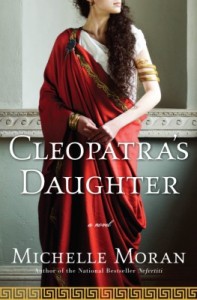
Please welcome Michelle Moran to Medieval Bookworm today! She has graciously agreed to answer a few of my questions here. I hope you enjoy the answers as much as I did.
1. What drew you to tell Selene’s story and move into ancient Rome?
Actually, it all began with a dive. Not the kind of dive you take into a swimming pool, but the kind where you squeeze yourself into a wetsuit and wonder just how tasty your rump must appear to passing sharks now that it looks like an elephant seal. My husband and I had taken a trip to Egypt, and at the suggestion of a friend, we decided to go to Alexandria to see the remains of Cleopatra’s underwater city. Let it be known that I had never gone scuba diving before, but after four days with an instructor (and countless questions like, “Will there be sharks? How about jellyfish? If there is an earthquake, what happens underwater?”) we were ready for the real thing.
We drove one morning to the Eastern Harbor in Alexandria. Dozens of other divers were already there, waiting to see what sort of magic lay beneath the waves. I wondered if the real thing could possibly live up to all of the guides and brochures selling this underwater city, lost for thousands of years until now. Then we did the dive, and it was every bit as magical as everyone had promised. We saw the blocks that once formed Marc Antony’s summer palace, came face to face with Cleopatra’s enigmatic sphinx, and floated above ten thousand ancient artifacts, including obelisks, statues, and countless amphorae. By the time we surfaced, I was Cleopatra-obsessed. I wanted to know what had happened to her city once she and Marc Antony had committed suicide. Where did all of its people go? Were they allowed to remain or were they killed by the Romans? And what about her four children?
It was this last question that surprised me the most. I had always assumed that Cleopatra’s children had all been murdered. But the Roman conqueror, Octavian, actually spared the three she bore to Marc Antony: her six-year-old son, Ptolemy, and her ten-year-old twins, Alexander and Selene. As soon as I learned that Octavian had taken the three of them to Rome for his Triumph, I knew at once I had my next book. And when I discovered what Cleopatra’s daughter lived through while in exile – rebellion, loss, triumph, love – I absolutely couldn’t wait to start writing. I can only hope that the novel is as exciting and intriguing as the research proved to be. It may be two thousand years in the past, but a great love story, as they say, is timeless.
2. Is there a little known fact about ancient Rome or Egypt that you think everyone should know?
I’m not sure I could pick out just one fact! Perhaps I’d simply like people to know how similar ancient Romans and Egyptians were to us today. In ancient Egypt, Nefertiti’s daughter had her own perfume line, and in ancient Rome, women used curling irons and had an ancient form of bras. These two incredible civilizations really paved the way for how we live life today.
3. Do you have an absolute favorite period in history?
I wish I did! It would make choosing my next book so much easier! No. But I have particular periods I’m drawn to, such as the ancient world, the Middle Ages, the 18th century, and the Victorian era.
 4. Why did you choose to write historical fiction? 4. Why did you choose to write historical fiction?
It all began on an archaeological dig. During my sophomore year in college, I found myself sitting in Anthropology 101, and when the professor mentioned that she was looking for volunteers who would like to join a dig in Israel, I was one of the first students to sign up. When I got to Israel, however, all of my archaeological dreams were dashed (probably because they centered around Indiana Jones). There were no fedora wearing men, no cities carved into rock, and certainly no Ark of the Covenant. I was very disappointed. Not only would a fedora have seemed out of place, but I couldn’t even use the tiny brushes I had packed. Apparently, archaeology is more about digging big ditches with pickaxes rather than dusting off artifacts. And it had never occurred to me until then that in order to get to those artifacts, one had to dig deep into the earth. Volunteering on an archaeological dig was hot, it was sweaty, it was incredibly dirty, and when I look back on the experience through the rose-tinged glasses of time, I think, Wow, was it fantastic! Especially when our team discovered an Egyptian scarab that proved the ancient Israelites had once traded with the Egyptians. Looking at that scarab in the dirt, I began to wonder who had owned it, and what had possessed them to undertake the long journey from their homeland to the fledgling country of Israel.
On my flight back to America I stopped in Berlin, and with a newfound appreciation for Egyptology, I visited the museum where Nefertiti’s limestone bust was being housed. The graceful curve of Nefertiti’s neck, her arched brows, and the faintest hint of a smile were captivating to me. Who was this woman with her self-possessed gaze and stunning features? I wanted to know more about Nefertiti’s story, but when I began the research into her life, it proved incredibly difficult. She’d been a woman who’d inspired powerful emotions when she lived over three thousand years ago, and those who had despised her had attempted to erase her name from history. Yet even in the face of such ancient vengeance, some clues remained.
As a young girl Nefertiti had married a Pharaoh who was determined to erase the gods of Egypt and replace them with a sun-god he called Aten. It seemed that Nefertiti’s family allowed her to marry this impetuous king in the hopes that she would tame his wild ambitions. What happened instead, however, was that Nefertiti joined him in building his own capital of Amarna where they ruled together as god and goddess. But the alluring Nefertiti had a sister who seemed to keep her grounded, and in an image of her found in Amarna, the sister is standing off to one side, her arms down while everyone else is enthusiastically praising the royal couple. From this image, and a wealth of other evidence, I tried to recreate the epic life of an Egyptian queen whose husband was to become known as the Heretic King.
5. Since I know you go on amazing research trips, can you give us a hint of where you might be going next? Anywhere you would love to go but haven’t managed yet?
My next trip will be through Scandinavia. I’m very interested in the history of the Vikings and I’ve been intending to make this trip for quite some time. I would love to go to Mongolia, and it’s possible that my husband and I (my traveling partner) will add this on to our Scandinavian trip. It’s always been a goal of mine to see the Genghis Khan Festival there.
6. What’s ahead for your next book? Do you plan on returning to the ancient world soon?
For my fourth novel, I will be departing from the ancient world to write about the French Revolution. This book will be about the life of Madame Tussaud, in which young Marie Tussaud joins the gilded but troubled court of Marie Antoinette, and survives the French Revolution by creating death masks of the beheaded aristocracy.
7. Is there anything else you’d like to share with the readers of Medieval Bookworm?
Just that it is a pleasure to be here, and that I hope your readers enjoy my very first adult/YA crossover in the historical fiction genre!
Thanks Michelle! To learn more, you can visit her website and blog, and check out the awesome contest she’s holding in independent bookstores across the USA! Please also note that yesterday, I reviewed Cleopatra’s Daughter, and today is the last day to enter my contest for a signed copy.
 The love story of Marc Antony and Cleopatra is legendary. The question asked less often is what happened to their children after they killed themselves? Michelle Moran tackles this question by exploring the lives of the three children who were taken by Octavian and the rest of the Romans through the eyes of the one of the twins, and the only girl, Kleopatra Selene. Practically stranded in a totally new world, twelve-year-old Selene and her brother Alexander must learn how to live in ancient Rome while watching every step, perpetually in danger of losing their lives. The love story of Marc Antony and Cleopatra is legendary. The question asked less often is what happened to their children after they killed themselves? Michelle Moran tackles this question by exploring the lives of the three children who were taken by Octavian and the rest of the Romans through the eyes of the one of the twins, and the only girl, Kleopatra Selene. Practically stranded in a totally new world, twelve-year-old Selene and her brother Alexander must learn how to live in ancient Rome while watching every step, perpetually in danger of losing their lives.
I don’t know how high my expectations for Michelle Moran are going to have to be set for her to fail to match and surpass them, but she has done so in this book. Cleopatra’s Daughter is a great read and proves that the author can portray Rome with just as much skill as she has applied to Egypt. The novel starts out in Egypt with a bang as Octavian and his warriors invade, causing Cleopatra and Antony to kill themselves in desperation. Selene, Alexander, and Ptolemy are whisked away on a boat, on which Ptolemy dies. Selene already knew her life was never going to be the same, and the loss of not only her parents but her baby brother causes her to both fear and gather her strength. She vows that she and her brother will regain Egypt.
In Rome, the already great characters of Selene and Alexander are matched with teenage Roman children as their friends. These kids are nice, well-rounded secondary characters, especially Selene’s friend Julia, who has plenty of her own problems to deal with. Moreover, they are figures from history, and reading about them as they might have been as children is exciting.
The twins interact with the highest levels of Roman society, but Selene in particular still feels like a young teenager, albeit an intelligent one. She experiences her first crush and develops her interest in architecture, while coping with Octavian’s horrible wife Livia, who is determined to thwart her and humiliate her at every turn. It’s easy to relate to Selene in the midst of a great deal of foreignness and danger, which is why this book also works as a fantasy YA novel. Plus, I adored the way the love story angle wound up. I knew it was one based on the dedication, but it took a good long time for me to figure out who Selene loved exactly. When the pieces fell into place, I realized I had seen it all along without really thinking about it.
These are not only dangerous times for Selene and Alexander but for Rome as well, which experiences the beginnings of a slave rebellion, and a mystery as to who the ringleader is. No one is safe from suspicion. This mystery definitely powers the plot along since Selene herself doesn’t have all that much to do. Luckily, her voice is strong enough that she is still an ideal choice for narrator; she has inside information and she is by far the most interesting character.
I’m happy to be able to say that I definitely recommend Cleopatra’s Daughter. This is a very solid historical fiction novel with enchanting characters, a richly described setting, and an enthralling plot.
 When Iris’s father dies, she finds that she wants to continue his legacy by establishing his children’s center in Vietnam. The center was not completed and Iris decides to abandon her career as newspaper book reviewer and fly to Vietnam to help. She takes her neighbor Noah with her, a man impaired both physically and mentally from his experience in the Iraq War, in the hopes that a purpose will give his life meaning and direction. In Saigon, Iris and Noah are amazed by the kindness and warmth of the Vietnamese and the clever street children, who quickly realize the goals of the center and wish to be enrolled. In this cutthroat world, however, it isn’t all as easy as it should be, and Iris and Noah find themselves fighting to save the children they come to love. When Iris’s father dies, she finds that she wants to continue his legacy by establishing his children’s center in Vietnam. The center was not completed and Iris decides to abandon her career as newspaper book reviewer and fly to Vietnam to help. She takes her neighbor Noah with her, a man impaired both physically and mentally from his experience in the Iraq War, in the hopes that a purpose will give his life meaning and direction. In Saigon, Iris and Noah are amazed by the kindness and warmth of the Vietnamese and the clever street children, who quickly realize the goals of the center and wish to be enrolled. In this cutthroat world, however, it isn’t all as easy as it should be, and Iris and Noah find themselves fighting to save the children they come to love.
It seems to me that this is a book about hope. Iris hopes to build a center beyond all the others, to truly educate girls and make them into productive and happy citizens. Noah eventually learns to hope again through Thien, who is at peace with the universe. The children all hope to be let into the center, so they have a chance for a brighter future. Everyone is making something better, whether it’s themselves or society, and the entire book has a bright, cheerful message in the end.
While Iris and Noah are admirable people, it is really the street children who make this book the wonderful read it is. There are three children who are really focused on, Minh, Mai, and Tam. Minh and Mai are brother and sister; Minh doesn’t talk, has only one hand, and plays connect four with tourists to earn money, while Mai acts as his voice and sells fans. They are bright, innovative children and it’s impossible not to completely fall in love with them and hope that they can seize a brighter future through Iris and Noah. Unfortunately, they have a more powerful man who has them under his thumb and who insists on making things difficult. Tam is a very sick girl who is mostly cared for by her grandmother, and it’s here that the tragic aspect of the book makes its mark. Tam is suffering from childhood leukemia and 90% of children survive it if they get care early enough. Unfortunately, Tam did not, given that they live on the street, and while her personality is almost completely obscured by her illness, the love between her and her grandmother is so touching, as is the attitude of all the other characters towards them.
Saigon itself (as it is called in the book) almost acts as a character; since Minh and Mai are poor they move around quite a lot and allow descriptions of most of the city, as well as the hovels in which they and Tam live. I really enjoyed the descriptions in the book and felt that the author did an admirable job contrasting wealth and poverty and getting across the feel of both the city and the Vietnamese people. The plot is not particularly tight, especially in the beginning, but it doesn’t seem to matter because I was too busy enjoying the characters and descriptions and hoping for something better to come their way.
Dragon House is completely different from John Shors’s other work, but I really enjoyed my time spent with it. It is both a charming story and inspires us to do something better in the world by exposing the evils he’s seen. I definitely recommend it.
 From the back of the book: From the back of the book:
It is 1588, and as the Spanish Armada prepares to besiege England, Paris balances on the brink of revolution. To maintain her grip on the throne and on the dark magic that has become her obsession, Catherine de Medici turns to Louis Xavier, a ruthless corsair who was schooled in the dark arts and has mastered piracy along the Spanish main. But Louis’s basest instincts are held in check by the kindness of Lady Jane Danvers, a British exile whose innate sense of honor is but one facet of her complex and passionate nature.
On Faire Isle, Ariane Cheney, unaware of the escalating threat from the Dark Queen, struggles with the task of protecting the daughters of the earth and their vast story of ancient magical wisdom. Weak and desperate for an advantage, the ailing Catherine makes a devil’s bargain that will cast a shadow over all.
This is the fifth and final book in the Dark Queen series. I chose to provide the book’s summary because there are many plotlines here and I didn’t want to miss any! I intended to read the first four in the series before getting to this one, but then ran out of time, so I was worried I’d feel I’d missed something. To some extent I know I did, but this book stands alone extremely well. I understood everything that was going on without a problem and possibly wouldn’t even have noticed it was a series wrap-up if I hadn’t been told!
There are two threads to this story and they intertwine close to the end. The first is the Dark Queen Catherine de Medici’s search for Megeara, the former Silver Rose. Meg has memorized all the secrets from a dark book which Catherine believes is the cure for all of her ills. Catherine knows Meg is on Faire Isle, and tries to send Xavier there to get her. Xavier has no intention of doing so, until a storm blows his ship off course and sends him overboard, just in time for Lady Jane Danvers to find him nearly dead on the beach. Jane, a Catholic exile from England, is all but alone in the world, and Xavier proves to be just what she needs by way of a little romance and a lot of love.
This book proved to be a very enjoyable historical fantasy novel about how the late sixteenth century French court might have been with the addition of a little magic. Thanks to the various threads of the plot, there is a lot of action and the reader is often left wondering what is going to happen next, particularly thanks to Meg’s scrying abilities. We know the future, but not how the characters are going to get there nor what will happen afterwards. The love story is sweet and believable. I found myself attached to all of the characters, especially Meg, even though I had never “met” them before. I’m very much looking forward to reading the first four, which I have, and finding out just how they all got to this point.
In short, Twilight of a Queen comes very recommended, especially to those who like historical fiction with a touch of fantasy and romance.
 I have had a great weekend for several reasons. The foremost and best reason is that my Certificate of Approval from the British government has arrived, meaning that my American self can now marry my British fiance with no trouble whatsoever. All I have left to do is make us an appointment on Monday, send off a cheque, and show up to the wedding. Oh, and buy wedding rings, but that is the fun part of the process! My parents can buy their plane tickets and book their hotel, so everything will be all set by next weekend. After almost six weeks of worrying when this little bit of paper is going to show up, or whether it even would be approved, I can finally breathe, relax, and look forward to October 17th! I have had a great weekend for several reasons. The foremost and best reason is that my Certificate of Approval from the British government has arrived, meaning that my American self can now marry my British fiance with no trouble whatsoever. All I have left to do is make us an appointment on Monday, send off a cheque, and show up to the wedding. Oh, and buy wedding rings, but that is the fun part of the process! My parents can buy their plane tickets and book their hotel, so everything will be all set by next weekend. After almost six weeks of worrying when this little bit of paper is going to show up, or whether it even would be approved, I can finally breathe, relax, and look forward to October 17th!
Secondly, my dissertation draft is in to my supervisor and I don’t have to touch it until after our meeting tomorrow. I’m guessing that he will have a lot of revision suggestions, but on the bright side, I have less than two weeks left of working time on it. It is not going to be perfect and probably won’t get me a first, but at this stage I have worked very hard on it and it is ready to be completed. I can see how much I’ve improved since my BA thesis was completed and that in itself makes me very happy regardless of what result I end up with. This is the first weekend I’ve had since this whole thing started without it hanging over my head to some extent. I have taken weekends off, but I always knew that I shouldn’t have. Now I am guilt-free!
Lastly, this thing called guiltless free time, plus the fact that I have to be on my own in York to finish up, means that I have been reading a ton of books this weekend. It’s almost like my own mini read-a-thon, except I let myself sleep and take more breaks than I would have otherwise done. I’ve finished four books since Friday night and I’m reading a fifth. Two books came yesterday but I still feel like I’m making a little dent in my TBR pile. This will be nice to remember over the next two weeks. I’m also trying to write all of my outstanding reviews – I have eight to go! – before tomorrow, but I’m not sure that is going to happen.
Oh, I should also mention that I hit 200 books this week! I have now upped my yearlong goal to 250, which I think will be doable between the time when I finish school and when I can apply for jobs after the wedding.
Today, I’m reading Dead to the World by Charlaine Harris, book four in the Sookie Stackhouse series. I’m glad that the Sookie Stackhouse Reading Challenge, hosted by Beth Fish Reads, is pushing me to continue this series because I’m really enjoying it. I’ve gone for a total change of pace after Catching Fire, which I read yesterday, because I don’t want anything that could be compared. It would suffer too much! I think urban fantasy fits the bill, though. I think next up will be The Dangerous Book for Demon Slayers by Angie Fox and then It Happened One Autumn by Lisa Kleypas. Can you tell that I don’t want to think much right now?
What are you reading this weekend?
 This work of history takes a look at the multi-generational Paston family throughout the years immediately after the Black Death and through the Wars of the Roses. The Pastons left behind an immense number of letters which have been miraculously preserved for six hundred years and as such are a historical treasure trove for those of us who wonder how gentlemen lived in the fifteenth century. Helen Castor recounts the rise and fall of their fortunes here, illuminating their individual personalities; the tenacious women, especially Agnes and Margaret, the hard-working William and John and the at times disappointing John II. Using the Pastons as a lens, Castor picks up larger issues at work in fifteenth century England and provides a fascinating biography about a surprisingly ordinary family. This work of history takes a look at the multi-generational Paston family throughout the years immediately after the Black Death and through the Wars of the Roses. The Pastons left behind an immense number of letters which have been miraculously preserved for six hundred years and as such are a historical treasure trove for those of us who wonder how gentlemen lived in the fifteenth century. Helen Castor recounts the rise and fall of their fortunes here, illuminating their individual personalities; the tenacious women, especially Agnes and Margaret, the hard-working William and John and the at times disappointing John II. Using the Pastons as a lens, Castor picks up larger issues at work in fifteenth century England and provides a fascinating biography about a surprisingly ordinary family.
I read this one for my dissertation, so I paid much closer attention to it than I would have otherwise. To my surprise, I still really enjoyed it. Helen Castor writes clearly and succinctly, so that while we’re learning facts, we don’t feel bogged down by too much academic language. She also summarizes quite a bit of information about the period, so I think this would be useful for even those who aren’t too familiar with fifteenth-century England. Even though I’m well acquainted with the Black Death and the manueverings of the Wars of the Roses, it is integrated enough into the Pastons’ story so as not to become boring.
I have personally read quite a number of the Paston letters; they’re invaluable because the Pastons were intimately involved at court and reflect the surprising amount of social mobility available shortly after so many died in the Black Death, so they have both an insider’s perspective and a consciousness of where they had come from. Castor reflects this well and does a very admirable job condensing the contents of the letters and quoting them where necessary to provide a steady, smooth narrative. It does falter occasionally because the Pastons were embroiled in a seventeen year struggle to reap some benefit out of Sir John Fastolf’s will after John I became closely involved with him. This can get boring, but the way the families’ characters show through the struggle kept me reading and it was certainly worth it in the end.
This would be a wonderful book to start with for anyone who is interested in familiarizing themselves with fifteenth century England. For those who have enjoyed the recent spate of historical fiction centered around the Wars of the Roses, Blood and Roses would be an excellent choice to broaden your knowledge of the period while avoiding writing that feels too academic or stilted. I highly recommend it.
 Hunter Greymore, an alpha lupus garou, or grey werewolf, has lost his pack. All but his sister have abandoned him due to a forest fire in California and because he refuses to move them to a city. They take up residence in Portland while he finds himself near the cliffs, in the woods. When three wolves take away his sister and he goes after them, Hunter is seriously injured. Tessa Anderson, a human woman who finds herself strangely attracted to wolves, finds him and brings him home. When Hunter discovers that a werewolf is stalking Tessa, he quickly realizes that he must do everything in his power to protect her, even if all he wants is to make her his mate for life. Hunter Greymore, an alpha lupus garou, or grey werewolf, has lost his pack. All but his sister have abandoned him due to a forest fire in California and because he refuses to move them to a city. They take up residence in Portland while he finds himself near the cliffs, in the woods. When three wolves take away his sister and he goes after them, Hunter is seriously injured. Tessa Anderson, a human woman who finds herself strangely attracted to wolves, finds him and brings him home. When Hunter discovers that a werewolf is stalking Tessa, he quickly realizes that he must do everything in his power to protect her, even if all he wants is to make her his mate for life.
This is the third book in a series, but I never would have noticed if it didn’t say so on the book and it stands alone very well. I hope that these characters appear in the next book, as I’ve grown fond of them, and I’m looking forward to reading the first two.
For all that the hero of this book is a werewolf (and so are many of the secondary characters), this was a nice romance. The hero isn’t threatening but the stalkers are, which means it’s much easier to champion Tessa with her rescuer than with anyone else, especially not her ex-boyfriend from high school. As a result, the couple worked nicely together, with a great dynamic of their own when it was allowed to come to the fore. At times it feels that the book focuses too much on constant threat and injuries instead of the developing romance, but that may be just a personal preference. For readers of romantic suspense, this wouldn’t be a problem.
Where this book truly shines is the werewolf society and the group dynamics amongst them. The sparring between the alpha leaders is top notch and it’s fascinating to see how wolf habits transcend into human behavior, such as how Hunter’s sister Meara is grumpy not only because she is experiencing her first werewolf “heat” but also has a very human desire for a relationship with someone who can match her in all of her strengths. Hunter is also torn because while he wants to make Tessa his mate, he doesn’t know whether or not she would be an alpha, and if she was a beta, she would never be able to exercise the authority that he does over the pack. It is an interesting, close look into the pack, although I found it a little strange that while Hunter’s pack and their friends are reluctant to turn people, the other packs are not. Perhaps Tessa is just the (un)lucky exception.
All in all, I enjoyed To Tempt the Wolf. It wasn’t an earth-shattering romance for me, and I could have done with less of the suspense, but I am definitely looking forward to following up with the rest of the series.
As you may have guessed if you have been reading my blog long enough, I’m a huge fan of Michelle Moran’s work. I just finished Cleopatra’s Daughter and I found it to be another great read, which is wonderful but no surprise! So I’m very excited to offer you the chance to win a signed, hardcover copy of your own. Here is the publisher’s blurb:
The marriage of Marc Antony and Cleopatra is one of the greatest love stories of all time, a tale of unbridled passion with earth-shaking political consequences. Feared and hunted by the powers in Rome, the lovers choose to die by their own hands as the triumphant armies of Antony’s revengeful rival, Octavian, sweep into Egypt. Their three orphaned children are taken in chains to Rome; only two– the ten-year-old twins Selene and Alexander–survive the journey. Delivered to the household of Octavian’s sister, the siblings cling to each other and to the hope that they will return one day to their rightful place on the throne of Egypt. As they come of age, they are buffeted by the personal ambitions of Octavian’s family and court, by the ever-present threat of slave rebellion, and by the longings and desires deep within their own hearts.
The fateful tale of Selene and Alexander is brought brilliantly to life in Cleopatra’s Daughter. Recounted in Selene’s youthful and engaging voice, it introduces a compelling cast of historical characters: Octavia, the emperor Octavian’s kind and compassionate sister, abandoned by Marc Antony for Cleopatra; Livia, Octavian’s bitter and jealous wife; Marcellus, Octavian’s handsome, flirtatious nephew and heir apparent; Tiberius, Livia’s sardonic son and Marcellus’s great rival for power; and Juba, Octavian’s watchful aide, whose honored position at court has far-reaching effects on the lives of the young Egyptian royals.
Selene’s narrative is animated by the concerns of a young girl in any time and place–the possibility of finding love, the pull of friendship and family, and the pursuit of her unique interests and talents. While coping with the loss of both her family and her ancestral kingdom, Selene must find a path around the dangers of a foreign land. Her accounts of life in Rome are filled with historical details that vividly capture both the glories and horrors of the times. She dines with the empire’s most illustrious poets and politicians, witnesses the creation of the Pantheon, and navigates the colorful, crowded marketplaces of the city where Roman-style justice is meted out with merciless authority.
Based on meticulous research, Cleopatra’s Daughter is a fascinating portrait of imperial Rome and of the people and events of this glorious and most tumultuous period in human history. Emerging from the shadows of the past, Selene, a young woman of irresistible charm and preternatural intelligence, will capture your heart.
How to win:
- +1 Comment on this post, telling me why you’d like to read Cleopatra’s Daughter!
- +2 Become a subscriber to this blog or tell me that you are already one! Make sure to include this in your comment.
- +3 Tweet, blog about, or spread the news about this giveaway in some way and leave me a separate comment with the specific link.
Make sure you enter a valid email address into the comment form, as I’ve had several winners lose out because their emails bounced. This contest is open internationally until midnight EST on September 10th. Stay tuned for my review and an interview with Michelle Moran! This contest is now closed. The winner is Perpetual Mist.
|
|



Recent Comments