

 It’s been all over the news in the last few weeks in the UK – archaeologists digging in Leicester may well have found Richard III. Even if it wasn’t across the internet, it’s now been covered by the magazines I read.
When a group of archaeologists from the University of Leicester began digging in a car park in a search for the Franciscan Priory where Richard was supposedly buried, I admit I was sceptical. Archaeology is fantastic and reveals tons of information that informs our understanding of the past, but searching for one person whose burial site has long been lost? I thought they were foolish to publicize the fact that they were actively looking for the king who has been the source of so much speculation because it was so unlikely that they’d find him. Yet here we are, with the archaeologists having found a skeleton that has clear evidence of unhealed battle wounds and one shoulder higher than the other, buried in the highest status position in the church and with evidence of a hurried burial without a coffin. With the dig covered in at least two of the bigger magazines this month, it’s a subject that has attracted a huge amount of attention:
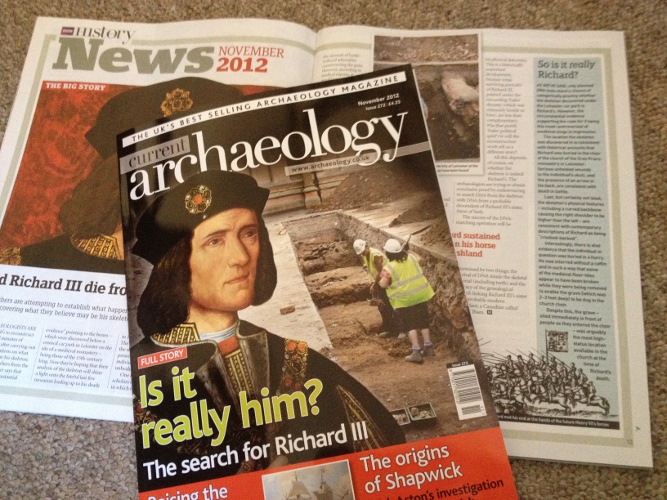
I’m fascinated by this in a sort of morbid way. Like probably most others who study history, I like to visit the mortal remains of the people that I find most interesting. Plenty of them have been lost, and Richard III has always been one of those figures. Finding his bones, if the DNA analysis proves that they are his, changes a few things about history the way we’ve understood it. We may now discover if his shoulder was actually higher on one side and how the end of the battle went, but we’re still not going to know whether or not he killed the famed princes in the tower. Yet this particular king has caught public attention for hundreds of years, both as a popular villain and as a king that some feel deserves a break. He has a society devoted to him and many many works of history and fiction attempting to do one of the two.
I waver between these two attitudes. Understanding the context around the history makes the question even harder to answer, although I tend to lean towards the fact that they were murdered under his watch these days. Will that stop me from visiting his grave, if this is him and when they finally decide where he will lie (in York, as he possibly wished, or in Leicester, where he was found) after all these years? No, I don’t think so. If anything, it’s incredibly interesting to me to watch this unfold, as it will inevitably become part of Richard III’s history, more than five hundred years after his death, even if it isn’t him. It is a tiny part that I actually get to live through, and these reminders that history happens all around us, all the time, are always welcome.
Have you heard about this potential discovery? What are your thoughts?



Recent Comments