|
|
 Emil Larsson is a Swedish tax inspector of sorts at the close of the 18th century, responsible for ensuring that shipping to and from Stockholm’s port is run properly. A frequent gambler and relatively happy singleton, he is dismayed when his employer demands that he acquire a wife in order to appear more respectable. While waiting to get his own cards read in order to help him find this wife, Larsson discovers that Mrs Sparrow, who runs his favorite gaming house, is actually very close to the Swedish king, and that his own fortune is a small part of the overall scheme taking control of Swedish politics. Emil Larsson is a Swedish tax inspector of sorts at the close of the 18th century, responsible for ensuring that shipping to and from Stockholm’s port is run properly. A frequent gambler and relatively happy singleton, he is dismayed when his employer demands that he acquire a wife in order to appear more respectable. While waiting to get his own cards read in order to help him find this wife, Larsson discovers that Mrs Sparrow, who runs his favorite gaming house, is actually very close to the Swedish king, and that his own fortune is a small part of the overall scheme taking control of Swedish politics.
Those who have read about the French Revolution may recognize that this time period was dramatic for Sweden, too; Count Axel von Fersen, one of Marie Antoinette’s rumored lovers and a key component in their failed escape plan, was Swedish and closely connected to the royal family there. France’s royal family aren’t the only ones in danger, as Sweden’s monarchy is fragile too, with a revolution brewing. Framed through this series of octavos, Emil has to work out the eight influential people around him and understand just how those people influence others in order to help change the fate of the Swedish nation – if he possibly can.
I wasn’t really sure about this book while I was reading it and I’m still not really sure about it as I’m reviewing it. Just looking at it heightens expectations; the British hardcover version of the book is truly beautiful, an elegant hardcover without a dust jacket and with a solid feel to the pages. The story is told through alternating viewpoints and as a result I found it surprisingly difficult to get at all interested in any of the characters, even Emil. He, for one, seems very mercenary and self-serving; once told he has to get married, he just chooses pretty girls without making any real attempt to get to know them or relate to them. I don’t think I’m someone who really needs to fall in love with a character in order to enjoy a book, but I certainly think it would have helped this one.
In addition, it’s a book that starts out slowly and really needs an initial element to help draw readers in. Purported to be a mix of romance, history, intrigue, and card-playing, it sounds more exciting than it actually is. There were some parts I found fascinating; the sections around fan-making and the fan language, for instance, and the little bits of history about the Swedish royal family and the history. The book is well written and very descriptive, bringing this frostier part of the world to life; but I felt while I was reading that there was something missing, a spark that would bring it all together and move this from being a good book into a great one.
A book I’d probably hesitate to recommend to any but a fellow historical fiction reader, The Stockholm Octavo is a decent read but not one that lives up to its promise, for me at least.
I am an Amazon Associate. I received this book for free for review.
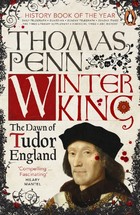 Henry VII, despite being the founding member of the Tudor dynasty, is not actually that well known as a historic figure. His son, granddaughters, and immediate predecessor are all much more prevalent in both fiction and non-fiction, but Henry himself was a significant figure that shouldn’t really be ignored. A bridge between the Plantagenets and the Tudors, Henry changed kingship in England in ways that directly influenced his son, Henry VIII, and shifted the country’s attitude permanently. Henry VII, despite being the founding member of the Tudor dynasty, is not actually that well known as a historic figure. His son, granddaughters, and immediate predecessor are all much more prevalent in both fiction and non-fiction, but Henry himself was a significant figure that shouldn’t really be ignored. A bridge between the Plantagenets and the Tudors, Henry changed kingship in England in ways that directly influenced his son, Henry VIII, and shifted the country’s attitude permanently.
This book has won accolades from numerous publications; my copy has an extensive list of awards sprawled right across the top of the cover, as you can see in the image to the left. It’s hard not to have high expectations for such a book, and indeed I was hoping for quite a lot from it, a more definitive view of a king who often remains in the shadows. Rather than not meeting my expectations, I’d probably say that I got a slightly different experience than I was thinking I would, but one that was still worthwhile regardless.
For one thing, this book doesn’t cover Henry’s entire life, not really. It focuses very heavily on his actual kingship, much less on the road there. Over quite a lot of the book, we can see exactly why Henry himself has remained a shadowed figure. Towards the end, he was a reclusive figure, often ill, and the deaths of his wife and first-born son seem to have pushed him ever further away from history’s prying eyes. He preferred to let his agents and ministers do the visible work, while they were responsible directly to him. Among these tasks was that of building his coffers by accusing people of crimes and extorting money from them, even if they hadn’t actually committed a crime at all. Worse, these agents rewarded informers, and lessened fines for those who did tell on their neighbors, creating a classic situation whereby everyone is falsely accused of something and no one profits but the government. Penn’s version of Henry VII’s reign sounds a torment to his subjects, punctuated by occasional generosity whenever the king suffered a bout of conscience.
The biography is written in a literary but relaxed style, one that would be very suitable for historical fiction. It makes the book easy to read, adding a small amount of imagination at times, but it wasn’t what I’d expected. It can be confusing sometimes, however, because when the author introduces someone new, we expect him to come back again and again, but in reality that particular person might have had only a small or insignificant effect on the reign overall. Because Henry’s government was large, and his ministers rotated often, there are a number of names in here, and I found it surprisingly difficult to keep them straight.
What I did like, though, was how readily Penn demonstrated what a change Henry VIII was. In some ways, the book focuses a lot more on this second son, who gained in power and prestige as Henry VII began to fade away. We can easily see, assuming Penn’s depiction of the taxes is correct, how the people might have been overjoyed to have a young, strong, chivalrous monarch rather than a reclusive aging one; a new monarch who might change policies and make their lives easier.
I also really appreciated how Penn emphasized that Henry VII’s reign was difficult. It was not guaranteed, as we always assume it is with the benefit of hindsight. No – he knew all too well how easily a crown could be taken away, and he must have known that he actually had no real right to it, given that he was descended from bastardy on both sides and couldn’t actually inherit through either. He was threatened over and over again by those he labelled pretenders, and building his dynasty through his children, who could inherit legitimately through his wife Elizabeth of York, was absolutely essential. With this in mind, it’s also easy to consider Henry VIII’s better-known obsession with having a son; might this be a lesson he learned from his father after his older brother Prince Arthur died unexpectedly?
Though by no means a perfect book, and far from a stereotypical biography, Penn’s work on the reign of Henry VII provides much food for thought on an English monarch who is often pushed to the sidelines. Recommended.
 It feels as though, recently, the balance between acquiring ebooks and acquiring physical books has started to take shape in my house. I seem to acquire both, but distinctions are appearing regarding which books belong where. It feels as though, recently, the balance between acquiring ebooks and acquiring physical books has started to take shape in my house. I seem to acquire both, but distinctions are appearing regarding which books belong where.
I’ve actually physically run out of space for real books. I have four bookcases, two normal-size and two small-size. One of the normal size bookshelves is for books I’ve already read and intend to keep, while the other is for unread books. Both are full. One of the smaller ones is for hardcovers that I’ve read, or ones that I would like to read soon, and the other is for books I’d like to reread in the very near future, or series that I’ve liked a lot and want to see together all the time. All full. And I do keep buying books, when I get the opportunity. Having to move all of them, though, is a prospect that worries me, because it was difficult enough moving just the books I had a year and a half ago, and I know that when we do move again, which won’t be in the terribly distant future, all those books will present a problem.
This predicament has led to me buying more ebooks. If I want a book, and I’m not sure it’s a keeper, I tend to add the ebook to my wishlist, rather than the physical book. This is in part convenience, because I have made a rule for myself, which is that I do not buy physical books online, I only buy them in the store. I do buy ebooks online, obviously, as I have a Kindle, and I do buy US imports online, since I have no easy other way to get them, but I buy real, physical books in a real, physical store, because I want that store to stay there and buying cheap books from Amazon is not the way to accomplish that.
Anyway, back to my original point; in certain genres especially, I’m leaning towards ebooks quite heavily. Urban fantasy, for instance; the series take up space and my bookstore doesn’t tend to stock all of them at once. Romance, as well, because most of the ones I want are imports that aren’t on the shelves here anyway, and because I very rarely read them twice. Big books that are only available in hardcover? Ebook, to spare both my hands and unfortunately my wallet. This does lead to the interesting situation where I buy books twice, one ebook and one real book, because I like it so much I want to own it.
Leaning towards ebooks in any sense makes me feel vaguely uncomfortable, like I’m cheating on my masses of unread paper books. And reading an ebook doesn’t really confer the same satisfaction as taking a book off the shelves to read, so I actually find myself leaning towards reading physical books more often, where I can see a pile (temporarily) diminishing, even as I become more comfortable actually acquiring more ebooks. It’s a very strange situation that I can only imagine is going to evolve further.
Have you noticed a shift in your own preferences towards ebooks? Or away from them? Or do you still feel the same way you did when they first emerged onto the market? Let me know your thoughts!
I have an unfortunate number of books that I read too long ago to write a normal, coherent, 500+ word review. So, more mini reviews are in order, to wipe the slate clean and feel like I can actually catch up with this blog of mine one of these days. These are all fantasy, although Blackout is on the line between fantasy and science fiction.
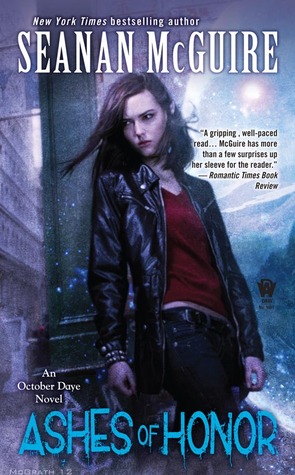
 Ashes of Honor, Seanan McGuire Ashes of Honor, Seanan McGuire
I love these books so much that I’ve lost the ability to even review them objectively, let alone in a way that will get you to read them with me. The stakes for Toby are always high, but in this one, they keep going up, and many characters from earlier books in the series pop back in again to help. And, I have one word for those who have read books in this series before: Tybalt. I am so invested in this series and these characters; I just sat down and read this book straight through because I simply had to know what happens next.
So, if you haven’t read these and you have the slightest interest in urban fantasy, get started with Rosemary and Rue!
 The Hidden Goddess, M.K. Hobson The Hidden Goddess, M.K. Hobson
I was one of the fans of Hobson’s The Native Star, so when the next book in the trilogy came out, I was looking forward to continuing this romantic historical fantasy series. While I liked it, I didn’t really fall in love with it. I think it’s suffering a bit from middle-book syndrome, and it’s definitely suffering from a lack of romantic interest. After the heady romance in the first book, I stopped being really sold on Emily and Stanton here. I’ll definitely pick up the third book in the trilogy, but it will probably sit on the shelf as long as this one did.
 Blackout, Mira Grant Blackout, Mira Grant
I feel guilty for consigning two of this author’s books to the mini reviews pile, but that’s what I get for putting off writing reviews – better something than nothing. Blackout was excellent; I had the pleasure of reading it with Jodie, mostly because we were terrified at what the author might do to the characters after the first book, but I was mostly satisfied by how it went and, while I was reading, I was completely glued to the pages. An excellent trilogy, totally worth your time, but make sure you start with Feed.
 Daughter of Smoke and Bone, Laini Taylor Daughter of Smoke and Bone, Laini Taylor
And finally we get to the book that everyone raves about but which I didn’t like much. I still don’t entirely see the appeal. I just didn’t fall in love with this book. I do often have difficulty with YA romance-y books, which I appreciate makes no sense as I inhale regular romance novels easily enough. But this one, I just didn’t connect with. I didn’t buy the magical connection between Akiva and Karou and – in all honesty – I saw the twist coming. And that never happens for me, as I’m horrendously bad at predicting what’s going to happen (on purpose). It’s more than that, though; I just felt like the book was too contrived, and I didn’t believe in what was happening.
What the book did have going for it, though, was the setting. The descriptions in this book were everything I’d imagined Prague to be, and everything I was disappointed by when it wasn’t. So that might have predisposed me against it. Just a thought.
Have you read any of these books? What did you think?
 The western world, particularly England where this book focuses, hasn’t always been as free in its sexual attitudes as it is now; indeed, for most of recorded history, all of the world has been more or less the same as the Taliban is now, with little concept of individual sexual freedoms or privacy. Adulterers, homosexuals, and prostitutes are among those who were deeply stigmatized as there was no real conception of individual privacy or the idea that your sexual history might be only your own business. The western world, particularly England where this book focuses, hasn’t always been as free in its sexual attitudes as it is now; indeed, for most of recorded history, all of the world has been more or less the same as the Taliban is now, with little concept of individual sexual freedoms or privacy. Adulterers, homosexuals, and prostitutes are among those who were deeply stigmatized as there was no real conception of individual privacy or the idea that your sexual history might be only your own business.
When did this change? Beginning in the late 17th and moving into the 18th century, a series of fundamental shifts happened in the understanding of privacy, sexuality, and even celebrity that resulted in concrete changes to the way people in Europe viewed their lives and those of the people around them. Dabhoiwala tracks this cultural shift, which has echoes running straight to the modern day, through its origins in a variety of different spheres to understand how and why it happened and how the attitudes creates are actually still being rewritten into the present day.
I found much of this book to be absolutely fascinating. The Enlightenment isn’t really my period of particular interest, so I knew very little about this subject. Coming into it from a medieval background, though, with a comprehensive knowledge of medieval attitudes towards sexuality and an idea of what happened in the Renaissance, I could recognize easily that this was actually a very significant shift. While medieval people weren’t necessarily as brutal or as hard on women as we necessarily think, that doesn’t mean that their society was particularly free. Sexuality outside marriage – sometimes even inside marriage – was routinely targeted as something to avoid wherever possible.
I also liked the approach that the author took here. Rather than strictly chronologically laying out exactly what was happening, he instead takes several themes and explores those and how each of them changed understanding in its own particular way. A chronological approach could have easily gotten confused; separating out particular themes and segments of history, like the rise of sexual celebrity with Charles II’s numerous mistresses, helped give the book focus and lend weight to the author’s arguments.
One section I particularly liked was the emphasis on the change in attitudes towards prostitution. Prostitutes were reviled in the period before this one, often viewed as tempting men into adultery and causing them to sin with their alluring ways. By the eighteenth century, the pendulum swung completely the other way, and prostitutes were viewed with extreme pity as fallen women who had fallen into impossible circumstances. The Victorians created workhouses where these women were rescued from their immoral lives, given religious training and isolated from all aspects of their former lives, and essentially forced to work for their upkeep. While this approach worked for some, with women emerging into the Victorian version of success with marriage and children, it failed monumentally for others, and the success rate really wasn’t high – nor did these workhouses make much money.
A truly fascinating look into a society that radically changed the way people thought, The Origins of Sex is a work of history that is well worth your time.
All external book links are affiliate links. I received this book for free for review.
Hello friends! October sped by in a flash, it seems; a week away and then a weekend away towards the end of the month means that we’re nearly halfway through November and I’m still not sure where the time went.
In October I had the privilege of going to Barcelona, Spain for work. While I did spend most of my time at the office, working and learning, there were palm trees outside to remind us that we were in fact in Spain.

We also were fortunate enough to have an evening free to explore. One of my favorite sights was the city’s second cathedral; not the famous La Sagrada Familia, still unfinished, but instead the medieval one towards the center of the city. Awash with golden light, with thirteen white geese in the cloisters to represent the saint to whom the church is dedicated, I found it to be an absolutely magical place.

Inside, I lit a candle for my younger brother, who would have been 25 last Friday and who passed away seven years ago this coming December. It just felt right.
In reading news, I finished ten books in October. I’ve discovered a trend in my reading now where I finish books in clusters on weekends and don’t really read that much in the week. Just glad I’m still in double digits!
Fiction
Non-fiction
- Imagine, Jonah Lehrer
- The Origins of Sex, Faramerz Dabhoiwala
Once again, the benefits of reading much less than I used to – I’m actually not that far behind on reviews! I still have a few from September (eek) but overall, I’m pleased.
Favorite of the Month
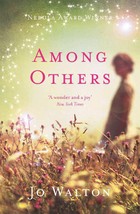
Easy choice this month, I loved this book to bits. If you haven’t read it yet, you should!

Trust me to find some history while everyone else is enjoying a glass of Scotch whisky! These are the oldest bottles of whisky in the collection in the Scotch Whisky Experience, Edinburgh.
I haven’t vanished – just been travelling and then ill over the past few weekends. I’ll be back next week!
|
|






Recent Comments