

 Henry VII, despite being the founding member of the Tudor dynasty, is not actually that well known as a historic figure. His son, granddaughters, and immediate predecessor are all much more prevalent in both fiction and non-fiction, but Henry himself was a significant figure that shouldn’t really be ignored. A bridge between the Plantagenets and the Tudors, Henry changed kingship in England in ways that directly influenced his son, Henry VIII, and shifted the country’s attitude permanently.
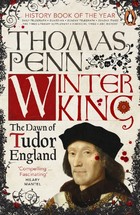
This book has won accolades from numerous publications; my copy has an extensive list of awards sprawled right across the top of the cover, as you can see in the image to the left. It’s hard not to have high expectations for such a book, and indeed I was hoping for quite a lot from it, a more definitive view of a king who often remains in the shadows. Rather than not meeting my expectations, I’d probably say that I got a slightly different experience than I was thinking I would, but one that was still worthwhile regardless.
For one thing, this book doesn’t cover Henry’s entire life, not really. It focuses very heavily on his actual kingship, much less on the road there. Over quite a lot of the book, we can see exactly why Henry himself has remained a shadowed figure. Towards the end, he was a reclusive figure, often ill, and the deaths of his wife and first-born son seem to have pushed him ever further away from history’s prying eyes. He preferred to let his agents and ministers do the visible work, while they were responsible directly to him. Among these tasks was that of building his coffers by accusing people of crimes and extorting money from them, even if they hadn’t actually committed a crime at all. Worse, these agents rewarded informers, and lessened fines for those who did tell on their neighbors, creating a classic situation whereby everyone is falsely accused of something and no one profits but the government. Penn’s version of Henry VII’s reign sounds a torment to his subjects, punctuated by occasional generosity whenever the king suffered a bout of conscience.
The biography is written in a literary but relaxed style, one that would be very suitable for historical fiction. It makes the book easy to read, adding a small amount of imagination at times, but it wasn’t what I’d expected. It can be confusing sometimes, however, because when the author introduces someone new, we expect him to come back again and again, but in reality that particular person might have had only a small or insignificant effect on the reign overall. Because Henry’s government was large, and his ministers rotated often, there are a number of names in here, and I found it surprisingly difficult to keep them straight.
What I did like, though, was how readily Penn demonstrated what a change Henry VIII was. In some ways, the book focuses a lot more on this second son, who gained in power and prestige as Henry VII began to fade away. We can easily see, assuming Penn’s depiction of the taxes is correct, how the people might have been overjoyed to have a young, strong, chivalrous monarch rather than a reclusive aging one; a new monarch who might change policies and make their lives easier.
I also really appreciated how Penn emphasized that Henry VII’s reign was difficult. It was not guaranteed, as we always assume it is with the benefit of hindsight. No – he knew all too well how easily a crown could be taken away, and he must have known that he actually had no real right to it, given that he was descended from bastardy on both sides and couldn’t actually inherit through either. He was threatened over and over again by those he labelled pretenders, and building his dynasty through his children, who could inherit legitimately through his wife Elizabeth of York, was absolutely essential. With this in mind, it’s also easy to consider Henry VIII’s better-known obsession with having a son; might this be a lesson he learned from his father after his older brother Prince Arthur died unexpectedly?
Though by no means a perfect book, and far from a stereotypical biography, Penn’s work on the reign of Henry VII provides much food for thought on an English monarch who is often pushed to the sidelines. Recommended.



Recent Comments