|
|
 Claire Randall has just ended her tenure as a WWII nurse and is on a second honeymoon of sorts with her husband, Frank, in Scotland, when a stone circle whisks her back in time to the 18th century, a budding war between England and Scotland, and a love that makes her question where exactly she belongs in the world.
Almost everyone I have spoken to has fallen in love with this book and immediately dashed out to buy the sequels. It’s a bit strange to be the one person not so affected by it. I liked it, don’t get me wrong – I do enjoy romance occasionally and that is what this book is. It just wasn’t unique, except in its unnecessary length. Certainly unnecessary – there are plenty of scenes which are completely superfluous to the novel’s plot and purpose. It just keeps going and going. Moreover, Claire forgives him far too easily for certain transgressions around the middle, and I found the ending scenes extremely disturbing and at times, again, implausible. Their reactions never felt natural, much less how Claire completely forgets her husband of several years after mere weeks in the company of Jamie Fraser.
I did enjoy the book, though. After a while, I started to believe that there was actually something between Jamie and Claire, and for all my resistance to some of their behaviors, sometimes you do just know that a person is right for you. I don’t understand why so many women of the world are in love with Jamie, though, as I certainly wouldn’t leave my fiance for him.
As far as the time travel aspect is concerned, I did my best to ignore the fact that it was simply impossible unless the worlds existed in parallel – a certain person’s death date changes, which makes it completely impossible that they exist in the same world, unless the issue comes up in later books.
Despite my criticism, I did like the book and I actually have Dragonfly in Amber sitting in my Amazon cart, used for $4. What can I say? I did like it, and all the reviews promise that number 2 is heavier on the historical fiction. I tend to prefer that, so I think I will give it a try. I don’t know if I want to embroil myself in the series, so I haven’t ordered it yet, but it’s certainly a temptation.
 Edith Pargeter takes us back to the very early 15th century, to a conflict between Sir Henry Percy, “Hotspur”, and Henry IV, the king of England, who has only recently usurped the throne from Richard II with the support of the Percy family. The story follows each man and his relationship with various people as well as their deteriorating relationship with each other as it continually worsens with time.
This book was, honestly, a bit challenging to read. Its prose was, in fact, dated, and although I think that added to the overall feel of the book in a positive way, it made it go very slowly. As a result, a book less than 400 pages took me 4 days to read, which is unusual. In addition, the story doesn’t really sweep the reader away. It is interesting and feels medieval, but it’s not fascinating and is pretty easy to put down. The characters remain detached from the reader as well as detached from each other. I felt the most sympathy for Prince Henry, the future Henry V, as we see the formation of his identity since he is fairly young as well as his conflict between his father and close friend. Otherwise, the two main characters somehow remain distant even though we are given the opportunity to get into their heads. This is somewhat rare for me with a work of medieval historical fiction since I’m getting fairly practiced as placing myself into the medieval mindset (or as close as a modern person can get).
I did enjoy it while I was reading it and I found her perspective interesting, but it certainly isn’t one of my favorites, and I’ll probably wait a while before picking up another of her works.
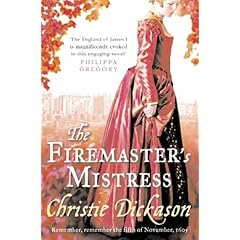 This book was an unexpected pleasure. I purchased it in the UK over a year ago at this amazing bargain bookshop that I found, and which has now closed. I’ve been putting off reading some of them because one of the first books I read from there was terrible and is one of the few books I’ve given away. With this book, on the other hand, I got a great deal!
The book follows the tale of two people, mainly, Francis Quoynt and Kate Peach. They were lovers before Francis left Kate a ruined woman two years before the novel’s beginning. Kate has had to do all that she can to survive, while Francis has been at war for England as a firemaster – someone who makes gunpowder and sets off “controlled” explosions. Not surprisingly, as the country’s premier firemaster, Francis is sent to London and ordered to ingratiate himself among a group of men who plan to kill the king. This is the famous Gunpowder Plot of 1605, and all the plotters aside from Quoynt are real historical figures. Francis finds himself involved with Kate, who is a secret Catholic like the plotters, and confusion ensues as he isn’t sure where his loyalties lie while she attempts to adjust to having the Quoynt family back in her life.
I particularly enjoyed this book. It was well-plotted, though a bit slow in the beginning, and I was hooked only a little way in. I could really empathize with Francis and Kate because the author gave me a great perspective right into their heads. Even Francis’s father, Boomer, was done well. The subject matter is as ever interesting and I felt was handled pretty well. The only thing that dissatisfied me was part of the ending, which constitutes a spoiler.
*spoiler warning*
I did not like that Kate ended up with Boomer. After all of Francis’s effort, I felt that he really deserved the girl, especially when he loved her so. I couldn’t see their relationship at all, and this change marred what was a really good book.
*end spoiler*
So, in the end, the quality of the book was quite good and it’s certainly up there with many other historical fiction authors, so I’m not quite sure why it was in a bargain bookshop! I’d recommend it to other historical fiction readers. In fact, I see it’s coming out in the US this September, so I hope Ms. Dickason gets more attention! I certainly intend to pursue her other works. In all, an absorbing worthy read.
The White Mary is mainly the story of one woman, Marika Vecera, a magazine reporter whose life mission is to travel to all the dangerous parts of the world and report back on them. The first half or so of the book alternates between these trips, a growing relationship with her boyfriend Seb that she never expected, and her dangerous search for older reporter Robert Lewis, her idol, in the jungles of Papua New Guinea. The second half focuses on her journey and is where she really discovers who she is, what she wants, and how to be happy.
I really, really liked this book. Marika’s emotions and motivations and personality were so believable. I’d be a bit more stunned by this if the author wasn’t a reporter herself, but even so, conveying it to that level in fiction is truly impressive. The other characters were unfortunately a bit shadowy, but she really shines; this is her story and these are her discoveries. I have never been to any of the places she visited and if we’re being honest here I have no urge to go (I’m no reporter), but with this book I felt that I was there when she was and experiencing the same dangers. It’s hard to detach yourself from the narrative and I read it very quickly.
Plot moves along swiftly for the most part, though her struggles in the jungle and afterwards were a bit slower. The interconnected storylines make sense and allow us to gradually understand Marika’s mission even as she goes forward with it. The author does a very neat job piecing together her history so that we have the full picture by the time the book reaches its climax.
I think The White Mary is meant to be compared to Heart of Darkness, given that Marika travels into the center of the Papua New Guinea jungle, but it is so much better and since I’ve tried to block Joseph Conrad’s work from my mind, I cannot go into that here.
Overall, though, the book is about self-discovery, and Marika’s realizations towards the end made sense. The author had been building up to them all along. That didn’t stop them from having an emotional impact – I even cried at the end, and I haven’t done that for at least a year. The book is very moving and the emotions all feel so real. I’m impressed for a first-time fiction author. I’d certainly recommend this book to someone else.
Release date: August 2008
David McCullough breathes new life into one of America’s foremost patriots with this excellent biography. It does everything a biography should do – it covers every detail of Adams’ life, his family, his interactions, and his immense influence on early American government, and more importantly, it makes him feel like a real, fully fleshed out person. He and his wife Abigail jump out from the page in numerous excerpts from their letters to each other, with the situations elaborated upon by McCullough in strong, clear writing, which is never boring as he manages to make tedious issues of government understandable and even interesting.
What struck me is how little about Adams I had learned previously. The great patriots seem to always be Washington and Jefferson. Both are included in this biography, especially Jefferson, but are shaded in a different light. We objectively know that no one is perfect, but somehow the founding fathers escape our scrutiny. McCullough does not spare them, but neither does he spare Adams – he is merely showing us the men as they were. This makes them feel far truer than any high school history class that simply extols their virtues has ever done. Adams’ contributions to American independence are given full weight and consideration here and it is hard to understand just why we don’t admire him the same way we admire the other patriots. Perhaps because he was a stubborn man whose enemies attacked him to an extent no longer allowed in American politics? Perhaps because he occasionally lost his temper and made some attacks of his own? I don’t know, but I certainly admire him all the more after this refreshing biography. It’s clear he was a brilliant man, and McCullough displays this equally alongside his faults.
Would I recommend this biography? Yes! I think it’s essential reading for every American. Especially now, when we are embroiled in a frustrating war, it’s important for us to realize that it was not always this way and that men did fight for peace when it counted, like Adams did even though it lost him the presidency. This man should be given more credit than he is now – McCullough has convinced me. He should be up there with Jefferson and Washington for his contributions. This is a brilliant work of history and it most certainly deserves that Pulitzer.
Year of Wonders tells the story of a plague year and a village that shut itself off from the world through the eyes of Anna Frith, a widow with two small sons. Her sorrow grows as so many that she loves die from the plague, but she also comes to realize more about herself, her endurance, and what is truly important to her. This is the reason for the “wonders” in the title, since otherwise a year full of tending plague victims would not be anything near wonderful.
I enjoyed this book. I liked Anna’s interactions with Elinor, so characteristic of someone who has lost everything and thus clings on to the one thing she can have. Anna’s sorrow and growth were both so real. In truth, nearly everything in this book felt very human and very understandable. People’s reactions to losing their whole families result in fear, suspicion, and murder, especially in this time in history when so much could be blamed on a “witch”. Brooks writes well and draws you into this small community’s difficult and deadly year.
I think this book has value for every reader since it says so much about human nature – it goes beyond the historical fiction genre to convey meaning about suffering and understanding. I would certainly recommend it.
I find Jacqueline Carey’s work to be addicting and intoxicating, particularly her Kushiel’s Legacy series. KUSHIEL’S MERCY is no exception to this rule, considering I received it yesterday (early, considering it is due out June 12th!) and read most of it in an hours-long marathon read overnight. It is impossible to put down.
Imriel and Sidonie’s love for each other has finally become public, but for it to acknowledged by the Queen of Terre d’Ange, Sidonie’s mother Ysandre, Imriel must find his mother and bring her to justice for the crimes she committed in Carey’s first trilogy. Imriel takes on this challenge to win his love, only to be confronted with even more insurmountable obstacles that endanger everything he holds dear.
This is a fabulous book. It is well-plotted, never a dull moment, events popping up that I never would have expected. As I mentioned, I literally could not put it down until I was done. Carey’s writing remains spectacular and her character development proceeds at a running pace. Imriel’s development is absolutely stunning, considering where he came from in KUSHIEL’S SCION, and she has done a wonderful job here as well. Princess Sidonie comes into her own, providing us with another of her very strong females, though she and Phedre are vastly different. Carey excels at creating characters to fall in love with – not only that, but who fall in love (and make love, though it’s never the focal point here) with each other in believable and wondrous ways.
This is a journey to treasure and a book I will read over and over again. I am sad that Carey will be turning away from these characters to set another story generations later in Terre d’Ange, but I will recommend these books whole-heartedly.
ROMA is an ambitious saga that portrays the early days of ancient Rome, from its first bare beginnings as a salt trading post to the the struggle of the heirs of Julius Caesar. Each chapter is from a different period, though the time between them varies and shortens as the book goes on. The chapters are held together by several families, the most important of which holds an ancient talisman which is passed down through the generations.
Of necessity, the book truly isn’t gripping. Since each chapter is told by a different person, it’s hard to become attached to any of them, and a genealogical chart somewhere tracking their descendants would have been very useful. Still, each chapter was well told and interesting. I enjoyed the way Saylor showed how something simple becomes a legend only to become mystical and forgotten. He also succeeded in linking together all the chapters enough to make the book feel like a cohesive whole. Roma itself is a personality just as those who inhabit her are, which helps a lot with the narrative in later parts of the book.
Still, I am left feeling that although it was enjoyable, it could have been better. Rutherford’s LONDON is the best novel I’ve read of this type, and I would recommend that one first. This book provides a painless, enjoyable fictional introduction to early Rome and would also serve as a good stepping-off point for those interested in its history.
In this novel, Cornwell spins an exemplary tale following the Northumbrian boy, Uhtred, set in Anglo-Saxon England before it was actually England, but instead a land of many minor kingdoms. Uhtred is the heir to an estate in Northumbria, Bebbanburg, but when his father and brother are killed by Vikings and he is taken prisoner, his uncle seizes the castle and it seems that his future as a nobleman is over. On the other hand, he is only a boy, so he doesn’t mind, and he grows to love his Danish captor, Ragnar, like a father. The book follows their adventures and traces Uhtred’s development from a boy to an accomplished adult warrior.
This is a great book. Uhtred is a likable character, despite his arrogance. He admits when he wasn’t prepared in his youth, but his older persona, who is ostensibly telling the story, shines through fairly obviously and so there’s never any doubt that he is very capable and survives. The book is extremely engaging and absorbing. Cornwell makes Anglo-Saxon culture very understandable and it’s clear that this is an area of history which fascinates him. It fascinates me, too, so I loved all the little tidbits he tossed in, even the ones I already knew. The historical characters are all real and seem fairly accurate to their real selves, particularly the very pious and forward-thinking Alfred. I can’t wait until Aethelflaed, his daughter, grows up in the next few books, as she is without question my favorite historical figure. The Vikings are depicted as real people, though they are certainly much more eager for battle. The only problem with the book really is that the church is so negatively stereotyped and piety is seen as very negative, so those among us who are Christians may be offended, but since that’s in Uhtred’s character and he is telling the story, I think the viewpoint is understandable, even though not actually true.
I particularly liked Cornwell’s use of the historical note to tell us what he made up and what he did not, as well as his use of Anglo-Saxon place names rather than modern ones. It gives the book a much more authentic atmosphere, and gave me some linguistic fun (as well as historical contentment) as I tried to decipher the names on my own rather than look in the handy glossary.
Overall, this book is great. The next book I buy will certainly be THE PALE HORSEMAN, number two in this series. Highly recommended to anyone who appreciates historical fiction.
I’m not sure why, but all the fantasy I have read lately has disappointed me, with the exception of Kushiel’s Justice. Black Sun Rising is also a disappointment, unfortunately. At the same time, however, I did like it and I would like to read the next book in the trilogy. Part of the problem with this book is that it jumped in without really showing me the relationships I was supposed to care about. I got a hint of a beginning relationship between Damian and Ciani, when all of a sudden he loves her and spends a lot of time regretting the path that she inevitably takes. I can see how relationships develop afterwards, but a large part of the emotional basis is missing and it just bugged me while I was reading. It probably didn’t help that Ciani annoyed me and I couldn’t figure out exactly what drew everyone to her
In terms of plot, the book moves very quickly and at times in unexpected ways. The novel is certainly fantasy, but it has a few hints of sci-fi – it’s clear that their civilization was once much more scientific than it is now. It remains interesting throughout and never drags, which is great in a book of fairly typical fantasy length. I enjoyed the story and I thought the world-building was fairly effective and interesting. Most of all, I liked the way the book ended. It wrapped up the main threads of the story but left a clever epilogue to show us that the story goes on and hook us in. So we don’t have to read more to find out what happens, but we want to.
In the end I’d probably call this fairly solid fantasy. It has potential to build on the relationships and the world to become something great, though. I’ll keep reading.
|
|


Recent Comments