|
|
 Lady Elizabeth Grey’s husband was killed at the Battle of St. Albans and she desperately wants his lands back for her two little boys. She is tired of living in her parents’ home and would like her independence. So she stands out in the road as the new king, Edward IV, rides by, holding their hands and hoping he’ll see her. He does see her and takes note not only of her problems, but of her beauty, and before she knows it, Elizabeth is the queen of England and in almost over her head with politics and intrigue. She is a Woodville, though, and she will perservere, going to the edge to push her family as high as it can possibly go before her tower of cards topples around her. Lady Elizabeth Grey’s husband was killed at the Battle of St. Albans and she desperately wants his lands back for her two little boys. She is tired of living in her parents’ home and would like her independence. So she stands out in the road as the new king, Edward IV, rides by, holding their hands and hoping he’ll see her. He does see her and takes note not only of her problems, but of her beauty, and before she knows it, Elizabeth is the queen of England and in almost over her head with politics and intrigue. She is a Woodville, though, and she will perservere, going to the edge to push her family as high as it can possibly go before her tower of cards topples around her.
This is going to be a good long review, as I have a lot to say on this book. For those who skim, here’s my verdict: much better than I was expecting!
If you know me and have been reading my blog, you’ll know that I’ve been working on a dissertation about Anthony Woodville (and fifteenth century chivalric culture in England overall) for what feels like forever. As such, this book was bound to touch on a topic near and dear to my heart, and it was bound to get some of the facts wrong, if only for the sake of storytelling. So it does; the Woodville family was loyal to Edward IV after 1461 but before he married Elizabeth, and Anthony was sent to besiege Alnwick Castle on his behalf with the earl of Warwick in 1463, not to mention that Elizabeth’s father Lord Rivers had already been appointed to office. The beginning was anachronistic in another way because Edward kept being referred to as a boy, and there is no way anyone in the medieval period would have considered a man who had commanded and won two battles a boy. I can see that she did this more for characterization purposes, especially given he was younger than Elizabeth, so I don’t mind as much, but still worth noting. And Anthony was not at Tewkesbury, although he was definitely in London and fighting when Thomas Neville arrived. There is also the whole magic subplot, but I thought that was actually quite creative, and historical inaccuracy only bothers me if people believe it’s true. I don’t think anyone would ever believe Elizabeth and Jacquetta were witches. I could go on, but I’ll spare you.
All that said, Philippa Gregory got more right than wrong in this instance and I was pleasantly surprised. No one is needlessly victimized here; in fact Elizabeth is quite a sympathetic character which is refreshing after all of the villainizing that typically surrounds her. Even Richard III is not a villain but a multi-faceted man whose ambition just kept on pushing a little too far. The rest of the history is in many ways what has been fictionalized before, and I found nothing that really bothered me. All things considered I enjoyed this book after the first fifty pages and I wasn’t expecting to. Gregory even included Anthony’s poem, which is authentic and the only one that survives; she inflates his reputation to some extent, but I didn’t mind, it fit in.
Gregory writes well, and in general the book is absorbing even for someone who has heard it all before. It’s romanticized, but in the way that makes us sigh and wish we had a big blond knight to save the day. It’s exciting and tense because everything is dangerous, and because I kept wondering who was going to kill the princes in this version. Another interesting twist there, and I think we’re meant to guess at what she means, but for someone who doesn’t know the history, it’s a nice question. And in the end, I like the way Gregory twisted things here. It’s interesting and it’s different when the story has been done over and over again. Given the fluidity of history itself, I found myself enjoying the way she pushes boundaries and suggests things that probably didn’t happen but might have done. I didn’t want to read another fictional recap of the Wars of the Roses, but Gregory made it a little bit new, and despite myself I think I’m looking forward to The Red Queen very much, even if I don’t think anyone ever called these ‘the cousin’s wars’.
In other words, I do recommend The White Queen. It is historical fiction, after all, and if you’re going to read another book that fictionalizes the Wars of the Roses, I highly suggest this one.
Amazon | Amazon UK
 Stealing the back cover description this time because this is so complex: Stealing the back cover description this time because this is so complex:
In his most dazzling novel since the groundbreaking New York Times bestseller An Instance of the Fingerpost, Iain Pears tells the story of John Stone, financier and arms dealer, a man so wealthy that in the years before World War One he was able to manipulate markets, industries, and indeed entire countries and continents.
A panoramic novel with a riveting mystery at its heart, Stone’s Fall is a quest to discover how and why John Stone dies, falling out of a window at his London home. Chronologically, it moves backwards–from London in 1909 to Paris in 1890, and finally to Venice in 1867– and in the process the quest to uncover the truth plays out against the backdrop of the evolution of high-stakes international finance, Europe’s first great age of espionage, and the start of the twentieth century’s arms race.
Like Fingerpost, Stone’s Fall is an intricately plotted and richly satisfying puzzle–an erudite work of history and fiction that feels utterly true and oddly timely–and marks the triumphant return of one of the world’s great storytellers.
I had an interesting time with Stone’s Fall. I read most of it in a couple of days, then set aside the last 200 pages to be read several weeks later. I didn’t do it on purpose, I just didn’t feel like lugging such a huge book on a plane with me. It’s worth noting that I wasn’t particularly compelled to pick it up again, especially as I’d forgotten most of what happened, but I enjoyed the end when I got to it.
Since it’s set in three time periods, it takes a bit of patience to see where this book is going. At first, everything seems clear. John Stone and his wife Elizabeth are fairly ordinary as millionaires go; it’s only when Stone falls out a window and Elizabeth invites reporter Matthew Braddock into their home that things get interesting. Stone has insisted that they find an illegitimate child of his before the will can be settled, but no one can find this child. And so this twisting mystery begins with a search, but widens into something much more.
Despite its massive length, Stone’s Fall needed every word to pull off its twisting plot. Even though the story goes back in time, we have no idea what the outcome in the present time is until the full story is told, and that outcome is extremely unexpected. I can’t imagine anyone guessing the result of this mystery and it’s all the better for it; I like a little unpredictability in my reading. It’s hard to get attached to the characters, especially as we’re treated to details of their sordid pasts, but they are complex and well-developed in all stages of their lives. I thought the best character was the man who represented Venice in the book’s last segment. The city is a character, so it makes perfect sense for it to be manifested as a human being. This was a nice touch.
If you like long, involved mysteries, I would recommend Stone’s Fall to you. It would be a great read for anyone else, too, but I do have to suggest not putting it down once you get involved! It’s hard to pick up the pieces in such a convoluted plot, at least not until it starts to make sense towards the end. I am still looking forward to An Instance of the Fingerpost by this author, which is sitting on my TBR pile staring at me.
 As an aspiring medieval historian, Kivrin has always wanted to visit the Middle Ages for herself. Since this book is set a great deal in the future, she actually can, although that doesn’t mean all of her advisors at Oxford think it is a great idea. In fact, one of them, Dunworthy, is frantic with worry about her; he is even more worried when after the drop, the tech who sent her falls very ill and can’t tell him her coordinates. Soon, all of Oxford is under quarantine as doctors desperately try to figure out where the mystery illness came from. In 14th century England, Kivrin’s quest doesn’t go well either, as she both falls ill and realizes that something has indeed gone wrong with the drop and she is about to be tested far more than she’d ever expected. As an aspiring medieval historian, Kivrin has always wanted to visit the Middle Ages for herself. Since this book is set a great deal in the future, she actually can, although that doesn’t mean all of her advisors at Oxford think it is a great idea. In fact, one of them, Dunworthy, is frantic with worry about her; he is even more worried when after the drop, the tech who sent her falls very ill and can’t tell him her coordinates. Soon, all of Oxford is under quarantine as doctors desperately try to figure out where the mystery illness came from. In 14th century England, Kivrin’s quest doesn’t go well either, as she both falls ill and realizes that something has indeed gone wrong with the drop and she is about to be tested far more than she’d ever expected.
Since this one appears to be science fiction, Keith had a go at it before I had a chance and really didn’t like it, so I was reluctant to pick it myself. Shame on me because I absolutely loved it. Obviously, as a medievalist myself, I am right there with Kivrin, I’d love to go for two weeks and experience it all for myself. Of course, I don’t think I’d much like her experience there, but I thought one of the coolest parts about the beginning of the book was when she realizes that medieval life wasn’t exactly like a textbook; not every highborn family is going to live in the exact same manor house with the same number of servants. I’m sure this was the case, although some of it is caused by events that later become prevalent (and which I won’t reveal because I don’t want to spoil the book!)
Perhaps the most surprising aspect of this book for me was how exciting it was. With everyone in Oxford falling ill, and Kivrin doing so herself, and all the craziness occurring in the first third of the book, it’s hard to tell what’s going on. Events roll on and eventually all becomes clear, but the book definitely had me guessing for a while. It’s easy to figure out what happened once details emerge, but even then the level of suspense and ensuing tragedy just builds up. This is a science fiction novel, ostensibly, but that didn’t bother me one bit. The technology has some fancy words attached, but since there isn’t much explanation and all the fancy words meant things I could translate into layman’s terms on my own, I didn’t experience any trouble with it.
I was so pleased with this book that despite its chunkster status, the pages flew by and I read it in two days. I would definitely recommend it to fans of both speculative fiction and historical fiction, although given Keith’s experience, if history bores you this one probably will not be for you. I, however, loved it, and know I’ll be on the lookout for other books by Connie Willis.
IndieBound | Powell’s | Amazon
 When her parents arrange for Bess de Montacute to marry Hugh le Despenser, Bess is extremely unhappy. Hugh is the son and grandson of traitors and in his thirties, while Bess is only thirteen. She cannot imagine ever getting along with her new husband and spurns many of his advances. Hugh, meanwhile, is thrilled with the match, given that Bess is lovely and her family is in favor with King Edward III, but regrets having to put aside his long-term and much-loved mistress. Still haunted by dreams of his tortured past in prison, Hugh needs someone who will love and support him. Will Bess be the one, or will their marriage result in heartbreak? When her parents arrange for Bess de Montacute to marry Hugh le Despenser, Bess is extremely unhappy. Hugh is the son and grandson of traitors and in his thirties, while Bess is only thirteen. She cannot imagine ever getting along with her new husband and spurns many of his advances. Hugh, meanwhile, is thrilled with the match, given that Bess is lovely and her family is in favor with King Edward III, but regrets having to put aside his long-term and much-loved mistress. Still haunted by dreams of his tortured past in prison, Hugh needs someone who will love and support him. Will Bess be the one, or will their marriage result in heartbreak?
Since I really enjoyed The Traitor’s Wife by Susan Higginbotham this spring, I was very much looking forward to Hugh and Bess. I was not at all disappointed; Higginbotham has written an eminently charming and touching novel of romance that varies enough from Traitor’s Wife to show off her writing talent while giving us something a little bit different.
As this is essentially a novel about a relationship, the two main characters must be well developed for the book to work, and here they certainly are. I loved Hugh and Bess. I loved them apart but I loved them together even more, which is what made this book such a pleasure to read. They each bring problems to the marriage, Hugh with his difficult past and Bess with her initial inability to look past Hugh’s traitorous family. Watching them fall in love with one another and get past their individual issues was pure enjoyment. Higginbotham efficiently fills us in on the history of Edward II and the Despensers, so readers without knowledge of the period will fully understand the stigma Hugh faces as he attempts to rebuild his family’s name. It also helps that the cast of this novel is considerably smaller; we don’t need an epic to get to know these people, and just under 300 pages is the perfect length for this book.
One rather small detail I appreciated was Higginbotham’s attention to the chivalric education of young men around this time. I just so happen to be educating myself on this topic right now and I love that she stuck to the history and incorporated her research, particularly in this one area about which I have become well-informed. It makes me trust the rest of her facts, which are all accurate as far as I know. Of course, historical novelists tend to slant portrayal of all characters one way or the other, but it’s wonderful knowing that there is a sound basis for such decisions.
Hugh and Bess is a wonderful read. I highly recommend it to fans of historical fiction (and romance!) everywhere. I’m eagerly awaiting more by Susan Higginbotham. In the meantime, she has a fantastic blog which you can find right here and you can also visit the other great blogs on this tour:
Musings of a Bibliophile (7/28)
Passages to the Past (8/1)
My Friend Amy (8/1)
Reading Adventures (8/2)
Jennifer’s Random Musings (8/2)
Peeking Between the Pages (8/3)
Historical Novels.info (8/3)
Grace’s Book Blog (8/4)
The Written World (8/5)
Mrs. Magoo Reads (8/5)
Historical Fiction (8/6)
Jenn’s Bookshelf (8/6)
The Tome Traveller’s Weblog (8/7)
Galley Cat (8/8)
Book Addiction (8/9)
Steven Till (8/10)
Carla Nayland (8/11)
The Literate Housewife Review (8/12)
Diary of an Eccentric (8/13)
Bookfoolery and Babble (8/14)
 As a poor urchin, Luciano steals food and crams it down his throat as fast as he possibly can. At least, he does so before he is abruptly adopted off the street by an illustrious chef and hired as an apprentice. There he learns to savor food, to appreciate the process of cooking, and in the process gets an inside view into much of Renaissance Venice’s politics. For the entire city is ablaze with rumors of an ancient book that holds the secrets to immortality, love, and gold. When Luciano witnesses a murder in the doge’s dining room, he begins to reconsider his position in life and whether those around him know the answers to the questions asked by so many of the city’s most important residents. As a poor urchin, Luciano steals food and crams it down his throat as fast as he possibly can. At least, he does so before he is abruptly adopted off the street by an illustrious chef and hired as an apprentice. There he learns to savor food, to appreciate the process of cooking, and in the process gets an inside view into much of Renaissance Venice’s politics. For the entire city is ablaze with rumors of an ancient book that holds the secrets to immortality, love, and gold. When Luciano witnesses a murder in the doge’s dining room, he begins to reconsider his position in life and whether those around him know the answers to the questions asked by so many of the city’s most important residents.
For me, this book is historical fiction, with a little bit of foodie lit and mystery tossed in. I love the setting of Venice. It lives and breathes in this novel, practically becoming its own character as Luciano runs through the streets, whether it’s to escape from authorities or to visit the woman of his dreams, a novice at the convent named Francesca. The food descriptions are similarly to die for; even the act of eating a grape is examined and detailed and made me really wish I had bought some grapes at the grocery store. Since the chef uses ingredients which no one imagines exist, common things about which we know (and I guessed before Luciano figured out what they were), their effect is given in every detail. In other words, yum.
The intrigue had me spellbound, too. I wasn’t sure what Luciano was going to discover, but I enjoyed his journey there. Certain aspects of the plot, particularly Luciano’s infatuation with Francesca, annoyed me, but never too much. Mostly I’m just impatient and I don’t like my characters to be slow on the uptake. I also really dislike it when characters declare their love when they haven’t ever spoken to each other, but I tried to keep in mind the fact that Luciano is a teenager and most teens suffer from this problem. On reflection, I didn’t actually like Luciano very much, but I thought that the plot and the descriptions held the book together enough for me to enjoy the experience overall. I can’t comment much on historical accuracy because I just don’t know much about 16th century Italy, but Elle Newmark does include a nice author’s note explaining what she changed, which is always appreciated.
Overall, this was certainly an enjoyable book. The Book of Unholy Mischief is recommended to historical fiction fans, especially those who appreciate drool-worthy descriptions of food.
 Brunin FitzWarin, ten years old, feels like an embarrassment to his family. His grandmother is domineering, his father is never satisfied, and his mother cries often. At a fair, he runs into two older boys, enemies of his father, who beat him mercilessly. As a result, Brunin is sent to be squired at the castle of his father’s best friend, Joscelin de Dinan of Ludlow. There he meets Joscelin’s daughter Hawise, who soon befriends him and helps him live a little outside the shadow of his family. As Brunin grows up, he must find confidence in himself, love with Hawise, and help Henry II to take the English throne. Brunin FitzWarin, ten years old, feels like an embarrassment to his family. His grandmother is domineering, his father is never satisfied, and his mother cries often. At a fair, he runs into two older boys, enemies of his father, who beat him mercilessly. As a result, Brunin is sent to be squired at the castle of his father’s best friend, Joscelin de Dinan of Ludlow. There he meets Joscelin’s daughter Hawise, who soon befriends him and helps him live a little outside the shadow of his family. As Brunin grows up, he must find confidence in himself, love with Hawise, and help Henry II to take the English throne.
Elizabeth Chadwick is a fantastic author and I don’t know why I don’t read more of her books. This is another one of my oldest TBR reads and it’s a shame that I let it sit so long. I was immediately drawn into the 12th century to live with these characters in their world. Those characters are truly wonderful. I loved Hawise and both her tomboyish ways as a child and her path towards maturity as a responsible, loving woman. Brunin was a more challenging character; in many ways he has to fight his way to favor both in the book and for the reader. Towards the middle, it becomes easier to feel for him. The timescale of the book over a long period of years suited the characters’ development particularly well, too; it takes us through enough of their lives that we can really get to know them and become interested in the outcome of their stories.
Chadwick has also evoked the period in history brilliantly. The battles are exciting, the behavior of the characters is right in line, and the political drama is played out on a personal scale. Her language is pitch perfect. She uses modern English without any colloqualisms (not any that I spotted) but with medieval words for clothes and objects which we would no longer recognize. All of it is very well done and makes it easy to sink into the world while not forgetting that this is meant to be set 900 or so years ago.
There is quite obviously romance in this book, but it’s one facet among many and feels very natural. The characters deal with family issues, loyalty, illness, unfair and arbitrary laws, and even aging. The outcome of the novel is never assured; the plot moves fairly quickly and the reader is not sure whether there will be a happy ending or not. There is suspense going on at times as well; I know I found myself racing through the pages to make sure that certain characters lived.
There is something here for everyone. Despite its length, it was also a quick read; it’s very easy to get swept away in this historical saga. I’d highly recommend it and I’m really looking forward to my next read by Elizabeth Chadwick.
Amazon UK
 Isolde, queen of Britain in the 6th century, has just lost her husband King Constantine and finds herself adrift and powerless in a court suddenly full of enemies. A generation has passed since the fall of Arthur and Camelot and infighting is on track to destroy the fragile alliance among the Britons at a moment in which strength is needed to conquer the threatening Saxons. Isolde, daughter of Arthur’s bastard son and murderer Mordred, is accused of witchcraft and sorcery and despite her suspicions, no one trusts her word; this dismays her even more because she has lost both her memories and her Sight. She finds compassion stirred when she visits two Saxon prisoners, aiding them to end their misery by giving them a knife. When she flees, she finds that one of them, Trystan, has escaped and becomes her trusted companion as she fights to save the British kingdom. Isolde, queen of Britain in the 6th century, has just lost her husband King Constantine and finds herself adrift and powerless in a court suddenly full of enemies. A generation has passed since the fall of Arthur and Camelot and infighting is on track to destroy the fragile alliance among the Britons at a moment in which strength is needed to conquer the threatening Saxons. Isolde, daughter of Arthur’s bastard son and murderer Mordred, is accused of witchcraft and sorcery and despite her suspicions, no one trusts her word; this dismays her even more because she has lost both her memories and her Sight. She finds compassion stirred when she visits two Saxon prisoners, aiding them to end their misery by giving them a knife. When she flees, she finds that one of them, Trystan, has escaped and becomes her trusted companion as she fights to save the British kingdom.
I have read many, many versions of Arthurian legends. I took a class in them and I have a personal interest in them, so I’ve read mostly everything from the origins to the present day. At times it feels like it’s impossible for a book to feel fresh and new and exciting when it’s working in this genre. If so, Anna Elliott has definitely achieved the impossible. I could recognize the echoes of the original Welsh legends in this book – the relations between the characters are notable in this instance – but at the same time this is a book (and I suspect will be a trilogy) that stands completely on its two feet.
Twilight of Avalon is grounded in historical fiction with some added magical elements; the author herself plays with the concept that legend is always more far-fetched than truth. For example, when Merlin is sent on a particularly dangerous mission for Isolde, he asks her to say that a beautiful enchantress has stolen him away to the Hollow Hills to explain his disappearance if he dies. Many of us will recognize that as exactly what happens in most versions of the legend.
I really liked one of the narrative strategies that Elliott used. Isolde has lost most of her memory from before a traumatic event in her life. So, she’s lost most of the power she had, and she thinks it’s because she purposely blocked out half her life. In this novel, she slowly regains memories, and by hearing the voices of the deceased come back to her, she learns gradually about her own life. In my opinion, this is a clever strategy to catch the reader up on both the Arthurian legends (in case they have somehow managed to avoid exposure) while building Isolde’s character and history. Elliott’s writing is a pleasure to read and very easily absorbing; I find it harder and harder to really get into books these days and I was thrilled that I could just sink into this one at any time.
Isolde herself is a strong woman, determined to make her world sit properly on its axis to the best of her ability and admirably devoted to Britain. Trystan is a hardened warrior who has seen people at their worst but who is willing to support and save Isolde when necessary. So far, they work well together, and the romance hasn’t even begun yet. I thought the secondary characters were fairly well fleshed out, too, especially Trystan’s little band.
I loved Twilight of Avalon and it definitely receives my enthusiastic recommendation. This is a keeper and I find myself excitedly anticipating the second volume in the trilogy, out next year.
 As a little girl, Cressida is terrified of George Harding, a scarred World War II pilot who insinuates himself into her family’s life. He’s provided for them in a sense since her father was rendered incapable, even moving them into his vacant servants’ house when they can no longer afford their own. For Cressida, he has a special assignment; he wants her to spend time with his nephew Edgar and make the timid boy into a bold spirit like she is. He even pays her to do it. Slowly, however, Cressida realizes that this isn’t about Edgar; it is about George and her relationship with him, and only Cressida can decide where she is going with her life. As a little girl, Cressida is terrified of George Harding, a scarred World War II pilot who insinuates himself into her family’s life. He’s provided for them in a sense since her father was rendered incapable, even moving them into his vacant servants’ house when they can no longer afford their own. For Cressida, he has a special assignment; he wants her to spend time with his nephew Edgar and make the timid boy into a bold spirit like she is. He even pays her to do it. Slowly, however, Cressida realizes that this isn’t about Edgar; it is about George and her relationship with him, and only Cressida can decide where she is going with her life.
I find it hard to clarify how I feel about this book. For one thing, I had a very difficult time identifying with Cressida or her mother. Both of them seem to change their mind on a whim, their opinion of people changing rapidly. Their behavior matches and sometimes I couldn’t understand why they were doing what they were doing. I could easily understand their frustration with each other, though, and recognize their predicament as a case of a mother and daughter being too similar in character to see eye-to-eye.
This book is meant to be a love story, but it’s difficult to see it that way in the beginning, and seems a peculiar one at that. Mr. Harding is a constant feature in Cressida’s life as she goes from despising him to being intrigued by him to loving him desperately. He is a fascinating and surprisingly good man, but is frustratingly determined to stop the relationship and to allow Cressida to use her intellect and succeed in life. Admirable motives, but frustrating to read about Cressida’s longing for him and difficulty with that same intellect.
Despite its very short length, this is by no means a light read. It certainly deals with tortured souls, class struggles, and conflict between all manner of characters, from servants and masters to parents and children. It felt very dark. None of the characters are happy and their lives are constantly changing, an endless seesaw of joy and misery. It is thoughtful and at times feels very deep and brooding.
Perhaps what was most disturbing about this novel is that there is no sense of setting. The period is ambiguous; it’s post-World War II but it’s difficult to tell how much after. The location can only be discerned from reading the book’s summary and even when I knew I found it difficult to believe the book was set in South Africa and not somewhere in Europe. Except for the scarred Mr. Harding, I had no idea what any of the characters were supposed to look like. It’s hard to pin them down. It’s as though I enjoyed reading the book, but felt I was left with phantoms for characters, and perhaps the very end of the book was the only part that pleased me.
I would struggle to recommend The Servants’ Quarters. If you enjoy dark and thoughtful novels about class struggles and strange romances, then by all means read this, but I think it will miss the mark for most people.
 From the back cover: From the back cover:
War is coming to Europe. French and German intelligence operatives are locked in a life-and-death struggle on the espionage battlefield. At the French embassy in Warsaw, the new military attache, Colonel Jean-Francois Mercier, a decorated hero of the 1914 war, is drawn into a world of abduction, betrayal, and intrigue in the diplomatic salons and back alleys of the city. At the same time, the handsome aristocrat finds himself in a passionate love affair with a Parisian woman of Polish heritage, a lawyer for the League of Nations. Risking his life, Colonel Mercier must work in the shadows amid an extraordinary cast of venal characters, some known to Mercier as spies, some never to be revealed.
This may be my very first spy novel, and I liked it! Mercier’s activities are unquestionably risky and exciting, as are those of the people with whom he associates. He operates within a dense network of spies and governmental operatives and the book really feels very pre-World War II. Everyone is on edge, sure that war is coming but not when or where. It’s Mercier’s job to figure these things out by employing both paid spies and by risking his own life investigating in Germany.
The novel opens with a man named Edvard Uhl, who was led into spying through his mistress since he could not bear to give her up. It becomes clear very early on that he’s not the main focus and he’s put to the side eventually through a particularly exciting scene. Mercier takes over and provides the backbone for the rest of the novel. He is torn between a private life and his goal of saving France; as expected, the book has plenty of political discussions and political dinners, but these are neatly counterbalanced by action scenes and the budding romance between Mercier and the Polish lawyer Anna.
Despite its fairly short length, this is not the quickest read. It’s a bit of a dense trawl through the political discussions at times and a healthy knowledge of the events leading up to World War II would be helpful. I don’t have that knowledge and the book didn’t lose me, but I suspect it would have enhanced my appreciation of the author’s work. As it was, I definitely enjoyed the book, but had a marked preference for the scenes where more actually happened rather than the dinners and meetings where the characters sat around and talked.
The Spies of Warsaw is an engaging, interesting book with moments of excitement and passion amidst the tense lead-up to war. I think that this would be an excellent read for anyone who enjoys watching James Bond or has an interest in World War II. If that’s you, you’re in luck, because I have one copy to give away! Just enter by leaving a comment on this review by August 6th. US and Canada only unfortunately, I’m sending this one out myself. The winner of this book is Amanda.
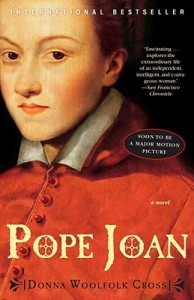 As a child, Joan is beaten for her brilliance and love of books. Her rigid father, a canon of the church, believes that women are inferior to men, incapable of learning, and is certain that his sons are destined for great careers in the church. When Joan’s intelligence gets both her and her brother John into a school, she is mocked by everyone except kindly Gerold, a young count who takes her in since she can’t live in the boys’ dormitory. Joan has an uncertain future until her brother John is killed in a surprise Viking attack along with almost everyone she knows. Assuming John’s identity, Joan enters a monastery and, distinguished by her incredible mind, eventually heads to Rome in a career that will prove as dangerous as it is ambitious. As a child, Joan is beaten for her brilliance and love of books. Her rigid father, a canon of the church, believes that women are inferior to men, incapable of learning, and is certain that his sons are destined for great careers in the church. When Joan’s intelligence gets both her and her brother John into a school, she is mocked by everyone except kindly Gerold, a young count who takes her in since she can’t live in the boys’ dormitory. Joan has an uncertain future until her brother John is killed in a surprise Viking attack along with almost everyone she knows. Assuming John’s identity, Joan enters a monastery and, distinguished by her incredible mind, eventually heads to Rome in a career that will prove as dangerous as it is ambitious.
I don’t know if Pope Joan actually existed, but if she did, her life in this novel certainly makes for an amazing story. It’s incredible how much Joan suffers and achieves in this book, going from beaten, submissive but intelligent little girl to a successful pope, albeit a female one. Joan is someone that can easily be admired as she never lets anyone get her down or force her to do anything that she knows is wrong. Even when the unspeakable happens during the Viking raid, Joan is able to take stock of her situation and figure out what needs to be done in order to both stay alive and get ahead in the world. She is strong enough to deny her own personal needs for the sake of the people and her faith.
The plot of this novel feels like it moves along fairly quickly. For under 500 pages, this book packs in a lot of events, but nothing ever feels rushed, it’s paced perfectly. Obviously, we know Joan is going to become a pope, but how she gets there is a mystery. There are also two other viewpoint characters, Gerold and Anastasius, who provide an alternate perspective on Joan as well as adding subplots and texture to her central story. Of the three, I liked Anastasius the least, but he’s not exactly a true villain because he’s just too ambitious. Most of the church was corrupt and he can’t entirely be faulted for acting as normal; Joan is just different and special enough to point out the flaws in the system.
In the author’s note, Donna Woolfolk Cross includes a fairly compelling argument for the existence of Pope Joan, although of course she was required to add huge amounts of fictional material to fill in the copious gaps which are inevitably left in any ninth-century account. For once I didn’t care all that much if it was true because I could really lose myself in the story. I know that women as strong as Joan must have existed in the Middle Ages, so it wasn’t really all that much of a stretch, whether there really was a Pope Joan or not.
In all, Pope Joan is a fascinating, moving work of historical fiction. It completely captured me and I couldn’t put it down. I highly recommend it.
While you’re here, if you do buy a copy of this book before July 31st, you can enter into the author’s red carpet contest to attend the movie premiere. And don’t forget that if you’ve entered on my giveaway post for a signed copy of this book that a comment here will gain you another entry!
|
|



Recent Comments