|
|
 The women in Amy’s family always end up raising their children alone. Almost without exception, the men leave. Thus Amy finds herself in a family full of women, yet still hopeful that her marriage will be better than all the rest. She moves to London with her journalist husband and they have a child together. Amy misses him, but thinks everything is okay until he leaves her and she discovers that he has a girlfriend. Amy flees to the bosom of her all-female family and sets about getting her life back together. The women in Amy’s family always end up raising their children alone. Almost without exception, the men leave. Thus Amy finds herself in a family full of women, yet still hopeful that her marriage will be better than all the rest. She moves to London with her journalist husband and they have a child together. Amy misses him, but thinks everything is okay until he leaves her and she discovers that he has a girlfriend. Amy flees to the bosom of her all-female family and sets about getting her life back together.
I thought it was really sad that their marriage didn’t work out and that they used their family histories as an excuse. To me it seems fairly obvious that a job like his would be a strain on any family, especially a couple that wasn’t used to dealing with it. With Amy all on her own as a single mother in a foreign country with a single friend, what were they expecting? I also expected this to be a bit more about Amy’s family, and while they were on the fringes of the story, they were certainly secondary to Amy’s main struggle to figure out how to be a single mother. She and her daughter have a wonderful relationship and it’s nice to see a teenage daughter not hating her mother for once (although tantrums come with the territory). Amy’s rise to fame as the new “Ann Landers” is anything but ordinary, but this is still a sweet story of a mother’s attempt to come to terms with her life, get on her own two feet, and alternately help and be supported by her family. Oh, and I loved the ending, very cutely done and its brevity was appreciated.
Overall, recommended if you like memoirs or heart-warming stories about families. I’d put this as a solid “good”. You’re not going to regret reading it, but it isn’t going to be your favorite book ever.
Buy The Mighty Queens of Freeville on Amazon. on Amazon.
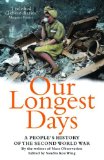 This is a compilation of several diaries from World War II collected by the Mass Observations project. This project was designed in 1937 to see what the people of Britain were really thinking. In the beginning, the writers responded to prompts, but by the start of the war they were asked to keep diaries of their thoughts, feelings, and actions for posterity. These diarists are surprisingly intimate, giving details of their own lives in far more detail than those of the war, and this collection aims to give us a closer look into how the public really dealt with the war. This is a compilation of several diaries from World War II collected by the Mass Observations project. This project was designed in 1937 to see what the people of Britain were really thinking. In the beginning, the writers responded to prompts, but by the start of the war they were asked to keep diaries of their thoughts, feelings, and actions for posterity. These diarists are surprisingly intimate, giving details of their own lives in far more detail than those of the war, and this collection aims to give us a closer look into how the public really dealt with the war.
I found these diaries to be absolutely riveting. The book is filled with the everyday life of people going about in war for five years of their lives. Their lives all change in ways they probably didn’t imagine – some of them say so, like Muriel Green who becomes a gardener for the cause – and it’s absorbing to watch it happen. I thought the most striking thing about the diaries was that they were not overly dramatic and the people in them did not seem very dismayed by the thought that a bomb could kill them at any time. Sometimes nearby houses are destroyed with people in them but the diarist in question always remains remarkably calm. They’ll remark on the bombing of another town, but never seem worried that their own is next, although I’m sure they must have been. The only outpouring of emotion was from a man who lost his brother in the war, which results in some of the saddest and somehow most beautiful passages conveyed in the book.
Mostly, though, this book is a story full of the little things, improvising meals, shopping for clothes, trying to see sweethearts, job-hunting, dealing with the blackout, a robbery, births, deaths, dances, and kisses. All the ordinary bits of life go on amidst a country struck by war. People are people even when the Germans threaten to invade and sirens rush them into bomb shelters multiple times a day. Even more interesting is considering what these reactions say about the British public at large during World War II. It would be truly fascinating to compare these diaries with newpapers and other media produced at the time in order to see the differences in reaction to the war.
I was a little disappointed to discover that most of the diarists were given pen names since their families could not be contacted for permission, but it’s understandable. Apparently the Mass Observation project was viewed in some circles as spying, since diarists gave details of not only their own lives but their neighbors’ as well without permission. So in this book, names are shortened to a single letter if permission has not been given and summaries of diarists’ lives are reduced to a few lines regarding what they were doing in the war.
Overall I’m delighted to see a historical archive like this published and I can only imagine how amazing it would be to work in such an archive as is still going on now. I have another book of theirs on my shelf; it is the post-war diaries of Nella Last, one of the most prolific diarists and one whose family has given permission for her real name to be used. It’s called Nella Last’s Peace. I’m very much looking forward to it; I’ll be reviewing it in March.
And a final note, I discovered after completing the compilation that the editor, Sandra Koa Wing, passed away aged only 28 in 2007 after a battle with cancer. I think this wonderful book is a tribute to her since her future career in history was cut so tragically short.
Buy Our Longest Days: A People’s History of the Second World War on Amazon. on Amazon.
 When Steven Rinella won a lottery to hunt for a buffalo in Alaska, he couldn’t believe his luck. This book chronicles not only his hunt for his buffalo but the American obsession with buffalo and the way his own life is wrapped up with these massive creatures. When Steven Rinella won a lottery to hunt for a buffalo in Alaska, he couldn’t believe his luck. This book chronicles not only his hunt for his buffalo but the American obsession with buffalo and the way his own life is wrapped up with these massive creatures.
There are definitely three parts to this book, although they’re woven together. Of them, I most enjoyed the bits about American history involving the buffalo. It’s not something I know much about and not something I’m massively interested in, but for the short time it took me to read this 250 page book, the buffalo held my attention. I knew that buffalo had been hunted to a very small percentage of their previous numbers, but never so much detail, and of course these are only the fun, interesting bits, like what happened to the bones that used to be everywhere on the prairies. Second, I think, was just how Steven got to the point of hunting a buffalo in Alaska. His discovery of a buffalo skull sent him on a journey to learn more about them and his eventual role as a hunter starts to make sense.
I did not, however, like the parts where Steven was hunting and butchering the buffalo. I don’t think I realized it would be so graphic when I requested this one. I’m one of those squeamish people who eats meat but I don’t really like to think about killing animals, hypocritical as that is. So I mostly skimmed the bits about the interior of the buffalo and I wasn’t too happy about them. If you’re okay with this, then there certainly isn’t a concern, but it does prevent me from recommending it completely.
To sum up, I liked the pop history, didn’t like the hunting. That should tell you whether or not it’s worth a shot!
Buy American Buffalo on Amazon. on Amazon.
 After realizing that all of his clothes were made in different locations, Kelsey Timmerman began to wonder about who made them and what their working conditions were like. Unlike many of us who consider such things, Kelsey took out a second mortgage on his house to travel to Honduras, Cambodia, Bangladesh, and China, while his girlfriend/fiancee waited patiently for his return. He met workers and in some cases observed their factories, and in this book he details their struggles for gainful employment and their lives. After realizing that all of his clothes were made in different locations, Kelsey Timmerman began to wonder about who made them and what their working conditions were like. Unlike many of us who consider such things, Kelsey took out a second mortgage on his house to travel to Honduras, Cambodia, Bangladesh, and China, while his girlfriend/fiancee waited patiently for his return. He met workers and in some cases observed their factories, and in this book he details their struggles for gainful employment and their lives.
I wasn’t entirely sure what to expect with this book, but I liked and was interested by what I got. Though he’s apparently not a professional journalist, Kelsey Timmerman can write very well and evokes sympathy for these people. We’re right along with him when he sits in their apartments eating questionable food, taking kids on rollercoaster rides they would never otherwise afford, or walking through the factories where the workers do the exact same thing for 16 hours a day. Kelsey realizes that although he doesn’t have any common ground, he can still feel for these people and their predicament; he also realizes what these jobs mean to them and the harm we do by boycotting certain factories and workers. Conditions could be much, much better, though, and through his stories, Timmerman shows us how to be enlightened consumers, how to buy from companies that promote the fairest working conditions and factories that are moderated by a third party. All so that these workers, several of whom become real people to us in this book, can remain working but in safer conditions and with a fairer wage.
I definitely recommend this. A book with a global conscience that should apply to all people who purchase clothes and who can feel sympathy for their fellow people.
Buy Where am I Wearing: A Global Tour to the Countries, Factories, and People that Make Our Clothes on Amazon today. on Amazon today.
Many thanks to Kim at John Wiley & Sons for my copy!
 Russell Shorto argues that Descartes’ theories underpin everything that modern people think and do, despite the fact that we give him little credit for it. To illustrate this, Shorto follows Descartes’ bones from the great man’s moment of death to the present day, illustrating how he and his mortal remains have powered and furthered thinking from the Enlightenment to 2008. Russell Shorto argues that Descartes’ theories underpin everything that modern people think and do, despite the fact that we give him little credit for it. To illustrate this, Shorto follows Descartes’ bones from the great man’s moment of death to the present day, illustrating how he and his mortal remains have powered and furthered thinking from the Enlightenment to 2008.
I didn’t really think this book was going to be any good. I read several reviews from people who had abandoned the book or who finished it only because they were compelled to as reviewers and had received an ARC like me. I have a bad track record when it comes to finishing non-fiction, even when I like it, so I opened this a bit warily.
Surprisingly, I didn’t have any trouble with it at all and really enjoyed it. I found the charting of intellectual and scientific history from Descartes’ time to now to be very interesting and relevant to the way I think now and the way I know others think. The use of Descartes’ bones and particularly skull to illustrate this mental journey was a clever device that unified the book from his death to the present. It isn’t exactly a story, but more a philosophical exploration of just how we got where we are, using the bones and the mystery surrounding them as a frame for the author’s deeper thoughts.
I thought it was smart, thoughtful, and a worthy read. I’d suggest this book if you’d like to delve into the issues behind our thought processes and theories, rather than looking for the mystery it’s sold as. You can buy it on Amazon . .
 I can’t summarize this book effectively, so I’m just going to quote from the back: I can’t summarize this book effectively, so I’m just going to quote from the back:
“To this day, Americans think of themselves as a Puritan nation, but Vowell investigates what that means – and what it should mean. Who were these people who are considered the political and spiritual and moral ancestors of our nation? What was this great enterprise all about? What Vowell discovers is something far different from their uptight shoe-buckles-and-corn reputation. The people she finds are highly literate, deeply principled, and surprisingly feisty. Their story is filled with pamphlet feuds, witty courtroom dramas, and bloody vengeance.”
And so on. Let me say that this book is absolutely hilarious. I found myself laughing regularly throughout Vowell’s journey through Puritan history. She makes history that is normally dull and confusing (even for me, who loves history) into a riot of a book that I just wanted to keep reading. She also relates the past to the present and shows us a fair amount of horrifying examples where history repeats itself – or worse, when American presidents take out bits and pieces of Puritan speeches and ignore the important bits about being good to your fellow citizens. I’m not sure the book has potential for being read and understood a hundred years from now given the pop culture jokes, but it’s certainly amusing now.
Sarah Vowell does a brilliant job of showing us how history is relevant while keeping us entertained and informed. I’d wholeheartedly recommend this one. Buy it on Amazon.
 Tiny Kline spent her entire life doing stunts. From youth to middle age, she worked with the circus, her love for which is apparent throughout the pages of her memoir. She continued doing iron jaw stunts, descending inclines at ridiculous speeds suspended only by her teeth, into old age and performed as Tinker Bell at Disneyland when she was in her 70s. By all accounts, Tiny Kline had a fascinating life. She really wrote two memoirs in an attempt to share that life with us. One contained mainly personal anecdotes, related to her work on the circus. The second mainly contained circus history and was stripped of these more intimate details. The editor, Janet M. Davis, combined the two to produce a memoir that is still Tiny’s but in a form readers will be more eager to consume. Tiny Kline spent her entire life doing stunts. From youth to middle age, she worked with the circus, her love for which is apparent throughout the pages of her memoir. She continued doing iron jaw stunts, descending inclines at ridiculous speeds suspended only by her teeth, into old age and performed as Tinker Bell at Disneyland when she was in her 70s. By all accounts, Tiny Kline had a fascinating life. She really wrote two memoirs in an attempt to share that life with us. One contained mainly personal anecdotes, related to her work on the circus. The second mainly contained circus history and was stripped of these more intimate details. The editor, Janet M. Davis, combined the two to produce a memoir that is still Tiny’s but in a form readers will be more eager to consume.
This book was a very educational experience. Circus history, while an interesting topic, is not something that I’ve ever learned in school and there don’t seem to be many accessible books written on it. There is the fiction bestseller, Water for Elephants, which I read and loved earlier this year, but that’s about all I’ve seen on my book radar. When this popped up on LT Early Reviewers, I knew that I simply must read it. And good choice by me; this is a terrific memoir. The combination of memoirs is brilliantly done and I never noticed a gap between Tiny’s two styles of writing. It’s fascinating to see how the circus changed over time, the insider’s view of circus politics, and just how some performers climbed the career ladder faster than others. Tiny’s ambition was tremendous and it’s easy to see why she advances so quickly.
The book does read precisely as someone’s account of their life. Tiny was not the best writer and it’s evident at times that she had little training, but it never hampers this book, just makes the author more real, if that is possible. It reads like a letter written by a friend; conversational, easy tone. There were some nice touches put in by the editor, such as including photographs with Tiny’s descriptions of some of her fellow performers, all bringing the circus to life. Tiny admits one lapse in her introduction; she included some fictional romances to make the book more “exciting”, even though she never had a romantic interlude after her husband died shortly after their wedding. The fictional parts are obvious and only in one part of the book; I don’t count this against it, especially as she admits their existence before the book even begins.
I’d definitely be recommending this book and if you’re interested in circus history, you shouldn’t miss it. I’m glad that I didn’t! Buy this book on Amazon.
Many thanks to Michael Roux and the University of Illinois Press for sending me this lovely book!
 This half-memoir, half-journal, was penned before and immediately after Agnès Humbert’s horrific experience as a French political prisoner of the Nazis. Agnès was a courageous woman, full of spirit and defiance, holding her love of France and desire for independence above all, even the worst treatment at the hands of inconsiderate jailers who did not mind if the prisoners lived or died, let alone suffered, so long as the work got done. Her journal chronicles her activism for the underground newspaper Résistance before her arrest, and afterwards moves on to a memoir style account of her time in prison and in various labor camps and factories before her eventual rescue by the Americans in 1945. This half-memoir, half-journal, was penned before and immediately after Agnès Humbert’s horrific experience as a French political prisoner of the Nazis. Agnès was a courageous woman, full of spirit and defiance, holding her love of France and desire for independence above all, even the worst treatment at the hands of inconsiderate jailers who did not mind if the prisoners lived or died, let alone suffered, so long as the work got done. Her journal chronicles her activism for the underground newspaper Résistance before her arrest, and afterwards moves on to a memoir style account of her time in prison and in various labor camps and factories before her eventual rescue by the Americans in 1945.
I found her newpaper days to be slightly over my head; they are full of names and I never quite managed to work out just who was who, or which of the members survived and which were killed. I did admire her sense of independence; she never masked who anyone was in her journal, seemingly certain that no Nazi would ever find it. She retains her composure under questioning and in the torturous jail cells, never revealing any of her compatriots, though most of them seem to be caught regardless. Her experience was consistently horrifying and it’s almost impossible to imagine human beings could treat each other so abominably. I know much about the experience of the Jews and other “rejected” minorities at the hands of the Nazis; I’ve been to the Holocaust Museum in Washington, DC, which is a place that everyone should visit for their own education and to help prevent future genocides (which we aren’t doing very well at). I never heard much about political prisoners, however, or their ordeals in labor camps and factories rather than in the death camps. These, of course, are still horrific.
Reading about Agnès’ suffering was extremely affecting and upsetting. I’m sure I would have committed suicide in her position like so many of the other girls did. Remarkably, Agnès retained her spirit and when she was released, immediately set about helping the Americans with their occupation of Germany and attempts to catch the remaining Nazis and Nazi sympathizers.
I’d recommend this book; it’s an account of one woman’s experience that really applied to many other prisoners. Agnès’ chronicle can help to ensure that these atrocities are not committed again. Buy this book on Amazon.
 For three generations of Chinese women, a restaurant is the key to their livelihood. It starts with Lily, who is born in a small Chinese town, moves to Hong Kong, and eventually to Great Britain to make her fortune for her two small children. Lily’s daughter Mabel opens her own restaurant in an attempt to recoup family fortunes, so her daughter Helen, the author of this book, grows up in a takeaway. Though she graduates from Cambridge and earns a law degree, Helen and her two sisters decide to open a restaurant of their own – Sweet Mandarin. For three generations of Chinese women, a restaurant is the key to their livelihood. It starts with Lily, who is born in a small Chinese town, moves to Hong Kong, and eventually to Great Britain to make her fortune for her two small children. Lily’s daughter Mabel opens her own restaurant in an attempt to recoup family fortunes, so her daughter Helen, the author of this book, grows up in a takeaway. Though she graduates from Cambridge and earns a law degree, Helen and her two sisters decide to open a restaurant of their own – Sweet Mandarin.
I enjoyed the story of these three women. More of the book is dedicated to Lily than to Mabel and Helen, but that seems almost the way it should be, since it was Lily who really made the biggest changes in her family’s fortunes. Lily’s story is also the most interesting, because her life reads like a novel, full as it is of twists and turns of fate. Beyond that, it is absolutely fascinating to witness the changes in China, Hong Kong, and British imperialism in general throughout the book. It is astounding to witness the vast differences in some areas of the world, while other ways of life in China remain basically the same as they were when Lily was a child. For this reason, my favorite part of the book was their visit to Hong Kong towards the end.
Helen Tse writes the story of her family’s fortunes as a memoir, which made it a pleasure to read. I felt for Lily, Mabel, and Helen throughout their stories and really enjoyed the way cooking and restaurants tied the whole book together, with the exception of some of Lily’s experiences (although I enjoyed those too, and they’re necessary to set up the rest of the book). The common thread of food ran through and it’s admirable that Helen and her sisters have embraced and retained their heritage in this way.
I’d recommend this book, especially to people who enjoy memoirs. It has a solid, interesting story and Helen’s family is a memorable one. Buy this book on Amazon.
You can also view an interview with the author on YouTube or visit the book’s website.
 How and why do rumors start? How powerful are they? How many of them are accurate? Nicholas DiFonzo answers some of these questions in The Watercooler Effect, a psychological study on rumors. I learned some things. For instance, rumors in the military are generally 99% accurate, because people are actually told things about troop movements and the effect “trickles down”. People create rumors when they are anxious about their situation because having an answer, even if it’s wildly wrong, is comforting to the human mind. Worst of all are email and internet rumors, as they are almost always wrong, so much so that groups of websites like snopes.com exist just to decry them. How and why do rumors start? How powerful are they? How many of them are accurate? Nicholas DiFonzo answers some of these questions in The Watercooler Effect, a psychological study on rumors. I learned some things. For instance, rumors in the military are generally 99% accurate, because people are actually told things about troop movements and the effect “trickles down”. People create rumors when they are anxious about their situation because having an answer, even if it’s wildly wrong, is comforting to the human mind. Worst of all are email and internet rumors, as they are almost always wrong, so much so that groups of websites like snopes.com exist just to decry them.
Rumors can also have disastrous effects on businesses and people’s lives. DiFonzo uses some of these examples, too.
This book was definitely interesting. It isn’t something that I would necessarily have picked up on my own, but it kept my attention. DiFonzo’s writing is clear and concise. Most of what he gets across is common sense that takes some thinking about, so there is no grand reveal at the end, just some advice on how to avoid spreading the wrong rumors. I probably wouldn’t jump to recommend it and I probably won’t read it again, but I’m glad I did. Preorder this book on Amazon.
|
|


Recent Comments