|
|
 Juana of Castile never expected to be queen, with an older brother and sister ahead of her. As a daughter of Ferdinand and Isabella of Spain and thus a Spanish Infanta, she is married to Philip of Flanders, with whom she quickly falls in love. Juana does not trust her husband’s advisor, and within reason, for when Juana’s brother and sister die, he persuades Philip to seize the Spanish throne for himself. When everyone around her deserts her, Juana keeps fighting through her despair and her determination is creatively interpreted as madness by all those who have greater designs on her throne and no interest in the woman who should hold it. Juana of Castile never expected to be queen, with an older brother and sister ahead of her. As a daughter of Ferdinand and Isabella of Spain and thus a Spanish Infanta, she is married to Philip of Flanders, with whom she quickly falls in love. Juana does not trust her husband’s advisor, and within reason, for when Juana’s brother and sister die, he persuades Philip to seize the Spanish throne for himself. When everyone around her deserts her, Juana keeps fighting through her despair and her determination is creatively interpreted as madness by all those who have greater designs on her throne and no interest in the woman who should hold it.
I have never really known much about Juana. She is just outside my time period and just outside my geographical sphere of knowledge. I am so grateful for the opportunity to have read this novel. Juana is a fiery character and I knew little about her quirks. I love how she grows from girl to woman over the course of this book. Her voice is strong and believable and to be honest, I can hardly believe a man wrote this book! Since I didn’t know what happened, I had a rare opportunity to let the plot of a historical novel really take over and I can say that this book doesn’t fail at all in that respect either. It was wonderful and I think it still would have been even if I’d known how it ended.
Knowing full well the ways in which medieval and early modern figures manipulated heirs to make their way to a throne, I had no trouble at all imagining that Juana’s madness was a convenient foil. It would be nothing new. I found the way the author used known events and cast them in a different light to be extremely creative and appealing, like her reasoning for staying outside for several days in winter and taking her husband’s coffin with her well beyond when he should have been buried. So many people let Juana down, most notably her father and her husband. She was determined to secure the throne for her son, Charles, and did not back down even when these men did their best. Is it any surprise that they attempted to cast her aside?
I’ve never been to Spain, but I could almost picture it in this book. I want to go now and I want to learn more. That, more than anything, is the mark of a great historical fiction novel for me. This is an extremely enjoyable book and one that I would certainly recommend.
The Last Queen is available from Amazon and Amazon UK. You can also check out C.W. Gortner’s website, blog, and tour stops.
 Thursday Next retreats into the Well of Lost Plots to avoid getting into more trouble with Goliath and the Chronoguard in the real world. With a baby on the way and her husband Landen erased from everyone’s memory but hers, she wants to stay safe, and the best way to do that is to take up residence in a failing detective novel. Unfortunately, trouble finds Thursday even when she’s hiding, as she must battle the new book upgrade, save the novel she has moved into, and figure out why Jurisfiction agents are being murdered. Thursday Next retreats into the Well of Lost Plots to avoid getting into more trouble with Goliath and the Chronoguard in the real world. With a baby on the way and her husband Landen erased from everyone’s memory but hers, she wants to stay safe, and the best way to do that is to take up residence in a failing detective novel. Unfortunately, trouble finds Thursday even when she’s hiding, as she must battle the new book upgrade, save the novel she has moved into, and figure out why Jurisfiction agents are being murdered.
As with the other books I’ve read by Jasper Fforde, this one is a treat. My favorite part is unquestionably the many literary references sprinkled throughout the text. We visit Alice In Wonderland, Great Expectations, Wuthering Heights, and several other literary destinations as well as hints. For example, Mr. Toad from The Wind in the Willows has a never-ending battle with Miss Haversham to see who can drive the fastest. During a meeting, everyone present remarks constantly that they are waiting for Godot. Humpty Dumpty and his nursery rhyme cohorts need to be satisfied; their stories aren’t always written down and they want equal rights with book characters. I think it’s those sneaky hints and literary connections that make these books great.
I did wonder a little bit why Thursday wasn’t gung ho about finding Landen. She has to battle her own memories to keep him alive and that certainly means a lot to her, but she uses the excuse of the baby to stop going out into the real world. Of course, she’s in plenty of danger in the Well of Lost Plots, too, but I guess gigantic monsters aren’t as scary as the Goliath corporation. You could also say that one is expected and one is not, but, well, I’m nitpicky. 
Anyway, after reading this I feel I have definitely gotten back into the Thursday Next groove. This was a library book and I actually own book 4, but it’s at my parents’. So it’ll be at least July or so until I can read the next one, but I’m really looking forward to it.
The Well of Lost Plots is available from Amazon and Amazon UK.
 Book Gluttony! Are your eyes bigger than your book belly? Do you have a habit of buying up books far quicker than you could possibly read them? Have you had to curb your book buying habits until you can catch up with yourself? Or are you a controlled buyer, only purchasing books when you have run out of things to read? Book Gluttony! Are your eyes bigger than your book belly? Do you have a habit of buying up books far quicker than you could possibly read them? Have you had to curb your book buying habits until you can catch up with yourself? Or are you a controlled buyer, only purchasing books when you have run out of things to read?
If there is a controlled buyer out there, I would really like to meet them! I’m certainly not one. I can’t hold back. That’s why my TBR pile is 350 books strong, mostly books that my mom is generous enough to buy me from our favorite charity shop. I buy new books, too, in alarming quantities. I should curb my book buying habits. I’m much better when I’m poor, as now. I’ve told Keith that I’ll certainly catch up because we’re too poor to buy many books, but he thinks that as soon as I get a job and have an income that I’ll be using the extra to get more and more books. Heh. Heh. We’ll see. I do have so many books these days that it takes me a half hour just to choose what I want to read next if I haven’t decided it already. I’ve started pulling out two or three books at once and reading them in a row to avoid these choices. A little like my read-a-thon pile, only smaller!
***
Secondly, I have a very special announcement to make. We are all book bloggers but we also have lives outside these blogs. When special events happen, we want to celebrate together, because we are a community. With this in mind, Amy, Michele, and I have put together the Book Blog Social Club so that we can celebrate virtually, the same way we all know each other. We’re kicking off with a baby shower for Jen at Devourer of Books tomorrow.
Of course, the website was designed for all of us to take part and host our own parties and celebrations. We invite you to make use of it in the future, on a first come first served basis. All you have to do is send an email to bookblogsocialclub at gmail dot com and we’ll be happy to discuss it with you!
Welcome to the blog tour for C.W. Gortner’s wonderful book, The Last Queen, here at Medieval Bookworm. Today Christopher has graciously agreed to answer a few questions for me, and I hope the answers are as interesting for you as they are for me!
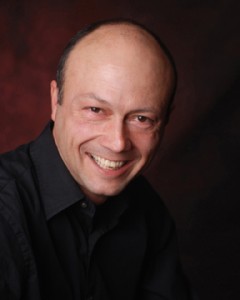 1. My blog readers will know that, as a historian-in-training, historical accuracy is a frequent issue of mine when it comes to fiction. I very much dislike historical books to go against known facts. I know that you strove for this kind of historical accuracy with THE LAST QUEEN. Would you mind weighing in on this issue? How close do you think authors need to get to real history in fiction? 1. My blog readers will know that, as a historian-in-training, historical accuracy is a frequent issue of mine when it comes to fiction. I very much dislike historical books to go against known facts. I know that you strove for this kind of historical accuracy with THE LAST QUEEN. Would you mind weighing in on this issue? How close do you think authors need to get to real history in fiction?
This is a very interesting issue, and, I must say, an often contentious one. For my writing, I always strive for accuracy; I think as writers of historical fiction it’s our responsibility to get our facts right. But sometimes dramatic license is required for the sake of a story that would otherwise get lost in a morass of history or to illustrate complex elements in a single scene. When this license is taken it should be well-considered and as plausible as possible. I did some of this to make THE LAST QUEEN accessible; my editors and my agent helped immensely in this regard. I also made some inadvertent mistakes, because, after all, I am human. Historical fiction is still fiction; as novelists we’re dramatizing a story based on actual events and/or people; but actual history, like life, isn’t always easily distilled. A historical novelist sometimes faces difficult choices in order to tell his or her story and because of these choices I believe some dramatic license is essential, providing it doesn’t go so far beyond what is known it careens into fantasy. If it does, then at the very least an author’s afterword or note is required.
2. I loved Juana’s character and had a really hard time believing that a man wrote this book! I had always heard that men couldn’t write women and women couldn’t write men but you completely eradicated that stereotype. Did you have any inspiration for her or experience that fueled your ability to portray a woman so well?
I heard that, too – for thirteen years as I attempted to get published! I think it’s one of those generalized misconceptions that persist, despite ample evidence to the contrary. Of course, there are men who can’t write women and vice versa, but novelists should, for all intensive purposes, strive to be as invisible as possible. Our characters tell our stories, not us. One of the marvelous boons of writing is that we are defined not by our gender but rather by our ability to inhabit the characters we create. That said, I was raised by women – my mom, my grandmother, my aunts – and I grew up at the table listening to them tell stories and gossip; maybe I somehow learned more about the female heart? I don’t know. I must admit, however, I often feel I understand women more than I do my own gender. I also first wrote THE LAST QUEEN in the third-person and it didn’t work. Juana was too enigmatic; the editors who read it came back with rejections that basically said, “Something is missing here.” It wasn’t until I put my own trepidations aside and slipped into her skin, so to speak, that much of her inner life became clear to me. Call it inspiration or channeling or imagination: whatever the case, Juana spoke to me as she never had before and as a result the book transformed in dramatic and unexpected ways.
3. What inspired you to write about Juana of Castile?
I grew up in southern Spain, near a ruined castle that used to be a summer residence of her parents, Queen Isabel and Fernando. I clambered about in that castle and knew she had lived there; in a way, she was a part of my world. Every school child grows up hearing the story of Juana la Loca; we even sing a childish rhyme about her. But when I first visited her tomb in Granada, I was fascinated by the sight of her effigy. It literally haunted me. I immediately wanted to know more about her. My grandmother was a celebrated theatre actress for years in Spain and had played Juana on stage; she introduced me to the drama inherent in the legend. She even took me to see a movie that was made in the 1940s about Juana, which had become a classic. I was entranced. I couldn’t get enough. I must have seen that movie over fifty times. I studied history in school, too, and Juana was one of those characters that everyone shuddered over, the poor mad queen. I remember thinking, What if she wasn’t really mad? Even then I had this sense that her side of the story had been buried under historical propaganda. The legend was dark and macabre and very juicy, but it felt like a legend, not the truth. Years later, when I began to pursue writing seriously in the hope of publication, I decided to write about her after my first novel didn’t sell. I set out to find out as much as I could, and the more I researched, the more inspired I became. Here was this woman who was locked up for forty-six years, accused of being insane, when in fact she may have been anything but. I felt she deserved a chance to speak for herself, and historical fiction was the perfect vehicle for it. Still, now and then I get e-mail from the occasional reader who tells me I’ve played fast and loose with her story; that everyone around her agreed she was unstable and unfit to rule. It shows how deep the legend has permeated, that for some readers the mere fact that I’ve chosen to depict a different version of Juana must mean I’m inaccurate. It could be I’m wrong; after all, I never met her. But I’m not convinced the popular version of her story is accurate, either.
4. I’m planning on visiting Spain in the next few years and, especially after reading your book, I can’t wait! Can you share with us a couple of places in the novel that you’d recommend visiting?
Absolutely! Spain is a marvelous country, full of contrast and vibrancy, much like Juana herself. I’d say a trip to Castile, the central part of Spain, is essential, as it’s where most of Juana’s story took place. The city of Toledo near Madrid is a medieval marvel and the Cathedral was embellished by Queen Isabel; also near Madrid is the Castle of La Mota, where Juana staged her infamous act of defiance. About three hours from Madrid is the city of Burgos, where you can visit the Gothic cathedral where Juana first declared herself queen; the Casa del Cordon, where Philip of Hapsburg died, is now a bank but the stone knotted façade remains intact. In southern Spain, you can visit the mountain city of Granada, the last stronghold of the Moors, and the stunning Moorish palace of the Alhambra.
5. Do you mind telling us what you’re working on now?
I’ve just finished a novel about Catherine de Medici, which will be published by Ballantine Books in 2010. Catherine de Medici is a much misunderstood and maligned woman in history, accused of some of the 16th century’s most heinous crimes, including the Massacre of St Bartholomew. She’s been called ruthless, ambitious and cruel; she truly has a black legend attached to her name. But during my research I uncovered a different picture of this Italian woman who became mother of the last Valois kings and one of France’s most influential queens. She had immense perseverance, loyalty, intelligence, and tolerance. She loved animals and detested the senseless waste of war. In an era of savage religious conflict, she steered France to safety. She’s interesting and complex; and I had an incredible time slipping into her skin. I’m very proud of this book. Though it was exacting and I had to revise it a few times to get it right, in the end I think I’ve done her justice.
6. How about favorite authors? Do you have any favorite authors or books we should be reading while we’re waiting for your next book, or perhaps seeking out your first?
I don’t have any favorite authors, per se, simply because I like so many for different reasons. Historical fiction books I’ve really enjoyed recently include Robin Maxwell’s Signora da Vinci; Karen Maitland’s Company of Liars; Vanora Benett’s Figures in Silk; Michelle Moran’s The Heretic Queen; Karen Essex’s Stealing Athena; David Blixt’s Master of Verona; and Judith Merkle Riley’s The Water Devil. All are well worth your time and money!
Many, many thanks to C.W. Gortner for answering my questions! The Last Queen was released in paperback on May 5th and has been published in 10 countries. It’s available from Amazon and Amazon UK.
 I have been wanting to do a library loot post (hosted by Eva and Alessandra) for a really long time! I’m a big fan of my local public library. They don’t always have the best selection when it comes to new and upcoming books or YA (they don’t have ANY of Melissa Marr’s books or John Scalzi’s books or the rest of the Uglies series or even all of the Sookie Stackhouse series), but I can usually find plenty of exciting books. I’m a grad student so I don’t have much money to spare, but I really like to bring new books home every so often. The library is the perfect solution, especially because I don’t feel guilty if I stock up on the romance novels. I have been wanting to do a library loot post (hosted by Eva and Alessandra) for a really long time! I’m a big fan of my local public library. They don’t always have the best selection when it comes to new and upcoming books or YA (they don’t have ANY of Melissa Marr’s books or John Scalzi’s books or the rest of the Uglies series or even all of the Sookie Stackhouse series), but I can usually find plenty of exciting books. I’m a grad student so I don’t have much money to spare, but I really like to bring new books home every so often. The library is the perfect solution, especially because I don’t feel guilty if I stock up on the romance novels.
Here’s what I found today:

In case you can’t see the titles, those are from the top:
Silk, Alessandro Baricco
Love Walked In, Marisa de los Santos
Across the Nightingale Floor, Lian Hearn
I had a couple that I actually put back. I’ve been tempted by The Other Queen by Philippa Gregory two weeks running now. I know I’m not going to read it soon, but I want to at some point. I also put down Hand of Isis by Jo Graham, mostly because it was long and I’m not really in the mood for a chunkster. When I am, I have a few very large ARCs that need to go first.
Then, since I’ve never done one of these before, I thought I’d show you all how many books I already have. I just realized now that I also have a crochet book that’s not in this picture, but I’m not too enamored with it so that’s okay.
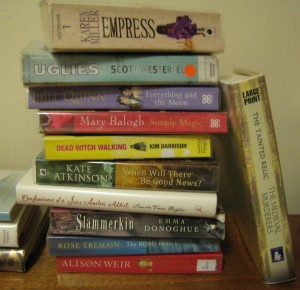 From the top: From the top:
Empress, Karen Miller
Uglies, Scott Westerfeld
Everything and the Moon, Julia Quinn
Simply Magic, Mary Balogh
Dead Witch Walking, Kim Harrison
When Will There Be Good News?, Kate Atkinson
Confessions of a Jane Austen Addict, Laurie Viera Rigler
Slammerkin, Emma Donoghue
The Road Home, Rose Tremain
Katherine Swynford, Alison Weir
The Tainted Relic, The Medieval Murderers is on its side there. I have a large print edition because that’s all the library had.
What should I read first?
(Quick reminder: giveaway for Tea and Other Ayama Na Tales ends tomorrow! You don’t want to miss this fabulous collection of short stories, especially when you might get it for free!)
 Summary via the publisher: Summary via the publisher:
“The Last Prince of the Mexican Empire is a sweeping historical novel of Mexico during the short, tragic, at times surreal, reign of Emperor Maximilian and his court. Even as the American Civil War raged north of the border, a clique of Mexican conservative exiles and clergy convinced Louis Napoleon to invade Mexico and install the Archduke of Austria, Maximilian von Habsburg, as Emperor. A year later, the childless Maximilian took custody of the two year old, half-American, Prince Agustín de Iturbide y Green, making the toddler the Heir Presumptive. Maximilian’s reluctance to return the child to his distraught parents, even as his empire began to fall, and the Empress Carlota descended into madness, ignited an international scandal. This lush, grand read is based on the true story and illuminates both the cultural roots of Mexico and the political development of the Americas.”
This work of historical fiction really sounds just like something I would love. In some ways, I definitely did. The prose is luminous and the story is compelling. As a reader, I wanted to know what happened next and whether or not Alicia and Angelo got their son back. I enjoyed feeling like I was learning something; this is a period I know very little about and I always enjoy learning more. I appreciated in huge amounts the author’s note with bibliography in the back of the book, particularly the bit about how she became interested, and I know I will now go off to read about Agustín and his family.
I loved the descriptions of scenery, too. Before I quote, I’d like to clarify that my copy is an ARC, and this text may not be the final version. Anyway, take a completely random example:
On the other side of the glass, the horizon, jagged with mountains, is paling, and the snowcaps of the volcanos tinged a fiery lavender, the exact shade, it occurs to Maximilian, of the inner lip of a Phalaenopsis orchid. For the past month, it has rained almost every afternoon, and sometimes all through the night, but this afternoon, the clouds, titanic puzzle pieces, have sailed apart to reveal a stretch of translucent ocean blue. To the east, a cloud bank soft as charcoal smudges the sierra; closer in, an island cloud shoots out swords of gold. The bids are coming in to their roosts around the lake in the park below. An eagle skims the tops of the ahuehuetes. In the distance, church bells begin to gong and chime.
A southern twilight: can there be anything in this world more sublime?
– p. 164
Beautiful, isn’t it? The whole book is like that. Mayo has a way with words.
All that said, I had one definite problem with the book. I found my mind wandering, usually when the story was focused on Maximilian or one of the other European leaders. I had a very hard time relating to any of the characters, in fact. The emperor and his wife were extremely unsympathetic, particularly Maximilian. I could not understand or agree with any of his decisions. This is in no way the fault of the author or even of the book, since I don’t think I’d have liked the real life guy any better than his fictional representation. As an example, he complains about a contract his cousin bullied him into signing only to bully Alicia into signing a contract in the same way, then he is shocked when she protests. The history is interesting, the people are a little infuriating. Of course, this is probably an entirely accurate picture of a 19th century monarch, convinced of the superiority of his own bloodline over every other person on the planet, but it absolutely annoyed me. I believe the way he was written didn’t help much, though, using “one” instead of “I” and putting everything in the third person. It gives a very accurate picture of his spoiled and superior behavior but makes it more or less impossible for the reader to feel any affection towards him. Then again, who would feel sympathy towards a man who basically stole a child from his mother?
I did like the characters who weren’t self-serving and self-righteous, but there weren’t many of them. Lupa, Alicia at times, and Dona Juliana all endeared me to them, but their parts in the story are small and scarce.
My honest opinion is that this is a very good book. The writing is lovely, the setting is amazing, and the story is intriguing. The characters, however well-developed, were impossible for me to feel anything for, though, and that was a bit of a disappointment. I would recommend it if you can get past their arrogance.
This book is available from Amazon and Amazon UK.
 As of Friday, my time has been freed up quite a bit. My exams are over, my papers and my full dissertation proposal are in, and now I am full speed ahead towards research. My dissertation is officially focusing on Anthony Woodville as a chivalric case study. Since I wrote my BA thesis on Richard III, I am finding this quietly amusing. For those who are not similarly obsessed with the fifteenth century, Richard III ordered Anthony Woodville’s execution. They are accused of feeling a great deal of animosity towards each other, although I personally don’t think it was quite as severe as some historians would like to imagine. At least not on Anthony’s side. As of Friday, my time has been freed up quite a bit. My exams are over, my papers and my full dissertation proposal are in, and now I am full speed ahead towards research. My dissertation is officially focusing on Anthony Woodville as a chivalric case study. Since I wrote my BA thesis on Richard III, I am finding this quietly amusing. For those who are not similarly obsessed with the fifteenth century, Richard III ordered Anthony Woodville’s execution. They are accused of feeling a great deal of animosity towards each other, although I personally don’t think it was quite as severe as some historians would like to imagine. At least not on Anthony’s side.
I have never decided whether or not I am a Ricardian. It seems to me that to go one way or the other would require ignoring a great deal of historical opinion and I can’t say I know enough yet to ignore all the options and interpretations. Since I’m looking at Anthony Woodville in a chivalric rather than political light (although as ever, everything in history is connected and divisions are obviously made by the historian), I don’t have to decide just yet. I do have to pin down just where he was, what he was doing, and when, which is a harder task than you’d imagine, before I can consider the whys of it all. Today, I’m consulting Edward IV by Charles Ross and Richard III: A Study in Service by Rosemary Horrox (which I love and highly recommend), as well as several minor sources. I’m secretly hoping that I will have to go to London and look at original documents. There are a few which I can track down that involve him and I really, really want to try my hand at reading more fifteenth century handwriting.
Today, I’m starting The Founding by Cynthia Harrod-Eagles. This book has been languishing in my library pile for months. Finally, someone has requested it, so I must get it read by the 14th. I’ve been somewhat wary about it. I need to stop reading fiction set in the late fifteenth century because I know too much. I’m also planning on making a little bit of progress on my review pile with A Convenient Marriage by Georgette Heyer. My review pile is actually diminishing. I’m lingering under this pleasant delusion because all of my post-late-June review copies are collecting in my parents’ house. I’m also excited to start The Reincarnationist by M.J. Rose today. This book is featured for By The Chapter this week with Marcia and Amy. I was a very lucky winner of Amy’s contest to read along with them. Thank you!
This week, I finished:
The Last Prince of the Mexican Empire by C.M. Mayo
Welcome to Temptation by Jennifer Crusie
The Well of Lost Plots by Jasper Fforde
The World in Half by Cristina Henriquez
The Vampire of Ropraz by Jacques Chessex
I reviewed:
Duchess By Night by Eloisa James
The Selected Works of T.S. Spivet by Reif Larsen
Briar Rose by Jane Yolen
The Wonder Singer by George Rabasa
Wicked Lovely by Melissa Marr
And I participated in Booking Through Thursday about comic books.
Finally and most importantly, Happy Mother’s Day to all mothers out there, and especially to my own, whom I love very much. I regret that I can’t spend this day with her.
 Aislinn can see faeries. She has always been able to see them. Her grandmother has spent her entire life admonishing Aislinn to keep this a secret from them, though, regardless of how many people they poke, pinch or shove or how scary they look. Faeries are dangerous. One day, however, a faery king begins stalking Aislinn and she can no longer avoid them. With the help of her friend Seth, who conveniently lives in a metal train car which fairies can’t enter, she is determined to find a way to get them to leave her alone. Aislinn can see faeries. She has always been able to see them. Her grandmother has spent her entire life admonishing Aislinn to keep this a secret from them, though, regardless of how many people they poke, pinch or shove or how scary they look. Faeries are dangerous. One day, however, a faery king begins stalking Aislinn and she can no longer avoid them. With the help of her friend Seth, who conveniently lives in a metal train car which fairies can’t enter, she is determined to find a way to get them to leave her alone.
Wicked Lovely is utterly enchanting. Each character is drawn in a sympathetic and intriguing fashion; the only one I didn’t like was the Winter Queen, but I don’t think I was supposed to like her. Even Keenan has a certain appeal to him and a reason behind his behavior. He’s not your average villain. I most liked the relationship between Aislinn and Seth. At some point, it feels as though you have to pick sides, and I knew which side I was on. I loved how Aislinn developed from a girl who feels she must hide in corners, away from faeries, into a girl who could face them head-on and take advantage of whatever situation she’s placed in. She changes a lot but never in a way that feels unnatural; I knew she had it in her and was just waiting for it to come out.
The faeries are so different than anything I’d expected. Creepy, but really interesting at the same time. I’d love to learn more about the fey court and I hope it’s expanded on in the rest of the series.
The story was wonderful, too. The viewpoint switches, which creates suspense, but the chapters are short enough that I wasn’t left wondering what had happened to a certain character for too long. This is one of those books that I sped through because I just had to know what happened. I knew that it was part of a series, and worse a series that I can’t continue for a few months, so I was afraid it would end on a cliffhanger. It didn’t. It wrapped up in a wonderfully satisfactory way, but not so much that there isn’t story left to tell. I know I’m looking forward to the next book in the series, Ink Exchange, and particularly Fragile Eternity, which I believe picks up these storylines again.
I’d definitely recommend this one to fantasy and YA readers, as well as anyone else who thinks it sounds intriguing! I loved it.
Buy Wicked Lovely on Amazon. on Amazon.
 Mark Lockwood has been entrusted with the secrets of Merce Casals’ life as her biographer, and that is a job he doesn’t take lightly. He has spent months immersing himself in her voice, teasing out her secrets, and preparing to share her story in her words with the world. Then Merce dies and Lockwood’s agent wants to attach a bigger writing name to the project. Lockwood is appalled and rejects the idea, going into hiding with his tapes and becoming determined to write the book as it should be written, never mind what he loses for it. Mark Lockwood has been entrusted with the secrets of Merce Casals’ life as her biographer, and that is a job he doesn’t take lightly. He has spent months immersing himself in her voice, teasing out her secrets, and preparing to share her story in her words with the world. Then Merce dies and Lockwood’s agent wants to attach a bigger writing name to the project. Lockwood is appalled and rejects the idea, going into hiding with his tapes and becoming determined to write the book as it should be written, never mind what he loses for it.
There are definitely two sides to this story. There is Merce’s story and there is Lockwood’s story. I loved Merce’s story. I always wanted to get back to her words, her voice. Her life is fascinating, from abandonment at a very young age, to a war, to a husband and fantastic opera career, and ending up living a quiet life with a maid and a man eager for her every word. I wanted to know everything about her, and I couldn’t say why; maybe because not only is her story fascinating, but Lockwood is similarly obsessed, and that means there is something extraordinary about this lady. Her life is a mesh of cultures and experiences and I could not get enough.
I felt a little less interested in Lockwood’s life. Personally, since I really liked Merce’s story, I could understand why he would have been obsessed, but I didn’t think it was quite worth what he put into it. Moreover, I didn’t get his interest in the maid and I didn’t like the “party atmosphere” that was created towards the end of the book while he was writing. Honestly, I think that’s my own preference. I’d hate to have that going on in my house even if I was absorbed in writing the greatest biography of the century. I also don’t think it’s acceptable to hit on another woman when you still love your wife.
That’s not to say that I didn’t like this part. If anything, Lockwood’s fascination was really curious. It was like a psychological peek into his head every time he spoke to his wife. His frantic efforts to make sure that the big name author and his agent didn’t get the tapes were quite amusing. I liked most that it wasn’t about the money; Lockwood wanted to do justice to Merce and her life.
I would recommend this book, particularly for Merce’s sections. I think someone who had more life experience and knew what marriage was like would probably appreciate Lockwood’s half more than I did. Still, I very much enjoyed reading this, and would definitely pick up another book by George Rabasa.
Buy The Wonder Singer on Amazon. on Amazon.
Last Saturday (May 2nd) is Free Comic Book Day! In celebration of comics and graphic novels, some suggestions:
– Do you read graphic novels/comics? Why do/don’t you enjoy them?
– How would you describe the difference between “graphic novel” and “comic”? Is there a difference at all?
– Say you have a friend who’s never encountered graphic novels. Recommend some titles you consider landmark/”canonical”.
I don’t really. I did read Watchmen and I enjoyed it, though, so I’m open to reading more. I’ve just started reading Elfquest online. I have a book, Letters To Jenny, by Piers Anthony, and in his letters to this poor girl, Jenny Gildwarg, who has been hit by a drunk driver and seriously brain damaged, he mentions Richard and Wendy Pini a lot, so I’ve always wanted to read their series. I think it stuck in my head because I really liked Letters to Jenny. I was a kid, and I thought Piers Anthony was funny and I was glad he was nice enough to keep up such a correspondence with her and help her recover. I always wondered what happened to her after the end of the letters in the book, although after some quick online searching it appears she was in college in 2006.
Anyway, that’s not what the question is about, is it? Heh. I’d also really like to read Neil Gaiman’s Sandman series, but have mostly been waiting to have a decent enough library so I can see if I like it before I start to pay for it. I have a couple of friends who read comics and I’ve had peeks at theirs and in the comic book store, but I’ve always strayed to the lone shelf of science fiction books when there, so I can’t really say too much. I know there is also a Firefly series continuation of some sort and I can’t say I’d be opposed to that either, so I guess I would be willing to read them. I just haven’t for some reason!
I guess to me, the difference between comics and graphic novels is probably very small these days and I’m not the person to judge. If I had to, I’d say comics are short, always a series, and possibly lighter than graphic novels, which I would envision at least as being a shorter series if not a contained work dealing with bigger consequences. Is that anywhere near right?
|
|


Recent Comments