

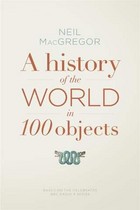
 How can one write a history of the entire world? It’s not an easy task, and could never be accomplished by a single being. Dr. Neil MacGregor has opted to take the approach of presenting 100 objects from the British Museum, in chronological order, which pick out some of the strands of civilization’s history and which attempt to show us how everything is related and interwoven.
This is a very intriguing book, although as you would expect, it really only scratches the surface and is very, very top-level. The 100 objects are grouped in five for each chapter and tend to come from all over the world. It’s rare for there to be two objects from similar European countries, for example; this does provide a really interesting view of history as we can see what’s happening around the world all at once, even if that is at a surface level.
The objects in the book spread from civilization’s earliest hours to the present day, including a credit card and a solar-powered lamp. Even the author comments on how our choices of what may reflect our society today will not necessarily be the choices made in 100 years, and perhaps the curator in 2112 will be as intrigued by those selections as any others. History, it is fascinating, even more so when you consider the fact that it is happening all around us all the time.
All of the objects included are at the British Museum in London; they’re marked in the museum itself, so you can follow through and try and find all 100. I’m not sure if they were all on display, but I did visit a few on a recent visit to London. For example, here are the Lewis chessmen:

Even though the book has a gorgeous, full colour image of each object, it was still exciting to see a few of them in person, although not exciting enough for me to trek around the entire museum for it.
The British Museum is also a perfect subject because, in many ways, it reflects the overarching theme of a dominant culture taking over smaller ones, something that keeps happening throughout the book with lost civilizations. Sometimes their voices are heard again, as in the case of the Rosetta stone, but sometimes they are truly lost, and we can only speculate. The museum itself is a remnant of Britain’s imperial past, and these treasures may have been contested; the simple fact that they’ve ended up in London from all parts of the globe is a tale worth telling, and which is told for quite a few of them.
I spent a considerable amount of time with A History of the World in 100 Objects and I found it to be a fascinating read, easily digestible in chunks given the nature of the chapters. Not for anyone looking for an indepth history, but for a thoughtful overview, this is perfect.
I purchased this book.



Recent Comments