|
|
 As a little girl, Cressida is terrified of George Harding, a scarred World War II pilot who insinuates himself into her family’s life. He’s provided for them in a sense since her father was rendered incapable, even moving them into his vacant servants’ house when they can no longer afford their own. For Cressida, he has a special assignment; he wants her to spend time with his nephew Edgar and make the timid boy into a bold spirit like she is. He even pays her to do it. Slowly, however, Cressida realizes that this isn’t about Edgar; it is about George and her relationship with him, and only Cressida can decide where she is going with her life.
I find it hard to clarify how I feel about this book. For one thing, I had a very difficult time identifying with Cressida or her mother. Both of them seem to change their mind on a whim, their opinion of people changing rapidly. Their behavior matches and sometimes I couldn’t understand why they were doing what they were doing. I could easily understand their frustration with each other, though, and recognize their predicament as a case of a mother and daughter being too similar in character to see eye-to-eye.
This book is meant to be a love story, but it’s difficult to see it that way in the beginning, and seems a peculiar one at that. Mr. Harding is a constant feature in Cressida’s life as she goes from despising him to being intrigued by him to loving him desperately. He is a fascinating and surprisingly good man, but is frustratingly determined to stop the relationship and to allow Cressida to use her intellect and succeed in life. Admirable motives, but frustrating to read about Cressida’s longing for him and difficulty with that same intellect.
Despite its very short length, this is by no means a light read. It certainly deals with tortured souls, class struggles, and conflict between all manner of characters, from servants and masters to parents and children. It felt very dark. None of the characters are happy and their lives are constantly changing, an endless seesaw of joy and misery. It is thoughtful and at times feels very deep and brooding.
Perhaps what was most disturbing about this novel is that there is no sense of setting. The period is ambiguous; it’s post-World War II but it’s difficult to tell how much after. The location can only be discerned from reading the book’s summary and even when I knew I found it difficult to believe the book was set in South Africa and not somewhere in Europe. Except for the scarred Mr. Harding, I had no idea what any of the characters were supposed to look like. It’s hard to pin them down. It’s as though I enjoyed reading the book, but felt I was left with phantoms for characters, and perhaps the very end of the book was the only part that pleased me.
I would struggle to recommend The Servants’ Quarters. If you enjoy dark and thoughtful novels about class struggles and strange romances, then by all means read this, but I think it will miss the mark for most people.
 From the back cover:
War is coming to Europe. French and German intelligence operatives are locked in a life-and-death struggle on the espionage battlefield. At the French embassy in Warsaw, the new military attache, Colonel Jean-Francois Mercier, a decorated hero of the 1914 war, is drawn into a world of abduction, betrayal, and intrigue in the diplomatic salons and back alleys of the city. At the same time, the handsome aristocrat finds himself in a passionate love affair with a Parisian woman of Polish heritage, a lawyer for the League of Nations. Risking his life, Colonel Mercier must work in the shadows amid an extraordinary cast of venal characters, some known to Mercier as spies, some never to be revealed.
This may be my very first spy novel, and I liked it! Mercier’s activities are unquestionably risky and exciting, as are those of the people with whom he associates. He operates within a dense network of spies and governmental operatives and the book really feels very pre-World War II. Everyone is on edge, sure that war is coming but not when or where. It’s Mercier’s job to figure these things out by employing both paid spies and by risking his own life investigating in Germany.
The novel opens with a man named Edvard Uhl, who was led into spying through his mistress since he could not bear to give her up. It becomes clear very early on that he’s not the main focus and he’s put to the side eventually through a particularly exciting scene. Mercier takes over and provides the backbone for the rest of the novel. He is torn between a private life and his goal of saving France; as expected, the book has plenty of political discussions and political dinners, but these are neatly counterbalanced by action scenes and the budding romance between Mercier and the Polish lawyer Anna.
Despite its fairly short length, this is not the quickest read. It’s a bit of a dense trawl through the political discussions at times and a healthy knowledge of the events leading up to World War II would be helpful. I don’t have that knowledge and the book didn’t lose me, but I suspect it would have enhanced my appreciation of the author’s work. As it was, I definitely enjoyed the book, but had a marked preference for the scenes where more actually happened rather than the dinners and meetings where the characters sat around and talked.
The Spies of Warsaw is an engaging, interesting book with moments of excitement and passion amidst the tense lead-up to war. I think that this would be an excellent read for anyone who enjoys watching James Bond or has an interest in World War II. If that’s you, you’re in luck, because I have one copy to give away! Just enter by leaving a comment on this review by August 6th. US and Canada only unfortunately, I’m sending this one out myself. The winner of this book is Amanda.
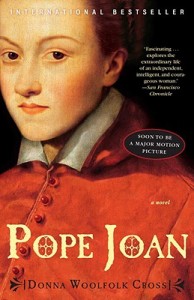 As a child, Joan is beaten for her brilliance and love of books. Her rigid father, a canon of the church, believes that women are inferior to men, incapable of learning, and is certain that his sons are destined for great careers in the church. When Joan’s intelligence gets both her and her brother John into a school, she is mocked by everyone except kindly Gerold, a young count who takes her in since she can’t live in the boys’ dormitory. Joan has an uncertain future until her brother John is killed in a surprise Viking attack along with almost everyone she knows. Assuming John’s identity, Joan enters a monastery and, distinguished by her incredible mind, eventually heads to Rome in a career that will prove as dangerous as it is ambitious.
I don’t know if Pope Joan actually existed, but if she did, her life in this novel certainly makes for an amazing story. It’s incredible how much Joan suffers and achieves in this book, going from beaten, submissive but intelligent little girl to a successful pope, albeit a female one. Joan is someone that can easily be admired as she never lets anyone get her down or force her to do anything that she knows is wrong. Even when the unspeakable happens during the Viking raid, Joan is able to take stock of her situation and figure out what needs to be done in order to both stay alive and get ahead in the world. She is strong enough to deny her own personal needs for the sake of the people and her faith.
The plot of this novel feels like it moves along fairly quickly. For under 500 pages, this book packs in a lot of events, but nothing ever feels rushed, it’s paced perfectly. Obviously, we know Joan is going to become a pope, but how she gets there is a mystery. There are also two other viewpoint characters, Gerold and Anastasius, who provide an alternate perspective on Joan as well as adding subplots and texture to her central story. Of the three, I liked Anastasius the least, but he’s not exactly a true villain because he’s just too ambitious. Most of the church was corrupt and he can’t entirely be faulted for acting as normal; Joan is just different and special enough to point out the flaws in the system.
In the author’s note, Donna Woolfolk Cross includes a fairly compelling argument for the existence of Pope Joan, although of course she was required to add huge amounts of fictional material to fill in the copious gaps which are inevitably left in any ninth-century account. For once I didn’t care all that much if it was true because I could really lose myself in the story. I know that women as strong as Joan must have existed in the Middle Ages, so it wasn’t really all that much of a stretch, whether there really was a Pope Joan or not.
In all, Pope Joan is a fascinating, moving work of historical fiction. It completely captured me and I couldn’t put it down. I highly recommend it.
While you’re here, if you do buy a copy of this book before July 31st, you can enter into the author’s red carpet contest to attend the movie premiere. And don’t forget that if you’ve entered on my giveaway post for a signed copy of this book that a comment here will gain you another entry!
 From the back cover:
It was whispered all through London Society that he was a murderer, that he’d spent his youth in an asylum and was not to be trusted – especially with a lady. Any woman caught in his presence was immediately ruined. Yet Beth found herself inexorably drawn to the Scottish laird whose hint of a brogue wrapped around her like silk and whose touch could draw her into a world of ecstacy. Despite his decadence and intimidating intelligence, she could see he needed help. Her help. Because suddenly the only thing that made sense to her was the madness of Lord Ian Mackenzie.
This is such an interesting premise. That was the first thing I thought when I heard about this book. I’ve never read a romance novel in which one of the main characters had a mental illness of any type. I think Ian is meant to have Asperger’s syndrome, and while I can’t even begin to tell you whether this is a very realistic depiction or not, I think it succeeds extraordinarily well in providing a story that is a little bit different.
Since Ian has this illness, he has certain handicaps on his relationship with Beth, especially at first. He’s convinced he can’t fall in love, for example. He doesn’t feel emotion the same way that other people do, merely mimics their behavior when he realizes he’s missed something. In one of their first scenes together, Beth weeps at an opera while he remains unmoved, completely unable to understand what she’s feeling, although he could easily play back the music and sing the words to her. It takes him a good long time to actually fall in love and understand what it is, although he knows he wants to be with Beth very early on in the novel.
In contrast, Beth appears to be a heroine bent on healing Ian and getting him past some of the scars from his childhood, mainly helping him realize that he is not his father, and falling in love with him despite the fact that he never meets her eyes. This seems an impressive feat to me, but I think the author succeeds in making their love story believable.
There is also a slight mystery plot woven throughout based on Ian’s accusation as a murderer. It’s interesting enough and adds some external tension to the story, but as always, this isn’t what this book is really about. It does, however, set up the Mackenzie family as “villains” of a sort, men incapable of escaping their father’s legacy, as a start to this new series. I’ll continue reading as I quite liked this one. I’d definitely recommend The Madness of Lord Ian Mackenzie to other fans of historical romance.
 Misha, an aristocratic young officer in the Russian army, returns to his hometown after the Revolution to discover that everything in his life has changed. Tonya, a nurse from a poor family, is dubious regarding the Revolution which is intended to benefit her and her family. Unexpectedly, Misha and Tonya meet and fall in love. Misha’s situation is so difficult, however, that he eventually is conscripted into the army and must flee Russia. Thirty years later, both Misha and Tonya have survived the world wars, but they have suffered and changed drastically. When they realize that they both may be in Berlin, they struggle to find one another, hoping at long last that they may be able to seize happiness.
I had this book on my shelf for 2 years and 2 months before I read it, which now seems very silly to me. Why did I wait so long? It was surprisingly good and entertaining. The love story of Misha and Tonya is very nice, but the real draw of this book is the atmosphere and the history, at least for me. Both characters spend time in concentration and labor camps, are separated from their families, and devastated by these wars. It’s incredible how difficult it is for them and even more so that they survived; I can’t imagine how hard this must have been for people in reality. As a result, the fictional lives of Misha and Tonya are gripping.
While the prose is merely competent, it fails to matter as the story sweeps the reader away, although it does feel awkward at certain points. The blurb on the front of my copy says, “An epic tale of love, war, separation and hope”, which describes this story perfectly. Each character has loved many others, has lived a life for thirty years, married another, and in general put the pieces together by themselves. They may have been happy that way. World War II, however, destroyed their lives yet again, and with everyone else they loved absent, they find solace only in the idea of each other; that by returning to where they started, perhaps they can rediscover joy in their lives.
Certainly the greatest asset this book has is in its characters, Misha in particular. He is somewhat idealized, an aristocrat who is actually noble and is willing to work with his hands, but he is easy to love. His desperate search, his creativity, and his love for all those around him make him a compelling person. It’s easy to see why Tonya loves him; her character changes more over the course of the novel as she endures hardship after hardship. By the end, I was rooting for them to find each other and finally be happy.
I very much enjoyed this historical novel. I generally prefer an older setting than the 20th century, but it would be hard to go wrong with this lovely, moving work of fiction. It isn’t going to change the world, but it is worth your time.
Amazon UK
 From the back cover:
It is the summer of 1950 – and a series of inexplicable events has struck Buckshaw, the decaying English mansion that Flavia’s family calls home. A dead bird is found on the doorstep, a postage stamp bizarrely pinned to its beak. Hours later, Flavia finds a man lying in the cucumber patch and watches him as he takes his dying breath. Then someone steals a slice of Mrs. Mullet’s unspeakable custard pie that had been cooling on the kitchen window … As the noose tightens, Flavia decides it is up to her – and her fully equipped Victorian chemical laboratory – to piece together the clues and solve a murder.
Mysteries are one of the only two or three genres that I really don’t regularly like. I thought this was changing, given that I’ve read several mysteries this year and enjoyed pretty much all of them. That’s why I immediately chose this book from Amazon Vine. I wanted to test my theory and it sounded great. While this book has an interesting plot and should have had an interesting main character, I found that it didn’t work for me.
First, Flavia is not as appealing as she should be given the many blurbs about how awesome she is. In a sense, she is awesome, given her intelligence and ingenuity, but she doesn’t feel like an eleven-year-old girl. There isn’t much that is girlish about her and I feel that she could have been a boy just as easily. Her deep passion for chemistry and certainty about her life’s direction do remind me of that weird stage of youth; it doesn’t really occur to her that others think she is strange, she just goes her own way and pursues her own interests. So as a character, she was a bit hit-and-miss with me.
I read an ARC, and I hope this is corrected in the proper version, but the name of the murdered person changed halfway through the book. Talk about confusing! I also thought that there was too much exposition. Flavia explained how she came to her various conclusions and it all seemed fairly obvious.
I did like the old-fashioned British feel of the book; even if we weren’t told that this takes place in 1950, it would be easy to guess somewhere around the proper time. I liked all the little bits of information about chemistry and postage stamps and boys’ schools. And I was interested in the conclusion to the mystery once I’d figured out who the villain was and who the victim was. The Sweetness at the Bottom of the Pie just wasn’t a major success for me. It succeeded in small ways, but not enough for me to be interested in continuing the series.
 Eve Brown had always said that she wanted to go into the Peace Corps. Two years out of college, she figured it was time to take the plunge. With a boyfriend, she hardly expected to fall for her Peace Corps recruiter, but fall she did, and spent most of the months before her assignment trying to get him to love her so much that he begged her to stay. Of course, he did not, and off Eve went, if only to satisfy John’s expectations of her. She fled a year later, unable to cope with Ecuador, only to find herself heading to Uganda as John’s bride before very long, set on changing the world just a little bit.
This memoir is basically a joy to read. Eve’s life is spectacularly eventful and she writes about it with the proper touch of humor while somehow still conveying how different and difficult life in third-world countries is. In Ecuador, for example, Eve lives in the city and manages to see her friends quite frequently and gets luxuries sent from her family at home. Her life seems almost normal, until she interacts with the little lost boys, taking them home and giving them toothbrushes, or travels to one of the villages and sees all the rundown shacks without running water or toilets. Until the event which leads to her departure, Eve writes about everything with a light-hearted voice which makes her experience simultaneously scary and entertaining.
Similarly, her love story with John is serious but also hilarious. There is very little as funny as her Jewish mother asking her newly minted boyfriend if he’d shtupped her daughter yet, or Eve’s determination to get him to marry her. Somehow she even makes the stupidly hard separation of long distance relationships entertaining, which impressed me because I know how terrible it is and I could never write about it with any sort of humor.
I loved the book even more when Eve and John got to Uganda. I really felt like they were making some sort of little difference in those people’s lives and it was fascinating to read about a totally foreign culture; even more so to learn how they became completely accustomed to it and realized they couldn’t really feel at home again in the United States. It’s just so outside my experience but this memoir made me feel as though I could have been there too.
In short, I really loved First Comes Love, Then Comes Malaria. I love reading about women who are changing the world and accomplishing goals in their own ways, no matter how big or small the goals are. Eve tries to educate people about AIDS and even though she doesn’t always succeed, she does achieve many of her other goals throughout the book, as does her husband. It’s inspiring to read about them and I really recommend this to everyone.
 After eleven years, Helen Carter is sick and tired of being the ignored mistress of the Duke of Lister. Worse, she knows that if she leaves him, he’ll take her children, Jamie and Abigail, away from her. So she flees, with the help of a friend, to a dirty castle in Scotland inhabited only by a taciturn, scarred war veteran. Sir Alistair Monroe is used to children screaming at the sight of his twisted face and can’t imagine venturing outside his castle any time soon, preferring to write his books about nature in solitude. When Helen and her children arrive in his life and embrace him despite his appearance, Alistair realizes that his world isn’t confined to his castle tower, but that he will indeed have to fight for what he loves.
I have been feeling a little bit burned out on romance novels lately. I read a whole lot of them because I was stressed and eventually they all started to feel the same. You’ll see this if you stick around to read more reviews later this month and next month. This book, however, I loved, despite the fact that I felt weary of the genre. In fact, it totally revolutionized my boredom with the formula because I felt it was good enough that I cared how the couple got to their happy ending. It ceased to be a formula and became a wonderful love story, which is exactly what I look for in my romance.
I probably can’t even tell you why this is different. I loved both characters; at first I didn’t think I was going to like Alistair, but once we learn a little bit about who he is and how he’s changed because of the war and his scars, it’s impossible not to feel for him. Watching him resist his growing feelings for Helen just because she’s beautiful and he’s not, even though she clearly returns his affections, is heartwrenching and definitely had me rooting for their happily ever after. Helen was a similarly interesting character, having been a mistress for years because it was easy for her and easy for her family once the Duke of Lister had got the idea in mind. I liked her experience, it made her a little different from the blushing virgins who never have any idea what to do. Surprisingly, I even loved Helen’s children. I must be growing to like romances with children because I definitely felt they added to this story. They were sweet and loveable and, most importantly, integral to the plot.
The fairy tale at the beginning of each chapter added to the story’s ethereal feel. I like how each excerpt applied beautifully to the chapter it headed and I loved the fairy tale’s ending as much as I loved that of the actual book. There is a bit of a mystery involved with regards to Alistair’s injury in the Colonies, but it isn’t completely resolved. Since I jumped in with the third book of a series, I can only imagine that this is a continuous plotline and will be wrapped up in the fourth book.
To Beguile A Beast revived my flagging interest in romance with a wonderful story, great characters, and touching moments. There is definitely a reason Hoyt has received so much praise in the romance community. I’m thrilled that I have another of her books waiting for me. If you enjoy the genre, this is a book worth reading!
 From the back cover:
On an otherwise ordinary day, in a small shrimping village off the coast of South Carolina, a boat goes missing. The entire town rallies as all are mobilized to find the lost vessel. Throughout the course of one day, flashbacks of Bud Morrison, the captain on board, and Carolina, his wife, reveal the happier days of a once-thriving shrimping industry juxtaposed with the memories of their long term marriage.
Bud and Carolina fell in love at first sight, but that doesn’t mean their life together has been an easy one. Their marriage has hugely deteriorated in recent years not only because of the decline of the shrimping industry but also because of a lack of communication and an unwillingness to forgive each other for sins committed in the past. Over the course of this novel, they realize how much they need to find their way back to each other properly, not just go through the motions.
Even though these two main characters are in a completely different stage of life than I am, I still enjoyed this book and appreciated their bond. This was made somewhat easier by the fact that their flashbacks encompassed all of their history, from the moment they met to their happiest moments to the mistakes they made. The story was told in such a way that even though tension was building in the present day because of Bud’s accident, the flashbacks were still important and appropriate as both characters endure a particularly difficult day.
At the core, this is very much a book about relationships. The novel takes us through the entirety of Bud’s and Carolina’s short courtship and marriage and we can see how they’ve changed and grown, for good or for bad, and eventually shows how they got to where they are in the present day scenes. It isn’t just about them, though, it’s also their daughter Lizzy and her ex-husband Josh, their relationship with Carolina’s parents, developments between the friends that they made as youths, and among other shrimpers on the ocean. It’s in a sense about the entire community and how it has changed right along with them in the thirty years since Bud and Carolina met and fell in love.
Last Light over Carolina feels very Southern. The characters’ accents aren’t spelled out phonetically, but the way they speak and their mannerisms more than make it clear. I loved the descriptions of life on the shrimping boat, the difficulties of working such long hours, the pain from hard labor, but with the beauty of watching the early morning sunrise and feeling free on the open ocean. It’s easy to see how the various characters are drawn to this life even as the supply of shrimp begins to let them down. The scenery is evoked wonderfully and places us right in South Carolina, in the Atlantic Ocean, and at times in Florida. One of the blurbs on the cover says that this book brings the South to life and that feels true throughout the narrative.
I definitely enjoyed my time with this novel. I came to appreciate the characters as I went on and to care about their plights. I would love to go on a shrimper and see what they experienced for real. Last Light over Carolina is a wonderful book and it’s well worth reading these carefully crafted pages.
Check out some of the other fantastic blogs on today’s tour:
All About {n}: www.bookwormygirl.blogspot.com
Bookin’ with “BINGO”: http://bookinwithbingo.blogspot.com/
My Guilty Pleasures: http://www.mgpblog.com/
Just Jennifer Reading: http://www.justjenniferreading.blogspot.com/
Chick With Books: http://www.chickwithbooks.blogspot.com/
Bella’s Novella: http://www.bellasnovella.com/
Books and Needlepoint: http://booksandneedlepoint.blogspot.com/
Booksie’s Blog: http://booksiesblog.blogspot.com/
Beth Fish Reads: http://bfishreads.blogspot.com/
Living Life and Reading Books: http://ilovelovebooks.blogspot.com/
Book N Around: http://booknaround.blogspot.com/
The Eclectic Book Hoarder: http://eclecticbookhoarder.blogspot.com/
Pick of the Literate: http://bookrevues.blogspot.com/
A Book Bloggers Diary: http://abookbloggersdiary.blogspot.com/
My Friend Amy: http://www.myfriendamysblog.com/
The Tome Traveller’s Weblog: http://thetometraveller.blogspot.com/
Gaijin Mama: http://gaijinmama.wordpress.com/
Blog Business World: http://blogbusinessworld.blogspot.com/
ScarpettaJunkie’s Blog: http://scarpettajunkie.wordpress.com/
Frugal Plus: http://frugalplus.com/
Carolina Gal’s Literary Café: http://susansliterarycafe.blogspot.com/
This Book For Free: www.thisbookforfree.com
Marta’s Meanderings: http://martasmeanderings.blogspot.com/
 From the back cover:
The seven stories in this collection are brilliant examples of the bizarre and wholly unexpected world that Roald Dahl, ‘that great magician’ (Spectator), made his own. It includes not only the trademark dark humour and other-worldly goings-on of ‘The Swan’ and ‘The Boy Who Talked With Animals’, but also a fascinating short essay on how he started writing, his first-ever story, ‘A Piece of Cake’, and the delightfully surprising title tale of a rich young idler who develops a most remarkable ability. Reading them, you’ll find that people are far stranger than you could possibly have suspected …
Roald Dahl’s voice is one that calls me straight back to my childhood and doesn’t let me go until his stories have finished with me. I adored this man’s works when I was younger. I read them countless times. As an adult, I have sometimes wondered what I would think, whether his bias against many members of society would affect my perception of his work. I am usually adept at pushing this aside. While such views are clearly, clearly wrong and probably adults should introduce these facets into discussion with children, it would be useless to forget the past and ignore the fact that Roald Dahl’s beliefs were shared by many. With this in mind, I greatly enjoyed this collection of short stories.
Actually, my least favorite story was probably the title tale. This one follows Henry Sugar, essentially a wastrel, to his discovery of a little blue book which contains an extraordinary story about a man who develops the ability to see somehow without his eyes, but through sustained and focused concentration. Henry learns this skill himself in order to become more successful at gambling, but when money is easy, he learns that there is more in the world he should be fighting for. I don’t know, but I just wasn’t really crazy about the story. I didn’t feel that Henry really redeemed himself or was any different at the end. I didn’t mind the magical aspects, indeed I expected them from Dahl, so it was mostly just his character that got to me.
I enjoyed the rest of the stories though. I really loved Dahl’s essay on how he became a writer and his first short story. I knew most of his history, but I haven’t read Boy or Going Solo for at least 10 years. I love the way he tells his personal history and this was no exception. The way that he backed into writing is fascinating and makes me think of what we would have missed out on had he never managed to find his way. I love the way he tells history, too. I think it adds a more personal touch to the British history which I am so fascinated by. All this time I loved memoirs and when I was a kid, I didn’t even know what I was reading!
This review has become more of an ode to Roald Dahl than a review. To be honest, these stories are mostly not his best work. They don’t quite match up to his novels for kids. (I’m not sure I want to go into his novels for adults. I’m quite happy compartmentalizing him in the happy childhood box of my brain considering what I’ve heard. ) Still, they are entertaining and were a wonderful nostalgia trip for me. If you loved Roald Dahl’s books, you will probably love these stories, too.
Amazon | IndieBound | Powell’s | Amazon UK
|
|



Recent Comments