|
|
 Translating, often assumed to be a fairly standard process, is in reality anything but. Text is one language is not directly transferable to another language. Just try translating an idiom from one language to another; finding a needle in a haystack or having your mouth water is not something that can be directly translated. And what is translation, anyway? To what extent do you change the text to make it fit in, and to what extent do you change it further to give a text an “atmosphere”? In this book, David Bellos, a translator himself, deconstructs the process and examines why we do what we do when we convert something from one language into another. Translating, often assumed to be a fairly standard process, is in reality anything but. Text is one language is not directly transferable to another language. Just try translating an idiom from one language to another; finding a needle in a haystack or having your mouth water is not something that can be directly translated. And what is translation, anyway? To what extent do you change the text to make it fit in, and to what extent do you change it further to give a text an “atmosphere”? In this book, David Bellos, a translator himself, deconstructs the process and examines why we do what we do when we convert something from one language into another.
My interest in this particular topic has been prompted by the fact that the company I work for in real life specializes in multilingual and multinational search. We have a translation agency in our company, and I’ve personally been involved in many projects where translation is involved and is really important to the project in question. Plus, with such an international workforce, it’s fun to get into debates about how different languages are and how it’s much more difficult to translate between some than others. We always focus on local and local knowledge as much as we possibly can, but there has to be the ability to translate somewhere, and that’s why I was quite curious about the actual process – plus, an ongoing interest in linguistics that I’ve abandoned since university is always a factor.
That said, I’d expected something a lot lighter than this book actually was. Bellos is an academic and his book reads like one that was written by an academic. Some parts are fascinating and full of facts, while others are a bit dry. He has one particular chapter that’s about meaning and how it’s expressed, which isn’t a light read for anyone. It’s all fascinating, in my view at least, but it took me longer and more brain power to get through than your average non-fiction read.
I did feel as I was reading that I was really learning something, though; I don’t speak anything but English fluently, so a lot of the book was new to me since I don’t know what goes through a translator’s head. I loved particular little tidbits which really made me feel I was genuinely learning, such as:
For the ancient Greeks, the sound of the foreign was the unarticulated, open-mouthed blabber of va-va-va-, which is why they called all non-Greek-speakers varvaros, that is to say, barbarians, “blah-blah-ers”.
I already knew about what he says directly after – that the Russian word for German means, basically, deaf – but that about the origin of the word “barbarian” just made me smile.
Bellos wraps up the book with more thoughts on meaning, and how we can express meaning without language at all. It’s a thoughtful look back at the whole book and the way people actually understand each other. I really liked Is That a Fish in Your Ear?, but I don’t think it’s for everyone; if you do enjoy languages and translation, though, it’s certainly a book that you should try.
I purchased this book.
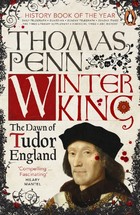 Henry VII, despite being the founding member of the Tudor dynasty, is not actually that well known as a historic figure. His son, granddaughters, and immediate predecessor are all much more prevalent in both fiction and non-fiction, but Henry himself was a significant figure that shouldn’t really be ignored. A bridge between the Plantagenets and the Tudors, Henry changed kingship in England in ways that directly influenced his son, Henry VIII, and shifted the country’s attitude permanently. Henry VII, despite being the founding member of the Tudor dynasty, is not actually that well known as a historic figure. His son, granddaughters, and immediate predecessor are all much more prevalent in both fiction and non-fiction, but Henry himself was a significant figure that shouldn’t really be ignored. A bridge between the Plantagenets and the Tudors, Henry changed kingship in England in ways that directly influenced his son, Henry VIII, and shifted the country’s attitude permanently.
This book has won accolades from numerous publications; my copy has an extensive list of awards sprawled right across the top of the cover, as you can see in the image to the left. It’s hard not to have high expectations for such a book, and indeed I was hoping for quite a lot from it, a more definitive view of a king who often remains in the shadows. Rather than not meeting my expectations, I’d probably say that I got a slightly different experience than I was thinking I would, but one that was still worthwhile regardless.
For one thing, this book doesn’t cover Henry’s entire life, not really. It focuses very heavily on his actual kingship, much less on the road there. Over quite a lot of the book, we can see exactly why Henry himself has remained a shadowed figure. Towards the end, he was a reclusive figure, often ill, and the deaths of his wife and first-born son seem to have pushed him ever further away from history’s prying eyes. He preferred to let his agents and ministers do the visible work, while they were responsible directly to him. Among these tasks was that of building his coffers by accusing people of crimes and extorting money from them, even if they hadn’t actually committed a crime at all. Worse, these agents rewarded informers, and lessened fines for those who did tell on their neighbors, creating a classic situation whereby everyone is falsely accused of something and no one profits but the government. Penn’s version of Henry VII’s reign sounds a torment to his subjects, punctuated by occasional generosity whenever the king suffered a bout of conscience.
The biography is written in a literary but relaxed style, one that would be very suitable for historical fiction. It makes the book easy to read, adding a small amount of imagination at times, but it wasn’t what I’d expected. It can be confusing sometimes, however, because when the author introduces someone new, we expect him to come back again and again, but in reality that particular person might have had only a small or insignificant effect on the reign overall. Because Henry’s government was large, and his ministers rotated often, there are a number of names in here, and I found it surprisingly difficult to keep them straight.
What I did like, though, was how readily Penn demonstrated what a change Henry VIII was. In some ways, the book focuses a lot more on this second son, who gained in power and prestige as Henry VII began to fade away. We can easily see, assuming Penn’s depiction of the taxes is correct, how the people might have been overjoyed to have a young, strong, chivalrous monarch rather than a reclusive aging one; a new monarch who might change policies and make their lives easier.
I also really appreciated how Penn emphasized that Henry VII’s reign was difficult. It was not guaranteed, as we always assume it is with the benefit of hindsight. No – he knew all too well how easily a crown could be taken away, and he must have known that he actually had no real right to it, given that he was descended from bastardy on both sides and couldn’t actually inherit through either. He was threatened over and over again by those he labelled pretenders, and building his dynasty through his children, who could inherit legitimately through his wife Elizabeth of York, was absolutely essential. With this in mind, it’s also easy to consider Henry VIII’s better-known obsession with having a son; might this be a lesson he learned from his father after his older brother Prince Arthur died unexpectedly?
Though by no means a perfect book, and far from a stereotypical biography, Penn’s work on the reign of Henry VII provides much food for thought on an English monarch who is often pushed to the sidelines. Recommended.
 If you’re hiking somewhere in the UK and you’ve bought a map, you’re probably holding a little piece of the Ordnance Survey in your hands. The governmental organization responsible for mapping the nation, the Ordnance Survey faced a difficult road in its early years to successfully covering the entirety of the UK, including England, Scotland, Wales, and Ireland. In the seventeenth and eighteenth centuries, maps were inaccurate, expensive, and incomplete, leaving travellers in most of the world unsure about the shape of the space in which they lived. The Ordnance Survey was created for the military, but it quickly became something that ordinary people eagerly followed as the outlines of their world were defined correctly for the first time. In this book, Rachel Hewitt traces the origins of the Survey through to the completion of the “First Series” of maps, where the entirety of Great Britain and Ireland was completely mapped in detail for the first time. If you’re hiking somewhere in the UK and you’ve bought a map, you’re probably holding a little piece of the Ordnance Survey in your hands. The governmental organization responsible for mapping the nation, the Ordnance Survey faced a difficult road in its early years to successfully covering the entirety of the UK, including England, Scotland, Wales, and Ireland. In the seventeenth and eighteenth centuries, maps were inaccurate, expensive, and incomplete, leaving travellers in most of the world unsure about the shape of the space in which they lived. The Ordnance Survey was created for the military, but it quickly became something that ordinary people eagerly followed as the outlines of their world were defined correctly for the first time. In this book, Rachel Hewitt traces the origins of the Survey through to the completion of the “First Series” of maps, where the entirety of Great Britain and Ireland was completely mapped in detail for the first time.
I don’t really know all that much about the Ordnance Survey, except for the fact that most maps seem to come from them, but I was very intrigued by the prospect of the origins of accurate map-making. Another little niche part of history that I know nothing about? Please, tell me more. Hewitt, in great detail, does exactly that, creating a readable early “biography” of an institution, peopled with many intelligent characters and full of descriptions about just how maps were created several hundred years ago.
I will completely at first admit that I didn’t actually come away from this book understanding precisely how maps are made, although I do have a greater knowledge than I did before. The geometry just baffled me; it’s been over ten years since I studied actual geometry and more than eight since I did any sort of mathematical subject, so I would suggest you hold this against me, not the book. I sort of understood the process of making triangles out of the land based on visible landmarks to check accuracy and map everything in between, but if I was ever asked to do such a thing, I’m pretty sure no maps of the world would have existed before satellites. There is enough of this sort of thing here to slow the book down occasionally, but I wouldn’t let it put you off.
What I personally found far more interesting were the people that Hewitt profiles, especially the earliest ones and those who successfully run the Ordnance Survey from its inception on to the conclusion of the book. Their efforts and seeming belief in their hard work was admirable, and I was left with a distinct sense of awe at the actual enormity of the task they were trying to accomplish. There is a fantastic reminder that all of these men (because of course the project was exclusively run by men, unfortunately) were really just people on page 225 of my edition. As a reward for working diligently over four months’ surveying in Scotland, the men are treated to an enormous plum pudding, nearly 100 lbs of it, for which they conscripted many spare pots and pans and bits of cloth, and all took turns watching it boil so it didn’t burn.
The sections I also really liked had to do with place names, or toponymy. Coming up with accurate place names, especially as detailed here in Wales and Ireland, was a severe problem. The mainly English surveyors struggled to understand what people were calling their towns, much less how to spell it, and in Ireland the surveyors met with some reticence on behalf of the Irish (for which no one can blame them). The early Welsh maps were riddled with inaccuracies and the system used to determine place names had to be revised several times – in Ireland, eventually a separate team of all Irishmen was hired just to work out what the accurate names of places were.
In all, I found Map of a Nation to be a completely fascinating piece of history on a subject I really did know absolutely nothing about. I also trusted it more as it originated as a PhD thesis and the huge number of notes and works cited led me to believe that the author knew exactly where she was coming from. At the end, the author has bolded her works cited to indicate which books are most appropriate for further reading, a nice touch which has inspired me to see if I can get my hands on any of her copious recommendations. Those who aren’t particularly used to reading history might find it a bit dry and hard to get through, especially during the parts describing how the map-making happened, but it’s an endeavor that is well worth it.
All external book links are affiliate links. I purchased this book.
 Bletchley Park is now widely known as the center of British codebreaking during the Second World War, leading to huge advances in intelligence and in computing by some of the geniuses who were recruited to work there. But during and for years after the war, Bletchley Park was treated as a complete secret by the government and the many people who held jobs there during those years. McKay interviewed a number of the Bletchley Park veterans once the information was finally available to the public and has compiled his book in large part from their stories as well as archives held in the Bletchley Park museum. Bletchley Park is now widely known as the center of British codebreaking during the Second World War, leading to huge advances in intelligence and in computing by some of the geniuses who were recruited to work there. But during and for years after the war, Bletchley Park was treated as a complete secret by the government and the many people who held jobs there during those years. McKay interviewed a number of the Bletchley Park veterans once the information was finally available to the public and has compiled his book in large part from their stories as well as archives held in the Bletchley Park museum.
This book received a lot of coverage towards the beginning of the year and, curious sort that I am, I decided that I should read it for myself and find out exactly what happened at this well-known place. It hasn’t always been well known; the secret was kept for over thirty years after the war and many who worked there went to their deaths without breathing a word of its purpose. More recently, though, the achievements of those who worked within the park have been acknowledged and celebrated, with many of these intelligent people decorated for their efforts.
McKay covers the period right from the start of Bletchley Park, with its purchase and first use, until its eventual abandonment and resurrection as a museum. In between, of course, we meet several of the enigmatic people who worked there. Alan Turing, for example, is given a prominent place within this book, as he is one of the most well-known people who worked on the code-breaking machines which were the forerunners of today’s computers. He interviews a number of people who worked there, including some couples who met and fell in love while working there, and emphasizes mainly what life was like for them, from the conditions of their billets to the meals they ate and the truly grueling work that many of them performed.
For quite a few of them, who were brilliant young people recruited into the service without knowing much about what they were doing, Bletchley Park was something of a continuation of school and university, full of like-minded people who worked hard but enjoyed themselves in the little bit of downtime that they got. But their work was of critical importance to the war, and McKay never dodges around the simple fact that their hard work resulted in a massive amount of intelligence and huge steps taken in the war. He explains how they cracked the codes and the intelligence that resulted, which adds an interesting layer to the history I already know about World War II.
Despite the book’s discussion of computing systems there, I don’t think this is quite the book for those who are more interested in technology, but there are aspects of it involved here. I didn’t really feel like I grasped what was going on in this respect, other than some machines decoded encrypted messages in brilliant ways. Overall the writing in the book is relatively basic; the focus is much more on what happened than literary eloquence.
Very recommended to those who are interested in the history of World War II, The Secret Life of Bletchley Park is an engaging read that delves into the lifestyle behind the scenes in every way.
 For a few hundred years, the London Season began with a new crop of debutantes making their curtsey before the monarch – in short, being presented and coming out to society for the first time. Afterwards, a wave of balls took place, introducing each of these young women to the people with whom they were meant to socialise for the rest of their lives. The goal was always to find a husband, preferably a rich or titled one, and settle down nicely in the countryside, preferably in your husband’s mansion. For a few hundred years, the London Season began with a new crop of debutantes making their curtsey before the monarch – in short, being presented and coming out to society for the first time. Afterwards, a wave of balls took place, introducing each of these young women to the people with whom they were meant to socialise for the rest of their lives. The goal was always to find a husband, preferably a rich or titled one, and settle down nicely in the countryside, preferably in your husband’s mansion.
Fiona MacCarthy made her curtsey to the queen in 1958, the last year that any girls made their debut, and effectively the last year of the London Season as it had been known. Times were changing; women could do more than simply get married. The prospect of a career for women was not far off, and women like MacCarthy could be and increasingly were educated at England’s best universities. They learned quickly that talents gained while preparing to be a wife and run a great house could in fact be applied to trades, granting women more independence than ever before. Besides, the old landed families increasingly were pressed hard for the funds to present a girl properly. Old, inherited London townhouses were increasingly sold off and turned into flats, meaning that presentation balls and dinners took place in hotels while families rented expensive rooms for the duration of the season. After the two World Wars, Seasons and debutantes became a joke, and the aristocratic world shifted fundamentally.
This book piqued my interest immediately; as a long-time reader of romance novels, I’ve always been well aware of the London Season in the generally anachronistic way that it’s portrayed there. When you’re reading a romance novel anyway, there simply isn’t a better time for the heroine to find someone to fall in love with, especially when the same set of people get thrown together night after night. But the Season in real life hasn’t been something that I’ve personally researched. With this book, I seized a chance to change that and find out about the reality.
Because MacCarthy’s Season takes place at the very end, the book is half about social change and half about what actually happened during the Season itself. She notes the differences between her mother’s coming out years before and her sister’s two years later; at the former, balls still took place in old aristocratic houses, but by her sister’s (and much of hers) the balls were fewer and smaller. The actual narration of the Season was interesting as well; there were plenty of parties for her to attend, and she spends some time denoting who was who during those few months and what happened to them afterwards.
My only criticism, really, is that the book felt sort of disjointed; there wasn’t that strong a narrative running through it, no real point made at the end. It follows a rough chronological timeline, with elements explained where necessary, but it sometimes makes diversions from this and adds in bits and pieces that aren’t really necessary. It was an enjoyable read, yes, but I personally wanted it to go further and examine more social history, too. But given I knew nothing about the real London Season – much less that it was continuing right up to when my parents were born – I found that Last Curtsey expanded my knowledge and provided me with some intriguing food for thought.
 William Blacker spent years of his life in Romania from the early 90’s onwards. Longing for a simpler life, like that he’d experienced during his idyllic rural English childhood, he found the perfect match in rural Romania. People there still seldom watched TV and spent most of their lives at work in the countryside, harvesting and living off the land as their ancestors had done for generation after generation. It’s an image of not only the Romanians themselves, but the gypsies that live with them, and the disappearing other segments of the population as the steady march of modernisation takes yet another corner of the unspoiled world. William Blacker spent years of his life in Romania from the early 90’s onwards. Longing for a simpler life, like that he’d experienced during his idyllic rural English childhood, he found the perfect match in rural Romania. People there still seldom watched TV and spent most of their lives at work in the countryside, harvesting and living off the land as their ancestors had done for generation after generation. It’s an image of not only the Romanians themselves, but the gypsies that live with them, and the disappearing other segments of the population as the steady march of modernisation takes yet another corner of the unspoiled world.
I bought this book on a whim over a year ago and finally got around to reading it – I’ve recently become interested in the little pockets of Europe outside of my own knowledge, generally sticking to eastern Europe, and so this seemed like a perfect match. I found it even more interesting than I’d suspected, not only for Blacker’s experience, but for the comparisons he makes with medieval Europe, a topic with which I am very well acquainted.
First of all, the Romania he portrays is very much a rural idyll, so much so that I couldn’t help but feel some of the rougher areas were a little bit glossed over. It calls to the ideal of the rural peasant, happy to work, happy with life in general, free of superficial trappings of modern life like telephones, televisions, possessions, and so on. He also quotes from Huizinga’s The Waning of the Middle Ages, which is an old piece of scholarship that has been discredited in many ways by current medieval historians, a lot of which I read, and which put me on edge. I couldn’t help but feel that some of the problems of rural life, like bad harvests and lack of leisure time, were glossed over. Maybe the people did seem happier and more welcoming to him, and maybe they were, but he focused on other problems instead. It made for a very engaging read, and certainly I’d love to visit Romania now, but I questioned a lot of this as I read.
Blacker also spends a considerable amount of time with the gypsies, as the “love” in the subtitle alludes to, somewhat flabbergasted by their complete lack of preparation for life. The women, for instance, exist to do seemingly nothing but dance and charm foreign men, as Blacker discovers, and the gypsies almost always found themselves begging over the course of the winter as they failed to preserve enough food to last the whole season. Contrasted with the rural farmers, their lives seem confusing. He also meets some Germans, who even speak German, but return to the motherland over the course of the novel and find city life a difficult adjustment.
I think this review has already made it sound like I didn’t enjoy the book, which just isn’t true; I loved the descriptions of Romanian culture and people and Blacker’s experiences integrating into their society and trying to understand how things might have been. The book also has pictures in the middle, which helped, and I was outright fascinated by the idea that these people have been living the same way for centuries. They might have paved roads now, but the “good old days” such as they were do make for an excellent book.
I’d recommend Along the Enchanted Way if you, too, are interested in how life might be in the corners of forgotten Europe, but I’d take it with a little pinch of salt.
 One of the richest heiresses in eighteenth century Georgian Britain, Mary Eleanor Bowes had every reason to expect a glowing future. Educated beyond her female peers, indulged by her father, and pampered with every possible luxury, the young heiress satisfied her taste for literary and botanical endeavours, but at the same time was a very poor judge of men. When Andrew Robinson Stoney, a handsome Irish soldier, was gravely injured in a duel for her honour, she married him almost immediately, told that he had only days to live. To her surprise, he recovered within hours of their marriage and proceeded to wreak a brutal reign of terror on her life, beating, kidnapping, and imprisoning her and any other females who fell too closely within his grasp. One of the richest heiresses in eighteenth century Georgian Britain, Mary Eleanor Bowes had every reason to expect a glowing future. Educated beyond her female peers, indulged by her father, and pampered with every possible luxury, the young heiress satisfied her taste for literary and botanical endeavours, but at the same time was a very poor judge of men. When Andrew Robinson Stoney, a handsome Irish soldier, was gravely injured in a duel for her honour, she married him almost immediately, told that he had only days to live. To her surprise, he recovered within hours of their marriage and proceeded to wreak a brutal reign of terror on her life, beating, kidnapping, and imprisoning her and any other females who fell too closely within his grasp.
But Mary Eleanor wouldn’t endure his tyranny forever, and her fight back, for herself and her children, resulted in hope for all abused wives throughout Britain.
What a fascinating book. This popular history, which reads almost like a novel at times, traces the fall of an incredibly rich and privileged woman due to a couple of bad, life-changing decisions, and is a fascinating look at how a single man could ruin the lives of everyone around him. Stoney wasn’t even born particularly highly, but by simply using his attractiveness and ability to lie guilelessly, he managed to bag himself not one but two heiresses. By the standards of their day, his treatment was judged out of the ordinary, but both of his wives had very little power to free themselves from his clutches.
Mary Eleanor Bowes herself was a very compelling character and I felt for her very strongly throughout the course of the book. She was spoiled when young, and did obviously have bad judgement and suffered from a lack of maturity despite her rather more advanced book learning, but none of that meant that she deserved to be so ill-treated. I found all of the struggles she went through to finally free herself to be enlightening – married women under 18th century law genuinely had zero rights. She no longer owned any of the property her father had bestowed on her, as her new husband forced her to renounce her prenuptial contract keeping her own income and properties, and was kept a virtual prisoner by servants hired by her husband. She had nothing, not even her children most of the time.
Her fight to regain those rights is engaging and heartening, as it must have been for any of the women of her time following the case. It made me very glad that I wasn’t born in the eighteenth century, and that so many women before me fought for our gender, as I hope we continue to do so. Indeed, Moore lists when women gained some of the rights Mary Eleanor deserves, and some of them are depressingly recent, which only underscores the fact that there is still so much ground we need to gain.
A peek into the real-life trauma of a disastrous eighteenth century marriage, Mary Eleanor’s fight for her life and family in Wedlock makes for fascinating reading, even as it reminds us of how much women have fought for their rights over the past couple of hundred years.
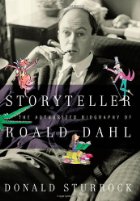 Roald Dahl wrote some of my favorite childhood books. I’ll never forget James and the Giant Peach, Charlie and the Chocolate Factory, Matilda, The Witches, or any of the other amazing books that he wrote for children, and I fully intend to share them with my own children someday. But a couple of the ones I found most interesting were the memoirs he wrote about himself, Boy and Going Solo. I was naturally very eager to learn more about his life, and Sturrock’s biography was a brilliant choice for doing exactly that. Roald Dahl wrote some of my favorite childhood books. I’ll never forget James and the Giant Peach, Charlie and the Chocolate Factory, Matilda, The Witches, or any of the other amazing books that he wrote for children, and I fully intend to share them with my own children someday. But a couple of the ones I found most interesting were the memoirs he wrote about himself, Boy and Going Solo. I was naturally very eager to learn more about his life, and Sturrock’s biography was a brilliant choice for doing exactly that.
Charting Roald’s life, from his immediate ancestry to his death, Sturrock does an amazing job communicating what sort of man Dahl was. He doesn’t shy away from some of the more difficult aspects of his life, or the way that he manipulated his own past when it suited him – mainly, it becomes clear that Dahl was a storyteller in all respects, and if he thought he could make his life more interesting by telling tales about it, he was happy to do so. While I wasn’t thrilled to discover that both Boy and Going Solo had a large degree of fictionalization, I was still eager to discover the actual, documented truth, and indeed there is a considerable amount of that here thanks to archives, research, and interviews consulted and conducted by Sturrock. Sturrock had also met Dahl before his passing, and so shares personal knowledge of him with us.
There is so much here that I’d never really guessed at it; I knew he’d written darker stories for adults, but I had never really known about his many love affairs, the true misery of his childhood, the losses he suffered in his own life both as a child and an adult, nor his crotchety and sometimes difficult personality. Sturrock liberally quotes from the author’s letters and documents, and I felt like I was genuinely getting to know him and connect him with the author I knew. His writing style is distinctive, and the picture Sturrock tells is cohesive. It’s in no way idealized; it makes him into a fully rounded person, which I think is the best possible result of a biography such as this one. Sturrock is equally praising of the author’s merits, especially his unflagging commitment to children’s literature and charitable work, as he is critical of other aspects of his life.
Naturally, I also found the circumstances around Dahl’s life to be fascinating. An attendee at a British boarding school, a pilot during World War II, and then an up-and-coming writer with a Hollywood star as his wife, Dahl lived through a considerable amount of exciting twentieth century history. I enjoyed Sturrock’s distillation of the facts and the way he built the background around Dahl’s life; it helped ground me and made the rest of the book wonderful reading.
A detailed and intensely appealing biography about one of the world’s best known children’s writers, Storyteller is worthy of a place in the library of any Roald Dahl fan.
 Home is probably the most cherished place in the world for most of us. We spend huge chunks of our lives cleaning, decorating, organising, and simply enjoying our homes, but how has the house change throughout history? What would our houses tell us about what went on in them before? Lucy Worsley tackles this topic by exploring the history and evolution of four different kinds of room in an English house, from the medieval period right through to the present. The living room, the kitchen, the bathroom, and the bedroom are Worsley’s subjects, but the people who populate them truly make them what they are, and this is a fascinating journey. Home is probably the most cherished place in the world for most of us. We spend huge chunks of our lives cleaning, decorating, organising, and simply enjoying our homes, but how has the house change throughout history? What would our houses tell us about what went on in them before? Lucy Worsley tackles this topic by exploring the history and evolution of four different kinds of room in an English house, from the medieval period right through to the present. The living room, the kitchen, the bathroom, and the bedroom are Worsley’s subjects, but the people who populate them truly make them what they are, and this is a fascinating journey.
I must admit a little bit of bias and prior knowledge of this book. The series, hosted by Worsley, was actually televised here in the UK over four episodes, one for each room. So I already knew that I was interested in the subject matter (although that wasn’t a surprise) and I’d picked up many of the facts previously. If you have seen the show, though, the book adds bits and pieces and draws more conclusions from Worsley’s experiences living certain aspects of old-fashioned lives.
Social history, for me, is completely addictive; I love finding out why there might be a shoe hidden in my attic or how recently some British homes actually got proper bathrooms and plumbing. There are Victorian ash-midden privies in my little garden and, even though now they’re considered “outbuildings”, that little slice of history is one of the things I love about England. Worsley gives equal time here to the ordinary and the aristocratic, particularly because in many cases developments made for the wealthy finally trickled down to the poor.
Worsley’s writing style is also very engaging and the book is a pleasure to read. There are plenty of endnotes, but this is not dry history at all. It’s full of facts that I’m sure I will regale people with for weeks to come, lots of curiosities about how our homes actually got to be the way they are and how differently people treated them. Consider the bedroom, once simply integrated into the main living space with little to no privacy, which slowly migrated to becoming one of the most private places of all, especially as the living room took its place.
One of the most interesting aspects of a book like this, for me, is how the home can highlight just how much society has changed. Just one part of this is obviously the presence of servants in our lives. Not that long ago, a huge proportion of the population was employed in service, a respectable occupation and one that had a huge part to play in the development of the home. Some things certainly wouldn’t have been possible without servants – older kitchen ranges, for example, required daily cleaning and blacking, not to mention the issues surrounding the chores of actually preparing and serving food. The monumental shift away from servants, along with the inventions and innovations that replaced them, have played a role in the development of the home today.
All in all, If Walls Could Talk is a fascinating journey through the home, a joy to read, and a trove of worthy little details for those interested in the history of ordinary people as well as royalty. Definitely recommended.
All external book links are affiliate links. I received this ebook for free for review.
 How can one write a history of the entire world? It’s not an easy task, and could never be accomplished by a single being. Dr. Neil MacGregor has opted to take the approach of presenting 100 objects from the British Museum, in chronological order, which pick out some of the strands of civilization’s history and which attempt to show us how everything is related and interwoven. How can one write a history of the entire world? It’s not an easy task, and could never be accomplished by a single being. Dr. Neil MacGregor has opted to take the approach of presenting 100 objects from the British Museum, in chronological order, which pick out some of the strands of civilization’s history and which attempt to show us how everything is related and interwoven.
This is a very intriguing book, although as you would expect, it really only scratches the surface and is very, very top-level. The 100 objects are grouped in five for each chapter and tend to come from all over the world. It’s rare for there to be two objects from similar European countries, for example; this does provide a really interesting view of history as we can see what’s happening around the world all at once, even if that is at a surface level.
The objects in the book spread from civilization’s earliest hours to the present day, including a credit card and a solar-powered lamp. Even the author comments on how our choices of what may reflect our society today will not necessarily be the choices made in 100 years, and perhaps the curator in 2112 will be as intrigued by those selections as any others. History, it is fascinating, even more so when you consider the fact that it is happening all around us all the time.
All of the objects included are at the British Museum in London; they’re marked in the museum itself, so you can follow through and try and find all 100. I’m not sure if they were all on display, but I did visit a few on a recent visit to London. For example, here are the Lewis chessmen:
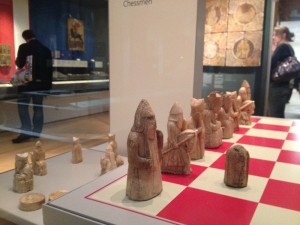
Even though the book has a gorgeous, full colour image of each object, it was still exciting to see a few of them in person, although not exciting enough for me to trek around the entire museum for it.
The British Museum is also a perfect subject because, in many ways, it reflects the overarching theme of a dominant culture taking over smaller ones, something that keeps happening throughout the book with lost civilizations. Sometimes their voices are heard again, as in the case of the Rosetta stone, but sometimes they are truly lost, and we can only speculate. The museum itself is a remnant of Britain’s imperial past, and these treasures may have been contested; the simple fact that they’ve ended up in London from all parts of the globe is a tale worth telling, and which is told for quite a few of them.
I spent a considerable amount of time with A History of the World in 100 Objects and I found it to be a fascinating read, easily digestible in chunks given the nature of the chapters. Not for anyone looking for an indepth history, but for a thoughtful overview, this is perfect.
I purchased this book.
|
|


Recent Comments