|
|
 Today’s question: Do you use a rating system on your blog? How do you feel about using the rating system provided on sites like Library Thing and Amazon? When looking up information on a book you are interested in, do you use the ratings provided by these sites (or similar sites) to help you make the decision on purchasing the book? Today’s question: Do you use a rating system on your blog? How do you feel about using the rating system provided on sites like Library Thing and Amazon? When looking up information on a book you are interested in, do you use the ratings provided by these sites (or similar sites) to help you make the decision on purchasing the book?
This is a very good question for me because I’ve always wondered if I should institute some sort of rating system around here. I’ve seen number ratings, letter ratings, and star ratings around the blogosphere. Something in me, however, has always resisted just giving a book a number or a letter. They are complex and I think almost all of them have bits that are good and bits that are bad. It’s very hard to categorize, especially after I’ve given my review, and sometimes I’m not sure the star rating I’d give a book matches what I’m trying to get across. This is why I don’t use them here.
That said, I do use star ratings on LT. Half the time, it’s a month or more before my review gets over there, and I know that I’m always a bit irritated by people who write reviews and then don’t put a star rating in. Maybe that’s hypocritical of me given my policy here, and given that I never miss it on other blogs if they lack a rating system, but since the mechanism is there, I like to see both, and I like to add my opinion to the little graph on the side so that it is the most accurate possible. I have a system for these. 5-star books are perfect, 4-star books I really liked, 3-star books are okay, 2-star books I disliked, and 1-star books I either didn’t finish or I hated the whole way through.
I hate the star system on Amazon, though. It seems there is something wrong with you there if you use anything less than 4 or 5 stars for a book that perhaps deserves only 3 stars. 3 stars is not bad, in fact, it usually means that the book is fine but it’s not really my cup of tea or didn’t draw me in for some reason. On Amazon, however, it seems that if you like a book, you must give it a 5 star rating. As such, it has lost its meaning. I’ve more or less stopped posting reviews there and only do so for review copies and books that have no reviews but mine.
I’d say I use the star ratings on LT to help me evaluate eventual books to be purchased, but most of my choices are spur-of-the-moment, buying a book I’ve heard of before. Since I don’t read reviews before I read a book myself (or I put sufficient time between the review and the reading to forget what the plot is about), I don’t have many other choices.
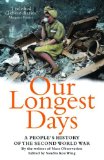 This is a compilation of several diaries from World War II collected by the Mass Observations project. This project was designed in 1937 to see what the people of Britain were really thinking. In the beginning, the writers responded to prompts, but by the start of the war they were asked to keep diaries of their thoughts, feelings, and actions for posterity. These diarists are surprisingly intimate, giving details of their own lives in far more detail than those of the war, and this collection aims to give us a closer look into how the public really dealt with the war. This is a compilation of several diaries from World War II collected by the Mass Observations project. This project was designed in 1937 to see what the people of Britain were really thinking. In the beginning, the writers responded to prompts, but by the start of the war they were asked to keep diaries of their thoughts, feelings, and actions for posterity. These diarists are surprisingly intimate, giving details of their own lives in far more detail than those of the war, and this collection aims to give us a closer look into how the public really dealt with the war.
I found these diaries to be absolutely riveting. The book is filled with the everyday life of people going about in war for five years of their lives. Their lives all change in ways they probably didn’t imagine – some of them say so, like Muriel Green who becomes a gardener for the cause – and it’s absorbing to watch it happen. I thought the most striking thing about the diaries was that they were not overly dramatic and the people in them did not seem very dismayed by the thought that a bomb could kill them at any time. Sometimes nearby houses are destroyed with people in them but the diarist in question always remains remarkably calm. They’ll remark on the bombing of another town, but never seem worried that their own is next, although I’m sure they must have been. The only outpouring of emotion was from a man who lost his brother in the war, which results in some of the saddest and somehow most beautiful passages conveyed in the book.
Mostly, though, this book is a story full of the little things, improvising meals, shopping for clothes, trying to see sweethearts, job-hunting, dealing with the blackout, a robbery, births, deaths, dances, and kisses. All the ordinary bits of life go on amidst a country struck by war. People are people even when the Germans threaten to invade and sirens rush them into bomb shelters multiple times a day. Even more interesting is considering what these reactions say about the British public at large during World War II. It would be truly fascinating to compare these diaries with newpapers and other media produced at the time in order to see the differences in reaction to the war.
I was a little disappointed to discover that most of the diarists were given pen names since their families could not be contacted for permission, but it’s understandable. Apparently the Mass Observation project was viewed in some circles as spying, since diarists gave details of not only their own lives but their neighbors’ as well without permission. So in this book, names are shortened to a single letter if permission has not been given and summaries of diarists’ lives are reduced to a few lines regarding what they were doing in the war.
Overall I’m delighted to see a historical archive like this published and I can only imagine how amazing it would be to work in such an archive as is still going on now. I have another book of theirs on my shelf; it is the post-war diaries of Nella Last, one of the most prolific diarists and one whose family has given permission for her real name to be used. It’s called Nella Last’s Peace. I’m very much looking forward to it; I’ll be reviewing it in March.
And a final note, I discovered after completing the compilation that the editor, Sandra Koa Wing, passed away aged only 28 in 2007 after a battle with cancer. I think this wonderful book is a tribute to her since her future career in history was cut so tragically short.
Buy Our Longest Days: A People’s History of the Second World War on Amazon. on Amazon.
|
|



Recent Comments