

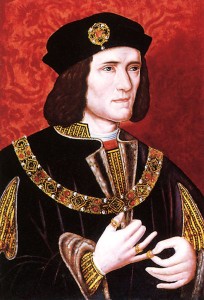
 I know I don’t actually talk about medieval history all that much around here, even though I originally wanted to. Instead I’ve settled for attempting to read and review more historical fiction. I have been thinking about one particular question, though, and it’s quite relevant to historical fiction, so I thought I’d give it a whirl and see if anyone was interested.
Why is Richard III so often presented as a chivalric figure in modern historical fiction?
First, what is “chivalric”? Well, success in war (prowess) is easily the most important factor overall. In most historical fiction novels about Richard, he is highly successful in battle except for Bosworth Field. He is regarded as a key figure in his brother Edward’s battle of Barnet and often he’s off fighting the Scots with great success. Fighting the Scots is brilliant for prowess because to Richard, they were foreigners, and killing foreigners was usually second only to killing heathens, especially if they came at you first. I came across the mystifying fact that we’re not even sure how much Richard fought except at Bosworth Field in my research last year. He was there, but we know so little of those battles that he might not have lifted a finger to help his cause. Of course, the fact that he was killed on the battlefield at Bosworth indicates he did think he knew what he was doing, or perhaps it indicates that he had no bloody idea. One never knows.
Secondly, success with ladies is key. This is the fun phenomenon known as courtly love. Lords were expected to flirt with highborn ladies, and usually one lord would pick one lady to carry on about, although it isn’t necessary for him to actually have a proper affair with her and in fact that would be frowned upon. Gazing and loving from afar is the best option unless you are married. Actually, virginity was the best option (like Galahad), but not a very likely one. Loyalty to the one you choose is essential. What do we have in Richard but a man who is always portrayed as deeply in love with one woman? Usually, it’s his wife, Anne Neville, but in A Rose for the Crown he is portrayed as faithful to his one mistress. Again, this is a fun little fact that can’t be verified. He had at least a couple of bastards, so he broke the no sex outside of marriage requirement and there’s no way to verify the identity of their mother or even how many there were. He may well have loved Anne Neville, but history can’t tell us that and instead shows us that she was actually an heiress with rights to half the extensive Neville/Warwick land (and given the part that Richard played in killing her father and uncle and imprisoning her mother, how do we know she would have loved him?). He wasn’t marrying a pauper and Richard was a very, very ambitious man. It’s just oh so convenient that by marrying her he completed his consolidation of the northern Neville hegemony, isn’t it?
Third, piety! Religion is very important. Even though chivalric men were ultimately warriors, they were supposed to view themselves as suffering. Strange as it may sound, they decided that warfare was a kind of martyrdom and thus eases the way into heaven. Don’t ask me, I didn’t come up with it. Richard is often fictionalized as an exceptionally pious man. He probably was to some extent, but all late medieval lords were to some extent. Richard planned for three foundations during his lifetime. I know they didn’t all succeed, but let’s think about this. Richard was a rich man. He had huge swathes of countryside and even if the economy was suffering, he must have had his fair share of disposable income. I must admit that I have not looked into this personally, but it stands to reason that he had plenty to give to his retainers since he was such a successful lord. In addition, he probably had his share of sins to atone for. Think of all the men he ordered killed for the sake of becoming king. He chose his side of the Wars of the Roses, may have (probably) killed a whole bunch of people, and may even have had a say in the death of his brother. In this context, foundations don’t mean he was especially pious. It just meant he had the money and the desire to get himself out of the hole called purgatory with a whole lot of praying.
So those are the three tenants of chivalry, as I have gleaned from numerous sources. Richard didn’t necessarily fill any of them. I just think he’s been targeted by historical novelists as a figure to be redeemed. There is no question that he was villainized by the Tudors and those associated with them, but that doesn’t make him a paragon of nobility. I think it’s fascinating that he’s been interpreted as such and that all of his activities have essentially been removed from their historical context, evaluated, and assigned the purest possible motivations. Of course, it’s entirely possible that he was a heavenly figure who has been getting a bad rap for hundreds of years. I think it’s more likely that he was an extraordinarly powerful, ambitious, clever man – a man who was very, very good at governing, no less – who lived in a difficult time and had to make some very hard choices. I often wish I could write a novel so I could put him in between as a human being, not a villain or a saint.
What do you think? Why do we put Richard on a pedestal? The man might have killed his own nephews, after all, although personally I prefer to believe he didn’t just because I like him. He’s by far the most likely culprit. Any thoughts? Or did you stop reading at paragraph 1? 


 on Amazon



Recent Comments