|
|
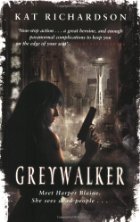 I’ll admit that I am not the world’s pickiest reader. I adore urban fantasy and I am often very willing to overlook faults in one of these books if one of the elements in the book – the world, character development, general plot, etc – stands up to me as worth reading. I have series in the genre that I adore, like the October Daye and Kate Daniel series, and I have some that I generally keep reading because they’re amusing and quick and keep my mind busy. I never know what to expect when I start a new series, and I’d heard some great reviews of Kat Richardson’s books. I’ll admit that I am not the world’s pickiest reader. I adore urban fantasy and I am often very willing to overlook faults in one of these books if one of the elements in the book – the world, character development, general plot, etc – stands up to me as worth reading. I have series in the genre that I adore, like the October Daye and Kate Daniel series, and I have some that I generally keep reading because they’re amusing and quick and keep my mind busy. I never know what to expect when I start a new series, and I’d heard some great reviews of Kat Richardson’s books.
Unfortunately, I completely failed to connect with Greywalker. I just couldn’t become invested or interested in the plot. It seemed like the heroine spent the entire book just talking to people. She’d go to the office, talk to people on the phone, go investigate in the evenings, talk to more people, and so on. It’s a shame because it starts out fantastic. She actually dies for two minutes after being attacked and, when she wakes up, discovers that she can suddenly “see” a whole other dimension of the world which is called the Grey, hence the title of the book. Unfortunately her discovery of the Grey mostly leads to her spending a lot of time talking about it, and when she does experience it, it’s mostly confusing and then needs to be explained. I still don’t really feel like I have a handle on what exactly she can do there or even what it is, probably because she spends most of the book denying that she has this new ability.
There are aspects of it that I should have liked. The setting is a good one. It feels very much like the book was set in the early 90’s. All of the characters have pagers, for one thing, which just seemed odd to me, as I’m mostly too young to have experienced the actual use of pagers in every day life. The book is set in Seattle and has a very rainy, very appropriately grey vibe pervading it. Harper also seems older than a standard urban fantasy heroine, experienced in her job and to a degree set in her ways.
But as a character, she didn’t appeal to me very much. Despite the drastic beginning of the story, she didn’t change very much, and I couldn’t understand why the main love interest was actually attracted to her, especially after a few of the events in the story took place. Not that I liked him much, either; all of the characters felt peculiarly shallow and I didn’t really care what happened to them. Harper is meant to be special, but I couldn’t really figure out why she in particular was special or what purpose she actually served that another person who could see the Grey couldn’t. Maybe my brain was just working too slowly while I was reading, but the details of the story just never fleshed out and became clear.
At this point I’m not sure I want to read the rest of the series. I’ll definitely get it out of the library if I do. Has anyone else continued reading and found it worth persevering?
I purchased this book.
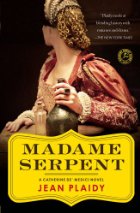 I have a confession: I’ve never actually been very fond of Jean Plaidy’s books. They’ve always seemed very popular to me with other historical fiction bloggers, but I haven’t actually reviewed any of them here. I read a couple of her Tudor books way back before I started blogging, so unfortunately I remember very little other than the fact that they were uninspiring. I was completely in love with historical fiction seven years ago, particularly the Tudors, so this was a huge disappointment. Then a few months ago I got the re-releases of her Catherine de Medici trilogy for review. They sat for those few months, as they were unsolicited and I wasn’t sure I’d like them, but I brought them over to the UK with me because they were light and I really should beef up my historical fiction reading again. I have a confession: I’ve never actually been very fond of Jean Plaidy’s books. They’ve always seemed very popular to me with other historical fiction bloggers, but I haven’t actually reviewed any of them here. I read a couple of her Tudor books way back before I started blogging, so unfortunately I remember very little other than the fact that they were uninspiring. I was completely in love with historical fiction seven years ago, particularly the Tudors, so this was a huge disappointment. Then a few months ago I got the re-releases of her Catherine de Medici trilogy for review. They sat for those few months, as they were unsolicited and I wasn’t sure I’d like them, but I brought them over to the UK with me because they were light and I really should beef up my historical fiction reading again.
Imagine my surprise when I cracked open Madame Serpent and found myself enjoying it – a lot! Catherine is very young in this book and I loved watching her turn into her more famous, scheming incarnation over the course of this novel. Starting in Italy, Catherine endures the difficulties of Florentine instability at a young age; her uncle, the Pope, decides that the Medici family is destined for further greatness and arranges her marriage to one of the French King Francis’s sons, Henry. Henry isn’t the heir, but for an essentially merchant family marrying into the greatest monarchy of the time, this is a huge step. Catherine’s feelings are never a consideration, of course; her love for her cousin and her country is dismissed. Catherine’s character is tested even further when she discovers that the heart of her young husband has already been captured by a much older woman, Diane de Poitiers, and while she falls passionately in love with him, she must watch him long for another woman.
Though the novel flips around between the perspective of several different characters, Catherine is very obviously the primary focus from the start; everyone else’s narrative simply exists to flesh out the space around hers. This book is a lot of set-up, as it’s the first in an entire trilogy about Catherine, covering her life from her childhood up to the birth of her youngest child. I find that most historical fiction focused on women slows down drastically when the main character starts having babies, mostly because they spend a lot of time having children and then recovering from having children, and there is a little bit of that here, but nothing particularly drastic. In addition, the author needs to set up Catherine’s relationships with her children, as I have a feeling they’ll be adding considerably to her later years.
Primarily, what this book shows is that, when Catherine is dismissed as a weak woman whose only function is to bear heirs to the French throne, when her family and her husband neglect her, and when she reaches the very end of her rope, she’s able to find the strength inside to subvert all expectations and become very powerful indeed. I have the feeling I will enjoy the rest of this trilogy greatly, and I’m very glad to have the next two books already waiting on the shelves.
I received this book for free for review. All external book links are affiliate links.
 “A Diamond is Forever” has become one of those advertising slogans that gets burned into a young American’s brain forever. I know just one person who got engaged without a diamond ring and I suspect most people do think that diamond engagement rings were always the standard. Not so – certainly not until Mary Frances Gerety penned those four lines and Ayer built an advertising campaign around engagement. In The Engagements, Sullivan takes a few wildly different relationships from the 1960s to the present day and explores love, with and without diamond rings, throughout the last fifty years. “A Diamond is Forever” has become one of those advertising slogans that gets burned into a young American’s brain forever. I know just one person who got engaged without a diamond ring and I suspect most people do think that diamond engagement rings were always the standard. Not so – certainly not until Mary Frances Gerety penned those four lines and Ayer built an advertising campaign around engagement. In The Engagements, Sullivan takes a few wildly different relationships from the 1960s to the present day and explores love, with and without diamond rings, throughout the last fifty years.
I had really high expectations for this book when I started it and I’m pleased to say it met all of them. I liked the many different perspectives on love, and particularly the focus on how little an engagement ring really means. A diamond may last forever, but it’s the couple that gives it meaning. Some of these couples do, and some of them don’t, but all of them have interesting, engaging stories that emerge believably from Sullivan’s pen. As she cycles between characters, she accomplished an amazing feat for me – I liked all of the different eras. I was interested in the outcome of all of the marriages.
I also just liked seeing how different each of the relationships was. One of the couples has been together for years, and it’s their son who is having the difficulty with his marriage. Another of the characters has left her husband for a whirlwind engagement, while a third adores his wife but can’t afford the diamond he believes she deserves. And one of the characters in Frances Gerety herself, who despite writing such a line, never married. Instead, she remained a “career woman” and remained at Ayer throughout her working life. It’s a window into a different world, as she’s a single woman with a steady, surprisingly typical office job, in contrast to the numerous other relationships in the book. Plus, we get an idea of how advertising works, and how these companies managed to completely change perceptions in a way that has lasted decades. Ayer doesn’t even exist now but people are still buying diamond engagement rings.
While there are a number of failed relationships, Sullivan doesn’t shy away from the successful ones, so this book isn’t at all depressing. Instead I found it uplifting, sweet, and thoughtful, with a measure of gravity; every relationship is different and has its own meaning and its own outcome. I loved the way that, in the end, all of the relationships were tied together and very cleverly so.
The Engagements is a fantastic book, a great story of a little period of history and how much relationships have changed throughout. Highly recommended.
All external book links are affiliate links. I received this book for free for review.
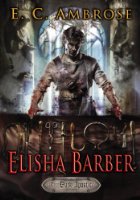 Elisha Barber lives in a fourteenth century England with witches and mages, unlike our own world, and war, poverty, and suffering, very much like it. He does all he can with his two hands, both acting as a barber, cutting and shaving men and women alike, and as a surgeon, plying the medical trade to save lives. But when he fails to save the life of his brother’s child, or indeed his brother himself, due to a feud that he initiated, Elisha can hardly live with his sins, and his capture by the king’s men is almost a mercy. Sent to practice his trade on wounded battlefield soldiers, Elisha learns to practice his true gift in the face of opposition thrown at him from every possible angle. Elisha Barber lives in a fourteenth century England with witches and mages, unlike our own world, and war, poverty, and suffering, very much like it. He does all he can with his two hands, both acting as a barber, cutting and shaving men and women alike, and as a surgeon, plying the medical trade to save lives. But when he fails to save the life of his brother’s child, or indeed his brother himself, due to a feud that he initiated, Elisha can hardly live with his sins, and his capture by the king’s men is almost a mercy. Sent to practice his trade on wounded battlefield soldiers, Elisha learns to practice his true gift in the face of opposition thrown at him from every possible angle.
This book starts off rocky. It’s hard to explain why; I think it just took a little while for the book to find its purpose and its actual story. The first few chapters are almost like a prologue, an explanation as to why Elisha gets where he’s going, and as such don’t really feel like they fit the story as well as they might. Once I’d persevered past that point, though, I could see why it was chosen to go first, because the rest of the story can’t happen without it. It’s worth continuing, in any case, if you do find yourself somewhat stuck there, as what comes after is a lot better than the beginning.
Mainly, this is because we see Elisha in his element, and start to actually learn more about the world that he lives in. His skills as a medical practitioner start to come through, and we can admire the fact that he’s saving men’s lives and fighting in the face of “modern” medicine. Of course, some medieval medicine did more harm than good, while some actually was perfectly sufficient, and Elisha experiences both kinds, although more of the former than the latter.
In terms of characterization, Elisha is the only character that we actually come to know particularly well; the book is experienced exclusively through his perspective, although it’s narrated in third person. Everyone else seems to be the mirrors through which he discovers himself and what he can actually do. Most of the characters are either good or bad, aside from a couple whose intervention changes his life at various times. A lot of the characters are somewhat stereotypical peasants with hearts of gold, while the truly “bad” characters are nobility. But there is enough variation amongst the nobility to avoid falling into any traps, and in any case, Elisha is the star of the show, with the book a bit too short for us to get to know anyone else particularly well.
Finally, the magic system. Mages in this book have a few skills; they can talk to one another through various mediums and they can transform similar objects into other objects. They also seem able to feel other people’s emotions by attuning themselves to the environment and other people, but I felt like that particular skill wasn’t as well defined. There are other abilities too, but they were also not as clearly defined, leaving me to wonder what else the author might come up with!
In all, Elisha Barber was a very solid, ultimately enjoyable read – a great choice for someone who enjoys reading about medieval England and fantasy rolled up into one. I’ll definitely keep my eyes open for the next in the series.
All external book links are affiliate links. I received this book for free for review.
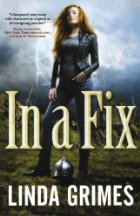 Ciel Halligan is a chameleon-like aura adapter; she can change shape to look and sound just like anyone she touches. She runs her own little business and transforms into her clients to get them out of sticky situations and endure events that they simply can’t take. Her latest job is persuading a client’s boyfriend, Trey, to propose on vacation. Everything’s going perfectly until the villa explodes, Trey disappears, and Ciel’s friends Mark and Billy turn up to protect her. The villains? Modern-day Vikings who have it in for both Ciel and the male population. Ciel Halligan is a chameleon-like aura adapter; she can change shape to look and sound just like anyone she touches. She runs her own little business and transforms into her clients to get them out of sticky situations and endure events that they simply can’t take. Her latest job is persuading a client’s boyfriend, Trey, to propose on vacation. Everything’s going perfectly until the villa explodes, Trey disappears, and Ciel’s friends Mark and Billy turn up to protect her. The villains? Modern-day Vikings who have it in for both Ciel and the male population.
Urban fantasy has been my addiction for some time now, and I’m always eager to add a new series to my shelves while I wait for other authors to release further books in my already-beloved series. In a Fix is definitely on the lighter side of the urban fantasy spectrum, and not precisely “urban” either, as there isn’t a focal city in the book as there is in so many of them.
I liked the initial idea behind this book, with shapeshifters who basically take on the difficult situations of others as a job. There are plenty of times when I think we’d all like to hire a duplicate of ourselves to deal with an event that we really couldn’t be bothered with ourselves.
Unfortunately, I really didn’t like much else about this book at all. The main character, Ciel, was so irresponsible that she drove me insane. She needed to be rescued by her male cohorts what seemed like every other page, as she went charging in no matter what, sometimes only seconds behind them. There are only so many times I can deal with someone getting caught by the exact same bad guys because of their own stupidity. She doesn’t even start off well, as her first job has a contract that allows her to sleep with another woman’s boyfriend / planned-to-be fiance for the purposes of securing “the ring”. That whole scenario makes me feel uncomfortable. The fact that the book later features a love triangle also served to put me off, as she mostly seems indecisive but keen to take whatever she can get in the meantime. Eh.
In some instances, characters that aren’t likeable can be redeemed by a good plot, but this one just became silly over the course of the book. I’m sure this book is aiming more at a quick, fun read than anything else, but I suppose I just prefer my urban fantasy reads to be at least somewhat serious and believable (in the context of their own fantasy worlds, that is). I didn’t experience that here, and overall the book let me down.
In a Fix seems like it would suit someone looking for a light, casual, funny read; when it comes to urban fantasy, it’s a bit of a let-down. I won’t be continuing with any further books in the series.
All external book links are affiliate links. I received this book for free for review.
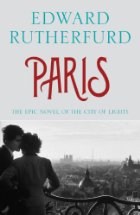 Subtitled “the epic novel of the city of lights”, Paris follows four families throughout the history of Paris. The De Cygne family are nobility, though their status gradually erodes over the course of history, while the Le Sourds are a range of commoners. The other two families are bourgeois and workers, representing the different sectors of French society. Throughout the novel their relationships and statuses change with history right up until the 1960’s. Subtitled “the epic novel of the city of lights”, Paris follows four families throughout the history of Paris. The De Cygne family are nobility, though their status gradually erodes over the course of history, while the Le Sourds are a range of commoners. The other two families are bourgeois and workers, representing the different sectors of French society. Throughout the novel their relationships and statuses change with history right up until the 1960’s.
Unlike the other novels I’ve read by Rutherfurd, Paris focuses on a particular segment of history more so than the others, following a few members of the families more closely from 1875. The books I’d read earlier – Sarum, Russka and London – had started in the past and moved up to the present, more or less.
I’m not really sure I liked the change, to be honest. I can kind of see why it was done, perhaps because the late nineteenth century and onwards is a bit better known, and because it allows Rutherfurd to focus more closely on specific characters for once, but those reasons are exactly why it doesn’t work. I am much more interested in earlier history and Paris certainly doesn’t lack for a fascinating past; what happened to the history before the 13th century? Just because Paris wasn’t properly the capital of a France like the modern one we know until Philip Augustus doesn’t mean that its history, even fictional history, isn’t worth writing.
Secondly, Rutherfurd really doesn’t excel at creating believable characters or writing deeply enough to make the story of them compelling. He’s much more skilled when it comes to the epic big events, creating incidental characters whose only purpose really is to live through the cities’ big moments. When half of the book is devoted to looking more closely at a few characters, this approach no longer works. I rolled my eyes at a lot of the writing here; characters’ judgement of each other is incredibly shallow and unrealistic, for one thing, and things are always told and not shown. I really did not enjoy returning to the more modern strand because I had no interest in who Marie was actually going to marry or whether Luc was going to get his revenge on Louise. I felt that his previous books worked a lot better in this respect; I wanted more historical fiction, less little social dramas that didn’t reflect anything actually about Paris.
It’s not all bad; the chapter that had the St Bartholomew’s Day massacre was actually particularly good because it gave the events a really human element through two children that suffer from the events, and reminded me of why I actually wanted to read the book in the first place. Unfortunately, most of it didn’t live up to my expectations, making this one of the most disappointing books I’ve read yet this year.
I received this book for free for review. All external book links are affiliate links.
 Louise Fletcher is a dairymaid in 1790, and a reasonably content one at that; she has a purpose in life, and a purpose that she’s actually good at. Then the hand of fate steps in and she finds herself a lady’s maid to a Captain’s daughter, Rebecca Handley, soon to be engaged to a gentleman and move to London. But first, Harwich, a port on the Thames where all manner of folk wind up, and where her brother vanished a few years ago, called to the sea like all Fletchers. Alongside Louise is Luke, a boy pressed into service in His Majesty’s fleet, at first miserable but who gains his sea legs and his skills as time goes on. These two stories intertwine in surprising ways as the novel goes on. Louise Fletcher is a dairymaid in 1790, and a reasonably content one at that; she has a purpose in life, and a purpose that she’s actually good at. Then the hand of fate steps in and she finds herself a lady’s maid to a Captain’s daughter, Rebecca Handley, soon to be engaged to a gentleman and move to London. But first, Harwich, a port on the Thames where all manner of folk wind up, and where her brother vanished a few years ago, called to the sea like all Fletchers. Alongside Louise is Luke, a boy pressed into service in His Majesty’s fleet, at first miserable but who gains his sea legs and his skills as time goes on. These two stories intertwine in surprising ways as the novel goes on.
Reviewing this book without giving the story away is going to be a real challenge, but I’ll give it a shot. It’s definitely one of those books that you should let take you without much prior knowledge from the story. I didn’t expect what was coming, especially in the second half of the book.
Unfortunately, the book did fall prey to the fact that I just don’t really like this period in history and I like stories set on ships even less, if that’s possible. The beginning and end of the book felt too long; the middle really picked up and became excellent but sank back after the main revelation. I actually liked what the author did with the plot and the two main characters. It added a different spin on the story and gave it a new dimension of meaning. If you read the book, you’ll understand – it put me into a perspective that I had never experienced before and I thought it was worth reading for that alone. The plot twist is very reminiscent of Sarah Waters, as many other reviewers have said, and it’s not a surprise that Waters was Worsley’s mentor during her degree.
Worsley is also an exceptional writer, and the prose throughout the book shows this brilliantly. The settings are evocative, the characters’ feelings leap out from the page, and the narrators are distinct. Louise’s sections are told to a certain “you” which doesn’t take long to discern, while Luke’s are simply told from his perspective. It feels a very literary novel, carefully crafted, meticulously written, but unfortunately in this case lacking the spark that I needed to fall in love with it. This is very much a like but not love book.
Still, particularly if you enjoy Sarah Waters, you may find that She Rises is worth your while. I know I’d be keen to read more by Kate Worsley in the future.
All external book links are affiliate links. I received this book for free for review.
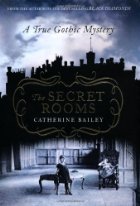 Catherine Bailey, intent on writing a book about villages affected World War I, visited Belvoir Castle to investigate the extensive archives kept by the ninth duke, John Manners. To her dismay, she found that John’s journal abruptly ended in June 1914, just when his unit was about to enter the fighting. When she read his correspondence, she found the same gap, and on further investigation, found three complete gaps in otherwise comprehensive archives. She was so curious that she kept looking and the result was this book, a mystery unwinding into a fascinating picture of a still-privileged aristocracy hovering on the brink of change. Catherine Bailey, intent on writing a book about villages affected World War I, visited Belvoir Castle to investigate the extensive archives kept by the ninth duke, John Manners. To her dismay, she found that John’s journal abruptly ended in June 1914, just when his unit was about to enter the fighting. When she read his correspondence, she found the same gap, and on further investigation, found three complete gaps in otherwise comprehensive archives. She was so curious that she kept looking and the result was this book, a mystery unwinding into a fascinating picture of a still-privileged aristocracy hovering on the brink of change.
This is a book that actually took me by surprise. I’d read the first few pages a while back and didn’t feel compelled to continue. I have to be in a certain kind of a mood for a mystery, and I never felt that the time was right. When I finally did persevere, though, I found an absolute gem of a book. There are actually 3 mysteries, which are the gaps in John’s life, and Bailey does an excellent job of keeping the reader wondering about what’s happened while slowly revealing a picture of an aristocratic family which simply no longer exists.
The book is structured with chapters that are fairly short. A number of them end in cliffhangers, so that as a reader I was compelled to go on and read more to see what the author would find next; I actually read most of the book on a train and it was the perfect distraction to make a long journey seem much shorter. More than waiting to find out the mysteries, though, I was fascinated by the world which Bailey revealed. John’s life, and that of his parents and siblings, is still full of aristocratic excess, but crisis and change is very clearly on the horizon. When he is young, his family is virtually untouchable, yet by the time the first World War is over, this world is simply gone.
The amount of influence the family has – and believes they have – is incredible, and some of the strings pulled to get some of the events in the book to happen are almost difficult to believe now. Bailey quotes copiously from the letters and journals she finds, which helped me feel like I was digging through the archives with her. The way she slowly reveals John’s character and the events that shaped his life gave a feel for how she must have experienced the unveiling of his character; overall I thought it was an excellent way to keep me invested and reading. It’s also worth mentioning that this is a really quick and easy read for non-fiction; Bailey’s writing is smooth and easy to read, and her detective story makes the book feel like it could be fiction.
I’d definitely recommend The Secret Rooms and now I’m eager to read Bailey’s first book, Black Diamonds, too.
I received this book for free for review.
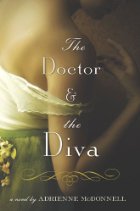 Erika von Kessler is a diva with big dreams; though she’s well into her twenties and married, she secretly longs to leave her husband and travel to Italy where she might become the star she believes she is destined to be. Her businessman husband Peter’s fervent desire to have a child, and her seeming inability to conceive, have only caused her to long even more to leave him. Fertility doctor after fertility doctor have failed to help her conceive, until the couple go to Doctor Ravell, a Boston specialist who has reportedly worked miracles in an age before artificial insemination was regularly practiced. Ravell is immediately captivated by Erika and, eventually, she by him, until their lives and ambitions become woven together. Erika von Kessler is a diva with big dreams; though she’s well into her twenties and married, she secretly longs to leave her husband and travel to Italy where she might become the star she believes she is destined to be. Her businessman husband Peter’s fervent desire to have a child, and her seeming inability to conceive, have only caused her to long even more to leave him. Fertility doctor after fertility doctor have failed to help her conceive, until the couple go to Doctor Ravell, a Boston specialist who has reportedly worked miracles in an age before artificial insemination was regularly practiced. Ravell is immediately captivated by Erika and, eventually, she by him, until their lives and ambitions become woven together.
This was not a book that sucked me in right away. In fact, I didn’t actually like the characters. Perhaps realistically, they are all very selfish in their own ways, very human and particularly flawed, but that certainly makes them hard to understand. Erika’s struggle for a child dominates the beginning of the book; it infuriated me, I must admit, when her husband refused having his sperm sample analyzed and then Ravell found out that the “fault” lay with him, not her – I find this difficult to articulate but I intensely despised him after his arrogance allowed him to go on blaming his wife for something that had nothing to do with her, when in reality it was a burden they could have borne together.
In some ways, despite the fact that I didn’t like her much, it’s easy to understand Erika’s struggle, which was particularly indicative of the early twentieth century. Her ambitions are greater than the life she has, and she is forced to contain her talent in a world which expects her to be happy as a wife and mother. Although some women are, she isn’t made for that role, and because she doesn’t fit the mold, she has to do something extreme to achieve her own dreams. Still, she doesn’t do so without any emotion, and her eventual choice is one that does in fact devastate her. I may not have appreciated the “romance” within this book much, but I can’t fault McDonnell’s characterization of these characters.
Yes, the “romance”. I really did not feel that much about any connection between Erika and Ravell. I did not like a huge number of their actions and I honestly didn’t get where the romance came from. Ravell has a complicated relationship with his gynecological patients, given he’s also having an affair with another one when the book opens, and there is some insight in how they could feel some level of intimacy towards one another. But … I just wasn’t convinced.
Anyway, the book is actually quite well written and cleverly structured, with different phases of Erika’s life mapped out with different sections of the novel, of which there are six in total. Some of the scenes are beautifully written, and I found those in Trinidad, in the jungle, to be particularly appealing, almost as though I could feel the sand and the breeze and the warm nights. I think McDonnell could be a phenomenal writer, and it’s impressive that this is her first book – it’s just a shame I didn’t relate more to the characters in this very character-driven novel.
I received this book for free for review.
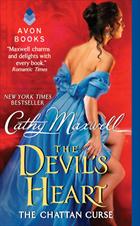 Lady Margaret Chattan knows that she’s the only person who can stop the curse that’s been plaguing her family for generations. Decades ago, Fenella Macnachtan cursed one of Margaret’s ancestors for leaving her daughter Rose to marry an English girl, causing Rose to kill herself. Both of Margaret’s brothers have fallen in love and, as the curse dictates, fallen ill shortly thereafter, with one of them near death. As the only girl born to the Chattans since the curse, Margaret is special, but as she heads homeward to Scotland, she knows that she has no idea on how to save her brothers’ lives. Then, a horrific freak accident takes the lives of nearly everyone escorting her, leaving Margaret untouched and rescued by the Macnachtan family, the very clan who have fostered the destruction of her own. Little does Margaret suspect that the head of the family, Heath, is an honorable man who has been admiring her from afar for years. Lady Margaret Chattan knows that she’s the only person who can stop the curse that’s been plaguing her family for generations. Decades ago, Fenella Macnachtan cursed one of Margaret’s ancestors for leaving her daughter Rose to marry an English girl, causing Rose to kill herself. Both of Margaret’s brothers have fallen in love and, as the curse dictates, fallen ill shortly thereafter, with one of them near death. As the only girl born to the Chattans since the curse, Margaret is special, but as she heads homeward to Scotland, she knows that she has no idea on how to save her brothers’ lives. Then, a horrific freak accident takes the lives of nearly everyone escorting her, leaving Margaret untouched and rescued by the Macnachtan family, the very clan who have fostered the destruction of her own. Little does Margaret suspect that the head of the family, Heath, is an honorable man who has been admiring her from afar for years.
Having read The Scottish Witch a few months ago, I’ve been eager to find out how the so-called Chattan curse is defeated. It had to be; this is a series of romance novels, after all, and killing off the heroes very shortly after the books have ended just wouldn’t happen. So I was looking forward to reading about Margaret, who has spent years of her life being pursued and fighting off that pursuit, convinced that love is not the course for her, and Heath, who has little in his mind beyond how to save his family’s ancestral home. The added touch here is that of course Heath saw Margaret years ago and was captivated by her beauty, so finding her in the midst of a carriage wreck is not the first time he’s confronted by her.
I really liked this romance, though; I think sometimes the curse makes it a bit too convenient for the couple to be together, but they have chemistry. It just means that the author can write that they feel as though they’re meant to be together while still having it work within the plot, rather than either of them ever really having serious doubts about their relationship. It’s fortunate that the couple works, because I think it could easily have felt forced. The magic element isn’t too bad, either. Again, it’s something that could have felt off very easily, but it works well within the context of the book.
A quick, engaging read, The Devil’s Heart is a good choice for historical romance fans who don’t mind a little bit of magic in with their love stories. I would recommend checking out the first two books too, though, as it’s very nice to get the back story to these characters before we find out how the curse is resolved.
All external book links are affiliate links. I received this book for free for review.
|
|



Recent Comments