“Name a favorite literary couple and tell me why they are a favorite. If you cannot choose just one, that is okay too. Name as many as you like–sometimes narrowing down a list can be extremely difficult and painful. Or maybe that’s just me.”
No, it is quite difficult to narrow down a list! I do have a specific favorite though. I’ll reference my favorite literary couple, Phedre and Joscelin, from Jacqueline Carey’s Kushiel’s Legacy series. This is a bit spoilery here. I like them in their own trilogy; they get a bit more boring in Imriel’s. It’s hard to say why exactly they are my favorite. For one I think they have quite a believable love story going on. They’ve been through so much together over the course of the books that it’s very diffiult to imagine them not forming such a bond. Furthermore, they will go through anything just to be with one another, particularly Joscelin (Phedre is a bit more concerned with saving Terre d’Ange). All of that would fall flat if the emotion Carey portrays wasn’t so true to love, but it is. This fantasy series is far beyond a love story but without that love story it would lose a lot of its emotional appeal. I think another thing that I love about them is that they are not perfect. Of course they are typically beautiful, but they have distinctive, screwed up personalities of their own that are, to me, completely believable. Maybe Joscelin is the best warrior ever, but he’s been trained to be the best warrior ever and it’s genuinely interesting to watch him combat the philosophies imparted with his skills when he falls in love with Phedre. Similarly, Phedre struggles with monogamy because she was brought up to embrace love in all its forms. Besides that, they are both exceedingly stubborn. In other words, they feel human to me, and that makes their love much more real. They may appear to be perfect on the outside, but I like that the books reveal extra dimensions to their characters.
Finally, I think another reason that I am biased towards this couple in particular is the fact that their epic, passionate, believable love story is something that doesn’t often – or ever – happen in real life, and that sort of escape that I can believe in is one of my requirements for the fiction I just adore. This couple does it the best.
Russell Shorto argues that Descartes’ theories underpin everything that modern people think and do, despite the fact that we give him little credit for it. To illustrate this, Shorto follows Descartes’ bones from the great man’s moment of death to the present day, illustrating how he and his mortal remains have powered and furthered thinking from the Enlightenment to 2008.
I didn’t really think this book was going to be any good. I read several reviews from people who had abandoned the book or who finished it only because they were compelled to as reviewers and had received an ARC like me. I have a bad track record when it comes to finishing non-fiction, even when I like it, so I opened this a bit warily.
Surprisingly, I didn’t have any trouble with it at all and really enjoyed it. I found the charting of intellectual and scientific history from Descartes’ time to now to be very interesting and relevant to the way I think now and the way I know others think. The use of Descartes’ bones and particularly skull to illustrate this mental journey was a clever device that unified the book from his death to the present. It isn’t exactly a story, but more a philosophical exploration of just how we got where we are, using the bones and the mystery surrounding them as a frame for the author’s deeper thoughts.
I thought it was smart, thoughtful, and a worthy read. I’d suggest this book if you’d like to delve into the issues behind our thought processes and theories, rather than looking for the mystery it’s sold as. You can buy it on Amazon.
As you probably all know by now, I loved the first two volumes of Brandon Sanderson’s Mistborn trilogy and I’m very anxiously awaiting my ARC of the third, The Hero of Ages. This is one of the few instances that I regret being in the UK, because otherwise I’d have read it a week ago!
Anyway, in lieu of my review, which will be here directly after the book I expect, here’s a new book trailer for the series featuring Brandon talking about why his fantasy series is different and what’s next for him:
Interested? You can also hear Brandon talk and have him sign your book on his book tour! Here is a list of the tour dates and locations.
Today’s question: Series. Do you collect any series? Do you read series books? Fantasy? Mystery? Science fiction? Religious? Other genre? Do you use the series feature in LT to help you find new books or figure out what you might be missing from a series?
I love a good series. According to LibraryThing, I have at least one book from 296 series, covering 544 books in total. That’s nearly half my library. I think that this is probably due to my somewhat large collection of fantasy – almost all fantasy books come in series and I quite like it that way. I also have a fair number of historical romance novels, most of which come in series form too, although each can normally stand alone. I’m impressed by the amount of knowledge people have contributed to the series feature on LibraryThing; there are many books that I own that I didn’t even realize were part of any series, like Looking Backward by Edward Bellamy. Who knew?
I like to read series because they allow me to form a greater attachment to characters I can revisit over and over again. In fantasy novels, I like that the complexity of the story can grow with each book, but I only like that if the series is going to end someday. I have one in particular that has left me hanging for a while now, which is George R.R. Martin’s A Song of Ice and Fire series. He’s still alive, which is nice, but he still hasn’t finished the fifth book of the series, which was supposed to be imminently published after number four. At the rate he’s going, it’s easy to worry that he won’t finish it and even more so that the final books will never live up to our expectations. He hasn’t got it all planned out for the wondrous Brandon Sanderson (or someone like him) to take over like Robert Jordan did. This is a shame because the first three books of the series were probably the best I’ve ever read in fantasy.
So I guess that’s the only pitfall. I want a conclusion! Otherwise, series are a yes for me.
When Mike Borden, the headmaster of a prestigious private school in Vermont, is handed a tape by his secretary, he isn’t sure what to expect. He certainly doesn’t expect to see two highly respected students and a third post-graduate student engaging in sexual intercourse with a 14 year old girl, but that’s precisely what he does see. The last thing he anticipates is the explosive effect that this single tape – that this single evening – will have on so many lives, both in and out of the small town in which the private school is located.
This is quite an overwhelming book. The story is immensely more complex than I’ve just described, but it’s very difficult not to give away any details and still write a summary. The author rotates viewpoints, featuring the girl, the boys, the headmaster, some of the parents, and other related people. It really reads like a collection of testimonies from all the players in the very serious events of those few days that determined many futures. At times this is disorienting. Each person’s narrative is written in a distinct style so that they’re easily distinguished, but it’s very easy to lose track of where you are in the story, particularly when a person’s chapter is only two or three pages long. They also skip around in the book’s timeline, and as I read quickly, occasionally I’d wonder just what was happening with the other people at the time because it didn’t seem clear to me. Perhaps if I had spent more time on each perspective, this wouldn’t have mattered, but I also really wanted to work out just what happened.
On the other hand, the emotional power of this book is not to be missed. Anita Shreve carefully gathers in all the threads of her tale and brings it to a startling climax that you don’t expect until only a page or two before it happens; looking back, however, you can see how the rest of the day’s events led to it. It feels carefully crafted to evoke this particular outcome and to minutely examine how everyone felt about the tape.
In the end, I’d call this a very good book. It has compelling characters, a riveting plotline, and terrific attention to detail. The rotating viewpoints are a minor problem, but one that I could get past to enjoy the book. And I’m now compelled to add Anita Shreve to my “authors whose work I should read” list. Check this book out on Amazon. It’s released today!
Finally, many thanks to Miriam Parker at Hachette for sending me this review copy!
Since I’m off in the UK for now, some review books are unavailable to me thanks to publishing laws and such things that I don’t really understand but accept. Many of you are Americans, though, so today I am offering you a giveaway of Paul of Dune, the direct sequel to Dune by Frank Herbert. Here’s the description offered up by one of my favorite publicists:
Continuing the groundbreaking Dune series, Brian Herbert and Kevin J. Anderson bring us more about Paul Muad’Dib and his background, as well as what happened during the lost years between Frank Herbert’s Dune, and his second Dune novel, Dune Messiah. This novel showcases the first years of the God Emperor’s reign—the most requested story in the fan letters they receive—and chronicles Paul’s childhood. It is the Tor/Sci Fi Essential pick for September 2008.
Booklist notes, “Standing well enough on its own for Dune novices, it goes without saying that it’s must reading for established fans.”
Sound interesting? Great! I have one request – that you write me a guest review when you’ve finished! Since I can’t review the book, I want to make sure my readers hear about it and meanwhile mix up the voices around here. How do you enter? Just leave me a comment here. The contest is open until October 31st and only open to US residents. I’m sorry about that, but since I’m not sending it out (and can’t get it myself!) I have to follow the rules!
Good luck!
Don’t want to trust your luck? Buy Paul of Dune on Amazon today.
Azincourt is the French spelling of Agincourt, known widely as a shocking loss for the French against the English in the Hundred Years’ War. Bernard Cornwell imagines the lead-up to the battle here focusing again on an archer, Nicholas Hook, who serves as our lens looking in on the wider struggle, ending with the monumental battle itself. We all know the ending, but Cornwell still manages to make it suspenseful as we never know who will live and who will die.
As usual, the battles are the best thing about Cornwell’s writing. He makes us feel like we’re there, or at least that we could have been there in a past life. He underscores the extraordinary importance of archers with their longbows, the single greatest advantage that the English had against the French here and during many other battles in this lengthy on-and-off war. I should also mention that the priests are corrupt and the good one is not as religious as you’d expect a priest to be, so another warning for those of us who are devout Christians and prefer not to have their reading slander their religion unfairly.
Cornwell’s third person narration is a bit different from his first person fare, most of what I’ve been reading lately. It feels colder and it’s much harder to get into the characters’ heads. As such, Hook and Melisande remain very distant from the reader throughout the novel. Hook is a bit humbler than Cornwell’s normal male heroes, but of course he is still the best. In all, this feels very much like the Grail Quest trilogy, and as I believe Hook is related to Thomas of Hookton, that’s not entirely a surprise. Still, I think I prefer his first person narrators, arrogant and similar as they all are. The books feel more human with a fully fleshed out narrator.
I enjoyed it, but I’d definitely recommend his Arthurian trilogy or Saxon Chronicles first. I feel this one may only be for fans of Cornwell or those of us who like to read about the more violent side of the Middle Ages. Pre-order this book on Amazon.
I haven’t opened a book since Friday; since I thought I was participating in the Read-a-Thon, I gave it a rest that evening and did some schoolwork instead. I didn’t get it all done, so after this post I will be doing yet more work. It’s interesting, but I would rather start The Heretic Queen by Michelle Moran. It arrived on Friday with my fiance and I really can’t wait to read it. Come back later on this week for a guest post by Michelle, my review, and a giveaway of a signed copy!
I’m also hoping that The Hero of Ages by Brandon Sanderson makes it across to me this week. It missed me in the US, so I’ve had to wait for my parents to send it over here. I feel like I’ve been waiting forever, on the edge of my seat, for both of these books, so I’m glad that I can start them very soon.
As far as the Read-a-Thon is concerned, I’m amazed by how much people read and even more so how much has been donated for charity. You are all awesome! I don’t want to single anyone out because there may be people not on my Google Reader that also did such terrific things, so I really want to offer up congratulations to everyone who participated. I will definitely be joining you next April, and I will arrange seeing everyone I know around that day.
Some exciting things have been going on this week; I acquired a York Card, which not only gives me access to the libraries but gets me into three museums for free just because I live here. Isn’t that awesome? I’ve never lived in a place which so encouraged its citizens to embrace their heritage, and in York, people have a fantastic history to celebrate. I’ll be using this card to get into the museums with one of my classes; the tutor will be taking us through at least twice to show us various things that we’re studying.
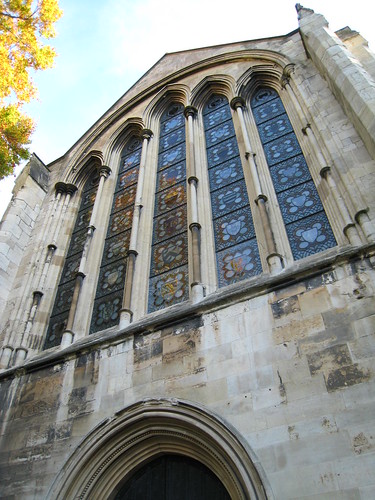
I’ve also volunteered to join an archaeological dig going on this year in the city. I’m not sure yet if they have any spots for the remainder of 2008, but hopefully I’ll be first on in the spring if not. That’s not to mention my volunteer slot at the York Minster Library, a medieval palace converted into a space to hold thousands of really old books. When I went in on Thursday, I actually got to page through a book from the 16th century that was bound in an even older manuscript. It’s a fantastic place! Have a look at the photos below:
I’m off to catch up on my reading and get an early night in preparation for morning class; here’s hoping everyone has a fantastic week!
I will no longer be participating in the 24 hour Read-A-Thon today. My fiance unexpectedly turned up last night and I can’t spend 24 hours reading while he’s here. I’m disappointed that I can’t read but I’m very happy he’s here, so I’ll just have to arrange things better for the next read-a-thon. I’m sorry! I’ll be keeping updated on your progress when I can and cheering you all on, though.
Kvothe is a hero and a legend. It says so on the back of the book. Yet the story opens in a backwoods tavern and it takes us a while to learn who Kvothe is (or not, depending on how quick you are). As he begins his lengthy tale, we realize that this book covers his childhood and adolescence; he is not yet the great hero that is lauded and derided in songs and stories across the country. It leaves me wondering, how did he get to that backwoods tavern? What happened?
We’re not going to know yet, so let me review this book first.
Patrick Rothfuss has been hailed left and right as a fantasy god. Very few people dislike this book. I’m not one of them, I loved it. I can tell I’ll be reading it again when book two comes out next year. In fantasy novels, I love two things; complex characters and complex worlds. So it was important that I liked Kvothe most of the time and I found him to be a very believable teenage boy given a brain that is much too skilled for his age. I wished the best for him even as I dreaded the worst, and the foreshadowing meant I always knew the worst was coming. He is generally full of young hormonal male feelings, but as the story is told through his older self, they didn’t get to me that much. I found the world, and the history Rothfuss created, to be interesting and I can’t wait for it to be fleshed out further. I really hope Kvothe feels his Ruh blood and goes wandering about just so we can see a bit more of this world.
I don’t think this book is the best fantasy ever written, but Rothfuss has a lot of potential. This is excellent for a first time fantasy novelist and as I said, I just can’t wait until the next two are released so I can find out what happened. Firmly recommended to all fantasy fans and anyone interested in experimenting in the genre. Buy this book on Amazon.


“Name a favorite literary couple and tell me why they are a favorite. If you cannot choose just one, that is okay too. Name as many as you like–sometimes narrowing down a list can be extremely difficult and painful. Or maybe that’s just me.”

 Russell Shorto argues that Descartes’ theories underpin everything that modern people think and do, despite the fact that we give him little credit for it. To illustrate this, Shorto follows Descartes’ bones from the great man’s moment of death to the present day, illustrating how he and his mortal remains have powered and furthered thinking from the Enlightenment to 2008.
 .
.

 When Mike Borden, the headmaster of a prestigious private school in Vermont, is handed a tape by his secretary, he isn’t sure what to expect. He certainly doesn’t expect to see two highly respected students and a third post-graduate student engaging in sexual intercourse with a 14 year old girl, but that’s precisely what he does see. The last thing he anticipates is the explosive effect that this single tape – that this single evening – will have on so many lives, both in and out of the small town in which the private school is located.
 It’s released today!
 on Amazon today.
 Azincourt is the French spelling of Agincourt, known widely as a shocking loss for the French against the English in the Hundred Years’ War. Bernard Cornwell imagines the lead-up to the battle here focusing again on an archer, Nicholas Hook, who serves as our lens looking in on the wider struggle, ending with the monumental battle itself. We all know the ending, but Cornwell still manages to make it suspenseful as we never know who will live and who will die.
 by Michelle Moran. It arrived on Friday with my fiance and I really can’t wait to read it. Come back later on this week for a guest post by Michelle, my review, and a giveaway of a signed copy!

 Kvothe is a hero and a legend. It says so on the back of the book. Yet the story opens in a backwoods tavern and it takes us a while to learn who Kvothe is (or not, depending on how quick you are). As he begins his lengthy tale, we realize that this book covers his childhood and adolescence; he is not yet the great hero that is lauded and derided in songs and stories across the country. It leaves me wondering, how did he get to that backwoods tavern? What happened?



Recent Comments