|
|

This is the sixth and final book in the current Vampire Academy series, and this review WILL contain spoilers for the first five. If you’re new to the series, read my review of Vampire Academy.
The stakes have never been higher for Rose and her friends. Rose is in prison, accused of murdered Queen Tatiana, and with the evidence against her, will almost undoubtedly be convicted and sentenced to death. The court itself is in turmoil over Tatiana’s death, still over Dimitri’s restoration to Moroi from Strigoi, and over turning dhampirs into guardian at just sixteen, instead of eighteen. A new monarch must be chosen for the Moroi world and the choices aren’t stellar. Rose must escape and find the real murderer before it’s too late.
While I enjoyed this final installment in the series, I have to say that it wasn’t as satisfying as I’d expected it to be. In large part, I suspect this is because the Vampire Academy universe will be continued in the future. Rose’s story is wrapped up, but the author has a lot of loose threads to tie together at the end. I wasn’t particularly pleased with how things went with Lissa and Jill, for example, and especially not with what happened with Adrian. We’re just left with a lot of questions and not as many answers as I’d have expected. What did happen was mostly what I expected to happen, regardless of what I actually wanted. Suffice it to say that this was enjoyable, but not my favorite of the lot. Okay, I’ll be including spoilers now, as I just can’t hold back!
What’s worse is that I wasn’t entirely sure I liked Rose at the end of the book. At one point, Adrian tells her that she’s hurt a lot of feelings and used a lot of people to get to the end, and I had to agree with him. She does use people, she gets them into trouble, and she has the ability to ruin lives. I actually would have been happier had the ending gone a different way – I hated how she treated Adrian, who I thought was actually a much better match for her in Dimitri. Sure, I was caught in that romance at the beginning, but that just wasn’t a sensible choice. I didn’t feel that he was the one for her. I wanted to believe that she was getting past it and that she’d find a new future with Adrian, but she didn’t.
After all her talk of best friendship, I thought she ended up using Lissa the most. By making her friend queen – she didn’t make it happen entirely but she certainly got into the idea and made it so it COULD happen – she took away Lissa’s young adulthood and freedom, something she’d obviously longer for in previous books. Maybe Lissa was the best choice, but primarily the goal was to delay the Moroi election, and to buy Rose time. It was selfish, although in some respects she made up for it in the end.
This was a good series, even if it didn’t end precisely how I wanted with Last Sacrifice. Recommended for fans of YA fantasy and vampires.
I am an Amazon Associate. I purchased this book.
 Jane Eyre has been one of my favorite books for more than ten years. I read it regularly as a teen, before I went to college. When I had to choose a book to read aloud from in my public speaking class, Jane Eyre was it, and nothing else quite matched it (until, of course, I read The Age of Innocence by Edith Wharton, and I’ve never been able to choose between them since!). Jane Eyre has been one of my favorite books for more than ten years. I read it regularly as a teen, before I went to college. When I had to choose a book to read aloud from in my public speaking class, Jane Eyre was it, and nothing else quite matched it (until, of course, I read The Age of Innocence by Edith Wharton, and I’ve never been able to choose between them since!).
But when I went to college, many of my reading habits lapsed. I had friends constantly around and, while I still read, for about three years I read considerably less than I do now and than I did in high school. Rereading was the first to go, and I hadn’t read Jane Eyre in about six years. I knew I wanted to read it again, but it was hard to persuade myself to do so, with other review books stacking up and, finally, feeling financially comfortable enough to buy new books and support the publishing industry on a regular basis. Rereading still falls by the wayside.
Luckily, I received just the impetus I needed to read Jane Eyre again in the form of a lovely publicist, who let me know about a new series of pocket classic editions from White’s Books. All of them have new, lovely art and introductions commissioned just for them. I couldn’t resist the opportunity to receive a gorgeous new edition of this book, especially when it’s so lovely. And the edition is nice; the front and back of the book have appropriate, evocative art and the book fit right in my hands for easy reading. There’s even a little ribbon to mark my page. The font did happen to be a bit small, but I expected that out of something called a “pocket” edition. The publisher also sells more expensive, normal size versions; here’s their website for more. Here are a few of the book covers for this edition:
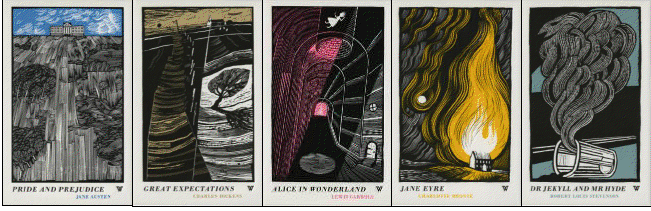
Anyway, as the book itself went, I loved it just as much this time. Mostly, I adore Jane herself; she’s such a passionate person even when she’s determined to hide it in herself. She doesn’t let people push her around and sticks by her morals even when she would rather do otherwise, to the point of turning aside from her own love. She lives on her own terms even as she relies on others for employment, as a woman in her position at the time had to do, and she actively seeks people who appreciate her for who she is, the people who don’t dismiss her for being a governess, teacher, poor relation, or younger student.
I’d forgotten so much of the Gothic atmosphere as well, with creepy, dark Thornfield, Jane’s many dreams, and how much the book has to say about religion – what is true faith and what is twisting Christianity to suit one’s own goals. I’m not surprised, but reading it now after four years of English literature classes and lots of classics read on my own, it really sticks out as a Victorian novel. The new introduction by Jacqueline Wilson was also a pleasure to read and picked out many points about the book’s treatment of Jane that I wouldn’t have considered on my own – just right for someone who’d read the book multiple times before.
Have you read Jane Eyre? What did you think of it? I know not everyone agrees with me and I’d love to hear your thoughts.
I received this edition free from a publicist.
 When you move to a new place in adulthood, making new friends isn’t easy. I’ve moved three times since graduating college and, everywhere I go, it seems difficult to meet people with whom I have a common interest. It certainly isn’t as easy as it was when I was in school. Blogger Rachel Bertsche at MWF Seeking BFF has precisely this problem. Having moved only a few years after college to be with her now-husband, she’s found herself without a best friend locally. Though very successful in her professional life, she’s spent two and a half years best-friend-less and thus decided that the time has come to step it up a notch and find one. She’s spent the past year blogging about her efforts to find someone and she’s writing a book about her search, which will be published in early 2012. When Jen at Booklicity contacted me and asked if I’d feature Rachel, of course I said yes. When you move to a new place in adulthood, making new friends isn’t easy. I’ve moved three times since graduating college and, everywhere I go, it seems difficult to meet people with whom I have a common interest. It certainly isn’t as easy as it was when I was in school. Blogger Rachel Bertsche at MWF Seeking BFF has precisely this problem. Having moved only a few years after college to be with her now-husband, she’s found herself without a best friend locally. Though very successful in her professional life, she’s spent two and a half years best-friend-less and thus decided that the time has come to step it up a notch and find one. She’s spent the past year blogging about her efforts to find someone and she’s writing a book about her search, which will be published in early 2012. When Jen at Booklicity contacted me and asked if I’d feature Rachel, of course I said yes.
One of the posts which struck a particular chord with me was Rachel’s discussion of how a husband isn’t quite enough in the friend department. This is something that’s also been true for me; I love my husband, but having him as my sole in-person anchor just doesn’t provide the same emotional satisfaction. He doesn’t always want to converse about people’s reactions in death, he’s not interested in what I’m wearing and whether it goes, and really sometimes he’d rather just go off and play a video game (or head out to snooker with one of his own friends). It’s so nice to find someone who feels similarly, and this is only one of the reasons I’ve become a reader of Rachel’s blog.
I also really enjoyed this post, wherein Rachel writes about how we think others won’t want us as friends. I think after school, we expect friendships will just pop up naturally, but in reality they just don’t always. People often love being your friend as much as you love being theirs – which is why, as she writes, going for it is actually a great move. This is something I’ve heard from others as well, but shyness is always a barrier. It’s a fantastic reminder that it it’s sometimes worth going out there and just meeting people. If you hit it off at work or in a book club, it’s worth trying to be friends outside too.
One of Rachel’s most recent posts, A Case of Friends That Could Be, hit a particularly relevant note for me, too. I have made friends towards the tail ends of time in particular places – in high school, in college, even in grad school – where I felt that those friendships could have definitely been more. I had plenty of close friends in college, so I didn’t think I needed more, but now I do often regret not chatting to those people more, not making an effort to be real friends while we had the chance. I did with one and it turned out to be a great friendship. Of course, I now don’t have the opportunity to see them and follow up like Rachel does – but should that come my way in the future, I am determined to do so.
In addition to these reflections on friendship issues that will resonate with all women – whether or not our best friend lives next door – Rachel is a fantastic writer, also loves to read, and has plenty to say about pop culture. I definitely recommend checking out her blog. I suspect you’ll become a subscriber just like I did.
 In this alternate history world, a steampunk version of Victorian England has just defeated the Horde, a barbarous group of people who controlled English citizens by means of nanobots. The nanobots could force people to do their will, until the Iron Duke, Rhys, takes down the controlling tower in a mad, suicidal act. Mina, half-Horde and a product of the Frenzy, is also a detective inspector, and finds herself on a collision course with the duke when a dead body is dropped on his doorstep without warning. Unexpectedly they find themselves on a quest together to save Mina’s brother and, eventually, England, but all Rhys really longs for is to possess and protect Mina for the rest of his life. In this alternate history world, a steampunk version of Victorian England has just defeated the Horde, a barbarous group of people who controlled English citizens by means of nanobots. The nanobots could force people to do their will, until the Iron Duke, Rhys, takes down the controlling tower in a mad, suicidal act. Mina, half-Horde and a product of the Frenzy, is also a detective inspector, and finds herself on a collision course with the duke when a dead body is dropped on his doorstep without warning. Unexpectedly they find themselves on a quest together to save Mina’s brother and, eventually, England, but all Rhys really longs for is to possess and protect Mina for the rest of his life.
I am in two minds about this book. The world was indescribably awesome. It’s fantastic and logical at the same time and I just loved spending time in it, uncovering the little bits and pieces about it, and I really can’t wait to learn even more about it in future books. I found it a little confusing at first but soon figured out everything that was happening; it’s just the perfect combination of Victorian society, technology, and Brook’s own imagining.
Unfortunately, the romance fell flat for me, and when I say flat, I mean really flat. I didn’t like Rhys. I hated that his sole objective in life was to possess Mina and he’s bound and determined to do it regardless of what she says, feels, or actually wants. He does some things to her that made me uncomfortable and I couldn’t forgive him. The rest of him was fine, it was just his behavior towards Mina and this attitude of possession that I really didn’t appreciate. I know some women like that, but I am very much my own person and this sort of thing turns me off a book quite a bit. (I’m thinking of Twilight and how Edward creeps me out but everyone else loves him.)
Mina, on the other hand, was fantastic. She’s nuanced, she’s clever, she kicks butt but she’s vulnerable – basically, she’s everything I like in a heroine. She’s also not stereotypically beautiful, but is instead the very picture of society’s oppression. She’s had a lot to deal with and it’s not men falling over her in the normal way, either. I loved that the world Brook created had a place for determined, ambitious women and doesn’t relegate them to the sole duties of marrying and having children. In fact, Mina doesn’t think she’ll have either of those things, so instead of mooning over men, she’s busy filling her life on her own. She wouldn’t even have mooned over Rhys if he wasn’t so determined, at least I don’t think so.
The Iron Duke is not my favorite romance, but it does have a great world and a nice, twisty plot alongside the romantic one. For those two reasons, I’d still recommend it, and I’m looking forward to seeing how the next one stacks up. Meljean Brook is very popular in the romance world, so I am more than eager to try her books again and see how we get on.
I am an Amazon Associate. I purchased this book.
 This review contains spoilers for the first three Tiffany Aching books – start with The Wee Free Men. This review contains spoilers for the first three Tiffany Aching books – start with The Wee Free Men.
Tiffany Aching is finally a witch and on the Chalk, the land where she grew up and which she deeply loves. Being a witch, unfortunately, means that she’s overworked and constantly trying to do the best for everyone, even if they don’t like it. It also means that she’s ostracized, even from the people she once held dear. This includes Roland, the boy she saved in The Wee Free Men and who she thought would be her boyfriend, someday. Instead, as his father lies on his deathbed, Roland must assume the Baron’s responsibilities. But there are bigger problems afoot, namely the Cunning Man, who nudges thoughts against witches wherever he goes, and makes Tiffany endure far more hardships than otherwise would be necessary.
I loved this book. I think it’s my favorite of the series (which makes it appropriate to review today, on my birthday). It was everything that I loved about the rest, with added maturity, romance, and a feeling of completion. I’m content to leave the series here, and in a world where far too many series go on unending, I like that a lot. It could continue, but it doesn’t have to. It’s a book about Tiffany growing up, growing into the inheritance we’ve known about since the start, and even if it’s difficult and she gets into tough situations, she embraces it with all her heart. At the end she has grown and learned. She’s not only a better witch but a better person, an adult ready to face the world.
And, of course, probably half the reason I loved this book best was the fact that it does center on more mature issues; namely, romance, one of my obvious favorite types of plot. I must admit that I was quite sad to discover that Roland and Tiffany weren’t going to end up together, but the explanation was simultaneously so sad and wise at the same time that I couldn’t disagree with it. The way it ends up, of course, is just perfect for Tiffany and hit precisely the right note. I found it even more satisfying than what I had thought was going to happen throughout the first three.
The rest of the book is also substantially darker. Tiffany is now dealing with issues that closely mirror problems in the real world, such as when she rescues a young woman from her abusive father, who has beaten her so badly that she has miscarried a child. There is still humor, but the fact remains that Tiffany is no longer a little girl and the issues she faces are genuine and difficult. I don’t think it’s any coincidence that she also finds herself in the city in this book; it’s more closely intertwined with the adult Discworld books, which reflects on its place as a more mature story than the earlier, more enclosed novels.
I Shall Wear Midnight is a wonderful conclusion to this series, if it is the conclusion; it’s unquestionably my favorite and I know I can’t wait to read this series over again. Highly, highly recommended.
I am an Amazon Associate. I purchased this book.
 Mary Katherine Blackwood, nicknamed “Merricat” by those who love her, hates going into town. She’s convinced everyone is against her and all she really wants is to go back to her cozy life with her sister Constance and her uncle Julian. No one in town likes her, but she still has to buy the supplies twice a week and exchange library books for new ones. The townspeople have reason to be suspicious, though; the entire rest of the Blackwood family was killed by arsenic in the sugar, and Constance was accused, though later acquitted, of the crime. Merricat herself is a very peculiar girl, who is convinced that by nailing books to trees and burying various items of treasure she can keep Constance safe. Her methods don’t succeed when a cousin, Charles, comes to visit, and proceeds to shake up her careful existence. Mary Katherine Blackwood, nicknamed “Merricat” by those who love her, hates going into town. She’s convinced everyone is against her and all she really wants is to go back to her cozy life with her sister Constance and her uncle Julian. No one in town likes her, but she still has to buy the supplies twice a week and exchange library books for new ones. The townspeople have reason to be suspicious, though; the entire rest of the Blackwood family was killed by arsenic in the sugar, and Constance was accused, though later acquitted, of the crime. Merricat herself is a very peculiar girl, who is convinced that by nailing books to trees and burying various items of treasure she can keep Constance safe. Her methods don’t succeed when a cousin, Charles, comes to visit, and proceeds to shake up her careful existence.
I originally intended to read this for Carl’s RIP challenge last fall; I didn’t get to it then but I was in the mood for a creepy book over the holidays so I picked this up anyway. It isn’t a horror novel at all, which is what I expected, but more of a psychological story, focusing for me on the innate peculiarity that is Merricat herself. It’s very eerie – Merricat’s first scene in the town has a masterful atmosphere, especially with her dark thoughts towards all of the townspeople – but it isn’t particularly scary, which I’ll admit was something of a let down. Still, it has plenty of merit, and I did like it.
What was most interesting for me was the peek inside Merricat’s obviously very disturbed mind. At times I felt sorry for her sister, Constance; when Charles arrived I could almost feel her straining for a more normal life. He had the potential for that, and undoubtedly she would have enjoyed meeting a man, falling in love, cooking for her children. But she at the same time has a lot of affection for her disturbed little sister; she sees that things aren’t right, but she seems to have no idea how to fix them, or even the will to do so. After a time she sees her folly in leaning on Charles, who Merricat decided was a demon straightaway, and when she and Merricat begin to construct their own life together, she seems content to stay in her kitchen and keep with the status quo.
Indeed, by the end of the novel, the sisters have become a creepy legend, a pair of spirits that the villagers leave offerings to in forgiveness for their sins. It’s a very peculiar, creepy, atmospheric little novel. Some of the scenes towards the end are so evocatively described that I could see them in my head, which is a rare occurrence for me, and I think I’ll be rereading We Have Always Lived in the Castle with the right set of expectations this time, just to see what I get out of it. Maybe for next fall’s RIP challenge!
I am an Amazon Associate. I purchased this book.
 Despite being a son of the North of England, Stuart Maconie has found himself mostly living in the South, a very different place. When he realizes he has a cappuccino maker and keeps sundried tomatoes on hand at all times – both, apparently, very un-Northern things to do – he decides to return to the country of his childhood in search of the true North. He explores how the cities and countryside have changed over the years and whether any of the stereotypes still hold true. Despite being a son of the North of England, Stuart Maconie has found himself mostly living in the South, a very different place. When he realizes he has a cappuccino maker and keeps sundried tomatoes on hand at all times – both, apparently, very un-Northern things to do – he decides to return to the country of his childhood in search of the true North. He explores how the cities and countryside have changed over the years and whether any of the stereotypes still hold true.
I haven’t lived in England for all that long and even I know the stereotypes of Northerners – generally big, dirty men (I always think of miners, probably for good reason as there were many here) with rough exteriors but a heart of gold. For the most part, that’s what you get on TV shows, especially older ones. Of course, the mining industry is basically gone now, and Northern towns are pretty much the same as Southern towns, in my limited experience, so Maconie’s quest to discover the true North interested me very much. After all, we live in the North now, so I was looking forward to finding out more about it.
Unfortunately, I think this book didn’t really suit me personally as a reader. For one thing, I’m American. There are many, many British cultural references that I’m still unfamiliar with and I’m pretty sure Maconie uses every last one of them. He also relies heavily on many places’ musical roots, which again I’m unfamiliar with. I know the big British bands that made it over the pond, but there are quite a few – many of which are probably big names over here – that I just hadn’t heard of. There were also a few notes about football, which is again something I’m not crazy about, nor do I know the details of football history and rivalries. So, I’d recommend other non-Brits to be a bit hesitant before picking it up.
For me that was kind of a shame, because I did quite enjoy the rest of the book. I loved learning about the different Northern cities and how they’d changed over the years, whether they’d done well this century or not. The book is slightly outdated so I’m not sure the same towns are still prosperous, but it was all very interesting and usually focused on areas I didn’t know much about. He did manage to leave out a large part of Yorkshire, including the bit that I live in, despite having a whole chapter on the country. I think his focus was on the “happening” cities and the ones around here aren’t really what I’d call exciting. I think Maconie does a decent job breaking the North out of its stereotyping and explaining just why it’s so appealing. It’s not the dirty poor place that it’s imagined to be.
I think Pies and Prejudice would appeal to those Brits who are interested in a cultural journey through the North of England, but I’d hesitate to recommend it to anyone who isn’t very familiar with British culture and recent history.
I am an Amazon Associate. I borrowed this book from my local library.
 One of my goals for the New Year was to start reviewing right after finishing a book, so that I didn’t gain a review backlog, and not allow myself to read another book until the review was finished. Unfortunately, I’ve already failed miserably! My reading in 2011 has been off to a roaring start, but that means I have five reviews (yes, FIVE) already waiting to be written. I’ve decided to amend my goal and instead do all the reviews on the weekend after I’ve read them, when I normally have more time and feel a bit more like writing. This does mean I have five reviews to write today, but I can manage if I get my head in the right place. One of my goals for the New Year was to start reviewing right after finishing a book, so that I didn’t gain a review backlog, and not allow myself to read another book until the review was finished. Unfortunately, I’ve already failed miserably! My reading in 2011 has been off to a roaring start, but that means I have five reviews (yes, FIVE) already waiting to be written. I’ve decided to amend my goal and instead do all the reviews on the weekend after I’ve read them, when I normally have more time and feel a bit more like writing. This does mean I have five reviews to write today, but I can manage if I get my head in the right place.
In other bookish news, my TBR has similarly skyrocketed this week. In part, this is because I had some money for Christmas, and decided there was no better way to spend it than buying new books. I’ve already welcomed two of these purchases into my house and I’m anticipating more over the next week. It’s bad for my shelves, but I do like to support the publishing industry by buying new, and after accumulating a year-long wishlist of books slightly more expensive than I could buy during the year, it’s nice to just purchase them and have them for my very own.
Plus, I’ve realized how little I’m actually paying attention to my Kindle and under-utilizing it. I know I can read classics on it for free, but I’d never really ventured beyond Amazon, getting stymied whenever there was a charge. But while I was perusing blogs yesterday, I stumbled across this post on Eva’s blog, and with her new Nook she’s downloaded lots of classics that I too would love to read. I must admit I’ve now gone a little crazy with public domain books, but I think this should mean I’ll feature more classics in time, as I get them read.
Speaking of ebooks, I wanted to let you all know about a free e-novella from HarperCollins. David Vann, author of the upcoming Caribou Island, has released his novella Sukkwan Island for free. It previously appeared in his collection, Legend of a Suicide, and won the Prix Medicis award for best foreign novel in France. Definitely worth a download. It’s available on Amazon, the Sony ebook store, and for the Kobo ereader, and I’m told will shortly appear for the Nook as well.
Finally, in terms of reading today, I’ve begun to read A Tale of Two Cities for the read-a-long hosted by Jen at Devourer of Books and Nicole at Linus’s Blanket over on What’s Old Is New. I’ve wanted to re-read this for years, and doing so with the actual publication schedule seems both fun and doable. I’ve finished the first installment and it took less than half an hour, so my initial impressions were correct. I can’t wait to get a bit deeper in and see if I enjoy it as much as I did in high school. I also managed to read one of those way-too-old ARCs, Something Missing, between today and yesterday, which was surprisingly delightful and shouldn’t have sat in my review pile for so long. Yesterday I completely devoured The Raising by Laura Kasischke in one sitting, and only wish I didn’t have to hold my review until March! It was excellent and I’m not sure how I’ll keep the gushing out of my review – I was totally consumed by the book and put off everything I’d planned for the day just to keep reading.
 This week, I think I’ll be spending some time in the realm of non-fiction, with Notes from a Small Island by Bill Bryson and Packing for Mars by Mary Roach. I’m very excited about both of these and plan to savor them over the course of today and the next few days. This week, I think I’ll be spending some time in the realm of non-fiction, with Notes from a Small Island by Bill Bryson and Packing for Mars by Mary Roach. I’m very excited about both of these and plan to savor them over the course of today and the next few days.
What do you have planned for this Sunday? Any great books on your horizon?
 5 year old Jack and his Ma live in one room. Jack has never known anything different; he adheres closely to their daily rituals and truly believes that the world doesn’t extend outside the one room. His only view of the outside world is a skylight and he thinks everything that happens there is really just in the TV. He dreads visits from “Old Nick”, the man who visits his mother, and has to hide in the wardrobe every time he comes to visit. When Jack turns five, his mother starts trying to tell him about the world, but Jack isn’t sure he’s ready to face it. 5 year old Jack and his Ma live in one room. Jack has never known anything different; he adheres closely to their daily rituals and truly believes that the world doesn’t extend outside the one room. His only view of the outside world is a skylight and he thinks everything that happens there is really just in the TV. He dreads visits from “Old Nick”, the man who visits his mother, and has to hide in the wardrobe every time he comes to visit. When Jack turns five, his mother starts trying to tell him about the world, but Jack isn’t sure he’s ready to face it.
Just a quick warning, this book is best going into it knowing nothing more than that, and I will be including spoilers in my review.
I had two reactions to this book. I struggled with the beginning. Unlike Jack, I knew what was going on. I knew “Old Nick” had kidnapped and raped his mother, and that Jack was the product of that rape; it seemed incredibly sad to me how he simply got on with his life as though it were normal. I doubt any mother could have chosen to do anything else, there certainly isn’t any sense in raising a child to be miserable, but it was hard to take. I felt stifled just thinking about the life of Jack’s Ma. I must admit that I was also quite disgusted at the continuation of breast feeding, though I could see why there was no reason to actually stop.
And then they escape, and I started to appreciate the book more. For me, their integration into the real world was the interesting part. Seeing how much Jack hadn’t experienced and how poorly equipped he was for the actual world was, again, heartbreaking. One of the more interesting parts of it, though, was the fact that Jack completely misses out on societal stigmas. He doesn’t think it’s weird that he has long hair like a girl, or that Dora is his favorite television character. He carries a pink Dora backpack and thinks nothing of it – an interesting, and I think accurate, view on how society teaches us about the differences between boys and girls.
When they emerge into the real world, it’s also apparent that Jack has the adaptive ability of his age, while Ma struggles desperately to cope. Despite his confusion over separation from her, he continues to learn about the world and find his own place in it, which in contrast to the rest of the book is heartwarming and gives us hope. I loved the sections when he’s with his grandparents and learning little things about the world that he likes. It’s really a testimony to the power of childhood. He struggles at first, but he does realize that the outside world is a nice place – and that he can still be with his Ma in it.
Room has garnered quite a bit of attention in the press and on blogs due to its recent Booker prize nomination, so I don’t think I’m adding anything new to the discussion; regardless, I would definitely recommend this book. It’s dark, but not without its strands of hope.
I am an Amazon Associate. I received this book for review for free from Amazon Vine.
 The third book of the Tiffany Aching series, part of the larger Discworld series, finds Tiffany accidentally taking place in a Morris dance. She can’t help herself; she’s simply drawn in. Unfortunately, due to her folly, she finds that the Wintersmith is in love with her because she has taken the place of the Summer Goddess. Since Tiffany is in the mortal world, unlike the Goddess, the Wintersmith can follow her every move, and she must kill him if Spring is ever to arrive for her people. As always, there are plenty of sideplots in the mix, including a witch who sees her own death and the misadventures of the arrogant Annagramma, who finds that she needs quite a bit of help to actually be a witch. The third book of the Tiffany Aching series, part of the larger Discworld series, finds Tiffany accidentally taking place in a Morris dance. She can’t help herself; she’s simply drawn in. Unfortunately, due to her folly, she finds that the Wintersmith is in love with her because she has taken the place of the Summer Goddess. Since Tiffany is in the mortal world, unlike the Goddess, the Wintersmith can follow her every move, and she must kill him if Spring is ever to arrive for her people. As always, there are plenty of sideplots in the mix, including a witch who sees her own death and the misadventures of the arrogant Annagramma, who finds that she needs quite a bit of help to actually be a witch.
Wintersmith was another enchanting book in the Tiffany Aching series – and a perfect read for when the world is covered in snow, as Tiffany’s is too. It’s full of the same insights and little wisdoms as the first two books were, although I would argue that it’s probably the weakest. Tiffany has much to distract her from the Wintersmith and after the beginning, which throws us into the mix of things, much of the rest of the book feels a bit slow (despite its short length). I still appreciated it all, but the plot definitely felt a bit looser than the previous ones. I did especially love the ending, though.
I probably mentioned it in my last review, but one of the things I appreciate the most about these books is how incredible wonderful all of the characters are. Pratchett doesn’t cut corners on any of them; even Annagramma, the witch who doesn’t really know what she’s doing, has several layers to her personality. She could have been a stereotype so easily, but Pratchett doesn’t take the easy route – he makes her a witch who is uncertain, who covers that up with arrogance, but who truly does want to do well. And, of course, there is Tiffany, who always has that edge of reality to her, as though she could just be a twelve-year-old I’d meet on the street. Plus, it’s impossible to not love the Nac Mac Feegles; the addition of Horace the cheese makes for some hilarious moments throughout this book.
I really enjoyed Wintersmith; it had me so eager to read I Shall Wear Midnight that I didn’t actually wait more than two days, although most of me was saying I should let the series last a bit longer. I would definitely recommend it to all fans of fantasy, but as always I think the series is best begun at the beginning (of this arc anyway) with The Wee Free Men.
I am an Amazon Associate. I purchased this book.
|
|



Recent Comments