|
|
 Look around you and attempt to count how many objects of plastic are nearby. If you’re on the computer, you’re probably touching some right now. Besides my laptop, I can see my cell phone, which is plastic, the plastic on the cushion I’m sitting on, the plastic on my pen, and there are even some synthetic fibers in the clothes I am wearing. And I’ve gone no further than an inch. When Susan Frienkel attempted to categorize the plastic in her life, she became overwhelmed, and set about writing a book on plastic. Focusing on eight key items that have shaped plastic’s history and our own, she examines the effect the plastic industry is having on our bodies, on the environment, and on the economy, going down to what we can do about it and even whether or not we should. Look around you and attempt to count how many objects of plastic are nearby. If you’re on the computer, you’re probably touching some right now. Besides my laptop, I can see my cell phone, which is plastic, the plastic on the cushion I’m sitting on, the plastic on my pen, and there are even some synthetic fibers in the clothes I am wearing. And I’ve gone no further than an inch. When Susan Frienkel attempted to categorize the plastic in her life, she became overwhelmed, and set about writing a book on plastic. Focusing on eight key items that have shaped plastic’s history and our own, she examines the effect the plastic industry is having on our bodies, on the environment, and on the economy, going down to what we can do about it and even whether or not we should.
I’ll confess right here and say that I’m not a huge anti-plastic person. I do bring reusable bags to the grocery store and I recycle the plastic that’s accepted at my local dump, but I don’t really think about it much more than that. Reading this book suddenly made me realize how much of our lives seriously are based on plastic and how little of it is reused. People are far more likely to recycle glass or cardboard or paper, even though plastic is what’s cluttering up the earth, and every attempt at minimising waste or implementing “better” plastic is generally stymied because it costs money. This, while animals are dying and the sea is covered in little tiny bits of plastic, while some plastics are having unknown effects on our bodies, and while we continue to accept the dominance of it in our lives.
Frienkel doesn’t say plastic is all bad, far from that. She even talks to experts, and most of them say that they don’t put plastic in the microwave (whoops, I do this) and do recycle, but they’re not really worried about it in any other sense. Some are damaging, but more research will enable us to sort out the dangerous plastics from the safe ones. Some have already been banned and it’s a matter of paying greater attention as opposed to outright expulsion of plastics. She accepts that we have a reliance on plastic, so in addition to the historical parts on each plastic product, she is more pragmatic about going forward while continuing to keep plastic in our lives. It’s fairly obvious that she leans more towards the side of less plastic is more, but then ideally so do I, and she does treat both sides equally.
Naturally for me, the historical parts were the most interesting. Susan delves into eight items, among them the comb, the lighter, the plastic bag, the plastic chair (who hasn’t spent their childhood sat on a tiny plastic chair?), and IV tubing. With the comb, for example, she looks at how the comb was made before plastic, and how sustainable that practice was. Combs were expensive, generally made from tortoiseshell, ivory, or even wood – they’re something that’s found in virtually all layers of human history, and used to be a high status value item. Those of us who read historical novels probably know that already. Now, obviously, using a tortoiseshell or ivory to make a comb is considered atrocious, and wasn’t exactly sustainable then, so in this respect plastic, if treated properly, has actually improved things. Plastic combs are cheap, easy to use, and hardly ever get damaged, unlike the other types. It’s very, very interesting reading, and gave me a lot to think about that I’d never actually considered before.
Of course, Frienkel also stresses the need for more research, more recycling and investment, and more consideration of our choices. Implementing things like bottle charges are proven to work, yet have been shot down since 1986 because people don’t want to pay and don’t want to be obliged to return to the store to get their five cents per bottle. Thinking about the wider impact, though, makes it obvious that we should go that extra step. It’s not hard to round up all your bottles and cans and take them with you when you next grocery shop, and it’s those little steps, combined with larger measures of research and safety standards across plastic manufacturers, that will make the world a safer place for our children.
Plastic is a flat out fantastic book, well worth reading for everyone, because let’s face it: plastic is a huge part of our lives and it’s a part that’s going to stay. Isn’t it worth educating ourselves? This book is a great first step in that direction.
I am an Amazon Associate. I received this book for free for review from netgalley.com.
 I’ve never been one to take notes in books. I have cracked spines and dog-eared pages, but putting a mark in a book? Nope. I find notes in books distracting and am actively irritated when I’ve taken one out from the library and discover that someone else has written in it. Buying used textbooks in college was a necessity but I disliked having someone else’s notes in the margins of my book. I just find it distracting – I can sort of see the appeal in seeing someone else’s thought process at work, and the obvious historical potential for marginalia, but I find that they get in the way of my own thoughts. I’ve never been one to take notes in books. I have cracked spines and dog-eared pages, but putting a mark in a book? Nope. I find notes in books distracting and am actively irritated when I’ve taken one out from the library and discover that someone else has written in it. Buying used textbooks in college was a necessity but I disliked having someone else’s notes in the margins of my book. I just find it distracting – I can sort of see the appeal in seeing someone else’s thought process at work, and the obvious historical potential for marginalia, but I find that they get in the way of my own thoughts.
Since I don’t write in books themselves, I’ve seldom actually taken notes. Strangely, though, this weekend I had an urge to actually write some things down. I often start composing reviews in my head as I read, but if it takes me too long to actually sit down and write the review, I forget what I meant to say. As I get further behind on reviews, this gets more and more irritating, and I find myself putting off reviews because I don’t remember what I wanted to talk about in a particular book. So, in lieu of writing in my actual books, I have purchased a nice little notebook and for the first time have my very own reading journal. I am planning on noting down whatever comes to mind as I go along and, hopefully, using the results to make my reviews easier to write and more interesting to read.
Do you take notes while reading, whether in your books or in a notebook? Does it make it easier to write reviews?
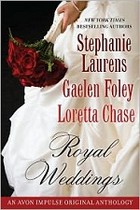 In celebration of the Royal Wedding coming up later this month, Avon commissioned this romance anthology from three of the genre’s best authors. Stephanie Laurens, Gaelen Foley, and Loretta Chase are all household names in the romance world. Each of these stories revolves around a royal wedding but has the characters finding a bit of love themselves along the way (naturally!). In celebration of the Royal Wedding coming up later this month, Avon commissioned this romance anthology from three of the genre’s best authors. Stephanie Laurens, Gaelen Foley, and Loretta Chase are all household names in the romance world. Each of these stories revolves around a royal wedding but has the characters finding a bit of love themselves along the way (naturally!).
The first one is “The Wedding Planner” by Stephanie Laurens. In it, Lady Margaret Dawlish is called upon to plan a royal wedding; with her exceptional planning skills, surely such a big event is well within her grasp. Throwing a wrench in her neat plans is the new Duc de Perigord, a man she’d met years ago while still engaged. Now, Meg’s fiance has been killed in the line of duty and Gaston has come to seize her heart for himself.
I quite liked this story; it’s the longest in the book but still very short. Gaston has a few obstacles in his way to winning Meg over finally which make for an engaging read, plus I liked that Meg had a sort of career of her own. It’s a bit rarer in historical novels to find a woman who is actually busy doing something other than waiting for a husband – and she’s good at her job, too. It’s probably not the most memorable story I’ve ever read but was lovely nonetheless.
The second story is “Ever After” by Gaelen Foley. Surprisingly, given my recent history with Gaelen Foley’s novels, I loved this one. It’s about a husband and wife who have grown apart over the years. Eleanor feels that her husband always puts his work first and has recently become convinced that he’s acquired a mistress, while he struggles with post-traumatic stress disorder and is perplexed at his wife’s coldness. It was so sweet to watch these two come back to loving one another after an obviously painful separation for both of them and it did a stand-out job of portraying the way misunderstandings can mushroom in a marriage. I really felt like Foley got some of her passionate storytelling back with this novella and I can only hope it comes back to her novels soon, too.
The final story, and my favorite, is “The Jilting of Lord Rothwick” by Loretta Chase. In this very short tale, heiress Barbara has decided that she and her fiance, Lord Rothwick, simply won’t suit, and writes him a letter to that effect. Inspired by the imminent loving nuptials between Queen Victoria and Prince Albert, Barbara craves a loving relationship and is convinced that Rothwick is only marrying her for her money. But Rothwick has simply been behaving as society expects him to; in reality, he’s head over heels in love.
Much like the last story, this is about a misunderstanding that has completely magnified; it’s obviously an overused trick but here it is also done very well. I have to admit that this story captured me with the sheer romantic appeal of it; the characters’ personalities and emotions just leapt off the page and into my head. Chase has the perfect opportunity to really work this situation and she does a fantastic job – further proof that I should be reading more of her novels. Luckily, I have three in my possession and I suspect it will not be long before I read them now!
This is a lovely anthology celebrating the upcoming royal wedding. If you’re craving a bit of romance, it’s ideal, and at the bargain basement prices of $1.99 and £0.49, there is no reason to resist!
I am an Amazon Associate. I received this book for free for review from Netgalley.
 Mount has declared that Latin is fun and is using this book to show the rest of us the way. It’s a quick Latin primer, designed to take the casual reader or lapsed Latin learner through the paces of the language, up to the point of translating a small passage at the end. Interspersed with the tables are a lot of amusing stories about Latin and the appropriate hints of what you’ll begin to understand once you actually can read Latin. Mount decries the falling trends in Latin learning and explains, convincingly, why Latin is indeed a worthy language to learn. Mount has declared that Latin is fun and is using this book to show the rest of us the way. It’s a quick Latin primer, designed to take the casual reader or lapsed Latin learner through the paces of the language, up to the point of translating a small passage at the end. Interspersed with the tables are a lot of amusing stories about Latin and the appropriate hints of what you’ll begin to understand once you actually can read Latin. Mount decries the falling trends in Latin learning and explains, convincingly, why Latin is indeed a worthy language to learn.
In many ways, Mount is preaching to the crowd with this book and me. I have taken Latin, both at undergrad and graduate levels, but it has slipped out of my mind in the past two years. I don’t want to get too rusty, as I do want to do a PhD, so I have been trying to find ways to improve and refresh my Latin without actively sitting down and devoting hours to it. This was a fun way to do so and reminded me of all the Latin I used to know (thanks Professor Johnston!). Plus, I adore languages. I ascribe my general ability to understand grammar and my wide vocabulary (not usually evidenced around here) to the fact that I’ve studied five – even though I speak none but English fluently, they’ve taught me an insane amount about my own language and codified the intuition I’d picked up from reading everything in sight.
Latin in particular is surprisingly fun, and that’s one of the best parts of this book. Translating Latin into English is like doing a puzzle; you first have to find all the pieces and then put them together in a way that makes sense. I’m probably crazy for thinking that’s fun, but it truly is if you’re armed with the knowledge to do so. The not-so-great part of this book is that it’s too speedy. It’s easy to just skip the charts and move on to the next bit of English. It’s a nice refresher, but I couldn’t imagine actually learning any Latin from the book, and I certainly wouldn’t have been able to translate the bit at the end.
Regardless, Mount reminded me of how much I love to study languages, and his goal to encourage others to learn them too is nothing short of inspiring. He laments ‘the good old days’ a bit too much, but his intentions are excellent. I immediately decided to learn French, too, and actually bought myself a beginner’s course. In for a penny, in for a pound, I suppose – why not learn both languages I need to at once?
Anyway, Amo, Amas, Amat, and all that … is a fantastic choice for the lapsed Classicist and an interesting book for the rest of us, too, giving us a peek into the history of a civilisation and a language that has influenced a huge amount of what we do today. Highly recommended.
I am an Amazon Associate. I borrowed this book from my library.
 More and more women over the course of the twentieth century made the choice to be single; still more didn’t choose to be single but ended up in that boat anyway. Marching alongside the female crusade for greater freedoms was often a parade of usually young women determined to enjoy them, creating waves and social trends as they went along. Israel’s book charts their progress, from the Flappers of the ’20s to the working women in World War II to the professional single women of today. She ends by asking whether or not women are still expected to marry and have children – and if so, why? More and more women over the course of the twentieth century made the choice to be single; still more didn’t choose to be single but ended up in that boat anyway. Marching alongside the female crusade for greater freedoms was often a parade of usually young women determined to enjoy them, creating waves and social trends as they went along. Israel’s book charts their progress, from the Flappers of the ’20s to the working women in World War II to the professional single women of today. She ends by asking whether or not women are still expected to marry and have children – and if so, why?
This is a very light, magazine-like read about the history of single women, mainly in New York City to give the book a focal point, though Israel actually starts out with nineteenth century women that chose to be or ended up single like Louisa May Alcott. In many respects the book wavers between these two types of women, the ones who chose not to marry and the ones who were widowed or simply couldn’t find an appropriate husband (the advent of the spinster). She charts the greater freedoms accorded to women and just when it became okay for a girl to go out on dates alone, when they went out dancing with just their girlfriends, and how employment helped the single woman get by and enjoy herself.
The most interesting aspect for me was obviously the historical, rather than the sociological angle. I had fun imagining my grandma out in New York City with her friends as a young girl; I know she got married young and didn’t really work before she married my grandpa, but it was still fun to think about, putting a human face on the stories of the women Israel actually discusses. It’s fascinating to see how the pendulum on treatment of women swings depending on circumstances and even events going on in the wider world – everyone knows that women were freer during the World Wars because the men were off fighting and they had to work, but the book also discusses what happened when the Depression hit and mentions other, later eras as well.
The real downside of the book was the fact that, although it is meant to focus on the single woman, the author really emphasizes the stigma they’ve always faced in opposition to the celebration the book suggests. Yes, there are issues even now; women are still looked down upon for not wanting to have children, for getting on in years without marrying, and so on. Men are still praised for doing things that women are expected to do, like childcare and housework. But I went into the book expecting a celebration of choices, because we really can lead happy and fulfilled lives without getting married (not that I can talk having been married at 23), and didn’t really feel I got that. The author takes things from a feminist point of view, but I felt depressed by the end of the book instead of empowered. If it makes sense, there wasn’t enough, “Look how far we’ve come, we can go even further!”, and too much, “Things are still bad and probably won’t get better.”
Still, Bachelor Girl was an engaging read that delved a bit deeper into the issues single women have faced throughout history right up until the present day. Its approachable, magazine-style prose makes it perfect for even the most casual reader. Recommended.
- No buy links because the book appears to be out of print and I can’t find anywhere that has it!
I am an Amazon Associate. I borrowed this book from my library.
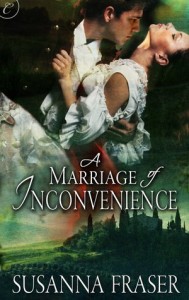 Miss Lucy Jones has little hope to marry. Orphaned as a child, almost consigned to the workhouse, she and her brothers now live on the charity of their aunt and uncle. Lucy has learned to curb all of her emotions in order to perfectly please her aunt and give her brothers the best chance possible for success in life; she knows she’s destined to be a companion for the rest of her days. At a house party for the marriage of one of her cousins, Lucy accidentally runs into James Wright-Gordon, Lord Selsley, and his sister. She’s immediately drawn to Lord Selsley, but her cousin has just asked her to marry him, throwing all of her expectations to the wind. When she’s accidentally compromised by Lord Selsley, she finds herself as the lady of consequence, a position she’d never foreseen, with a husband she isn’t sure how to deal with. Miss Lucy Jones has little hope to marry. Orphaned as a child, almost consigned to the workhouse, she and her brothers now live on the charity of their aunt and uncle. Lucy has learned to curb all of her emotions in order to perfectly please her aunt and give her brothers the best chance possible for success in life; she knows she’s destined to be a companion for the rest of her days. At a house party for the marriage of one of her cousins, Lucy accidentally runs into James Wright-Gordon, Lord Selsley, and his sister. She’s immediately drawn to Lord Selsley, but her cousin has just asked her to marry him, throwing all of her expectations to the wind. When she’s accidentally compromised by Lord Selsley, she finds herself as the lady of consequence, a position she’d never foreseen, with a husband she isn’t sure how to deal with.
There were so many things I liked about A Marriage of Inconvenience! I was surprised by how delightful it was. The writing was fairly simplistic, but the story itself was a really fun read. It actually kept me up past my bedtime, for once making use of my lighted Kindle case, as I kept on reading to try and get to the end of the story. It wasn’t that I didn’t know how it would end, as all romance novels end more or less the same, but I genuinely was enjoying myself.
Carina Press is meant to be experimental and so far I’m really liking what I’m reading, in that a lot of times the characters behave in ways they never would in a ‘traditional’ romance. I’m going to risk the spam bots and say that one of these was the couple’s approach to the bedroom. Unlike in a normal romance, where everything is hunky dory, this couple has a bit of trouble. Naturally it’s unrelated to their actual physical compatibility, but I can’t remember if I’ve ever actually read a romance where things didn’t go smoothly (when both of the people involved wanted them to). Refreshing!
Lucy is a wallflower, like many romance heroines; she fades away into the background next to James’s sister and her own beautiful cousin. Still, she obviously has appeal of her own, and just needs to gain the confidence to seize her position in the spotlight. James, in contrast, is already a powerful man, with a fast-track political career and a lot of influence where it counts. He needs an assured wife, not a wealthy one, but he isn’t really looking when the book starts. He doesn’t have the immediate need to possess Lucy forever and ever. Instead, their marriage is truly inconvenient – he doesn’t get the wife he thinks he needs and Lucy is thrown into a situation she isn’t entirely ready for. They’re both ill prepared, not at all madly in love, but are forced to reconcile with each other and actually grow fond of each other in the end.
There were a couple of downsides – as I mentioned earlier, the writing is fairly simplistic. It’s just a vehicle to move the story along. And there was a plot twist towards the end that I found more or less unnecessary; it was obviously foreshadowed and made James and Lucy realize some things about their relationship, but their reactions to it didn’t really fit with their characters.
Overall, though, A Marriage of Inconvenience was a truly delightful read and would be a great way to spend an afternoon or evening. Recommended.
I am an Amazon Associate. I received this book for free for review from Netgalley.
 As anyone who was visiting undoubtedly noticed, my last post for the event was in hour 9. I think I lasted up until about Hour 11, falling asleep around midnight, and then got up again this morning to continue reading. I read 1311 pages in a total of 11 hours and 9 minutes. As anyone who was visiting undoubtedly noticed, my last post for the event was in hour 9. I think I lasted up until about Hour 11, falling asleep around midnight, and then got up again this morning to continue reading. I read 1311 pages in a total of 11 hours and 9 minutes.
The end of event survey:
1. Which hour was most daunting for you?
Around midnight, which isn’t a huge surprise. I haven’t been able to stay awake past midnight very often since I started working – my body clock is too good at sending me to sleep!
2. Could you list a few high-interest books that you think could keep a Reader engaged for next year?
Of the ones I read this time around, Shades of Milk and Honey and Howl’s Moving Castle were the best choices. They were both great books and kept me very entertained – plus I read them both ridiculously fast, giving me a sense of accomplishment.
3. Do you have any suggestions for how to improve the Read-a-thon next year?
Nope, I am happy to sit back and read!
4. What do you think worked really well in this year’s Read-a-thon?
I thought everything was organized pretty well. To be honest I didn’t spend much time on the mini-challenges or on the main blog – I mostly read and visited the blogs of others I knew participating.
5. How many books did you read?
I read 4 complete books and then finished the remaining half of what I was reading previously.
6. What were the names of the books you read?
Shades of Milk and Honey by Mary Robinette Kowal, Touching the Void by Joe Simpson, Howl’s Moving Castle by Diana Wynne Jones, Lady Isabella’s Scandalous Marriage by Jennifer Ashley, and Dreams Underfoot by Charles de Lint.
7. Which book did you enjoy most?
It’s hard to say, but a clear toss-up between Shades of Milk and Honey and Howl’s Moving Castle.
8. Which did you enjoy least?
Touching the Void. It was fine as a book, but I’m not into mountaineering which made it harder to enjoy.
9. If you were a Cheerleader, do you have any advice for next year’s Cheerleaders?
Not a cheerleader.
10. How likely are you to participate in the Read-a-thon again? What role would you be likely to take next time?
Very likely, and I’d probably still be reading.
Part of my problem this time around is that I actually got tired of reading at some point Saturday evening, around dinnertime. I took a break, but I wasn’t that crazy about heading back to the couch and reading again. I’m not sure if this is just a sign that I read plenty in my normal life, so I don’t really need to spend an entire day reading, or that it was just a nice day and I didn’t like that I’d been cooped up inside all day. I would have read outside if there was an area nearby peaceful enough for reading! But never mind – I did read a lot and I actually started reading another book this afternoon, so I wasn’t put off too much!
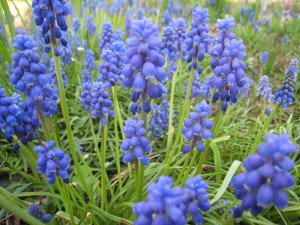
Speaking of this afternoon, we spent the rest of today in the sunshine. Here are some lovely blue flowers:
It’s time for a (late) dinner and that makes it a great time for an update! I have finished three books so far:
- Shades of Milk and Honey by Mary Robinette Kowal
- Touching the Void by Joe Simpson
- Howl’s Moving Castle by Diana Wynne Jones
I loved Howl’s Moving Castle – it’s wonderful to have read two amazing books already today! I am definitely adding more Diana Wynne Jones to my next book order. It is a shame that I have now only discovered her after her passing, but I am glad to have a huge backlist to work through before I face the fact that there won’t be any more.
I have since started reading Lady Isabella’s Scandalous Marriage by Jennifer Ashley. It wasn’t in my pile, but I didn’t really want any more fantasy and my choices suddenly seemed too fantasy-heavy. This should be a nice break from that.
As for the stats, I have read for 6 1/2 hours so far and have finished 922 pages. I’m really pleased with that – I think I’m doing better than last time!
How is everyone else doing? Have you read anything amazing so far?
We’ve now been reading for 4 hours – so entering into hour 5!
Books Read:
Shades of Milk and Honey, Mary Robinette Kowal
Touching the Void, Joe Simpson
I’ve managed to finish both, bringing me up to a total page count of about 500. I loved the first; the second I didn’t enjoy quite so much, as I’m not particularly familiar with mountaineering and while the story itself was gripping, I kept wondering why on earth Simpson ever wanted to climb the mountain in the first place! Still, though, a good read-a-thon book, as I kept reading to find out what happened to him after the accident (since he wrote the book, it’s obvious he survived).
In total I’ve been reading for 3 hours and 45 minutes. It’s been a little more difficult because it’s a lovely sunny day outside; though I’m not actually out in it, I am enjoying the sun through the windows and the nice breeze coming through at least!
How is everyone else doing? I am going to start reading again shortly, after a few blog visits; I can’t decide whether to read Book of a Thousand Days by Shannon Hale or Howl’s Moving Castle by Diana Wynne Jones, and I still plan to finish my current read, Dreams Underfoot by Charles de Lint, at some point during the Read-a-thon. We’ll see!
To evoke the British countryside and provide a bit of a visual for this otherwise text-heavy post, here’s a random picture of Rievaulx Abbey: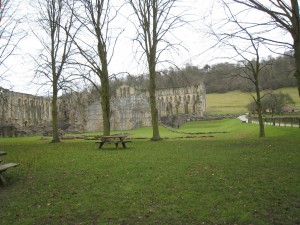
It’s time for the Read-a-Thon! This is my fifth one, which is hard to believe, but no less exciting for that! I’m looking forward to getting started today and meeting all of the new Read-a-thon participants as well as the ones I know already. I have my netbook, have eaten lunch, have snacks ready and a husband on meal duty, and a huge pile of books to choose from, so I am all set to go.
Here is the stack at the start:
 There are actually two stacks there, but never mind. I couldn’t stop putting more books on the pile. As it stands, though, I am starting out with Shades of Milk and Honey by Mary Robinette Kowal. I have heard amazing things about this book since well before it was published, it’s a Nebula nominee, and it arrived in the mail yesterday so I’m very excited to read it. Best of all, it’s short and I’m told it reads quickly – so it is the perfect Read-a-Thon book! I aim to continue reading it until I’ve finished, and then come back for an update, so I’ll see you all in a couple of hours. There are actually two stacks there, but never mind. I couldn’t stop putting more books on the pile. As it stands, though, I am starting out with Shades of Milk and Honey by Mary Robinette Kowal. I have heard amazing things about this book since well before it was published, it’s a Nebula nominee, and it arrived in the mail yesterday so I’m very excited to read it. Best of all, it’s short and I’m told it reads quickly – so it is the perfect Read-a-Thon book! I aim to continue reading it until I’ve finished, and then come back for an update, so I’ll see you all in a couple of hours.
ETA to add the intro meme:
1)Where are you reading from today?
My flat in Beverley, England.
2)Three random facts about me… food-themed, as I’ve done this before, and part of the read-a-thon fun is the snacking:
- I like cheese and hamburgers but not cheeseburgers.
- I forced myself to like tea about 4 years ago and have become an addict, so will be drinking a lot over the next 24 hours!
- I would quite happily eat pizza every day.
3)How many books do you have in your TBR pile for the next 24 hours?
16. I know. I got excited.
4)Do you have any goals for the read-a-thon (i.e. number of books, number of pages, number of hours, or number of comments on blogs)?
Not really, I’d like to read more than 12 hours (my current average) and at least 4 books.
5)If you’re a veteran read-a-thoner, any advice for people doing this for the first time?
Definitely pick short, fun books, don’t get sucked into the internet (particularly twitter) and take breaks when you need to!
Good luck to all the participants!
|
|


Recent Comments