|
|
 Blood Work is a multi-pronged look at the history of blood transfusion during the Scientific Revolution in both England and France. Tucker mainly tells the story of Jean-Baptiste Denis, a physician outside the cult of Paris-educated noblemen, who in what could have been a world-changing experiment transfused calf’s blood into a madman in Paris. The madman died and Denis wound up framed for murder as a result. Tucker also looks at the race between the English and the French to transfuse faster, and their struggles to publish first and occasional glossing over of facts as they did so. The book is also a deeper look at the ethics behind blood transfusion; the many ways people questioned what they didn’t understand, tried to stop it happening, and eventually wound up slowing progress for hundreds of years. Blood Work is a multi-pronged look at the history of blood transfusion during the Scientific Revolution in both England and France. Tucker mainly tells the story of Jean-Baptiste Denis, a physician outside the cult of Paris-educated noblemen, who in what could have been a world-changing experiment transfused calf’s blood into a madman in Paris. The madman died and Denis wound up framed for murder as a result. Tucker also looks at the race between the English and the French to transfuse faster, and their struggles to publish first and occasional glossing over of facts as they did so. The book is also a deeper look at the ethics behind blood transfusion; the many ways people questioned what they didn’t understand, tried to stop it happening, and eventually wound up slowing progress for hundreds of years.
Blood Work has been on my wishlist since well before it was published. I bought it almost immediately afterwards, but for some reason took a while to actually get around to reading it. I think my expectations were slightly too high. I needn’t have worried, as this is truly a riveting account of a story I’d heard little about. Blood transfusion is an essential for our modern day doctors. It saves lives every day. As a result, it’s somewhat shocking to read about the origins of it and the many crazy things people thought would happen. Would cow’s blood turn a man into a bovine? Would he start to baa like a sheep? If you transfused blood from people of different colours, what happened? These questions made people very nervous, some so much so that they would do anything in their power to stop the process.
I have to admit one of the questions foremost in my mind as I was reading this book was just how people and animals weren’t dying left and right from the transfusions. There was no idea of blood types then. These scientists thought they were transferring blood from all different species, including at the final experiment, and most patients seemed to have only mild symptoms. Tucker thankfully reveals the answer to this; there probably wasn’t actually that much blood being transferred. The technology wasn’t really advanced enough until the 20th century, when luckily blood typing was also discovered.
The philosophical issues surrounding transfusion were also fascinating. Tucker explains in the book that she was inspired by George W. Bush’s statements against stem cell research. Many of the same arguments we hear now against stem cell research were employed in the battle against blood transfusions. That treatment saves lives every single day. I’ll let you draw your own conclusions, but it certainly provides much food for thought.
I haven’t even touched on the historical mystery that Tucker explores within the book, but it also works quite well and the threads of the book fit perfectly together. My only reservation is that parts of the book made me a bit queasy – I’m not even good with this sort of thing written in words! For someone who isn’t particularly bothered by descriptive language about transfusions, this wouldn’t be a problem.
Blood Work is a very engaging, fast paced narrative work of history that will appeal to any curious about the Scientific Revolution, how blood transfusions began, or even the issues surrounding experimentation on human beings. Recommended.
All book links to external sites are affiliate links. I purchased this book.
 Marcelline Noirot is a London dressmaker trying to make it big. Her innovative, French-inspired designs are unlike anything seen in staid English ballrooms and Marcelline is convinced that all she has to do is score one big client to ensure her family’s success – and freedom from poverty – for the rest of her life. So she sets her sights on the future Duchess of Clevedon, by way of the Duke, who has yet to propose. Marcelline gambles that the best way to convince Clevedon is to show him just how incredible her creations are in person, in Paris; what she stands to lose is no less than her reputation and her heart to a man she can never have. Marcelline Noirot is a London dressmaker trying to make it big. Her innovative, French-inspired designs are unlike anything seen in staid English ballrooms and Marcelline is convinced that all she has to do is score one big client to ensure her family’s success – and freedom from poverty – for the rest of her life. So she sets her sights on the future Duchess of Clevedon, by way of the Duke, who has yet to propose. Marcelline gambles that the best way to convince Clevedon is to show him just how incredible her creations are in person, in Paris; what she stands to lose is no less than her reputation and her heart to a man she can never have.
Loretta Chase is a rising star on my romance radar. After a few fairly disappointing reads by her, I seem to suddenly be falling in love with her books. Silk is for Seduction is not an exception, as I virtually inhaled it on a couple of train journeys and struggled to keep the tears from my eyes in public. I did catch a few anachronistic notes, as I don’t really think this HEA would have occurred in real life, but the emotions were all genuine and the story was fabulous.
Marcelline herself was one of the high points of the book for me. A woman who has clearly been through it all, a widow with a small child who has pulled her entire family out of poverty and established them as dressmakers, she still manages to dream big. She’s obviously clever and positions herself as the dressmaker who will single-handedly inspire English fashion, but she knows it won’t be easy, putting in far more effort than she ever lets any of the other characters know.
Meanwhile Clevedon, the hero of our story, needs to learn a few of those tough lessons and stop taking everything in his life for granted. He’s returning from a three year wastrel’s tour of Europe having finally decided to propose to the woman who has been waiting for him for years, even though he truly believes he loves her. Marcelline shows up and, without meaning to, throws his life completely off track by introducing something he needs to work for and a purpose he can devote himself to. It’s easy to fall in love with him.
What I also loved about this book was the atmosphere. The sensation that Marcelline causes whenever she walks into a ballroom in one of her creations has still left a lingering memory imprinted on my brain – I can almost see her dresses in my mind. She’s present in glittering ballrooms across Paris and London, making an imprint on fashion that none of the characters ever manages to forget. To me, this added a real dimension to the book.
And, finally, the shadow heroine, Clevedon’s intended Clara. She too comes into her own in this book, and I sincerely hope she will be the focus of her own soon.
There were a few picky things I didn’t like about it; as I said earlier, I wouldn’t put this HEA in the context of real life because it isn’t particularly realistic. Neither was Marcelline’s daughter, who was an adorable character but for some reason I couldn’t imagine her as a real child. There was a side plot involving theft of Marcelline’s designs which did contribute to the story but was very much on the side of the main romance as well.
All in all, however, I loved reading this book and it’s stuck vividly in my mind for weeks now. I would highly recommend it to any romance reader.
All book links to external sites are affiliate links. I received this book for free from Netgalley.
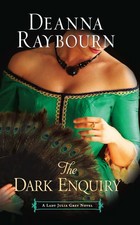 Lady Julia and her husband Nicholas Brisbane have now returned from their honeymoon and are ready to start living their proper married life together in London. Julia has begun to tinker with substances and, as you would expect, stick her nose into Brisbane’s business once again. This time, under the guise of worrying about him and his mysterious associations with her brother, Julia tags along to a seance dressed as a man. She doesn’t find anything as simple as communion with the spirits; instead, she finds herself embroiled in a murder mystery, spy plot, and tangled love affairs between other people. Lady Julia and her husband Nicholas Brisbane have now returned from their honeymoon and are ready to start living their proper married life together in London. Julia has begun to tinker with substances and, as you would expect, stick her nose into Brisbane’s business once again. This time, under the guise of worrying about him and his mysterious associations with her brother, Julia tags along to a seance dressed as a man. She doesn’t find anything as simple as communion with the spirits; instead, she finds herself embroiled in a murder mystery, spy plot, and tangled love affairs between other people.
A new Lady Julia Grey novel is an intensely exciting event for me – this declared itself as one of my favorite series in book 1, Silent in the Grave, and has never budged from that position. Dark Road to Darjeeling only came out about six months ago and I am loving the shorter wait in between books of this series. The Dark Enquiry certainly did not disappoint and I am thrilled that the standards for this series haven’t dropped at all, even though we’re now on book 5.
One of the differing aspects of this particular book was the new-ish supernatural element. We’ve always known that Brisbane’s migraine headaches are a result of him refusing to see visions which are a result of his gypsy birthright. I can’t really remember them rising to the fore like they have in this one, though, perhaps because Julia was not so intimate with him when they did strike previously. Here, though, they serve a pivotal plot point, and we’ve even visited a gypsy camp with Julia and Brisbane, to explore a bit further into his past. These seem like tantalising little glimpses of a world we have yet to enter, though, and I’m sure we’ll be hearing a lot more about Brisbane’s past and his visions in subsequent volumes. An interesting new character is introduced as well who I also suspect will play a prominent position in books to come.
One other aspect that I picked out of this one and particularly enjoyed was the fact that ever-impulsive and headstrong Julia comes into contact with a few less free-thinking men of her time during her investigations. As many have observed before me, Julia is very peculiar for a Victorian woman, and though it’s easy for me as a modern woman to relate to her, I think a real woman of her type would have run into this problem very quickly. The men in question don’t play a pivotal role in the story but Julia’s reaction to them and their thoughts was another added layer to a story I already enjoyed.
The Dark Enquiry is another excellent installment in the Lady Julia Grey series that I and many other readers have come to love. I would definitely recommend this series to mystery and historical fiction fans alike.
I am an Amazon Associate. I received this book for free for review from Netgalley.
 Vivienne de la Mare’s marriage has been fading for a while, so she doesn’t actually mind very much when her husband goes off to fight in World War II, leaving her, her mother-in-law Evelyn, and her two daughters alone on the island of Guernsey. Vivienne has many other problems to deal with, such as Evelyn’s fading memory, her elder daughter’s budding womanhood, and the difficult choice of whether to leave the island. Just when Vivienne chooses to stay, the Germans occupy Guernsey, and Vivienne faces the most pressing problem of all as she falls in love with a German soldier, Gunther, even as she witnesses the atrocities committed by his fellow soldiers right before her eyes. Vivienne de la Mare’s marriage has been fading for a while, so she doesn’t actually mind very much when her husband goes off to fight in World War II, leaving her, her mother-in-law Evelyn, and her two daughters alone on the island of Guernsey. Vivienne has many other problems to deal with, such as Evelyn’s fading memory, her elder daughter’s budding womanhood, and the difficult choice of whether to leave the island. Just when Vivienne chooses to stay, the Germans occupy Guernsey, and Vivienne faces the most pressing problem of all as she falls in love with a German soldier, Gunther, even as she witnesses the atrocities committed by his fellow soldiers right before her eyes.
After I flat out adored The Guernsey Literary and Potato Peel Pie Society I knew I wanted to read more World War II fiction centred around the occupation of Guernsey, one of the Channel Islands. This book fit right in with my plans; smooth and easy to read, it nonetheless dealt with a lot of the very difficult issues surrounding German presence on the island as well as Vivienne’s own struggle to continue to live a meaningful and content life in the shadow of so many other problems.
Because Vivienne’s husband has been rather openly cheating on her, she has very little guilt about betraying him, but with a German soldier? That’s a whole different story, because Vivienne can see all too well the suffering that other Germans are inflicting on others. She doesn’t have to rely on tales she hears when there are dying men in front of her eyes. But she knows that Gunther is different, even as she questions how deeply she can ever truly know a person. It’s thoughtfully and sensitively handled; Leroy speaks to both the horrors of Nazi acts even as she shows us that not every soldier was behind what was happening.
At the same time, it’s a considerate look at the difficulties that children go through in wartime. Vivienne’s elder daughter longs to have the glamorous life she’s read about in so many places, but it simply isn’t possible with rationing. She dreams of London and fancy dresses, but she’s trapped on Guernsey and Vivienne is the one who must tell her so and attempt to keep her daughter happy in the midst of deprivation and struggle.
And there’s Vivienne’s own self-discovery, as she starts to come out of the shell that years of an unloving marriage have left her in, with difficult decisions to make completely on her own. Her indecisiveness at the beginning of the book changes as she make choices, and whether they turn out correct or not, we can see that Vivienne’s experience through the war years have changed and strengthened her.
Overall, The Collaborator is a very moving and sensitive read, dealing with issues unique to wartime and universal to women at the same time. Well worth it for those who enjoy historical and women’s fiction.
All book links to external sites are affiliate links. I received this book for free from a publicist for review.
 Good afternoon everyone! This is going to have to be a quick Sunday Salon as I’m exceptionally busy today. Good afternoon everyone! This is going to have to be a quick Sunday Salon as I’m exceptionally busy today.
Yesterday I had the pleasure of meeting Kathy from Bermudaonion’s Weblog and her husband Carl. We had a great time wandering London for a few hours – I only wish I could have stayed longer! Carl took all of the pictures, so I’ll have to wait until she’s home to show them to you.
Kathy was kind enough to bring me no less than five books from home:
- The Linen Queen by Patricia Falvey
- The Maid by Kimberly Cutter
- This Burns My Hearts by Samuel Park
- A Fierce Radiance by Lauren Belfer
- The Art of Fielding by Chad Harbach
I can hardly wait to dig into them! I’m so backlogged that it may be a while, but I’m sure I’ll enjoy all of them. She also brought me a lovely Harper Perennial tote bag. You know how it works with tote bags – you can never have too many.
Next weekend I am off to London once again to meet Jodie of Book Gazing, Ana of things mean a lot, and Ana of The Book Smugglers. It promises to be another awesome Saturday!
In the meantime, I am trying to read and review, but mostly failing at home (though I got some good reading time in on the train yesterday with The Story of Beautiful Girl). I have a couple of books I have to review this week, but that might be it from me. In the meantime, I hope you are all reading fabulous books and enjoying the start of summer!
As you may have noticed (or maybe not!) I have been very absent from this little blog lately, at least for me. I haven’t abandoned it, and have no desire to, but my life has gone a bit crazy and I’ve found both my weekends and my evenings full over the past month or so. Things aren’t looking likely to calm down, as I’ll be away a few more weekends, two full weeks, and am going to be moving in the next two and a half months. I’m really hoping everything will be back to normal by the end of August.
In the meantime, while I struggle to actually write anything, I thought I’d share a few photos of my recent adventures with you.
We went to visit the Brontes first:
 I actually enjoyed this quite a bit, possibly because my expectations were lowered and a bit conflicted after reading about Ana’s visit. It wasn’t particularly crowded when we went, and I loved seeing everything that actually belonged to the sisters and their family. Finding out that Charlotte was smaller than me, for example, and seeing her dresses for myself, really humanized her. I actually enjoyed this quite a bit, possibly because my expectations were lowered and a bit conflicted after reading about Ana’s visit. It wasn’t particularly crowded when we went, and I loved seeing everything that actually belonged to the sisters and their family. Finding out that Charlotte was smaller than me, for example, and seeing her dresses for myself, really humanized her.
We then had a bit of a walk along the countryside:
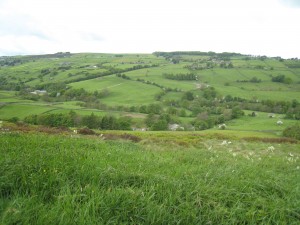
We had the somewhat misfortune of visiting Haworth during a 1940’s festival, and it was more crowded than possibly anywhere I’ve been in my life, so no pictures of the town from me. I’m not kidding; it was so crowded that we were trapped unmoving on the High Street until policemen got involved. But many of the participants were wearing 40’s outfits, which were really fun to see, and were distracted from the Parsonage itself by the festivities, so I credit this with the reason it was very quiet within the museum.
Just last weekend we visited Oxford, and for me the highlight was clearly the Bodleian library:
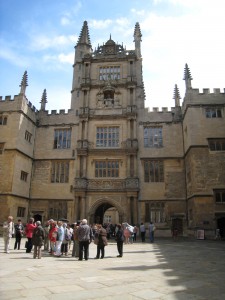 I loved seeing Duke Humphrey’s library, as it’s called, with its medieval roots, especially as I’d learned about Humphrey previously. It was enough to make me wish I’d studied in Oxford, just for the right to go in there every so often. (To be fair I had York Minster Library which is amazing in its own right). I loved seeing Duke Humphrey’s library, as it’s called, with its medieval roots, especially as I’d learned about Humphrey previously. It was enough to make me wish I’d studied in Oxford, just for the right to go in there every so often. (To be fair I had York Minster Library which is amazing in its own right).
As for the rest of Oxford, we were left a bit disappointed by the culture. I was shocked by how many beggars there are on the streets; it seemed so wrong that the richest people in the country go to university here when the streets are lined with people who are begging for spare change. You’ll have some obviously well off students in expensive dress striding past these poor people without giving them a glance. It felt wrong and made me quite sad. I don’t know why Oxford is such a focus, but I’ve never seen so many beggars in one city before.
Oxford did have its excellent points, with extensive history, free museums, and a burrito place among them, but unfortunately that is the image the city has left me with.
Our last stop was Blenheim Palace, the only non-royal secular palace in the whole of the UK:
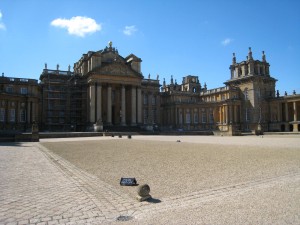 It’s quite stunning, inside and out, and was especially interesting for me as I’ve read a couple of books featuring Sarah, the first Duchess who was behind much of the construction. Most notable of those books is Duchess by Susan Holloway Scott, which focuses quite a bit on the romance between Sarah and her husband and Sarah’s tempestuous relationship with Queen Anne. It’s quite stunning, inside and out, and was especially interesting for me as I’ve read a couple of books featuring Sarah, the first Duchess who was behind much of the construction. Most notable of those books is Duchess by Susan Holloway Scott, which focuses quite a bit on the romance between Sarah and her husband and Sarah’s tempestuous relationship with Queen Anne.
And that’s a summary of all I’ve been up to lately! I do hope to write a couple of reviews this weekend, but I am off on Saturday to meet the exceptionally lovely Kathy of Bermudaonion’s Weblog in London, so it’s mostly crossing fingers that I’ll have time on Sunday. In the meantime, enjoy the slight lessening of the burden on your feed readers, and I hope to be back in full force soon.
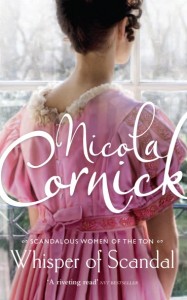 Today I have the pleasure of welcoming Nicola Cornick, author most recently of Whisper of Scandal here in the UK, to my blog for a quick few questions! I hope you’ll welcome her. Today I have the pleasure of welcoming Nicola Cornick, author most recently of Whisper of Scandal here in the UK, to my blog for a quick few questions! I hope you’ll welcome her.
· I’ve seen that you’ve been writing romance since 1998, which is fantastic! How did you get started writing historical romance?
Thank you! I started writing historical romance when I was eighteen. It was my favourite reading material throughout my teens and I thought I would like to try writing it myself. I always knew I wanted to write historical rather than contemporary fiction because it fired my imagination from the start and history has always inspired me. So I wrote a historical romance and sent it to Harlequin Mills & Boon and after several attempts and rejections they published my first book, True Colours, in 1998.
· What was your inspiration for your new Scandalous Women of the Ton series?
Lots of ideas came together for me to inspire the Scandalous Women of the ton series. First there was the idea for the first book, Whisper of Scandal, which came to me when I was researching the cult of celebrity in the 18th and 19th centuries. I discovered how famous explorers and travellers were during that period and thought that voyage to the Arctic would make an intriguing background for a novel. Then I realised that only male explorers were lauded – female travellers were considered unfeminine and inappropriate. This made me realise how very scandalous it would be for a woman to travel to the Arctic and so the idea for the first book and for the series was born.
· Can you tell us more about the series?
Each of the Scandalous Women of the Ton books features a heroine who has done something that outrages society in a different way. As well as Lady Joanna travelling to Spitsbergen in Whisper of Scandal we have her sister Merryn, who works for a living, and another sister who is a political cartoonist… I wanted to explore the concept of what was scandalous in early nineteenth century society and take a different aspect of it in each book.
· What’s your favourite romance novel?
Oh, that is such a tough choice! How many can I choose? I have a lot of old favourites on my keeper shelf but I think it is probably Frenchman’s Creek by Daphne Du Maurier. I love the evocative atmosphere that she creates and the way that she effortlessly conjures the historical setting. The characters are wonderful and it is such a romantic book!
· Besides the one you write in, which period in history is your favourite?
I have so many! I studied Medieval History and love British history to 1485. The Tudor period was a favourite of mine when I was younger and I’m still very fond of books set in that time. And I work as a guide in a 17th century manor house so am very drawn to the English Civil War and Restoration period… Imperial Russia interests me as well… So many historical periods, so hard to choose!
Thanks Nicola! To purchase the book, visit The Book Depository.
After a disastrous first marriage, the lovely widow Joanna Ware has absolutely no desire to marry anyone, ever again. Certainly not another explorer cut, in her mind, from the same mold as her late husband. But in the midst of thwarting yet another proposal, Joanna kisses Alex, Lord Grant, an Artic explorer who was her husband’s best friend. Despite the seeming clash in their personalities, the will of Joanna’s late husband throws them together again and again. It’s no surprise when she and Alex start to feel something for one another, and rumors begin to run rampant across London.
This first novel in a new series by long time romance author Nicola Cornick is an engaging, witty, and emotional journey through London up to the chilly Arctic to retrieve a little girl, the child that Joanna Ware never had with her husband. While the characters sometimes suffer colossal struggles to communicate, their mistrust eventually fades and I did get a genuine sense that they loved one another and belonged together. It’s difficult because sometimes I did want to smack them, but I certainly supported them in the end.
They have so many misunderstandings to surmount that we automatically know reconciliation isn’t going to happen in a second anyway. There are sparks, but there are also problems. Joanna has been led by her experience with her husband, while Alex’s mind has been poisoned by his slander, so they have learn to actually know one another instead of knowing the myths that each of them have built around their lives.
Providing a bit of comic relief to the otherwise emotional, painful story is Joanna’s friend Lottie. This frivolous society girl takes along an unimaginable amount of belongings to the frozen north and doesn’t hesitate to head straight for affairs when she feels necessary. While she is surprisingly ridiculous, Lottie isn’t a soulless character, as she has an affair of the heart in the book and learns just what it feels like to be treated the way she normally treats men.
Mostly, however, this book is an emotional journey through one couple’s struggle to learn to be comfortable with one another, to set aside past scars and focus solely on their future together rather than the battle-strewn past they’ve endured. With that in mind, Whisper of Scandal is an excellent choice for the romance reader, though not one lacking patience, and I’m looking forward to the second and third books in the series.
All book links to external sites are affiliate links. I received this book for free for review.
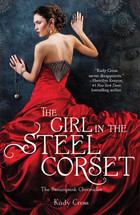 Finley Jayne would have just been an ordinary servant girl in this steampunk version of London if she wasn’t two personalities in one body. Her dark side gives her supernatural strength and an incredible amount of anger, while her normal personality is sweet and unthreatening. When she flees from one of the numerous houses in which she’s attempted service, after (rightly) beating an aristocrat for sexually accosting her, she runs into Griffin King, a young duke who promptly takes her home to his relatively ragtag bunch of odd personalities. Each has a special talent, but they’ve also been targeted by a mysterious villain, The Machinist, who has it out for Queen Victoria. Finley Jayne would have just been an ordinary servant girl in this steampunk version of London if she wasn’t two personalities in one body. Her dark side gives her supernatural strength and an incredible amount of anger, while her normal personality is sweet and unthreatening. When she flees from one of the numerous houses in which she’s attempted service, after (rightly) beating an aristocrat for sexually accosting her, she runs into Griffin King, a young duke who promptly takes her home to his relatively ragtag bunch of odd personalities. Each has a special talent, but they’ve also been targeted by a mysterious villain, The Machinist, who has it out for Queen Victoria.
This was an incredibly entertaining read that I just couldn’t put down. I loved the atmosphere of steampunk London and the special skills that each of the characters had. It felt almost like I was reading a classic superhero comic book set in Victorian London, with some vicious automatons added in. It’s a atmosphere at once familiar and different, so I could fit right in while still taking some time to learn about the world.
The book is pretty clearly a YA novel with a bit of an emphasis on Finley’s romantic relationships and her seesawing between Jack Dandy and Griff. It’s very much about her personal growth from a girl with two personalities into a girl who can control herself and unleash her feelings when it’s more appropriate. She changes quite a bit over the course of the novel; at times it’s difficult to get a grasp on who she is due to her separate personalities, but overall I certainly liked her as a heroine and felt I could understand her issues and hope for her to do better.
I did feel the book was a bit predictable; I figured one part out well before the characters managed it, and while I was probably meant to, I would have preferred that extra suspense towards the end. Plus I felt by the end that I hadn’t got to know many of the other characters particularly well; it was enough to like them, but not the same degree as I felt for Finley after her journey of self-discovery.
Still, though, I really enjoyed The Girl in the Steel Corset. I looked forward to reading it whenever I had a chance and I was very invested in the story’s outcome. It’s not perfect, but I will most definitely be looking forward to further volumes in the series.
All book links to external sites are affiliate links. I received this book for free for review from Netgalley.
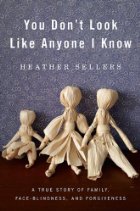 As an adult, Heather Sellers discovers that she suffers from a condition called prosopagnosia, commonly known as face blindness. She is unable to recognize people by their faces; while she can usually identify them by features such as hair, ears, and clothing, it’s never reliable and she runs into her own husband thinking he’s a stranger. With her condition as a guide, Heather can start to process her difficult childhood and her relationship with her parents, both of whom have issues of their own. More importantly, Heather’s diagnosis comes to provide more clarity for her life, giving her a better understanding of who she is and how she can deal with her condition. As an adult, Heather Sellers discovers that she suffers from a condition called prosopagnosia, commonly known as face blindness. She is unable to recognize people by their faces; while she can usually identify them by features such as hair, ears, and clothing, it’s never reliable and she runs into her own husband thinking he’s a stranger. With her condition as a guide, Heather can start to process her difficult childhood and her relationship with her parents, both of whom have issues of their own. More importantly, Heather’s diagnosis comes to provide more clarity for her life, giving her a better understanding of who she is and how she can deal with her condition.
I’d never heard of prosopagnosia before reading this book, but it sounds very difficult. I couldn’t imagine what it would be like not to recognize people I knew walking down the street, or introduce myself to someone I already knew at a party – it’s just automatic for me and, clearly, for the many people who told Heather, “Oh, I’m really bad with names too”, ignoring her very real condition. I could feel her frustration and her certainty that she genuinely had this problem and I was relieved when she finally got a diagnosis and could begin to deal with what she did have. There is currently no cure for face blindness, but letting others know about the situation seems to help.
Tied in with Heather’s modern day story is the depiction of her childhood, which was far from ordinary. Her mother appears to be a paranoid schizophrenic, while Heather’s father has issues that are never fully understood throughout the narrative. Her parents live separately and as a child Heather lives with one and then the other and back again, switching schools on a yearly basis and struggling to make many friends. Her success to PhD level and eventual professorship at a university is simply astounding coming out of that and she deserves a lot of credit for sticking to her education, even when her mother handed her job listings for secretaries and cleaning women.
I did find the stories of her childhood very hard to take, simply because her life was so difficult. I felt very bad for her but to be honest, I was also just more interested in her modern day struggles with her condition, her marriage, and the fallout from her childhood rather than the events itself. As a result the second section of the book, which moves more away from childhood, struck a deeper chord with me and had me much more eager to read to the end. I think that Heather’s childhood is essential to understand her problems as an adult, but personally, I wouldn’t have minded an entire book on face blindness.
You Don’t Look Like Anyone I Know is a moving memoir on a condition very few people are familiar with. The author is a strong woman with a difficult past to overcome that readers will come to empathize with and even admire. Recommended.
All book links to external sites are affiliate links. I received this book for free for review from the publisher.
|
|



Recent Comments