

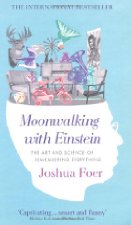
 In Moonwalking with Einstein, Joshua Foer digs deep into the concept of memorisation and how our lack of it as a society has affected us. He goes so far as to compete in a memory championships, sharing his tips along the way, as we learn just what it takes to be a memory professional. He doesn’t memorise just the shopping list or the US Presidents; he memorises poems, playing cards, and people, with easy tips for us to learn how to memorise as well.
I have a memory that is simultaneously atrocious and very efficient, so I was incredibly curious about recognised memory techniques. Foer mainly describes the memory palace idea that I’d seen used previously, although I can’t remember where. It’s surprisingly effective; I managed to do his little exercise and actually found it very successful, to the point where I can still remember it a few weeks later. There are a couple of other hints and tricks throughout as he goes through the process of learning to be a memory champion.
That wasn’t the most interesting part for me, though, as I was much more interested in the history of memory and his investigation into the top minds in the world, including those with mental illnesses whose memories are somehow naturally more effective than the rest of us. He goes in two directions with the latter, interviewing a man who has no memory and a man who has unnatural memory abilities. It’s absolutely fascinating to see how the mind is affected at different stages of memory recall. Foer also talks to memory professionals – people who help you remember – and gets a wide range of perspectives on the subject. All of it was quite interesting.
I’m sure it helped that I am firmly in Foer’s camp in that I believe memory is very important. I am partially blessed with a good memory; I can stick things in my memory with relative ease when I try, and sometimes I find random dates and facts stuck in my head without real effort (my new mobile number popped into my head one day and hasn’t left yet!). But if I’m not paying attention, I forget very easily, and I’ve never been good at using memory devices to remember things like the planets. I usually just remember the sentence and forget which planet is which word!
But I do believe memory is important, largely for the reasons Foer mentions; we need to have a lodestone to attach future knowledge on. As a practical example, I know a lot more history than the average person who has never really cared for it, like my husband. When we go to a museum, I love it partly because I can usually relate what I’m seeing to the store of memory in my head (partly because I love history). He loses interest pretty quickly and forgets what he’s seen because nothing has meaning to him, but when he sees something he can relate to, he’s much more interested. We need to have some firm grounding of facts in our heads to relate to the world around us – this is why a lot of older literature is harder to read, because we’ve lost the intimate knowledge of things like classical literature and the Bible to attach allusions to.
Although I enjoyed parts of this book more than others, I would still highly recommend it to anyone who is at all interested in memory, whether you’d like to remember better or are simply curious about the history of memorisation.
All book links to external sites are affiliate links. I received this book for free from Amazon Vine.



Recent Comments