

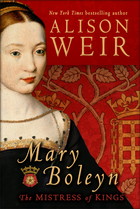
 Like many of the women who are the new focus of popular history, Mary Boleyn has left a very slim paper trail. There are entire periods of her life where no one is quite sure where she actually was, let alone what she was doing or feeling. Only two of her letters survive, to our knowledge, and our ideas of her as a legendary whore are based mainly on much later opinions of her. With very little to work with, Weir attempts to reconstruct Mary’s life and, in several cases, set the record straight.
In a lot of this book, Weir engages in one of my favourite things, evaluation of other historians. I love historiography, and she does a good job picking apart others’ arguments and showing what was based on actual source and what wasn’t. Unfortunately, a number of the historians she chooses to engage with were working a considerable amount of time in the past, rather than those who are working now and would be more likely to follow current standards for documentation and analysis. Saying that, I’m not sure how many historians are presently working on the Tudors and Mary Boleyn, as popular culture is not necessarily connected to academic culture, so it’s possible she didn’t have much more recent to work with; her main focus is revising people’s opinions of Mary as an infamous whore, and I did enjoy her investigation of how that reputation came about.
Unfortunately, because of the scarce information, some flaws pop up in Weir’s work; it’s extremely repetitive, as she has the need to make an assumption about Mary’s past, then treats it as fact and tells us about it over and over again. Her reputed affair with the French king is constantly discussed, for example. I’ve definitely appreciated some of Weir’s other works more than this one in this respect. There just isn’t much here. I felt like Mary’s life would have been much more suited to a longer article or inclusion into a collection, instead of a book on its own. I failed to really get a sense of who she was; the most affecting and interesting part of the book, for me, was when Weir actually quoted a letter that she wrote. I understand that there are only two letters, but the difference really demonstrated to me how little I’d felt for Mary up until that point.
Mary Boleyn was a book I didn’t mind reading; it may be considered dry by others who aren’t particularly used to reading history and expect it to be more like a novel (there are pages of speculation about Mary’s birthday, for instance), but if you do enjoy biography you won’t have any trouble getting involved here. Unfortunately, I found the end result ultimately disappointing, and I hope Weir chooses a better documented subject for her next full-length work of popular history.
I received this book for free for review. All external links are affiliate links.



Recent Comments