|
|
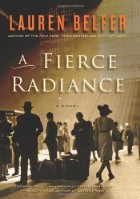 Claire Shipley, a divorced single mother, is a photographer for Life magazine. With the United States on the cusp of, and then deep into, World War II, she has plenty to photograph, but one story captures her devoted attention. It’s the development of penicillin, the miracle antibiotic which has the potential to save lives. After losing her daughter to septicaemia at the age of 3, Claire knows all too well what a difference this drug could make in people’s lives, but it’s incredibly difficult to manufacture and impossible to synthesize – moreover, the government has mandated that penicillin be affordable and patent-free. That means the drug companies are dangerously eager to research more profitable alternatives, and they’re not afraid to hurt the people Claire loves to get their hands on that potential. Can she balance telling the story with keeping her family safe? Claire Shipley, a divorced single mother, is a photographer for Life magazine. With the United States on the cusp of, and then deep into, World War II, she has plenty to photograph, but one story captures her devoted attention. It’s the development of penicillin, the miracle antibiotic which has the potential to save lives. After losing her daughter to septicaemia at the age of 3, Claire knows all too well what a difference this drug could make in people’s lives, but it’s incredibly difficult to manufacture and impossible to synthesize – moreover, the government has mandated that penicillin be affordable and patent-free. That means the drug companies are dangerously eager to research more profitable alternatives, and they’re not afraid to hurt the people Claire loves to get their hands on that potential. Can she balance telling the story with keeping her family safe?
This was a fascinating book. I knew that penicillin, and the other antibiotics we have today, was a game-changer for human life as it stood, but I’d never thought about it from this perspective. The idea that a scratch or a blister could end up killing a person is completely foreign to most of us now. I’ve never had an infection from anything; we even have antibiotic bandages and soaps. Viewing the world from Claire’s perspective, with her full knowledge that this could indeed save lives, was breathtaking and added a layer of intensity to a story that, for me, was already compelling.
That’s because Claire’s emotions don’t remain detached from the story for long. She falls in love with a handsome doctor in charge of the initial tests after photographing him at his work. This makes the hunt for antibiotics personal and close to home; moreover, Claire’s own father, absent from nearly all of her life, begins to make more of an impact on her, leaving her to make tough decisions that affect both her life and that of her son Charlie.
I found all of the characters in the book to be interesting, really; I enjoyed a turn in each of their minds. The book occasionally shifts perspective strangely, because it’s written completely in third person, but it doesn’t happen often enough to be a problem. It’s certainly worth considering everything from each of their perspectives, as in some ways the book is a deeper look at what motivates people to commit certain acts that are either condemned or praised. Life is not black and white, and it certainly isn’t here.
Written thoughtfully, with sympathetic and deep characters, against a truly fascinating backdrop, A Fierce Radiance is one for the historical fiction fans amongst us. And it’s still relevant; after all, with the over-prescription of antibiotics, we may well return to a world where each and every scratch could be a death sentence. Recommended.
All external book links are affiliate links. I received this book as a gift from Kathy. Thanks again, Kathy!
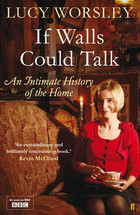 Home is probably the most cherished place in the world for most of us. We spend huge chunks of our lives cleaning, decorating, organising, and simply enjoying our homes, but how has the house change throughout history? What would our houses tell us about what went on in them before? Lucy Worsley tackles this topic by exploring the history and evolution of four different kinds of room in an English house, from the medieval period right through to the present. The living room, the kitchen, the bathroom, and the bedroom are Worsley’s subjects, but the people who populate them truly make them what they are, and this is a fascinating journey. Home is probably the most cherished place in the world for most of us. We spend huge chunks of our lives cleaning, decorating, organising, and simply enjoying our homes, but how has the house change throughout history? What would our houses tell us about what went on in them before? Lucy Worsley tackles this topic by exploring the history and evolution of four different kinds of room in an English house, from the medieval period right through to the present. The living room, the kitchen, the bathroom, and the bedroom are Worsley’s subjects, but the people who populate them truly make them what they are, and this is a fascinating journey.
I must admit a little bit of bias and prior knowledge of this book. The series, hosted by Worsley, was actually televised here in the UK over four episodes, one for each room. So I already knew that I was interested in the subject matter (although that wasn’t a surprise) and I’d picked up many of the facts previously. If you have seen the show, though, the book adds bits and pieces and draws more conclusions from Worsley’s experiences living certain aspects of old-fashioned lives.
Social history, for me, is completely addictive; I love finding out why there might be a shoe hidden in my attic or how recently some British homes actually got proper bathrooms and plumbing. There are Victorian ash-midden privies in my little garden and, even though now they’re considered “outbuildings”, that little slice of history is one of the things I love about England. Worsley gives equal time here to the ordinary and the aristocratic, particularly because in many cases developments made for the wealthy finally trickled down to the poor.
Worsley’s writing style is also very engaging and the book is a pleasure to read. There are plenty of endnotes, but this is not dry history at all. It’s full of facts that I’m sure I will regale people with for weeks to come, lots of curiosities about how our homes actually got to be the way they are and how differently people treated them. Consider the bedroom, once simply integrated into the main living space with little to no privacy, which slowly migrated to becoming one of the most private places of all, especially as the living room took its place.
One of the most interesting aspects of a book like this, for me, is how the home can highlight just how much society has changed. Just one part of this is obviously the presence of servants in our lives. Not that long ago, a huge proportion of the population was employed in service, a respectable occupation and one that had a huge part to play in the development of the home. Some things certainly wouldn’t have been possible without servants – older kitchen ranges, for example, required daily cleaning and blacking, not to mention the issues surrounding the chores of actually preparing and serving food. The monumental shift away from servants, along with the inventions and innovations that replaced them, have played a role in the development of the home today.
All in all, If Walls Could Talk is a fascinating journey through the home, a joy to read, and a trove of worthy little details for those interested in the history of ordinary people as well as royalty. Definitely recommended.
All external book links are affiliate links. I received this ebook for free for review.
 Lucy Morgan’s position in Elizabethan society is awkward, to say the least. Part of a troupe of singing girls who entertain the queen and court, Lucy is often hidden away in the back due to her African heritage, even though she has one of the most beautiful voices in the group. That’s until one of the soloists becomes ill, and the queen takes a liking to her. On the famous royal visit to Kenilworth, often viewed as the occasion during which Robert Dudley aimed to win the queen’s hand in marriage, Lucy becomes favored by the queen, and is asked to spy on Dudley and his mistress Lettice Knollys for Elizabeth. But she’s not the only one spying – or plotting – in the court, and an assassination plot that Lucy uncovers could have deadly consequences for all involved. Lucy Morgan’s position in Elizabethan society is awkward, to say the least. Part of a troupe of singing girls who entertain the queen and court, Lucy is often hidden away in the back due to her African heritage, even though she has one of the most beautiful voices in the group. That’s until one of the soloists becomes ill, and the queen takes a liking to her. On the famous royal visit to Kenilworth, often viewed as the occasion during which Robert Dudley aimed to win the queen’s hand in marriage, Lucy becomes favored by the queen, and is asked to spy on Dudley and his mistress Lettice Knollys for Elizabeth. But she’s not the only one spying – or plotting – in the court, and an assassination plot that Lucy uncovers could have deadly consequences for all involved.
It’s been a few months since I read a novel set in Elizabethan England, and I think the break did me good as I found myself thoroughly enjoying this novel. Told in alternating viewpoints, with Lucy, her guardian and spy Goodluck, Lettice Knollys, and the queen herself narrating, I was quickly swept up in this exploration of the history surrounding that single event, a visit to Kenilworth Castle. For me, this worked much better than another book covering some large part of Elizabeth’s reign. Instead, we witness all those tensions over the course of a summer, when many things appear to come to a head.
For one thing, the author chooses to depict this as the moment at which Elizabeth firmly rejects her lifetime love, Robert Dudley, for practical reasons in part; she chooses to speculate something about the queen which I won’t reveal. The real origin of this is disclosed in the author’s notes, as with all the historical fiction I like best. But there is also Elizabeth’s anger at Dudley’s relationship with Lettice Knollys, her younger cousin who still retains much of Elizabeth’s youthful, now vanished beauty.
All of this creates quite a bit of emotional drama at the court, and Lucy is mixed up in all of it. She is chosen by Leicester and by the queen to carry out individual tasks, plus she is becoming aware of herself as an attractive person thanks to the fact that she meets a stableboy, Tom, who shares the color of her skin, and who is very attracted to her. But this isn’t a romance novel, and Tom isn’t her primary concern; the queen, her guardian, and Leicester are. She’s under a lot of pressure to reveal secrets, only to discover that there might be even more afoot. There are consequences to the prestige that Lucy’s always wanted, and she certainly discovers them in spades here.
I also really liked Lucy as a character; I could easily imagine a young black woman being shoved to the back of a procession not very long ago, much less in the Tudor period, and I found her reactions to be honest and authentic for the most part. The author does a very good job setting the scene at Kenilworth, too; I’ve been there, and I could picture some of the events taking place in a more complete castle. It added a nice bit of realism to the whole book.
A very enjoyable read for those of us who are still looking for more Elizabethan historical fiction; if you haven’t been reading any for a while, you may find yourself pleasantly surprised by The Queen’s Secret. Recommended.
All external book links are affiliate links. I received this book for free for review.
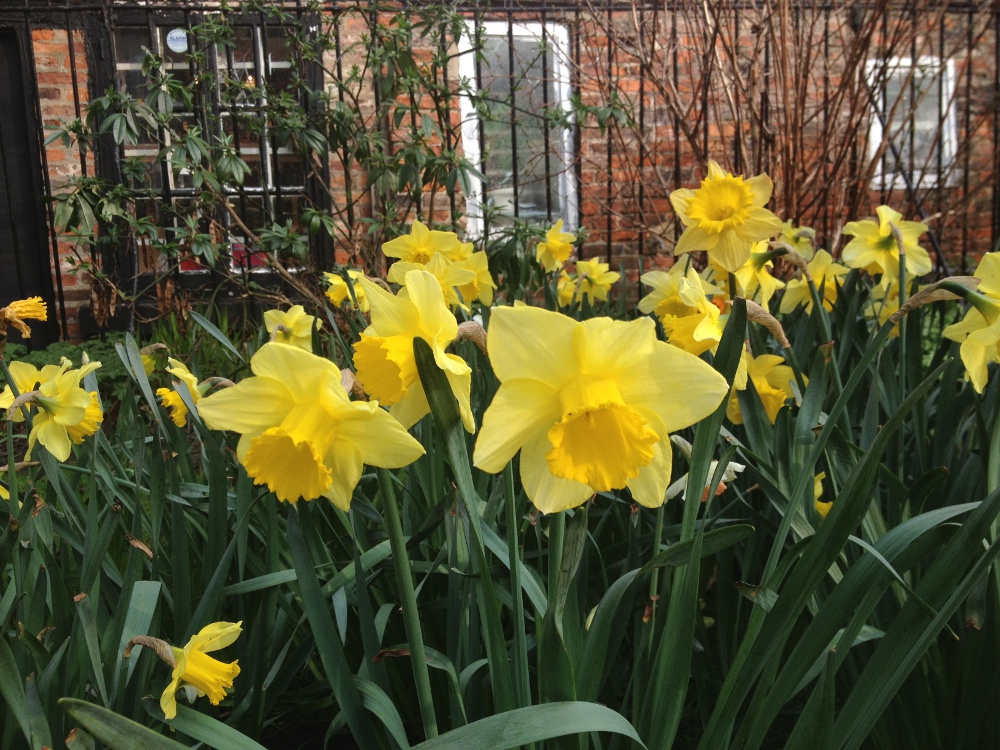
 Good morning Saloners! Despite the fact that we’ve lost an hour this morning, the recent spring weather and my renewed time for reading, blogging, and other favourite tasks has me feeling surprisingly cheerful. We went for a walk around town yesterday and being greeted with daffodils in every area of greenery is welcome, even if we did have a lack of sun up north. Yellow is my favourite colour, so it’s inevitable that I am happier every spring. Summer is coming – at last! In many ways, this winter has felt like an eternity. Good morning Saloners! Despite the fact that we’ve lost an hour this morning, the recent spring weather and my renewed time for reading, blogging, and other favourite tasks has me feeling surprisingly cheerful. We went for a walk around town yesterday and being greeted with daffodils in every area of greenery is welcome, even if we did have a lack of sun up north. Yellow is my favourite colour, so it’s inevitable that I am happier every spring. Summer is coming – at last! In many ways, this winter has felt like an eternity.
 Daffodils always seem to be around York’s most historic places – surrounding the walls, on the motte of Clifford’s Tower, and around the gravestones of Holy Trinity Church, tucked away from the bustle of a small city on a nice day. Daffodils always seem to be around York’s most historic places – surrounding the walls, on the motte of Clifford’s Tower, and around the gravestones of Holy Trinity Church, tucked away from the bustle of a small city on a nice day.
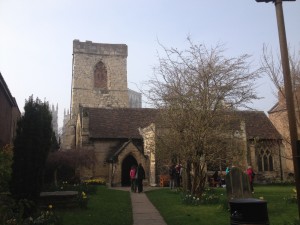 This is the way that York’s history surrounds you, but sneaks up on you at the same time – little hidden alcoves, monumental historic discoveries just left for the curious passerby to find on her own. There is so much here, and I am even now still exploring. This is the way that York’s history surrounds you, but sneaks up on you at the same time – little hidden alcoves, monumental historic discoveries just left for the curious passerby to find on her own. There is so much here, and I am even now still exploring.
In reading news, things are picking up nicely; I finished 3 books this week, and I’m on track to finish a fourth today, a lovely chunkster about a mystery surrounding the mass production of penicillin during World War II, A Fierce Radiance by Lauren Belfer. I actually managed to write a review directly after I finished a book yesterday, which reminded me how much I like writing about books in the first place. With all of the old obligations on writing gone, I can remember that yes, I do like writing, and yes, I like blogging. I started for a reason.
In fact, this Sunday holds more reading – I have a book to finish, after all – and I’d like to get started on completing my outstanding reviews. After my mini-reviews this week, there aren’t that many left, and I’m looking forward to having a clean slate for once. I’d definitely like to achieve that before Easter, when I’m heading home to visit my parents for the first time in many months.
Have a wonderful Sunday, everyone!
 Minerva Highwood is determined that Colin, Lord Payne, not marry her sister. She’s firmly convinced that her sister deserves a love match, and she knows Payne won’t be that for her. In an effort to deter him, she suggests that they head to Scotland, where she will present at a geology conference and, potentially, win £500 to pay him off. However much he doesn’t really want to go, he ends up with her on a madcap journey to the conference, and the bespectacled bluestocking and handsome womanizer discover they have quite a lot more to attract them than they ever would have suspected. Minerva Highwood is determined that Colin, Lord Payne, not marry her sister. She’s firmly convinced that her sister deserves a love match, and she knows Payne won’t be that for her. In an effort to deter him, she suggests that they head to Scotland, where she will present at a geology conference and, potentially, win £500 to pay him off. However much he doesn’t really want to go, he ends up with her on a madcap journey to the conference, and the bespectacled bluestocking and handsome womanizer discover they have quite a lot more to attract them than they ever would have suspected.
I’ve enjoyed all of Tessa Dare’s romances and A Week to be Wicked was another pleasant read. I actually missed one of the books in the Spindle Cove series because I’m behind on reviews, although I have it on my Kindle, but I read the novella, Once Upon a Winter’s Eve, and I really enjoyed it so was eager to read more. When I ended up in a very stressful place over the last few weeks, I knew exactly what book to go for, and I was completely correct in my assessment.
In particular, I just loved Minerva’s character; I know it’s a bit of a stereotype to have a geeky, glasses-wearing woman attract the hottest guy in town, but as a geeky, glasses-wearing woman, I just can’t resist this kind of storyline, especially when the heroine is written well. Minerva definitely is and I loved spending time with her and her nerdy ways. The slow unveiling of her realization that Payne is actually attracted to her, after uncertainty and pain in the beginning, is very well done, particularly when he starts using her name.
I also thought that this book was structured delightfully – the core of the story is about Minerva and Colin on the run trying to get to Scotland, a trunk with a plaster cast of a dinosaur foot between them. The hilarious ways in which they spin their story and the people they deal with along the way make for enjoyable reading, and I loved how the awkward circumstances continued bringing them together over and over again. And while the book does have the classic tortured hero / unappreciated heroine combination, it is done so well that it doesn’t feel like a stereotype.
Tessa Dare definitely has my attention and I’m very much looking forward to reading more of her books in the future. Recommended!
All external book links are affiliate links. I received this book for free for review.
I built up a little review backlog while I was away, even though I didn’t get a vast amount read. To clear up some of this, here are a few completely unrelated brief mini-reviews. Actually, they are related in one aspect; these are the books I read when I’m stressed and solely seeking pleasure.
 Leviathan Wakes, James S.A. Corey Leviathan Wakes, James S.A. Corey
I’m always in the mood for an excellent space opera, and Corey’s debut was lauded by many of my favourite SF bloggers. James S.A. Corey is actually a pen name for Daniel Abraham and Ty Franck, who collaborated on the book, and I’ve actually been meaning to read Abraham for some time now. This seemed like a fantastic chance, and it was indeed a good and gripping book, a surprisingly fast read for its imposing size, and a relatively satisfying story. It felt, in places, a bit detective noir, which was probably my only actual issue with it, as I’m not a huge fan of that particular genre, but there was enough Firefly-esque space opera to keep me very happy indeed. The authors are clearly going for that group crew vibe and, for the most part, succeed nicely, with some interesting characters and relationship dynamics. I’d recommend it to someone looking for more character-driven sci fi with a mystery attached.
 And Then He Kissed Her, Laura Lee Guhrke And Then He Kissed Her, Laura Lee Guhrke
This was a fantastic romance – set between a working girl turning 30 and her oblivious boss in Victorian England, it did an excellent job of showing how people hide parts of themselves from others and how romance can slowly grow. Emma has always wanted to be a writer, and so she works for a publisher, Harry – but he’ll never read her work, a book of advice, because it’s written for women and outside of his interest completely. When she turns 30, she gets fed up and decides to go after her dreams, teaching Harry to look at the world outside of his box in the process. I loved it and I immediately bought the next in the series.
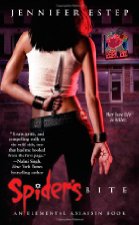 Spider’s Bite, Jennifer Estep Spider’s Bite, Jennifer Estep
I’m never opposed to more urban fantasy in my life, and this is a series I’ve been eyeing for a while. A lot of people have called Estep’s Elemental Assassin a favourite, so I decided that, as I’m still waiting for new installments in several of my own favourites, that I’d take this one on as well. I immediately liked it; Gin is an assassin who really doesn’t have any problems at all with her job, until someone targets her nearest and dearest for an attack. A quick and enjoyable read which had me ready for the next in the series, and which has satisfactorily filled the gap while waiting for my favourite UF authors to write more books!
All external book links are affiliate links. I purchased all these books.
Hello everyone! I’ve just taken what is almost definitely the longest blogging break since I started blogging. My life over the last two weeks has been absolutely ridiculous, and to be honest, not in the best possible way, as it has mostly consisted of work and work-related activities. Fortunately, in some respects at least, things are finally calming down, and I’m actually hoping to post some reviews this week and start putting thought back into my blog. This is definitely good news for me, and I hope it’s good news for all of you, too; I’ve missed blogging, and it’s strange to think how much I’ve organised my reading life around this little corner of the internet over the past nearly five years.
Another massive time suck I’ve encountered this past week has been Mass Effect 3. I’m a gamer as well as a reader, and I’ve been looking forward to this game since I finished the first two – obsessively in succession – back in December. So far, it’s fantastic. I’ve heard very uncertain things about the ending, but I’m going to reserve judgement until I actually get there, which will probably happen at some point this week. Then I will really be back to reading and blogging, at least until another gaming obsession decides to take over my life. In the meantime, this one is certainly satisfying my need for science fiction and incredible, engulfing narratives and characters. That may not be what you expect from a video game, but this has been an epic three-part experience and I am seeing it through to the end.
Since the craziness ended roughly this past Thursday, I’ve been reading, too. I’ve read several very good romance novels, which I needed as stress relief, and I’ve even managed some non-fiction with Lucy Worsley’s If Walls Could Talk. I’d already watched the TV show, which aired on British television several months back, but the book filled in some gaps and was very entertaining reading. You’ll be hearing more about it soon. I also, a bit further back, read The Hare with Amber Eyes by Edmund de Waal, which I’m still organising my thoughts around in preparation for writing a review.
Anyway, I do hope to be back in full force this week – I even managed to leave some comments over the past couple of days, which I’d sorely missed doing. I’m at some point going to hit the dreaded “mark all as read” button, though – so if you’ve posted something and you’d love me to have a look, please do say so in the comments, and I’ll pop over to visit.
Thanks for sticking around and I hope you all have fantastic Sundays!
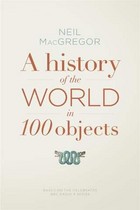 How can one write a history of the entire world? It’s not an easy task, and could never be accomplished by a single being. Dr. Neil MacGregor has opted to take the approach of presenting 100 objects from the British Museum, in chronological order, which pick out some of the strands of civilization’s history and which attempt to show us how everything is related and interwoven. How can one write a history of the entire world? It’s not an easy task, and could never be accomplished by a single being. Dr. Neil MacGregor has opted to take the approach of presenting 100 objects from the British Museum, in chronological order, which pick out some of the strands of civilization’s history and which attempt to show us how everything is related and interwoven.
This is a very intriguing book, although as you would expect, it really only scratches the surface and is very, very top-level. The 100 objects are grouped in five for each chapter and tend to come from all over the world. It’s rare for there to be two objects from similar European countries, for example; this does provide a really interesting view of history as we can see what’s happening around the world all at once, even if that is at a surface level.
The objects in the book spread from civilization’s earliest hours to the present day, including a credit card and a solar-powered lamp. Even the author comments on how our choices of what may reflect our society today will not necessarily be the choices made in 100 years, and perhaps the curator in 2112 will be as intrigued by those selections as any others. History, it is fascinating, even more so when you consider the fact that it is happening all around us all the time.
All of the objects included are at the British Museum in London; they’re marked in the museum itself, so you can follow through and try and find all 100. I’m not sure if they were all on display, but I did visit a few on a recent visit to London. For example, here are the Lewis chessmen:
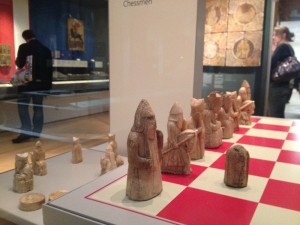
Even though the book has a gorgeous, full colour image of each object, it was still exciting to see a few of them in person, although not exciting enough for me to trek around the entire museum for it.
The British Museum is also a perfect subject because, in many ways, it reflects the overarching theme of a dominant culture taking over smaller ones, something that keeps happening throughout the book with lost civilizations. Sometimes their voices are heard again, as in the case of the Rosetta stone, but sometimes they are truly lost, and we can only speculate. The museum itself is a remnant of Britain’s imperial past, and these treasures may have been contested; the simple fact that they’ve ended up in London from all parts of the globe is a tale worth telling, and which is told for quite a few of them.
I spent a considerable amount of time with A History of the World in 100 Objects and I found it to be a fascinating read, easily digestible in chunks given the nature of the chapters. Not for anyone looking for an indepth history, but for a thoughtful overview, this is perfect.
I purchased this book.
February wasn’t a great month here at Medieval Bookworm. My reading slowed way down, and my blogging slowed down even more, neither of which spelled great things for you, faithful readers. The various distractions in my life are probably set to continue for the next month, too; but I’m hoping to squeeze out more time for reading and blogging somewhere in there, because I miss it a lot.
Overall, it was a good month for me, though; in particular there was a long weekend trip to London, in which I geeked out:

I visited the Royal Manuscripts exhibition at the British Library while I was there, and it was about as amazing as I’d expected. No pictures allowed inside, but the accompanying book above is gorgeous and full of photos of them. No trip to London is complete without visiting Forbidden Planet, and Ezio, from one of my most recent favourite game series, Assassin’s Creed, elected to come home to York with me. We also visited Fifteen London in advance for my husband’s birthday, which is actually today.
I’ve spent the time since we returned being ill, though still going to work; I’m improving now, though, and hopefully will continue to do so.
On to what I actually read this month!
- The Turning of Anne Merrick, Christine Blevins
- Where She Went, Gayle Forman
- A History of the World in 100 Objects, Dr Neil MacGregor
- Leviathan Wakes, James S.A. Corey
- And Then He Kissed Her, Laura Lee Guhrke
- The Glovemaker, Stacia M. Brown
- Dead Beat, Jim Butcher
There may only be a few books on that list, but I can safely say I enjoyed each and every one. I also read a bunch of short stories as I started digitally subscribing to Asimov’s, to satisfy the science fiction craving, though I reviewed just one. I find them actually easier to read on my iPhone, as I can absorb a short story while waiting somewhere very easily. And I’ve simply adored almost all of the stories, novellas, and novelettes, so I’ve been very happy with my subscription.
Ahead for March; as I said, time is short this month, but I’ve finished two books so far and I believe I am about to embark upon a third. I have a number of books I’m really excited about reading, and I have a lot of review copies for this month. So whatever I end up doing, I’m sure the books I read will be fantastic.
How was your February?
 Michael, the Marquess of Bourne, lost his ancestral lands at an ill-fated card game when he was just 21. Ten years later, he sees an opportunity to regain them – by marrying his childhood friend, Lady Penelope Marbury. Penelope has accepted her place on the spinster’s shelf; after the Duke of Leighton broke their engagement, her name has carried the faint whiff of scandal, until now, when her father endows her with Michael’s former ancestral homes. Bourne quickly sweeps her off her feet and weds her, but somehow it’s just not the marriage she expected it to be. But as Bourne grows to know her, he begins to realize that she deserves something better than a marriage of convenience – nothing less than her whole heart will do. Michael, the Marquess of Bourne, lost his ancestral lands at an ill-fated card game when he was just 21. Ten years later, he sees an opportunity to regain them – by marrying his childhood friend, Lady Penelope Marbury. Penelope has accepted her place on the spinster’s shelf; after the Duke of Leighton broke their engagement, her name has carried the faint whiff of scandal, until now, when her father endows her with Michael’s former ancestral homes. Bourne quickly sweeps her off her feet and weds her, but somehow it’s just not the marriage she expected it to be. But as Bourne grows to know her, he begins to realize that she deserves something better than a marriage of convenience – nothing less than her whole heart will do.
Sarah MacLean stole my heart (and everyone else’s) with Nine Rules to Break when Romancing a Rake and she hasn’t lost her touch. A Rogue by Any Other Name is an exceptionally sweet, well-written romance that will tug at your heartstrings and have you rooting for this star couple from the minute you start reading. Yes, it does make use of the stereotype of the harsh hero who just has to come around for the heroine – but in this case, we know that Bourne used to be a good guy.
The letters interspersed between the chapters of the book are so sweet and heartbreaking, from when Michael left Penelope the first time for school and the second time when he lost his lands. They’re a brilliant way of getting us close to the couple without actually shoving their past in our faces; we know what happened, but it makes that older relationship so much more real, and their present-day relationship that much more poignant.
I also loved that MacLean chose to write about Leighton’s jilted fiancee from Eleven Scandals – giving fans a perfect opening to the series, but at the same time giving us an opposite perspective. You see, in Eleven Scandals, I was 100% behind Leighton’s romance with Julia, which was fantastic. Now we’ve seen that life hasn’t been so fantastic for Penelope, but at least she has her happy ending. And it is a very, very good one.
Well worth the read for historical romance fans, Sarah MacLean’s latest is as wonderful as all her books are turning out to be.
I received this book for free from Netgalley. All external book links are affiliate links.
|
|




Recent Comments