|
|
 Rather than try and review each of these books separately, as I rushed through them so quickly that I can no longer separate them, I thought instead I’d just mainly explain to you why ALL of the books are awesome, and why they’ve become one of my top two favorite urban fantasy series. Then I can review the latest, One Salt Sea, without the other books hanging over my head calling for their reviews. Rather than try and review each of these books separately, as I rushed through them so quickly that I can no longer separate them, I thought instead I’d just mainly explain to you why ALL of the books are awesome, and why they’ve become one of my top two favorite urban fantasy series. Then I can review the latest, One Salt Sea, without the other books hanging over my head calling for their reviews.
As I’ve already reviewed Rosemary and Rue, you’ll know that the main character of the series is October “Toby” Daye, a half-breed Daoine Sidhe who has her mother’s blood magic but is greatly weakened due to her mortal father. After a certain age, Toby grew up mostly on the streets, until she became a knight under the service of Sylvester, the Duke of Shadowed Hills. On her first and only failed case, Toby wound up transformed into a fish, while her liege lord’s wife and daughter endured years of suffering. After recovering, Toby decided to avoid the magic world, until she wasn’t given a choice. Ever since she was mostly restored to her role as a knight in the first book, Toby’s returned to the world of magic, got tied up in complicated politics, saved (and failed to save) countless people, and very nearly died. More than once.
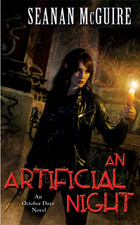 There are so many things to love about these books that I can’t express them all. Even just on the surface, the fact that all of the books are named by a Shakespeare quote appeals to my very literary soul, and shows that McGuire is going a bit further than your standard kickass girl urban fantasy. These books get to you, at least they got to me, and they worm their way under your skin. The magic system is so clever and fleshed out, with new species and kinds of magic revealed in every single book. McGuire pulls from myths, from standard fantasy, and from an imagination that is very clearly her own to create a world that’s one of the best mixes of fantasy and city I’ve ever seen. Toby may live in the city, but many of her magical counterparts live in old-fashioned duchies and counties, their knowes hidden across the landscape. There are so many things to love about these books that I can’t express them all. Even just on the surface, the fact that all of the books are named by a Shakespeare quote appeals to my very literary soul, and shows that McGuire is going a bit further than your standard kickass girl urban fantasy. These books get to you, at least they got to me, and they worm their way under your skin. The magic system is so clever and fleshed out, with new species and kinds of magic revealed in every single book. McGuire pulls from myths, from standard fantasy, and from an imagination that is very clearly her own to create a world that’s one of the best mixes of fantasy and city I’ve ever seen. Toby may live in the city, but many of her magical counterparts live in old-fashioned duchies and counties, their knowes hidden across the landscape.
And then there are the characters and their relationships with one another. Toby loves fiercely, even when it’s complicated, and will protect those she cares about with a vengeance. As the series has moved on, these relationships have developed, whether they are with her ex Connor, who is now married to the daughter of her liege lord, her Fetch May, whose appearance in theory means she will die soon, or the King of the Cait Sithe, Tybalt (my personal favorite).
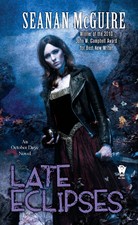 Best of all, the books have that “epic” feel which you all know I absolutely adore. Somehow, when Toby is up against the world, the book just consumes me and the struggle feels real, immediate, and breath-taking. These are the kind of books I dash through because I’m so worried about the main characters and I need to know what happens to them. After I read the first book, I bought ALL of the rest because I knew I was going to need them, and then I read them and pre-ordered the latest. These are the books you simply can’t put down, that keep you up at night, that make you ignore anyone who actually tries to speak to you while you’re reading (seriously, how dare they?). Best of all, the books have that “epic” feel which you all know I absolutely adore. Somehow, when Toby is up against the world, the book just consumes me and the struggle feels real, immediate, and breath-taking. These are the kind of books I dash through because I’m so worried about the main characters and I need to know what happens to them. After I read the first book, I bought ALL of the rest because I knew I was going to need them, and then I read them and pre-ordered the latest. These are the books you simply can’t put down, that keep you up at night, that make you ignore anyone who actually tries to speak to you while you’re reading (seriously, how dare they?).
So, in conclusion to this, if you’ve ever enjoyed any sort of fantasy, urban or not, I’d highly recommend this series to you. McGuire just gets better and better with every installment, and I can’t wait to share One Salt Sea with you next week. And also, I must thank Ana of The Book Smugglers for introducing me to this series, as she pressed the first book into my hand and told me I should read it. She was so right!
If you do read these, and you really should, the series order is:
All book links to external sites are affiliate links. I purchased these books.
 This is an omnibus edition containing what I’ve found out are the first two novels in the Vorkosigan saga. Unfortunately, if you’ve read my review of Young Miles, or heard anything about the series, you know that most of it centers around Miles, so you probably know the outcome of this book as much as I did. So I’ll avoid spoilers to some extent, but assume you’ve read my earlier review. This is an omnibus edition containing what I’ve found out are the first two novels in the Vorkosigan saga. Unfortunately, if you’ve read my review of Young Miles, or heard anything about the series, you know that most of it centers around Miles, so you probably know the outcome of this book as much as I did. So I’ll avoid spoilers to some extent, but assume you’ve read my earlier review.
We start out with Shards of Honor. Captain Cordelia Naismith is heading a scientific survey of a new planet when things go very wrong and she winds up a prisoner of the Barrayarans, under their leader Aral Vorkosigan, the “Butcher of Komarr”. Barrayar and Beta, Cordelia’s home world, are complete opposites; the Barrayarans are a military-led society, very firm with rules, while the Betans are more relaxed in almost every way. While struggling to get Cordelia’s wounded comrade to safety, Aral and Cordelia learn that they actually have a lot in common; namely, a sense of honor and a surprisingly strong attraction.
This is Bujold’s first book, and since I’d accidentally read later work first, I could kind of tell. That doesn’t mean I enjoyed it any less, though, because like most women would I immediately fell in love with Cordelia – the best kind of honorable woman who does the best for her country and herself, with a whole lot of brains to back her up. She’s strong, but not so strong as to be stupid; she knows where her heart lies, and she’s the appeal of the book.
But this is really the story of how Cordelia and Aral meet and come to fall in love – it’s obvious that they will do so from the first page – and the conflicts of two similar people from very different cultures coming into contact. I preferred Cordelia to Aral, but both characters were wonderful, and with the adventure mixed up with romance, I found this overall to be a very appealing book that I enjoyed greatly.
The second book, Barrayar, comes after Cordelia and Aral are married, and while Cordelia is pregnant with Miles, who takes center stage for most of the rest of the series. Aral’s political career, not so much a factor in the first book, is taking off, and he finds himself in the dangerous position of being in charge of the infant Emperor. Dangerous for not only him, but also for Cordelia and their unborn child as the enemies of the Regent appear.
For me, the appeal of this second book wasn’t really in the plot, but in Cordelia’s growth as a character. Barrayar is a difficult place for a Betan like her to live. She isn’t used to the rules, to the idea of birthing her baby herself, to the lack of privacy that her husband as a political figure has. Despite the action, this is a very character-driven novel.
As Bujold says herself, the book is also about motherhood. It’s not only Cordelia learning to be a mother; other characters also learn the difficulties and the joys of having children. This was written after some of the Miles books, so I felt like it was appropriate here that I knew what Miles was going to become. Seeing the way his mother felt about him – as well as the evolution of Barrayar society – really shed light on the book I’d read already and the ones I have read since.
I keep talking about it, but I just loved the characters in this book, and in the series as whole. They just come to life, leaping out of the page, with all their flaws and problems and little quirks intact. It’s simply brilliant. I haven’t read a series so addicting in what feels like years – probably, in fact, is actually years. Read this; you truly won’t regret it.
All book links to external sites are affiliate links. I downloaded this book for free from the Baen Free Library.
 World War II wreaked havoc on men’s and women’s lives, changing them in ways they never could have anticipated. Next to Love takes us on a journey through the war and the following twenty years of aftermath, as characters learn to live with themselves and try and regain who they once were. The novel follows three women, Babe, Grace, and Millie, who were best friends and whose husbands and boyfriends went to serve in the war. Feldman examines the problems women on the home front faced and the devastation of war away from the battlefields – and the way it never quite lets go of its victims. World War II wreaked havoc on men’s and women’s lives, changing them in ways they never could have anticipated. Next to Love takes us on a journey through the war and the following twenty years of aftermath, as characters learn to live with themselves and try and regain who they once were. The novel follows three women, Babe, Grace, and Millie, who were best friends and whose husbands and boyfriends went to serve in the war. Feldman examines the problems women on the home front faced and the devastation of war away from the battlefields – and the way it never quite lets go of its victims.
I knew I was going to like this book, but I never expected it to love it as much as I actually did. I read it in what felt like a flash, completely enthralled by the stories of these three women and the struggles they have to endure. While they mainly saw themselves as getting on with it, they were really witnessing a pivotal period for women and for the family; their growing strength speaks to the stronger women’s movement that was approaching.
Feldman doesn’t skimp on difficult subjects. Babe’s husband, for example, returns from war changed in ways Babe isn’t sure she liked. We hear about the joyful reunion often; what about the one that is fraught with anxiety? The husband that can’t sleep and suffers from post-traumatic stress disorder? That night before your husband goes to war and you might never see him again? Each woman deals with difficult issues directly related to the war, and then related to moving forward with lives that are irrevocably changed.
The world changes, too. Characters in the book are determined to fight racism. They witness huge changes in status as the American world fundamentally shifts around them. It’s the story of a generation, told through characters that really steal your heart and make you wish that you could keep them with you forever. Babe was my favorite character by far; she just seemed the strongest, the most capable of handling everything that got thrown at her. And there is a lot for her to handle. That isn’t to say I didn’t like the other women; I certainly did and I was invested in their stories, too.
A gorgeous novel, I’d recommend Next to Love to anyone who enjoys historical fiction, especially that set around World War II with amazing, strong women at its heart. This is an excellent book and I am so glad I read it.
All book links to external sites are affiliate links. I received this book for free from Netgalley.
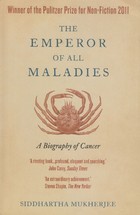 The struggle to understand and to cure cancer has consumed medical researchers throughout the twentieth and beginning of the twenty-first centuries. Mukherjee takes a thorough in-depth look at cancer throughout history in this biography of an illness, where the disease is often visualized as a crab scurrying and burrowing away from all reach of therapy. The author adds his own experience to a years-long study of cancer to provide a definitive, insightful book on the way this illness has gripped our modern day lives. The struggle to understand and to cure cancer has consumed medical researchers throughout the twentieth and beginning of the twenty-first centuries. Mukherjee takes a thorough in-depth look at cancer throughout history in this biography of an illness, where the disease is often visualized as a crab scurrying and burrowing away from all reach of therapy. The author adds his own experience to a years-long study of cancer to provide a definitive, insightful book on the way this illness has gripped our modern day lives.
I think almost everyone I know has lost someone near and dear to them to cancer. I have; my brother died at only eighteen from non-Hodgkin’s lymphoma. If anything, the fact that we’ve all been touched by this horrible illness in its many incarnations makes a book like The Emperor of All Maladies an even more important read. Reading this book was always going to be difficult, but it is on a subject I wanted to understand. After it won the Pulitzer Prize, and unending praise from many of my favorite bloggers, I simply had to read it, no matter how uncomfortable the subject matter.
I’m really glad I made that choice, because this book was excellent in so many ways. Mukherjee skilfully weaves together his own years treating cancer patients, ensuring that we get an up close and personal view of what it’s like to fight cancer today, with a thorough history of the illness, including its ancient manifestations, early treatments, and continuing right up to the medicines and techniques used to treat various kinds of cancer today. I learned so much from this book, certainly things I never even thought about, like how the War on Cancer got started in the first place, what the Jimmy Fund is, and so on.
I’d also never really understood anything about the biology of cancer. I knew the disease was basically uncontrollable cell division, but Mukherjee goes into depth without becoming confusing or using any jargon that an ordinary reader can’t understand.
While doing all this, he also succeeds in matching the struggle against cancer alongside current events, explaining how certain developments happened and why. I felt like I was getting the full story from all possible angles, which I so appreciated, and so thorough a look that I don’t think I really need to read another book. Adding in the perspectives of his modern patients just demonstrated the strength of the human spirit and the difficulties of treatment.
This truly is a biography; in many ways Mukherjee makes cancer itself a visible part of the book. Cancer is our normal body functions turned inside out and made virulent – and immortal. It’s a surprisingly fascinating read which has really enhanced my understanding of everything to do with cancer. I’d highly recommend The Emperor of All Maladies to almost anyone.
All book links to external sites are affiliate links. I received this book for free for review from Amazon Vine.
 The affair between Adele Hugo, Victor Hugo’s wife, and Charles Saint-Beuve has gone down in history as a mistake made by everyone; a doomed love affair that simply never should have started. Chock full of details that only history can make believeable, like Saint-Beuve’s hermaphroditism and cross-dressing, and the intoxicating world of 19th century France, the book is really a love story about two people who have made mistakes but have never ceased longing for one another. The affair between Adele Hugo, Victor Hugo’s wife, and Charles Saint-Beuve has gone down in history as a mistake made by everyone; a doomed love affair that simply never should have started. Chock full of details that only history can make believeable, like Saint-Beuve’s hermaphroditism and cross-dressing, and the intoxicating world of 19th century France, the book is really a love story about two people who have made mistakes but have never ceased longing for one another.
I knew I wanted to read another book by Humphreys after Coventry and she certainly hasn’t let me down here. The book is short, but it covers thirty years of the couple’s affair, even after one of them has passed on. We alternate between Adele’s and Saint-Beuve’s voices, witnessing their struggles to be together from both sides. Adele, obviously, cannot leave her husband, who grows increasingly famous, particularly because of her children, while Saint-Beuve struggles to become the man he longs to be in Victor’s ever-present shadow.
I had actually never heard of the affair between Saint-Beuve and Adele, but since reading this book have really come to realize that it was well known in its time and almost universally derided. Saint-Beuve in particular has borne the brunt of the ridicule, possibly because he was actually a hermaphrodite.
This makes for a very interesting book, but instead of making it seem at all vulgar or strange, Humphreys weaves it into his personality and makes his cross-dressing and his confusion sexually just another aspect of him, just like his desire to write is a part of him but does not define him. I thought this was an incredibly sensitive way to handle the subject and Humphreys does an extraordinary job, both with his personality and the way that Adele sees him and falls in love with him and is physically attracted to him despite things like cross-dressing which would immediately put off many straight women in the present.
Another aspect of the book that I really enjoyed, which I briefly alluded to above, is Saint-Beuve’s struggle to define himself. He virtually lives in Victor’s shadow – struggling to surpass Victor’s writing skills, falling in love with his wife, and even at times coveting Victor’s children. He tries so hard to set himself apart, but is all he really wants to be Victor. It’s a real struggle with individuality.
Humphreys is a beautiful writer and her words set nineteenth-century Paris alight. The atmosphere, especially when the couple are together, is wonderful and immediately grants us a sense of place.
A lovely, tender but sad read, The Reinvention of Love is the perfect choice for those who prefer their literary fiction set in the past with a whole heap of doomed romance.
All book links to external sites are affiliate links. I received this book for free from Amazon Vine.
 Good afternoon Saloners! This weekend finds me in full force blogging mode, in a way that hasn’t been spotted around here for a while. I’ve managed to write two full weeks’ worth of posts this week, so the pressure is off for the first time in months. I still have four reviews left to write, but given I started the weekend with eleven, I’m counting that as serious progress. As long as I don’t read too much, I can finish off those reviews over the course of the week and be completely caught up by the end of next weekend. Then, obviously, the goal is to stay caught up until the Read-a-thon. Speaking of which, have you signed up yet? Let me know if you’ll also be reading with me! Good afternoon Saloners! This weekend finds me in full force blogging mode, in a way that hasn’t been spotted around here for a while. I’ve managed to write two full weeks’ worth of posts this week, so the pressure is off for the first time in months. I still have four reviews left to write, but given I started the weekend with eleven, I’m counting that as serious progress. As long as I don’t read too much, I can finish off those reviews over the course of the week and be completely caught up by the end of next weekend. Then, obviously, the goal is to stay caught up until the Read-a-thon. Speaking of which, have you signed up yet? Let me know if you’ll also be reading with me!
My week has been very uneventful aside from that; just work, a moderate amount of reading, and some Assassin’s Creed: Brotherhood keeping me busy. We’re just over two weeks away from our trip to Rome, so keeping it low key is the plan until then. I’m going to spend a large part of the next two weekends planning out the trip in a bit more detail and it’s hard to express just how much I’m looking forward to it.
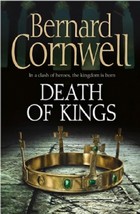 Today I’m reading Death of Kings by Bernard Cornwell, the latest in the Saxon Chronicles, which follow Uhtred of Bebbanburg as the discordant countries of Britain become, in part, the kingdom of England. In this particular book, Alfred the Great is on the edge of death, but the battles and intrigue never end for Uhtred, especially because he hasn’t actually regained Bebbanburg from his treacherous relatives yet. I love this series and I was thrilled when I was offered a review copy. As it turns out, Cornwell is also touring parts of England this week. Sadly, he’s not in my neck of the woods, but if you’re in London, Ely, or Winchester, you’re in luck. Today I’m reading Death of Kings by Bernard Cornwell, the latest in the Saxon Chronicles, which follow Uhtred of Bebbanburg as the discordant countries of Britain become, in part, the kingdom of England. In this particular book, Alfred the Great is on the edge of death, but the battles and intrigue never end for Uhtred, especially because he hasn’t actually regained Bebbanburg from his treacherous relatives yet. I love this series and I was thrilled when I was offered a review copy. As it turns out, Cornwell is also touring parts of England this week. Sadly, he’s not in my neck of the woods, but if you’re in London, Ely, or Winchester, you’re in luck.
As it turned out, I didn’t get to meet Philippa Gregory this week, as tickets had sold out before I knew she was visiting. (Probably a good thing given my opinion of her latest). But my heart is still set on meeting Brandon Sanderson in November, and I’m hoping more authors come to York over the next few months.
This week I’m especially looking forward to starting The Night Circus, a book which has captivated many of my blogging friends, and possibly continuing with more non-fiction. I finally feel as though I have the brain power to learn again, and I’m very much taking advantage of that feeling while it lasts.
What are you reading this week? Anything you’d recommend?
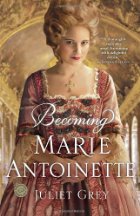 Maria Antonia is only a young girl when she’s informed that she is to be the bride of the future King of France – if she can get up to scratch, that is. She quite distinctly must become Marie Antoinette, a woman capable of being Queen of France, with the bearing, appearance, accent, and knowledge that any queen needs. She is melded to progress her family’s agenda, then sent to a brand new country to meet a completely new family, as though her life in Austria never existed. This first installment of a new trilogy fictionalizing Marie Antoinette’s life truly does describe how she became the queen remembered throughout history. Maria Antonia is only a young girl when she’s informed that she is to be the bride of the future King of France – if she can get up to scratch, that is. She quite distinctly must become Marie Antoinette, a woman capable of being Queen of France, with the bearing, appearance, accent, and knowledge that any queen needs. She is melded to progress her family’s agenda, then sent to a brand new country to meet a completely new family, as though her life in Austria never existed. This first installment of a new trilogy fictionalizing Marie Antoinette’s life truly does describe how she became the queen remembered throughout history.
Grey’s novel takes on the life of Marie Antoinette somewhat earlier than other books do and appears to be really taking an exhaustive look at her. I’d never before read about her struggles to actually be accepted as the appropriate wife of the Dauphin; it must have been hard for any young girl to be judged wanting so very much by her future family. She endures extra lessons, surgery on her teeth, and is constantly inspected for improvements.
As you might expect, then, Grey’s Marie Antoinette is a very sympathetic girl. She’s used to the relative flexibility of the Austrian court, even with her strict mother, and the laxness of her tutors who will falsify her results rather than force her to actually learn. Preparing to enter the French court – and then actually doing so – is a rather unpleasant revelation, and we can feel for the girl who has lost everything familiar to her.
Marie Antoinette’s relative innocence navigating the court in France continues, even as she is forced to seduce her own husband by order of her mother. She must become pregnant to solidify her family’s position and to provide an heir to the throne, but her husband is reticent for reasons mysterious to her. The poor girl is not only in an unfamiliar court, confused by the immorality around her, but is also rejected by the one she hoped would treat her well.
If you’re looking at a very sympathetic look at Marie Antoinette, you could hardly go wrong with this one. It’s also very well written, with fantastic descriptions of life in Vienna and Versailles. Grey has done quite a bit of research, as she explains in her author’s note, and almost everything she uses is true to history. She does an excellent job of matching the personalities of Marie Antoinette and Louis XVI, who both mainly just wanted to escape from their duties and be normal – a tragic story for those who know what is coming.
While I’ve read the story of Marie Antoinette’s life before, I found myself very much enjoying Becoming Marie Antoinette and looking forward to the next volumes. The author’s treatment of a familiar story is well done, and will have the most reluctant reader feeling very much for a young girl cast adrift in an unfamiliar world.
All book links to external sites are affiliate links. I received this book for free for review from Netgalley.
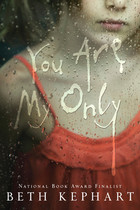 It only takes a minute for Emmy’s life to flip upside down; her baby, the spot of joy in her life, stolen, her husband accusing her of the crime. After she goes on a frantic search, Emmy ends up in a mental hospital, longing for her stolen daughter and for justice. In the present day, fourteen-year-old Sophie is hidden from the world, forbidden to do so much as leave her house. She and her mother have constantly been hiding, but Sophie has never understood why. When she befriends her neighbor, a boy called Joey, Sophie begins to put the pieces of her life together and wonder. Told in alternating chapters between the two women, You Are My Only is the story of a mother’s love and a daughter’s longing. It only takes a minute for Emmy’s life to flip upside down; her baby, the spot of joy in her life, stolen, her husband accusing her of the crime. After she goes on a frantic search, Emmy ends up in a mental hospital, longing for her stolen daughter and for justice. In the present day, fourteen-year-old Sophie is hidden from the world, forbidden to do so much as leave her house. She and her mother have constantly been hiding, but Sophie has never understood why. When she befriends her neighbor, a boy called Joey, Sophie begins to put the pieces of her life together and wonder. Told in alternating chapters between the two women, You Are My Only is the story of a mother’s love and a daughter’s longing.
Beth Kephart is a beautiful writer; I first experienced her wonderful style in Nothing But Ghosts and I’ve been looking forward to another read since. She has the incredible talent of getting right to the heart of human emotion and expressing it through her prose while telling a story. Some of the imagery is simply stunning, causing me to go back and read over again just to savor the beauty of the words. As you might expect, then, the point of this book is not the plot, though; it’s easy to see from the outset what exactly has happened.
Instead the book is a slow discovery, watching the characters, especially Sophie, work out what’s happened and how their lives have become like this. It’s also very much a tale about motherhood. Each of the adult women is a mother in different ways – Emmy, whose daughter has been stolen; Sophie’s mother, who craved a child; Joey’s aunts, who are perhaps the most traditionally “motherly” characters in the book despite their somewhat unconventional life. And in the center is Sophie, seeking a vision of motherhood she hasn’t had, and an opportunity to escape the stifling confines of her house and enjoy the life of an ordinary young girl. All of the characters are seeking something, and the heart of the book lies in whether or not they find it, and how they go about looking for it.
I do believe Kephart’s works should be read much more widely, and this wouldn’t be a bad place to start for any reader. Her books are lovely, evocative and full of pure emotion. I’d recommend both this and Nothing But Ghosts, and I’m very much looking forward to reading more of her work.
All book links to external sites are affiliate links. I received this book for free for review from Netgalley.
Our next stop was the lovely small city of Bruges. It’s a place I’ve decided to call Disney World for medievalists. Just walking around is amazing with the number of old, medieval buildings, but all the time you’re aware that the city has been restored and cleaned up just for tourists. Doesn’t make the experience any less amazing, although I’m not a huge fan of the many horse-drawn carriages that others seem to delight in.
Anyway! Walking into town, approaching the Markt, the sights begin:

We visited a house that gave refuge to Edward IV and Charles II, both kings of England:

And a gorgeous church, where we saw Michelangelo’s Madonna and Child:

One thing I noticed is that churches in Bruges tended to be very colorful, with paintings and decorations everywhere. It was in stark contract to the churches we saw in Amsterdam and those I’m familiar with here in England, which are still beautiful but very austere. I know they used to be colorful (at least in England) so I’m sure that has something to do with the Protestantism of both the Netherlands and the UK, but it was still very cool to see what churches look like with all that decoration.

The city is also simply gorgeous to walk around, with canals and parks and beautiful buildings everywhere (many of them emanating the smell of chocolate):

We also decided to spoil ourselves just a tiny bit because my part of the trip was almost over:

Unsurprisingly, I am definitely planning to go back. Bruges was just a nice place to spend some time. If I ever look for a relaxing weekend away in a gorgeous setting, I know exactly where to go.
 A fantasy classic, The Last Unicorn describes the decline of the unicorns and the struggle for the last one to find her comrades after leaving her forest home – only to discover that she is now horribly alone. Convinced that her fellow unicorns actually do still exist, she embroils herself in bad situation after bad situation, though not without non-unicorn friends, while looking for elusive companionship. A fantasy classic, The Last Unicorn describes the decline of the unicorns and the struggle for the last one to find her comrades after leaving her forest home – only to discover that she is now horribly alone. Convinced that her fellow unicorns actually do still exist, she embroils herself in bad situation after bad situation, though not without non-unicorn friends, while looking for elusive companionship.
I was absolutely thrilled when I stumbled upon a copy of this book while I was in the US in July. I had intended to buy a copy online at some point, so the serendipity of it appearing before me in a physical bookstore was plenty to persuade me to buy it and read it shortly thereafter. Unfortunately, it then took me over a month (!) to review it, so I’m afraid some of the details have been lost. But I’ll try and capture some of the essence of this magical book.
Half of its appeal for me was simply the way it was written; it struck as immediately a bit old-fashioned, the kind of fairy tale my mother might have read growing up. That’s probably because she could have as the book was published during her childhood, in 1968. The unicorn is beautiful but slightly terrifying in its beauty, kind of reminding me of Galadriel in the Lord of the Rings. Fantasy is a thing of awe, not something we can weave into modern life so much like in today’s urban fantasy; it’s distinctly medievalesque with castles, magicians, and lovelorn princes. It feels like proper, epic fantasy, despite its very short length. And though the characters sound like stereotypes, Beagle makes sure they don’t stay that way, weaving in personalities and little traits that make us grow to care about them.
The story itself also has an old-fashioned feel about it. Rather than pure action, much of the story is determined by fate and the way things have to be, rather than pure decision-making on behalf of the characters. Sure, they make some decisions; the unicorn chooses to venture out once she’s heard that there are no more unicorns, and Schmendrick chooses to help her at some stage along the way.
But a lot of the book simply flows along, inviting the reader to linger in the beauty of it rather than causing suspense even though the storyline actually does have a few cliffhangers and tense moments. Much of this is due to the absolute loveliness of Beagle’s writing, the way he describes the magic as though it could be real, and his descriptions. He creates an entire world in the space of a few pages – a true feat.
A proper work of fantasy, that immerses you into a world that you can almost believe in, The Last Unicorn is a classic that deserves to be read more often.
All book links to external sites are affiliate links. I bought this book.
|
|







Recent Comments