|
|
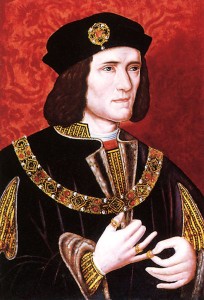 I know I don’t actually talk about medieval history all that much around here, even though I originally wanted to. Instead I’ve settled for attempting to read and review more historical fiction. I have been thinking about one particular question, though, and it’s quite relevant to historical fiction, so I thought I’d give it a whirl and see if anyone was interested. I know I don’t actually talk about medieval history all that much around here, even though I originally wanted to. Instead I’ve settled for attempting to read and review more historical fiction. I have been thinking about one particular question, though, and it’s quite relevant to historical fiction, so I thought I’d give it a whirl and see if anyone was interested.
Why is Richard III so often presented as a chivalric figure in modern historical fiction?
First, what is “chivalric”? Well, success in war (prowess) is easily the most important factor overall. In most historical fiction novels about Richard, he is highly successful in battle except for Bosworth Field. He is regarded as a key figure in his brother Edward’s battle of Barnet and often he’s off fighting the Scots with great success. Fighting the Scots is brilliant for prowess because to Richard, they were foreigners, and killing foreigners was usually second only to killing heathens, especially if they came at you first. I came across the mystifying fact that we’re not even sure how much Richard fought except at Bosworth Field in my research last year. He was there, but we know so little of those battles that he might not have lifted a finger to help his cause. Of course, the fact that he was killed on the battlefield at Bosworth indicates he did think he knew what he was doing, or perhaps it indicates that he had no bloody idea. One never knows.
Secondly, success with ladies is key. This is the fun phenomenon known as courtly love. Lords were expected to flirt with highborn ladies, and usually one lord would pick one lady to carry on about, although it isn’t necessary for him to actually have a proper affair with her and in fact that would be frowned upon. Gazing and loving from afar is the best option unless you are married. Actually, virginity was the best option (like Galahad), but not a very likely one. Loyalty to the one you choose is essential. What do we have in Richard but a man who is always portrayed as deeply in love with one woman? Usually, it’s his wife, Anne Neville, but in A Rose for the Crown he is portrayed as faithful to his one mistress. Again, this is a fun little fact that can’t be verified. He had at least a couple of bastards, so he broke the no sex outside of marriage requirement and there’s no way to verify the identity of their mother or even how many there were. He may well have loved Anne Neville, but history can’t tell us that and instead shows us that she was actually an heiress with rights to half the extensive Neville/Warwick land (and given the part that Richard played in killing her father and uncle and imprisoning her mother, how do we know she would have loved him?). He wasn’t marrying a pauper and Richard was a very, very ambitious man. It’s just oh so convenient that by marrying her he completed his consolidation of the northern Neville hegemony, isn’t it?
Third, piety! Religion is very important. Even though chivalric men were ultimately warriors, they were supposed to view themselves as suffering. Strange as it may sound, they decided that warfare was a kind of martyrdom and thus eases the way into heaven. Don’t ask me, I didn’t come up with it. Richard is often fictionalized as an exceptionally pious man. He probably was to some extent, but all late medieval lords were to some extent. Richard planned for three foundations during his lifetime. I know they didn’t all succeed, but let’s think about this. Richard was a rich man. He had huge swathes of countryside and even if the economy was suffering, he must have had his fair share of disposable income. I must admit that I have not looked into this personally, but it stands to reason that he had plenty to give to his retainers since he was such a successful lord. In addition, he probably had his share of sins to atone for. Think of all the men he ordered killed for the sake of becoming king. He chose his side of the Wars of the Roses, may have (probably) killed a whole bunch of people, and may even have had a say in the death of his brother. In this context, foundations don’t mean he was especially pious. It just meant he had the money and the desire to get himself out of the hole called purgatory with a whole lot of praying.
So those are the three tenants of chivalry, as I have gleaned from numerous sources. Richard didn’t necessarily fill any of them. I just think he’s been targeted by historical novelists as a figure to be redeemed. There is no question that he was villainized by the Tudors and those associated with them, but that doesn’t make him a paragon of nobility. I think it’s fascinating that he’s been interpreted as such and that all of his activities have essentially been removed from their historical context, evaluated, and assigned the purest possible motivations. Of course, it’s entirely possible that he was a heavenly figure who has been getting a bad rap for hundreds of years. I think it’s more likely that he was an extraordinarly powerful, ambitious, clever man – a man who was very, very good at governing, no less – who lived in a difficult time and had to make some very hard choices. I often wish I could write a novel so I could put him in between as a human being, not a villain or a saint.
What do you think? Why do we put Richard on a pedestal? The man might have killed his own nephews, after all, although personally I prefer to believe he didn’t just because I like him. He’s by far the most likely culprit. Any thoughts? Or did you stop reading at paragraph 1? 
This meme has been going around for a good week or so now. I asked Alea at Pop Culture Junkie to interview me. Here are the questions she asked:
1. Are the books always better than the movie adaptations?
In my experience, yes. I love some movies based on books, like Pride and Prejudice (you all know the one!) or Gone with the Wind, but I enjoy reading books more, so I’ll probably always like the books better. In general I sometimes struggle to compare them because they cut so much out. Those two are probably my favorites because they are so long and the storylines are very similar to the books. Well, for P&P at least.
2. What is the most you ever paid for a book?
I don’t think I’ve ever paid too much for books. I have some nice editions, but usually they were gifts. Overall, I’m pretty cheap. I don’t think I’ve ever paid more than $20, usually on Amazon for hardcover copies to support my favorite authors.
3. What is one book you love that has next to no words in it?
I’m not sure I own any books with next to no words in them! Wait, I can think of two. I have a coffee table book of Chanel gowns which is very lovely, but I also have a National Geographic book of famous photographs. That one is stunning and while it has explanations, the photos can speak for themselves.
4. Who is your favorite author?
This question could almost be easier if it was “who isn’t your favorite author?” because it’s very difficult to pick one. For an author to make my favorites list in general, I must love at least two of their books. I will copy my LT list, which I think is fairly accurate:
Jane Austen, Jacqueline Carey, Bernard Cornwell, Robin Hobb, Kazuo Ishiguro, Guy Gavriel Kay, Stephen King, George R. R. Martin, Michelle Moran, Sharon Kay Penman, Brandon Sanderson, Leo Tolstoy, Edith Wharton
Oh, except I have to add Robin McKinley to the list. You’ll see when my Deerskin review gets published, should be soon.
5. What is your favorite thing about blogging? Least favorite?
I love the community. I’m a lurker at heart and I have a difficult time getting involved with established groups of people. Book bloggers are always kind, friendly, and welcoming. I feel comfortable leaving comments on everyone’s blogs or chatting on Twitter and LT and I do my best to make all feel welcome on mine too and in my conversations. Thank you all for being awesome!
My least favorite part is probably the work I put into it. This is definitely a labor of love, but it can be hard to sit at the computer and tease out words to accurately convey how I feel about certain books. Making the site look nice, going out and finding new blog friends, and sometimes even being taken away from my own TBR pile can be negatives, but I love the sense of accomplishment I feel when I find a new awesome blogger and potential friend, look at my site, or write a review that I think really captures how I felt about a book. It just takes a lot of time and I worry how I’ll maintain it when I no longer have the time that I do now. But I have many worries to get over before that happens, so we’ll cross that bridge when we come to it!
—
Thanks for the questions, Alea! And now I extend the offer to all of you reading. Do you want me to send you 5 interview questions? Just leave me a comment saying so and I’ll send an email your way.

Check out this book on tour this month at Pump Up Your Book Promotion virtual tours.
From the back cover:
“Hope and Love – Pride and Honor.
Monsters wander the world of Mikon.
Caught in the aftermath of a vicious international war, thousands of refugees have fled the Coastal States, bringing their dangers with them into the wilderness near the untamed Middlelands.
Castaways from an imploding civilization – fighting to find and to understand the most dangerous of treasures …”
About the author:
“Jason Pratt is a native of West Tennessee, and the systems manager for Dyer Fiberglass, Inc. He holds a bachelor of communications degree from the University of Tennessee, Knoxville.
When he isn’t freelance editing other people’s books or writing philosophical treatises as a respected guest on various Internet sites, he can be found pondering tactics and strategies in the lates war game or studying metaphysics and world history. Occasionally he finds the time to instruct, judge and compete in the art of fencing; and has been known to write cinematic epic fantasies when people aren’t looking.
Cry of Justice is the first book of an initial trilogy, the third book of which he is currently composing.”
And finally, some reviews:

 Today’s question: Do you use a rating system on your blog? How do you feel about using the rating system provided on sites like Library Thing and Amazon? When looking up information on a book you are interested in, do you use the ratings provided by these sites (or similar sites) to help you make the decision on purchasing the book? Today’s question: Do you use a rating system on your blog? How do you feel about using the rating system provided on sites like Library Thing and Amazon? When looking up information on a book you are interested in, do you use the ratings provided by these sites (or similar sites) to help you make the decision on purchasing the book?
This is a very good question for me because I’ve always wondered if I should institute some sort of rating system around here. I’ve seen number ratings, letter ratings, and star ratings around the blogosphere. Something in me, however, has always resisted just giving a book a number or a letter. They are complex and I think almost all of them have bits that are good and bits that are bad. It’s very hard to categorize, especially after I’ve given my review, and sometimes I’m not sure the star rating I’d give a book matches what I’m trying to get across. This is why I don’t use them here.
That said, I do use star ratings on LT. Half the time, it’s a month or more before my review gets over there, and I know that I’m always a bit irritated by people who write reviews and then don’t put a star rating in. Maybe that’s hypocritical of me given my policy here, and given that I never miss it on other blogs if they lack a rating system, but since the mechanism is there, I like to see both, and I like to add my opinion to the little graph on the side so that it is the most accurate possible. I have a system for these. 5-star books are perfect, 4-star books I really liked, 3-star books are okay, 2-star books I disliked, and 1-star books I either didn’t finish or I hated the whole way through.
I hate the star system on Amazon, though. It seems there is something wrong with you there if you use anything less than 4 or 5 stars for a book that perhaps deserves only 3 stars. 3 stars is not bad, in fact, it usually means that the book is fine but it’s not really my cup of tea or didn’t draw me in for some reason. On Amazon, however, it seems that if you like a book, you must give it a 5 star rating. As such, it has lost its meaning. I’ve more or less stopped posting reviews there and only do so for review copies and books that have no reviews but mine.
I’d say I use the star ratings on LT to help me evaluate eventual books to be purchased, but most of my choices are spur-of-the-moment, buying a book I’ve heard of before. Since I don’t read reviews before I read a book myself (or I put sufficient time between the review and the reading to forget what the plot is about), I don’t have many other choices.
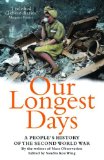 This is a compilation of several diaries from World War II collected by the Mass Observations project. This project was designed in 1937 to see what the people of Britain were really thinking. In the beginning, the writers responded to prompts, but by the start of the war they were asked to keep diaries of their thoughts, feelings, and actions for posterity. These diarists are surprisingly intimate, giving details of their own lives in far more detail than those of the war, and this collection aims to give us a closer look into how the public really dealt with the war. This is a compilation of several diaries from World War II collected by the Mass Observations project. This project was designed in 1937 to see what the people of Britain were really thinking. In the beginning, the writers responded to prompts, but by the start of the war they were asked to keep diaries of their thoughts, feelings, and actions for posterity. These diarists are surprisingly intimate, giving details of their own lives in far more detail than those of the war, and this collection aims to give us a closer look into how the public really dealt with the war.
I found these diaries to be absolutely riveting. The book is filled with the everyday life of people going about in war for five years of their lives. Their lives all change in ways they probably didn’t imagine – some of them say so, like Muriel Green who becomes a gardener for the cause – and it’s absorbing to watch it happen. I thought the most striking thing about the diaries was that they were not overly dramatic and the people in them did not seem very dismayed by the thought that a bomb could kill them at any time. Sometimes nearby houses are destroyed with people in them but the diarist in question always remains remarkably calm. They’ll remark on the bombing of another town, but never seem worried that their own is next, although I’m sure they must have been. The only outpouring of emotion was from a man who lost his brother in the war, which results in some of the saddest and somehow most beautiful passages conveyed in the book.
Mostly, though, this book is a story full of the little things, improvising meals, shopping for clothes, trying to see sweethearts, job-hunting, dealing with the blackout, a robbery, births, deaths, dances, and kisses. All the ordinary bits of life go on amidst a country struck by war. People are people even when the Germans threaten to invade and sirens rush them into bomb shelters multiple times a day. Even more interesting is considering what these reactions say about the British public at large during World War II. It would be truly fascinating to compare these diaries with newpapers and other media produced at the time in order to see the differences in reaction to the war.
I was a little disappointed to discover that most of the diarists were given pen names since their families could not be contacted for permission, but it’s understandable. Apparently the Mass Observation project was viewed in some circles as spying, since diarists gave details of not only their own lives but their neighbors’ as well without permission. So in this book, names are shortened to a single letter if permission has not been given and summaries of diarists’ lives are reduced to a few lines regarding what they were doing in the war.
Overall I’m delighted to see a historical archive like this published and I can only imagine how amazing it would be to work in such an archive as is still going on now. I have another book of theirs on my shelf; it is the post-war diaries of Nella Last, one of the most prolific diarists and one whose family has given permission for her real name to be used. It’s called Nella Last’s Peace. I’m very much looking forward to it; I’ll be reviewing it in March.
And a final note, I discovered after completing the compilation that the editor, Sandra Koa Wing, passed away aged only 28 in 2007 after a battle with cancer. I think this wonderful book is a tribute to her since her future career in history was cut so tragically short.
Buy Our Longest Days: A People’s History of the Second World War on Amazon. on Amazon.
 In Jackson, Mississippi, three women meet and do their best to make an unforgettable mark on their town’s history. Aibileen is a black maid who in part, raises white children for a living, always leaving before the children get too old. Skeeter is a recent graduate from college, has scandalously not come home with a husband, and is determined to write but not sure how to go about doing it or even what to write about. Minny is Aibileen’s best friend and also a maid, but far too out-spoken to get an ordinary job at this stage. All these women put their lives and futures at risk so their voices can be heard; they just can’t put up with it any longer. In Jackson, Mississippi, three women meet and do their best to make an unforgettable mark on their town’s history. Aibileen is a black maid who in part, raises white children for a living, always leaving before the children get too old. Skeeter is a recent graduate from college, has scandalously not come home with a husband, and is determined to write but not sure how to go about doing it or even what to write about. Minny is Aibileen’s best friend and also a maid, but far too out-spoken to get an ordinary job at this stage. All these women put their lives and futures at risk so their voices can be heard; they just can’t put up with it any longer.
I was surprised by how much I loved this book. Each character is given individual sections of the novel and together they form a powerful narrative voice that is touching and significant at once. The difference between Skeeter’s life and those of Aibileen and Minny is immense and appalling, particularly how white people had blinders on and did ridiculous things like installing a second toilet just for the black servants to use. Perhaps the most affecting part of the novel, however, was the feeling between the black servants and some of the white families they served, particularly with the children. There was affection in some cases amidst the degradations and I never imagined it to be like that. That said, this is fiction and none of these women have spoken up in real life (to my knowledge) so maybe it wasn’t so, but it still made the book immensely powerful emotionally. It astounds me that all this was happening just 50-60 years ago.
This read comes highly recommended from me. The Help is a wonderful, well-paced, stunning novel from a new writer that I suspect will go far, and a brilliant beginning for a new literary imprint.
Buy The Help on Amazon. on Amazon.
For those of you who weren’t on Twitter yesterday and noticed that my blog brought up an error screen, we had an incident with our host and it seems that the site was hacked and reported for phishing. And it has happened before. So! We made a switch to a new host, and after about a day of uncertainty and having my blog completely unavailable intermittently, things have been resolved! I may have lost some comments if you made them yesterday, so please repost if you can. And of course I have to thank Keith for fixing everything and engineering and paying for the move. I’m a lucky girl. =)
So, here we are with the same URL and the same RSS feed, but I’ve taken this opportunity to make some changes around here. First of all, I have a shiny new install of wordpress, which you can’t see but trust me, the whole admin part of my site is completely different and I have a lot to play around with. I didn’t realize how old my last wordpress install was. I also took this opportunity to change my theme and upload some of my own images. A few things might be changing over the next few days. I have to add some blog awards and links to the sidebar mainly, but this is what I have time for now. If you’re linking to me and I’m not linking to you, please let me know. I’ll be trying to add my favorite google reader blogs, but I missed so many before and want to avoid that happening again.
While you’re here, refresh a few times. The header changes! How cool is that? I’m thrilled that I can use my own pictures for my header now.
In the midst of my frustration yesterday, I endeavored to avoid the computer and finished two books. The first was Drood by Dan Simmons, which will be touring here and elsewhere in the book blog world on February 27th. I don’t want to give too much away, but it’s historical fiction featuring Wilkie Collins and Charles Dickens. Not much can go wrong there! Then I was annoyed with my inability to write the reviews I had planned on, so I read Romancing Mister Bridgerton by Julia Quinn. Not as fantastic as the first three Bridgertons, but a good distraction. I haven’t had time to start American Rust yet, but that will be for a bit later today, after I get some work out of the way. I need to come up with some dissertation and essay ideas, which is a bit too much for my little exasperated brain, but I will give it my best shot.
Please bear with us while we move the site to a more efficient server. Normal service should be resumed shortly.
The ever-overloaded-with-books fiancé,
Keith
 When the day comes for masters to choose apprentices, Will is nervous. He wants to go to Battle School and become a warrior like he believes his father was, but he is small and comparatively weak, unlike his friend Horace who is an immediate choice for a future as a knight. Instead, he is chosen by Ranger Halt. Will doesn’t know what to expect from his new future as Ranger’s apprentice, but he quickly realizes that it isn’t as easy as he thought. When the day comes for masters to choose apprentices, Will is nervous. He wants to go to Battle School and become a warrior like he believes his father was, but he is small and comparatively weak, unlike his friend Horace who is an immediate choice for a future as a knight. Instead, he is chosen by Ranger Halt. Will doesn’t know what to expect from his new future as Ranger’s apprentice, but he quickly realizes that it isn’t as easy as he thought.
I have heard a lot about the Ranger’s Apprentice series, so I was excited when I found a box set of the first three. Seemed like an ideal time to jump in, and I didn’t doubt that I’d like it since so many others had. Of course, I loved it, and quickly grew to care for Will and Halt and Horace in the space of one short book. It certainly reads like a YA book with certain lessons that can be gleaned, but is enchanting enough for adults too, as it’s good solid fantasy. The world is interesting and I want to learn more about it, the characters are endearing, the action and plot are great, and the writing is the perfect tone and level for this type of young adult book. I can’t wait for number two!
Buy The Ruins of Gorlan on Amazon. on Amazon.
 When in college, asha meets and marries a prisoner in a jail she visits for one of her classes. She is stunned by how intelligent, compassionate, and loveable Rashid is and believes he regrets his crime. She also believes that he will get out on his first opportunity, but she doesn’t want to have a baby while he’s in prison. When she finds herself pregnant for the first time, she has an abortion. The second time, she can’t bring herself to do so again, and has the baby, convinced that Rashid will be released soon. She never sees herself as a single mother, until Rashid gets in more trouble that he doesn’t deserve and asha leaves him, unable to continue on with a husband she may not have a future with. This is the story of asha’s struggle to cope as a single mother and her all-consuming love for her daughter, Risa. When in college, asha meets and marries a prisoner in a jail she visits for one of her classes. She is stunned by how intelligent, compassionate, and loveable Rashid is and believes he regrets his crime. She also believes that he will get out on his first opportunity, but she doesn’t want to have a baby while he’s in prison. When she finds herself pregnant for the first time, she has an abortion. The second time, she can’t bring herself to do so again, and has the baby, convinced that Rashid will be released soon. She never sees herself as a single mother, until Rashid gets in more trouble that he doesn’t deserve and asha leaves him, unable to continue on with a husband she may not have a future with. This is the story of asha’s struggle to cope as a single mother and her all-consuming love for her daughter, Risa.
I’m not a mother and my parents are still happily married, but I know single moms have it hard. Many of the people closest to me have just their mom and it’s always rough even if the father stays involved and pays child support. Despite that, I felt asha focused just a little too much on herself despite this love for her daughter. She develops alcoholism and tells her daughter that she needs “mommy time” on a very frequent basis; it’s hard to see how devoted she is when she keeps finding other things to spend her time with. She also sets a bad example with abusive relationships. This is all despite a good upbringing, a job, and a college education. I found significant, though, her candid admission of how difficult it is for a black woman alone and in general the stereotypes that surround her despite what she does to buck them. Seeing why an intelligent, beautiful woman would stay with an abusive man was a revelation to me; I still think I’d leave, especially if I had a young daughter who might be influenced by my actions.
I guess in the end I couldn’t really relate to this book, perhaps because asha’s experience is so outside of my own and because I don’t believe I’d make the choices she did. I also found it very depressing. That said, perhaps it’s important for me to read books like this in order to get a greater picture of the world outside of my own little bubble. I still don’t think anything could compel me to marry a prisoner, though, and from that perspective it’s very hard to understand asha or feel true sympathy for her despite all that suffering.
Check out Something Like Beautiful: One Single Mother’s Story on Amazon. on Amazon.
|
|


 on Amazon


Recent Comments